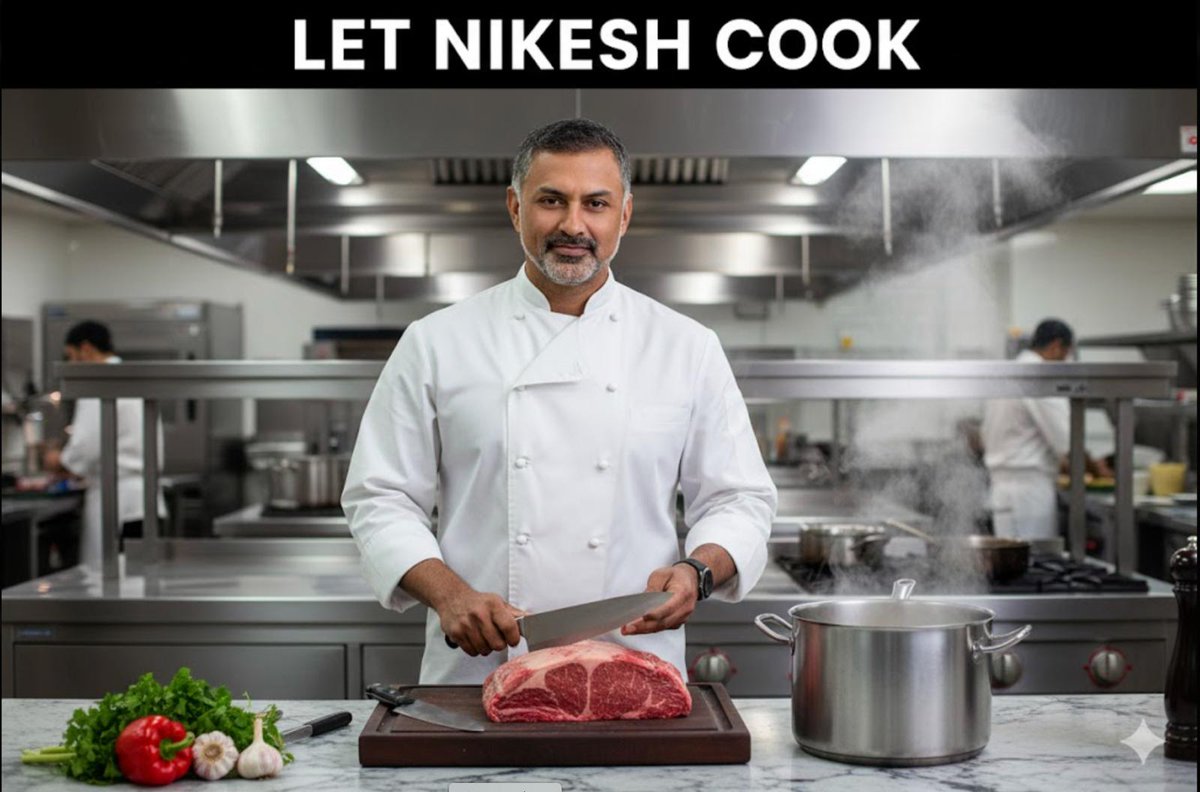
LET NIKESH COOK. $PANW
The Master Chef of Cyber is cooking a fine-dining dish…
a north-of-$300B dish for FY30. 👨🍳🔥
@nikesharora@HamzaFodderwala@PaloAltoNtwks
Bottom line: Palo Alto Networks isn’t just executing, it’s architecting the AI-era security, identity & observability platform. With management now raising the long-term NGS ARR target from $15B → $20B by FY30, the visibility into a $300B+ valuation path keeps improving every quarter.
Another powerhouse print:
• NGS ARR +29% YoY to $5.85B (vs ~$5.8B cons)
• RPO +24% YoY to $15.5B (vs $15.43B cons)
• Revenue +16% YoY to $2.47B (vs ~$2.45B)
• Product +23% YoY (vs 19% est)
• EPS $0.93 (vs $0.89)
• Op margin 30.2% (vs ~29%)
Platformization accelerating across US Fed, Telco & F500.
SASE ARR +34% YoY to >$1.3B.
Software Firewalls now ~44% of product revenue.
XSIAM momentum unmatched. ~$1M+ ARR per customer and an $85M deal, the largest ever for the category.
AI-security adoption inflecting: Prisma AIRS 2.0 deals doubled QoQ.
New integrations added across NVIDIA BlueField, IBM, ServiceNow & Glean.
AgentiX → true autonomous AI agents for the SOC: AI that detects, decides, and acts.
Quantum emerges as a new secular tailwind: PAN-OS Orion, Gen5 firewalls, cipher translation + IBM quantum-safe readiness.
CyberArk + Chronosphere broaden the platform:
• Identity → the control plane for agentic systems
• Observability → LLM-scale telemetry at 1/3 the cost
Combined TAM heading toward ~$300B within 3 years.
Management raised the long-term NGS ARR target from $15B → $20B by FY30, reinforcing confidence in multi-year compounding and platform expansion.
FY26 guide remains strong:
Revenue $10.50-10.54B, NGS ARR $7.0-7.1B, FCFm ≥37%.
Long-term FCF margin: 40%+ by FY28.
One of the cleanest long-duration compounders in software.
$PANW 🚀🔥
#AI #Cybersecurity #SASE #Observability #IdentitySecurity #QuantumSecurity #TechEarnings #NextGenSecurity
5 TMT events/takeaways from this past week:
1/ $META best week since early 2024, +15%. The Iris chip memo (July 9) closed the loop on the Meta Compute cloud announcement from the prior week. Meta is no longer just the most aggressive AI infrastructure buyer, it is building a vertically integrated compute stack: data centers, silicon, models, and now external cloud monetization. 7 GW compute capacity in 2026. 14 GW in 2027. $125-145B capex. The buildout is accelerating.
2/ $AVGO had the most ASIC-constructive single week in its history. Three simultaneous customer confirmations: Google TPU 5-year contract (majority volume share locked), OpenAI Jalapeño deployment beginning this year, and Meta Iris (Broadcom design partner confirmed). Then $AAPL announced a $30B+ multiyear chip deal on top. Four. In one week. The "custom silicon is a Google-specific story" thesis is closed.
3/ $SKHYV (will trade as $SKHY starting Monday), listed on Nasdaq. $26.5B raised, ~7x oversubscribed, above $170B in orders. Largest US listing ever by a foreign company. It happened while the Korean semi sector was selling off and the KOSPI was in a circuit breaker week. Global institutional capital just made a very loud statement about HBM demand being structural, not cyclical.
4/ $ORCL S&P downgraded to BBB-, one notch above junk, but S&P simultaneously improved its peak leverage forecast to 4.4x from 4.8x. This isn't Oracle's balance sheet deteriorating, it's sector-level AI infrastructure skepticism. S&P projects -$42B FCF in FY27 on $90-95B capex. RPO hit $638B at last print, up 363% YoY, one of the most staggering backlog buildups in enterprise tech history. $144/share with ~$167B in debt is the equity market saying it works. S&P is saying prove it first. ORCL is the cleanest real-world read on whether enterprise AI infrastructure demand is real, durable, and winnable outside the hyperscaler oligopoly. Watch every RPO print and OCI growth rate as the benchmark.
5/ $SPCX underwriter research blackout expired this week. 29+ buys, 5 holds, 1 sell, avg PT ~$236. Stock closed at an all-time low of $145.30 this week, well below its June 16 ATH of ~$200+. The $62-$800 PT range isn't analyst disagreement. It's an honest acknowledgment that nobody can model orbital AI compute from a DCF. The market is saying the same thing.
#Semiconductors #AI #Memory #Tech #AIInfrastructure
Fair bear case on the OpenAI concentration risk, and I flagged in my post for exactly this reason. But a few pushbacks:
1/ OpenAI IPO at a healthy valuation actually resolves the funding concern, public markets capital is a different equation than private burn
2/ RPO isn't just OpenAI: $META, $NVDA, xAI, US government are all in that backlog. Concentration is real but slightly overstated
3/ The model commoditization bear case cuts both ways: more models, more compute demand, more OCI utilization. Inference scaling doesn't care who wins the model race
4/ US government as a strategic backstop is underappreciated. $ORCL at low prices is a national AI infrastructure asset, that's not a trivial put option.
The net debt/EBITDA point is right. Uncomfortable today. But as $90B+ revenue guidance flows through to EBITDA, that denominator starts to look different. That's the bet.
@69nich Absolutely. $638B RPO with signed commitments from $ORCL customers including OpenAI, $META and $NVDA - that's not speculation, that's backlog. The credit rating story is about financing structure, not demand. Two very different things. Hardest part for bears to explain away.
S&P cuts $ORCL to BBB- (Stable): one notch above junk. S&P simultaneously improved its peak leverage forecast to 4.4x from 4.8x. This isn't Oracle's balance sheet deteriorating, it's sector-level AI infrastructure skepticism, and the timing is largely mechanical after ~1 year on Negative Watch.
S&P specifically flags $SPCX and likely $META entering the infrastructure sell-side market, rising memory component costs, and broader AI ROIC uncertainty as drivers. Worth noting $SPCX is now publicly traded, S&P citing them by name in a credit action is a meaningful legitimizing data point.
The Moody's risk is the next overhang to watch. Also on Negative Watch, a follow-through downgrade further constrains bond access and accelerates equity issuance, perhaps beyond what $ORCL has already telegraphed. Management already announced ~$40B in debt+equity raises for the datacenter buildout. BBB- mandates even more equity going forward. Watch that.
But zooming out, $ORCL is one of the most interesting risk/reward setups in TMT right now and arguably the best barometer for AI monetization skepticism in the market. It's not a hyperscaler with $500B balance sheet headroom. It's a company that has bet its entire credit profile on enterprise AI demand being real, durable, and winnable outside the hyperscaler oligopoly.
The bull case rests on the backlog. RPO hit $638B at last print, up 363% YoY. One of the most staggering backlog buildups in enterprise tech history. The stock re-rated violently in 2023-2024 on RPO momentum alone. Every strong print sent it up double digits in a session. The market learned to treat it as the definitive leading indicator of OCI revenue visibility. (Worth noting: a large portion is tied to the OpenAI relationship, concentration risk the bears will flag)
S&P is essentially saying: "we see the backlog, we're just not sure you can execute at the margins the equity market is pricing." That divergence, credit skepticism vs. equity optimism anchored on RPO: is the trade.
OCI growth, RPO trajectory, and customer prepayment behavior remain the cleanest real-world reads on enterprise AI infrastructure demand outside $AMZN $MSFT $GOOGL. If monetization is real → $ORCL works spectacularly. If ROIC disappoints → you see it in credit and equity simultaneously. Rare dual signal.
~$144/share with ~$167B in debt is the market saying it works. S&P is saying prove it first. Watch $ORCL as the benchmark.
#TMT #Oracle #AIInfrastructure #AIMonetization #Tech
Wishing everyone a Happy 4th of July, enjoy the long weekend. Happy 250th!! 'MURICAAA 🇺🇸
5 TMT events/takeaways from this past week:
1/
The market reaction to Meta Compute seemed unjustified and rather created an entry opportunity. Monetizing idle GPU cycles is ROIC-maximizing, not a capex reversal. The AI infrastructure thesis ($LRCX $AMAT $ANET $NVDA) is intact, and $GOOGL already has the compute monetization moat $META is building toward.
2/
Open-weight Chinese AI models are closing the capability gap on vulnerability discovery. GLM 5.2 now matches Claude Opus 4.8 and GPT-5.5 on baseline cybersecurity benchmarks. CVE volumes are already accelerating in 1Q26 data. The offense is getting better faster than enterprise defenses are hardening. $PANW $CRWD
3/
That vulnerability acceleration is the forcing function cyber insurance has been waiting for. Carriers are raising the underwriting bar, asking for platform security and PAM as coverage conditions. With CyberArk now closed, $PANW is the best platform delivering both at scale under one roof. The insurance mandate may move faster than any CISO budget cycle.
4/
The GS High-Beta Momentum basket (GSPRHIMO) had its worst two-day move since COVID, down 18%. KOSPI circuit breakers triggered. This was a crowded-position unwind, not a thesis change. The AI capex cycle is going higher, not lower.
5/
The agentic developer stack is reorganizing faster than SaaS metrics will show. Vercel Ship confirmed agent-led growth benefits infrastructure-layer names ($NET $DOCN $OKTA), not legacy application suites. $CRM faces proliferating alternatives from every angle. The SaaS Apocalypse is not fully over.
#Cybersecurity #AI #Semiconductors #Tech #SaaS
Chinese LLMs reaching Mythos-level capability with agent swarms for autonomous attack is the threat vector that makes cyber insurance the next repricing event.
Carriers are increasingly requiring robust platform security and PAM controls as key conditions of coverage. As AI-native attack capability scales, that underwriting bar moves higher fast.
With the CyberArk acquisition now closed, $PANW is the best platform delivering both network security and PAM at scale under one roof.
The insurance mandate becomes a powerful forcing function for enterprise security upgrades, perhaps faster than any internal CISO budget cycle.
@nikesharora@HamzaFodderwala@PaloAltoNtwks
#Cybersecurity #AI
Woke up in London to all the conversation of Chinese Cybersecurity models getting to Mythos like ability with agent swarms. Swarms that can explore vulnerabilites, determine attack paths and potential fixes in addition to persistent red teaming.
Happened just under 3 months, faster than my optimistic estimate. Expect that in a few weeks there will be more widespread capability. Highly likely that we will get US models released from bans faster with a promise of better hygiene.
What does it mean for the rest.
1. Test your own code!
2. Validate your vendors, ensure they are doing the same.
3. Start evaluating direct and virtual patching approaches to ensure open source is protected.
From a longer term perspective, we will need to ensure better security posture, no, no misconfigurations, robust platform products which can react swiftly, and a culture of constantly testing the enterprise with the most recent tools out there.
Woke up in London to all the conversation of Chinese Cybersecurity models getting to Mythos like ability with agent swarms. Swarms that can explore vulnerabilites, determine attack paths and potential fixes in addition to persistent red teaming.
Happened just under 3 months, faster than my optimistic estimate. Expect that in a few weeks there will be more widespread capability. Highly likely that we will get US models released from bans faster with a promise of better hygiene.
What does it mean for the rest.
1. Test your own code!
2. Validate your vendors, ensure they are doing the same.
3. Start evaluating direct and virtual patching approaches to ensure open source is protected.
From a longer term perspective, we will need to ensure better security posture, no, no misconfigurations, robust platform products which can react swiftly, and a culture of constantly testing the enterprise with the most recent tools out there.
5 TMT events/takeaways from this past week:
1/ $MU SCAs break the cyclicality bear case for now. ~$100B RPO, $22B in customer deposits, take-or-pay through CY2030. Floor pricing still delivers GMs above any prior cycle peak. The memory business model just changed.
2/ $QCOM made the biggest strategic pivot in its history. Dragonfly data center CPU, $3.9B acquisition of Modular, Meta as an anchor customer. $40B non-handset FY29 target nearly 2x its prior guide. Stock surged 15%+ intraday.
3/ Memory cost inflation has left the data center. $AAPL raised Mac/iPad prices 15-25%, largest like-for-like increase ever, explicitly citing DRAM/NAND. $MSFT raised Xbox $100-150 for the third time in 13 months. Same root cause. Same week.
4/ $SOX hit new all-time highs on 6/22, up +86.9% YTD. The Mag7 hit new YTD lows vs. the S&P the same week. The market is bifurcating: AI infrastructure hardware is a direct capex beneficiary. Hyperscalers face a growing question: is the return accruing to the hardware layer or the revenue line?
5/ The US government is now gatekeeping access to frontier AI models. OpenAI's GPT-5.6 required government sign-off per customer. Anthropic the week before. This isn't a one-off, a framework is being established. Single-model dependencies just became an operational risk
#Semiconductors #AI #Memory #Tech
$MU FQ3'26
The beat was historic. But the real story isn't the numbers.
16 binding, take-or-pay customer agreements through end of 2030. ~$100B minimum committed revenue at floor pricing. $22B in customer deposits ($18B unrestricted cash). Memory doesn't work like this - until now.
The floor price on these agreements still generates gross margins well above any prior cycle peak. The ceiling is set at today's market prices, which are already at record levels. This isn't a cyclical peak. It's a structural reset of what the memory business model looks like.
The numbers, for context:
• Revenue $41.5B (+346% y/y, +74% q/q): fifth consecutive record
• Gross margin 84.9%: new company record, doubled y/y
• EPS $25.11 (+106% q/q)
• FCF $18.3B: quarterly record
• Data center annualized run rate: >$100B
• Data center SSD >$5B, more than doubled sequentially
• HBM4 already shipped >$1B; ramping 2x faster than HBM3E
FQ4 guide: $50B revenue (±$1B), ~86% gross margin, $31 EPS (±$1).
Supply-demand tight beyond 2027. No line of sight to when memory supply catches up with AI-driven demand even into 2028.
Sanjay put it plainly: memory is a strategic asset. Customers are now treating it that way, with contractual, multi-year commitments to prove it.
Zooming out.
AI earnings are accruing to a narrow cohort, hyperscalers (AWS, Azure, GCP), Meta, and data/memory infrastructure names. Monetization at the software layer is absent for all but a small cohort within the data and cyber verticals.
I see no clear trough in IGV until NNARR accelerates and NRR bottoms concurrently, at minimum, channel checks need to show the turn before reported numbers do. Until then, software as a cohort remains Underweight.
The seat-based SaaS model is structurally impaired. Agents don't have headcount, they have workload. CRM is the clearest example: Agentforce consumption exists but isn't yet material enough to offset seat stagnation.
A drawdown in infra/hardware gets bought.
For memory exposure with lower tracking error: $LRCX is the higher-purity semi-cap play, DRAM/NAND etch and deposition a large share of WFE mix, a top pick for a few years now. $AMAT offers broader exposure augmented by logic and advanced packaging tailwinds.
#MU #Micron #Semiconductors #AI #Memory #HBM @MicronTech
$PANW FQ3'26 - one of the cleanest beat-and-raise in cyber.
The numbers:
• Revenue $3.0B (+31% y/y) ✅
• NGS ARR $8.13B (+60% reported, +28% organic) ✅
• Organic NNARR re-accelerated: +17% y/y vs. +11% last quarter ✅
• RPO $18.4B (+36% y/y; +22% organic) ✅
• SASE ARR $1.6B (+40% y/y) ✅
• EPS $0.85 vs. $0.79-$0.81 consensus ✅
• FCF $910M (+57% y/y), TTM margin 38.5% ✅
Every guided metric was beaten. Full-year guidance was raised across the board.
Nikesh said it plainly:
"Frontier AI has increased the terminal value of the entire cybersecurity industry."
Six months ago the narrative was that AI would compress cybersecurity spending. Today, AI is becoming arguably the biggest structural demand driver the industry has seen in decades.
Palo Alto researchers simulated a full ransomware campaign, from initial access to data exfiltration,in 25 minutes. The average enterprise still takes days to detect a breach.
That gap is a crisis.
It is pulling forward architectural conversations with virtually every CISO on the planet.
• 1,200+ customer outreach requests in 6 weeks
• 800 customer meetings completed
This wasn't just a strong quarter. It felt like an inflection point.
Chronosphere is the sleeper story.
A single frontier AI lab now generates $200M+ ARR and is still growing. That's a flagship business for most pure-play software companies. Here it's one customer inside a much larger platform.
80% of new Chronosphere customers this year adopted multiple products. Platformization is extending beyond security and into observability.
CyberArk integration is running 3-6 months ahead of schedule.
• 1,000+ cross-org customer engagements initiated
• Idira launched just months after close
• Synergies tracking ahead of plan
The FY28 40% FCF margin target looks increasingly achievable.
Under the hood:
• XSIAM >$600M ARR, +100% y/y
• Majority of customers responding to threats in under 10 minutes
• Best hardware quarter in a decade
• Firewall bookings +40% y/y
• Prisma AIRS customers tripled sequentially
Agentic AI is a structural firewall demand driver.
Every machine-to-machine interaction creates traffic.
Every traffic flow requires inspection.
Every inspection point increases the value of the platform.
Prisma AIRS is approaching $100M ARR for a product that wasn't in market 12 months ago.
Point products can't win this fight.
The platform with 125M sensors, 17 petabytes of daily telemetry, identity security, observability, AI security, SOC automation, network security, and runtime enforcement can. 🔒
AI isn't disrupting PANW.
AI is accelerating every major growth vector inside PANW simultaneously.
#PANW
@nikesharora@HamzaFodderwala@PaloAltoNtwks
#Cybersecurity #AI #PaloAltoNetworks #InfoSec