1/ A man in South Korea who posed as a Bloomberg journalist embedded himself in the press corps of a South Korean presidential candidate during last year's election, and has walked free after police concluded the evidence did not meet the legal threshold for fraud.
Please read our incredible media writer @dbauder's final piece in his illustrious career at the @AP:
A photographer has captured some 50 newsrooms to document places and lives endangered by the industry’s collapse https://t.co/m3BMELtZl9
AP: South Korean police said Tuesday they are seeking to arrest music mogul Bang Si-Hyuk, chairman of the agency behind K-pop supergroup BTS, as they expand an investigation into allegations that he illegally gained more than $100 million in an investor fraud scheme.
The best story about The New York Times this week didn’t appear in the paper.
In fact it wasn’t an article at all, but a web site created by a freelance journalist named Ted Alcorn.
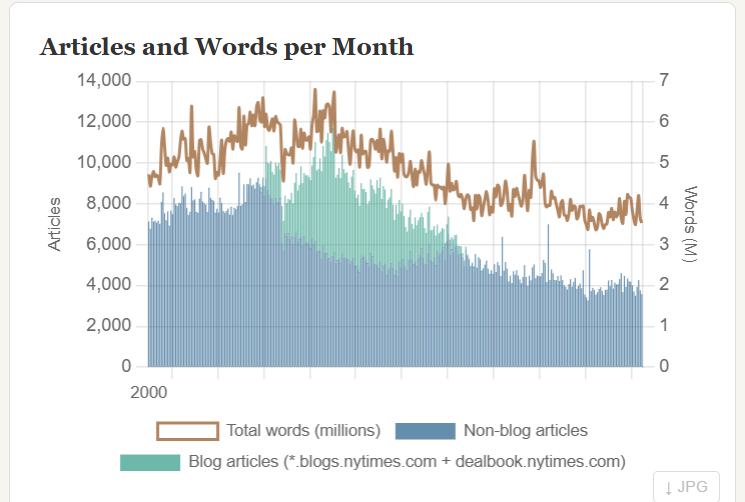
Alcorn tapped into the paper’s public API to create a dashboard that provides some extraordinary insights.
The first was that over the past 25 years, the Times employed – at various times – a total of 26,000 reporters who wrote 1.5 billion words to produce 2.2 million articles.
You can use the dashboard to drill down to see which beats, topics and people have been covered the most and how that coverage has fluctuated.
A few examples of the kinds of things Alcorn cited that he noticed:
➡️Trump dominates headlines vs everyone
➡️Maggie Haberman has the most bylines recently
➡️India has been undercovered per-capita
➡️China coverage peaked around 2014
➡️Iowa stories surge every four years
Political partisans will mine the site for ammunition to argue the paper of record is pro THIS or anti THAT.
But that debate misses larger truths unearthed counting the number of stories in so many ways over such a long time period.
The volume provides a measure of attention largely independent of ideology. Whether a news story about Trump is positive or negative doesn’t change the fact it is about Trump. And the fact that a story was published about Trump reflects interest in hm.
It’s not a perfect system, but at this scale, breath and consistency, there is probably no better public dataset to measure what is on everyone's mind.
What Alcorn built – whether he realized it or not – was effectively a better version of Google Trends.
Google Trends provides comparisons based on search but they don't give you the actual data. It's normalized so you get relative percentages and that limits the comparisons you can make.
The Times archive comes from a single institution with a mostly consistent editorial policy over 25 years. That makes apples to apples comparisons possible. It’s a clean cohort in a world where good data is hard to find.
It provides a useful signal for understanding how attention has shifted among countries, companies, or individuals.
Times reporters jumped on the site when it appeared, mostly to see where they ranked on the leader board. Times editors will likely use the tool to better understand how coverage has shifted.
Given its utility, it’s sort of insane that it took an outsider to build it.
But in an open API world, the best analytics often are built by people outside the wall.
Alcorn explained the difficulty of reconciling data: Categories shift and reporters change names. The same subject gets coded differently over time.
Some Times reporters flagged bugs and suggested features.
But so far the paper hasn’t commented on the project, which he cheekily called Below the Fold.
Here is the link to the @tedalcorn site https://t.co/5dS7xQTjsj
“Actors can be insightful about their craft, but they’re not all trained in the art of, say, asking follow-up questions. They’re also happy to leave whatever discomfiting subjects off-limits for their friends and peers.” https://t.co/xNpl2JKui3
A lot of people like to quip that the New York Times is a games company that happens to subsidize a news outlet, but I’ve always found that to be lazy analysis. The reason that the outlet has been more successful than virtually any other media company is
https://t.co/8OXxb6oyFa
South Korean officials say at least 50 people have been injured in a fire at an auto parts factory in the central city of Daejeon. https://t.co/g9Tkuxq6sj