Rich Ghanaian parents pay $18,000 a year at DPS International. $16,000 at Tema International School. Why?
Because their kids do the IB Diploma. SATs. Strong English. Strong essays. So they go straight to Harvard, MIT, Yale, Cornell on full scholarships.
Meanwhile, a brilliant kid in Kasoa, Tamale, or Ho is doing WASSCE thinking the best he can hope for is Legon or KNUST.
Same brain. Different information.
The rich kids aren’t smarter than you. They just had parents who knew the game.
Here’s the truth nobody tells you:
You don’t need DPS. You don’t need TIS. You don’t need rich parents.
I sold sachet water in Ghana. I went to Berea College on a full scholarship. Now I’m a software engineer in Dallas.
My friends from humble homes did it too. From WASSCE straight to top US universities. Full ride.
The system was hidden from us. Not from them.
https://t.co/pursEFinfC exists so the kid in the village has the same map as the kid in East Legon.
Share , like and repost for a fellow Ghanaian who needs this to see
You really don’t understand what this means to me. From going to school on a Monday morning after being obliterated 8-2 in 2011. From eating 10-2 on aggregate in 2017 and leaving the tv room with blurry vision. From finishing my dissertation in tears after 4-1 in Baku in 2019.
WOW ❤️❤️❤️
Rihanna took her lookalike out for dinner ,they ate, had some natural juice, and ended the evening with a selfie.
The crazy thing is, they are not related, yet the resemblance is striking! She even looks more like Rihanna than Rihanna’s own children. This just proves that your twin might be somewhere out there.
If you look like me , I got $5k for you, drop your picture in the comments section
Best places to visit this November
1. 🇬🇭 Ghana
2. 🇨🇦 Yukon, Canada
3. 🇻🇳 Southern Vietnam
4. 🇵🇦 Panama
5. 🇳🇵 Nepal
6. 🇳🇿 North Island, New Zealand
7. 🇲🇹 Valletta, Malta
8. 🇪🇸 Seville and Jerez, Spain
9. 🇰🇷 Seoul, South Korea
10. 🇲🇽 Oaxaca, Mexico
(Lonely Planet)
Ode to Nana Konadu Agyeman-Rawlings (It's long, so bear with me)
Where I come from, Vamboi, a tiny village just outside of Tumu in the Upper West Region, to have a boy as your first child was considered a big blessing. Above all other things, your worth as an asset was going to be determined by how much you contributed as a farmhand.
For starters, I had to do errands – fetch water, bring a cutlass, herd the cattle, this and that – as soon as I could steadily place one foot in front of the other.
It was pretty much the same for every family.
But some of that changed, quite significantly, in 1991, when the 31st December Women’s Movement (DWM) put up the village’s very first school, a Day Nursery.
Suddenly, there was a fresh incentive for parents to consider the prospect of formal education.
It wasn’t so straightforward, as some needed persuasion to enroll their wards, even fathers – the sole decision-makers, traditionally, in what is very much a patriarchal society – were urged to volunteer a child each towards assembling the inaugural batch of pupils.
And that included my father, who, at the time, had just one child.
Surely, he had every reason not to heed that call – and Lord knows there were more than a few who tried to get him to decline – as, after all, others who had children in the tens could afford to send half of them to the school and barely feel the pinch on the farm.
The odds were stacked against my father – and, thus, against me – but, ultimately, he made the difficult decision to take me to school. I was
I made it just in time for the day of the school’s commissioning, an occasion to be graced by no other personality than the then First Lady of Ghana – who doubled as Founder of the DWM – Nana Konadu Agyeman-Rawlings.
With a nursery full of children, and a charge to put on a proper show, the teachers got to work, teaching us basic nursery rhymes.
I was quite good at those. And that, perhaps, was where my lifelong interest in the English language began.
I was one half of a duo picked to perform those well-rehearsed rhymes for the sufficiently impressed First Lady and her entourage; Nuratu, a cousin, was the other. It is, till date, my most vivid recollection of my otherwise unremarkable childhood.
I remember the reaction after I was done performing ‘A Lion’.
I was no older than five years, yet I could see that everyone present – my beaming father, especially – was really proud of me. Oh, there were people from neighbouring villages as well. The atmosphere was almost like what you could expect to feel at a political rally.
And maybe it really was, unofficially, some sort of rally.
The general elections, Ghana’s first since mid-1979, were coming up the very next year, and Mrs. Agyeman-Rawlings’ husband, Flight Lieutenant Jerry John Rawlings, was reportedly eyeing a transition from military dictatorship to becoming the first democratic president of Ghana’s soon-to-be-born Fourth Republic.
Mind you, I have only come to appreciate all this history years later, only with the benefit of hindsight, of course.
What I did know for a fact back then, though, was that this event presented me with a first opportunity to see a 4×4 vehicle. Lots of them. And I sat in one, beside the then First Lady.
Mrs. Agyeman-Rawlings took Nuratu and myself in her car after the programme and proceeded to ‘campaign’ in other parts of the district, before bringing us back to our village.
The joy of that ride lasted a fair few days, before all that joy was replaced by creases on my rather prominent forehead – and for good reason.
We had been told the day’s events would be on national television not long afterwards, hence, each evening found us gathered around Mr. Dintie’s battery-powered TV, hoping to catch the news item and bask in the glow of it.
Yet weeks passed with nothing in sight, and my father – every bit as disappointed as myself – eventually stopped taking me on those news-watching, thrill-seeking visits.
The first day we didn’t show up, as fate would have it, was just the day the news report we had so eagerly sought, aired on Ghana Television (GTV).
Some of the older folks had sent one of my cousins running to our house to inform my father about the ongoing broadcast, sending us running almost immediately in the opposite direction.
We couldn’t get down there soon enough, however; by the time we arrived, breathless yet full of spirit, the focus of the news broadcast had shifted.
I had missed out on a chance to see myself on television. I didn’t know it then, but I would spend much of my adult life in the news – more specifically, chasing the news and telling the world about it. Maybe, sub-consciously, my career path was determined by that episode, as I continuously pursue the news.
I have always enjoyed watching the news every evening. While every kid always seemed to crave something else on TV, the news was all I ever wanted to see.
I loved the news.
The vicarious satisfaction my father felt while I took the stage, stayed with him for quite a while, long after the fanfare had dissipated.
He needed no more convincing that my place was not on the farm, but in school. The original idea was to take me away from school once the Konadu fanfare was over. But now, he saw that my future lied in the classroom, and so he kept me there, and the rest, as they say, is history.
And none of this would have been possible without that singular initiative from Mrs. Rawlings. I have never had the opportunity to thank her or give her this personal testimony. But I know people who know her, will send her this piece. I am grateful.
I am telling this story as a reminder to everyone that a programme aimed at expanding access, is always a laudable idea. Those 31st December Women's Movement Day Cares were crucial interventions, same as a programme such as Free SHS. They may not be perfect, but you cannot deny that they give kids like myself a chance at getting an education and influencing a whole community.
So, to Mrs. Rawlings, thank you again.
By the way, I am still searching for that news item from 1991. If anyone knows how or where to look, point me in that direction.
---Fentuo Tahiru Fentuo
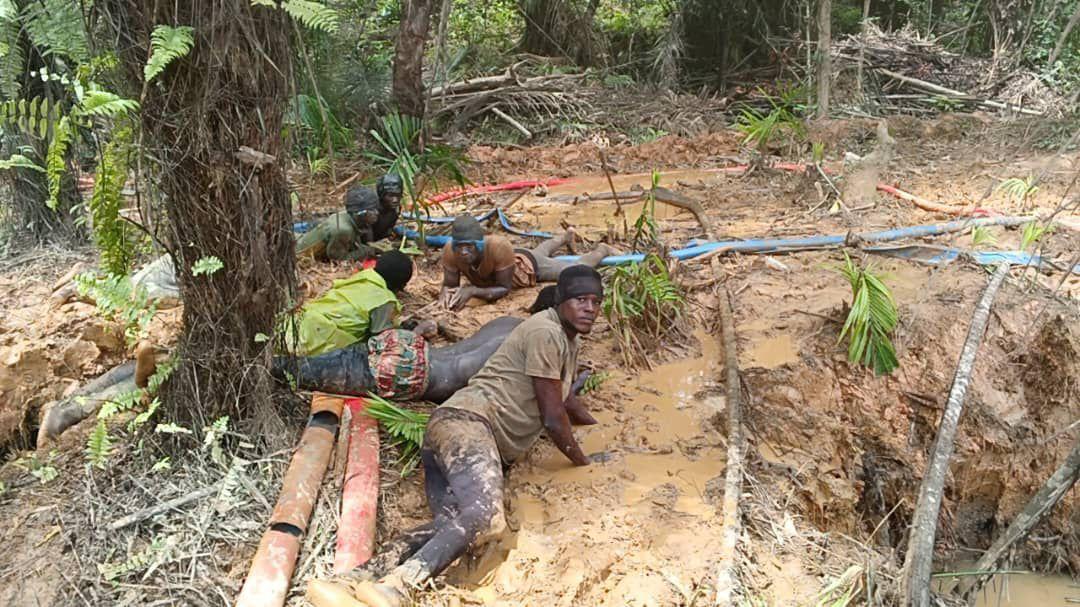
The National Anti-Illegal Mining Operations Secretariat (NAIMOS) Task Force has raided Gangway, a settlement in Aboso in the Prestea-Huni Valley District, reportedly a hub for illegal mining and narcotic activities.
During the operation, the task force seized 11 parcels of Indian hemp and other substances suspected to be narcotics, while hundreds of illegal miners, traders, gamblers, and drug users surrendered.
#UTVGhana