I passed the 2024 Bar Exams #BarNiJLo. Hindi ako nagstudy leave. Work/self-review lang.
3-5 hours reading every night. Kung pagod at antok na, di ko pinipilit, tinutulog ko na lang. Weekends and holidays puro basa at review din. I only used my notes and annotated books. TYL. 🙏
Earn $27 per song you listen:
have prepared a list of 13 Websites that'll pay you $100/hr for listening the music With Just a Smartphone or Laptop and Internet.
For absolutely FREE:
To get it:
1. Follow Me Must
2. Like and Retweet
3. Reply with "Send"
DELETING YOUR BROWSING HISTORY DOESN'T DELETE YOUR BROWSING HISTORY.
Google keeps its own copy, tied to your account, on a page most people have never opened.
Here's how to wipe all of it:
PRACTICE OF LAW, IN RE: SOCIAL MEDIA POSTS OF EDGAR S. DIZON
In a recently decided case, the Supreme Court ruled that the conduct of bar review coaching sessions and the authorship of bar review materials constitute the practice of law.
In support of its conclusion, the Court cited the 1991 case of Cayetano v. Monsod, where the Court defined the practice of law as:
“any activity, in or out of court, which requires the application of law, legal procedure, knowledge, training and experience.”
It is submitted, however, that this definition has been modified—or, at the very least, qualified—by the definition of the practice of law under the Code of Professional Responsibility and Accountability (CPRA), which provides:
“The practice of law is the rendition of legal service or performance of acts or the application of law, legal principles, and judgment, in or out of court, with regard to the circumstances or objectives of a person or a cause, and pursuant to a lawyer-client relationship or other engagement governed by the CPRA.”
Therefore, the mere fact that an activity involves the application of law, legal principles, knowledge, training, or experience should not, by itself, be sufficient to constitute the practice of law. The definition expressly contemplates that such rendition of legal services or performance of acts must be “pursuant to a lawyer-client relationship or other engagement governed by the CPRA.”
Is the conduct of bar review coaching sessions and the authorship of bar review materials an engagement governed by the CPRA?
If the answer is in the negative, then it may be argued that these activities, notwithstanding their substantial use of legal knowledge and training, do not fall within the present CPRA definition of the practice of law.
After a careful reading of the 2026 Bar Examination Questions in Political Law, here are my key observations:
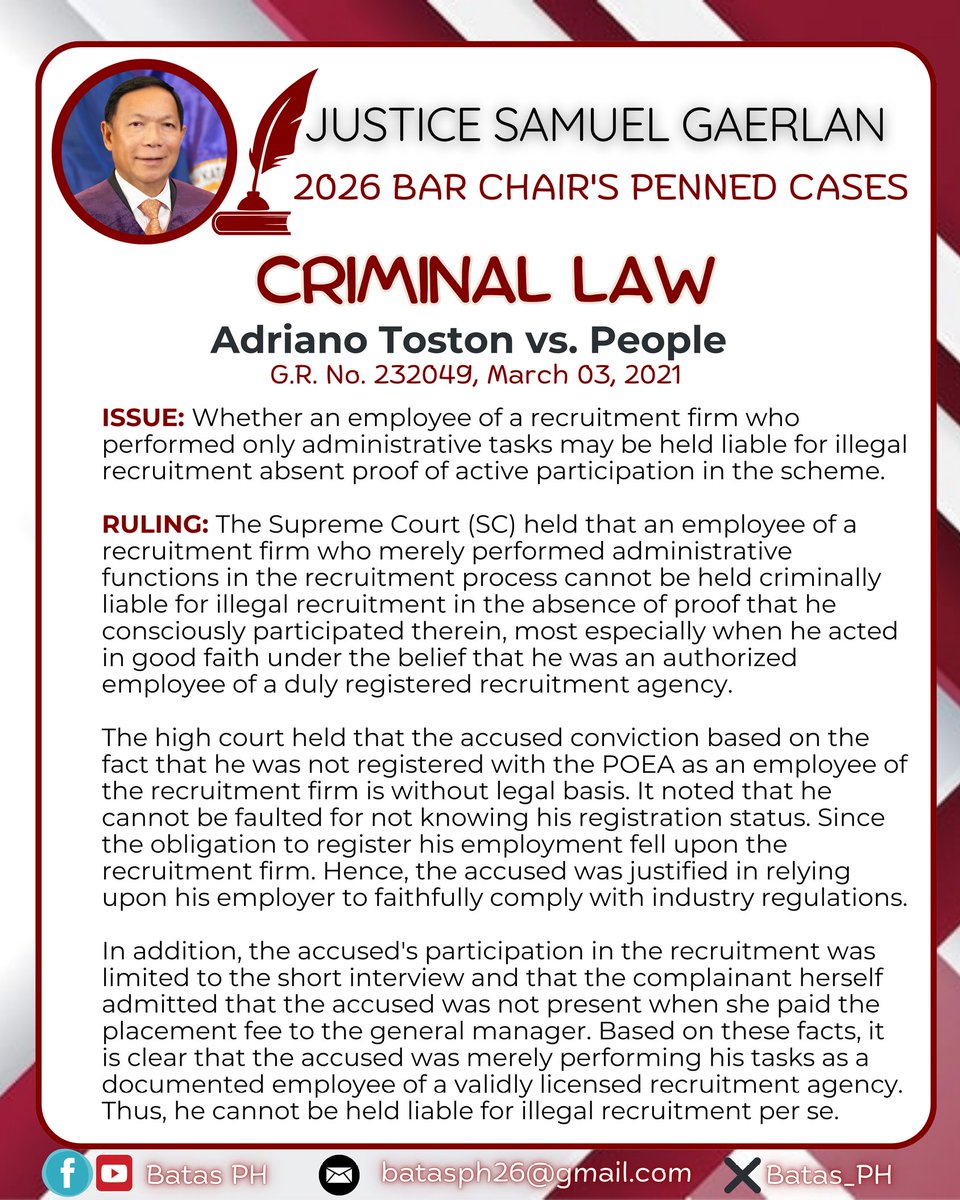
1. NO JUSTICE GAERLAN CASES.
Surprisingly, this year’s Bar Examination deviated from the recent trend of including at least two to three questions involving cases penned by the Bar Chairperson. Notably, no case penned by Justice Gaerlan appeared to have been directly asked in the Political Law examination.
2. CURRENT EVENTS AND PRESSING ISSUES WERE ASKED.
Several questions were anchored on current events, emerging legal issues, and pressing constitutional and governmental concerns, although this type of question is, of course, expected in a Political Law examination.
3. THE ISSUES WERE DIFFICULT TO SPOT.
The examination presented considerable challenges in issue-spotting, particularly because of:
(1) lengthy and complicated factual scenarios; and
(2) broadly worded questions with minimal factual context and clues.
4. SEVERAL QUESTIONS REITERATED PREVIOUS BAR QUESTIONS.
Some questions substantially revisited cases that had already appeared in previous Bar Examinations. In fact, certain questions had been asked MORE THAN TWICE in previous examinations.
5. NEW LANDMARK CASES WERE NOT A MAJOR FOCUS.
The examination did not heavily emphasize recently decided landmark cases. Only one or two questions appeared to directly implicate newer jurisprudence, indicating that the examination placed greater emphasis on established doctrines and fundamental principles.
6. THE EXAMINATION BALANCED FAMILIAR AND NOVEL QUESTIONS.
While some questions were clearly reiterations of past Bar questions, others were novel to an exceptional degree. Some presented legal questions for which there was little or no directly applicable jurisprudence, requiring candidates to reason from the Constitutional text, and fundamental legal principles, rather than merely recall specific cases.
7. NO SUB-QUESTIONS, BUT MULTIPLE ISSUES HAD TO BE RESOLVED.
Although the problems did not contain sub-questions, several questions required candidates to resolve multiple legal issues and contentions.
#2026Bar #AweSamBar
—
LMT in Labor Law will be adjusted accordingly.
"A PRIVILEGE TO SERVE THE FILIPINO PEOPLE"
Associate Justice Amy Lazaro-Javier, Chairof the 2025 Bar Exams, reminded the newest members of the Philippine Bar that admission to the legal profession is a privilege grounded in service.
#batasph
For those who passed and even topped the bar, heed the advice of Justice Ginsburg:
“If you are going to be a lawyer and just practice your profession, you have a skill-very much like a plumber. But if you want to be a true professional, you will do something
BAR PASSER AFTER 11 TAKES
Eduardo Rivera Regio, a 59-year-old Bar Examination taker, has passed the 2025 Bar Exams on his 11th take.
He said that he first took the Bar Exams in 1993.
#BarExams2025#AMYingForExcellence#AJustBar
🎥 https://t.co/3UWeeHiNED / @IanLaquiPatrick
With all due respect, I think the Supreme Court needs to revisit how they handle the #BarExams release. It needs to done quicker, minus all the unnecessary remarks. I think no one wants to hear jokes during such a tense moment. And that school pride flex needs to go too.
JUST IN: A reliable source told Batas PH that 5,594 of 11,425 examinees reportedly passed the 2025 #AMYingForExcellence Bar Examinations, though results remain unofficial.
#batasph
Civil Law questions were really crafted to pass. True to her words talaga si Justice Amy. Isang exam day na lang mga sibs at future attorneys. Padayon!