*Hearty Greetings and best wishes to you & your family on this 80th Independence Day. Let us strive hard to practice the ethics and ideals followed by several freedom fighters to successfully win the struggle over colonial rule*💐🙏💐🙏💐🙏💐🙏
PRESS STATEMENT
AIIEA Condemns Further Disinvestment of LIC
Calls Upon Employees to Hold Lunch-Hour Demonstrations on 5 August
Hyderabad-04/08:
The All India Insurance Employees' Association (AIIEA) strongly condemns the Government
of India's decision to further dilute its stake in the Life Insurance Corporation of India (LIC) through the Offer for Sale (OFS) announced on 3 August 2026. The offer comprises a base sale of 2.5 per cent of LIC's paid-up equity with an additional greenshoe option of 4 per cent, taking the potential disinvestment to 6.5 per cent.
The Government has attempted to justify this move by invoking the SEBI requirement of achieving a minimum
10 per cent public shareholding by May 2027. However, this technical compliance cannot obscure the larger
reality that yet another tranche of public ownership in India's premier financial institution is being
surrendered to the market. This follows the earlier dilution of 3.5% through LIC’s IPO in May 2022 and
represents a continuing retreat of the Government from its commitment to strengthen the public sector.
The latest disinvestment also exposes the deep crisis in the Government's economic management. Having
failed to stimulate investment, generate quality employment and augment revenues through sustainable means, the Government is increasingly dependent on selling public assets to bridge its fiscal deficit. During the current financial year alone, it has already realised over ₹21,000 crore by offloading shares in seven public sector undertakings. This is nothing short of selling the nation's family silver to cover up the failures of its economic policies.
LIC is not merely a profitable enterprise; it is a unique national institution built with the trust and savings of millions of policyholders. It has played an unparalleled role in mobilising household savings, financing nation-building and extending life insurance to every corner of the country. Weakening public ownership in such an
institution is against the long-term interests of policyholders, the economy and the nation at large.
AIIEA reiterates that LIC belongs to the people of India, not to the stock market. We call upon the Government
to immediately withdraw the proposed OFS and abandon its policy of piecemeal privatisation of public assets.
We appeal to all democratic forces, trade unions, policyholders and citizens to unite in defence of LIC and the public sector, which remain indispensable instruments for equitable growth, social justice and national development.
AIIEA has called upon its members and employees across the country to hold lunch-hour demonstrations on 5
August 2026 to register their strong protest against the Government's decision. The demonstrations will
reaffirm the employees' resolve to defend LIC's public character and oppose every attempt to dilute
government ownership of this premier national institution.
Shreekant Mishra
General Secretary
AIIEA
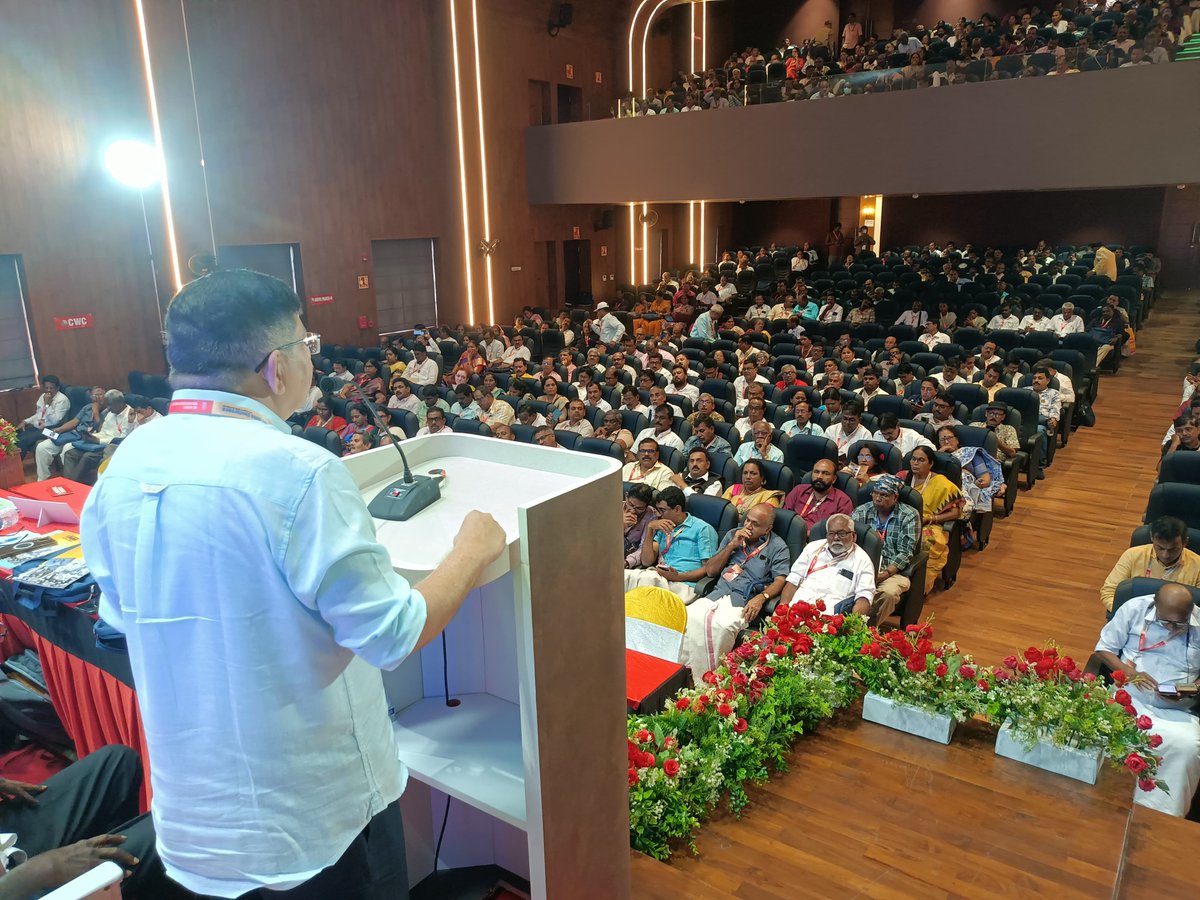
*Com. Shreekanth Mishra, General Secretary, AIIEA addressed today the Inaugural session of 7th All India Conference of LIC Agent's Organisation of India (2026 August 5, 6 -- Kozhikode)
🚩GOING BACK TO SCHOOL TO FIX THE SYSTEM
(JUSTICE MARKANDEY KATJU writes that If good education is the way out of India's biggest problems, making it available to the masses is the biggest challenge. And the time for incremental reforms is over.But historical experience shows that when a country is in a heaving crisis, as India is today, nature throws up great leaders. Seventeenth-century England, 18th-century France and 19th-century Russia all witnessed such churns. Cromwell, Robespierre and Lenin were little known in their countries before the revolutions. I am confident that such patriots will rise in India, too )
INDIA today faces massive chronic problems on several fronts-poverty, unemployment, malnutrition and skyrocketing prices of proper healthcare are just a few. How are they to be solved? Some well-minded people think they can be addressed by providing good education to the people. In principle, I agree.
It's not a new idea. In his treatise on statecraft, The Republic, Greek philoso-pher Plato said, "With a good system of education, every improvement is pos-sible. If education is neglected, it mat ters very little what else the state does." Others, including many thinkers in In-dia, have held a similar line.
The problem, however, is in ensuring a good system of education for the masses. Leave aside the few good pri vate schools-which often charge exor bitant fees that are out of reach for the vast majority and the rest are in a di-lapidated state. Clearly, education in India is in a rut.
The reasons are not far from hand. For one, as scandals are unearthed state after state, it's clear that teachers are often appointed to public schools not on merit, but by giving bribes. The result is that a large number of them are in-competent or not motivated enough.
Even in the national capital, government schools have been in a terrible condition for long, as was pointed out by the Delhi High Court in 2014. The court noted dilapidated furniture, broken desks and shortage of books, class-rooms, washrooms and playgrounds. Some of these problems were addressed in the decade since 2015. But without an update on their status, what can we make of the outcome? Moreover, what about the schools in the satellite cities of Noida, Faridabad and Ghaziabad?
Recently, a government high school building in Mehra village of Madhya Pradesh's Narsinghpur district was found to be in danger of collapse. Severe soil erosion from a nearby river had weakened its foundation, leaving the 15-year-old structure hanging precari ously and the floors visibly sinking, putting the lives of the schoolchildren in peril. After appeals to the authorities remained unheeded, a US-based private non-profit came forward to help.
A few years back, I went to meet an old friend in his village, Manjhanpur in Allahabad district, where he is a farmer. I asked one of his grandsons who had just passed class 7 to bring his maths textbook. When I asked him to solve some simple problems from it, he
If good education is the way out of India's biggest problems, making it available to the masses is the biggest challenge. And the time for incremental reforms is over
This was not an aberration. It's the plight of a substantial share of schools in our country, particularly in rural areas, where the majority of Indians still live.
failed at first. But when I showed him how, the bright boy picked up the method right away and quickly solved other similar problems.
We know that the biennial ASER sur vey gives us a picture of the share of schoolchildren across India trailing their years on subjects like maths. But what did this boy's quick pick-up tell us about his school?
Curious about it, I asked him if his teacher had gone over those exercises. He replied, "Master saheb thekedaari karne lage hain, aur doosre master saheb school aate nahi hain" (The maths teach er has become a contractor, and the oth er teacher rarely comes to the school).
There are other reasons for such per sistent problems. When I was a judge at the Allahabad High Court (1991-2004), I had once visited CAV Inter College, which was considered a good high school in the city. In one section of a class, I noticed 300 students. I asked the principal how could there be so many when the rules permitted only 40? He said, "There's pressure from politicians and officials to take in so many"
For imparting good education, per sonal attention needs to be given by the teacher to students. From my own school days at Prayagraj, I remember being assigned homework that had to be submitted in a day or two. The class teacher would take the copies home, where he scrutinised them closely and brought them back the next day to point out every mistake. Teaching is a pains-
taking job that, if we are improve the quality of education, cannot be merely treated as any other profession. Such attention is impossible in a class of 300.
Parents' focus on getting better education for their children-which they know isn't available at the school has forced them to give in to the tuition racket. Real education is imparted, mostly by the same school teacher, at his home; the school is just a formality. Of course, not all parents can afford paying for it. This again creates a socio-economic barrier to good education at scale.
This is not even to dwell on the mass copying or official glitches that lead to cancellation of exams year after year, destroying young Indians' futures. There is a protest going on right now at Delhi's Jantar Mantar against such grave issues.
To change all this would require a huge resources at all levels of govern ance. The focus of our political leaders of all stripes is not to improve education, but to win elections by any means. Except launching schemes and paying lip service, hardly anyone seems seriously interested in improving the system.
In my opinion, this amounts to nothing less than a collapse of the syston. The constitutional remedies have x-hausted themselves and become like ti able scarecrows. What do the fundam n tal rights to freedom of speech&id expression, liberty and equality man for a poor and unemployed Indian v10 cannot get his or her child educated or a better tomorrow? Nothing.
To those who say the system can be e-formed, I say that though some buildings can repaired, others like the school building in Madhya Pradesh-are so di lapidated that their foundations need to built afresh. Indian education today is like the second kind of building. It needs a revolution, not incremental reforms in education. In other words, the solution to our country's huge socio-economic problems lies outside the constitutional framework, not within.
One can't predict now how this will come about, or who will be its leaders.
But historical experience shows that when a country is in a heaving crisis, as India is today, nature throws up great leaders. Seventeenth-century England, 18th-century France and 19th-century Russia all witnessed such churns. Cromwell, Robespierre and Lenin were little known in their countries before the revolutions. I am confident that such patriots will rise in India, too.
(Views are personal)
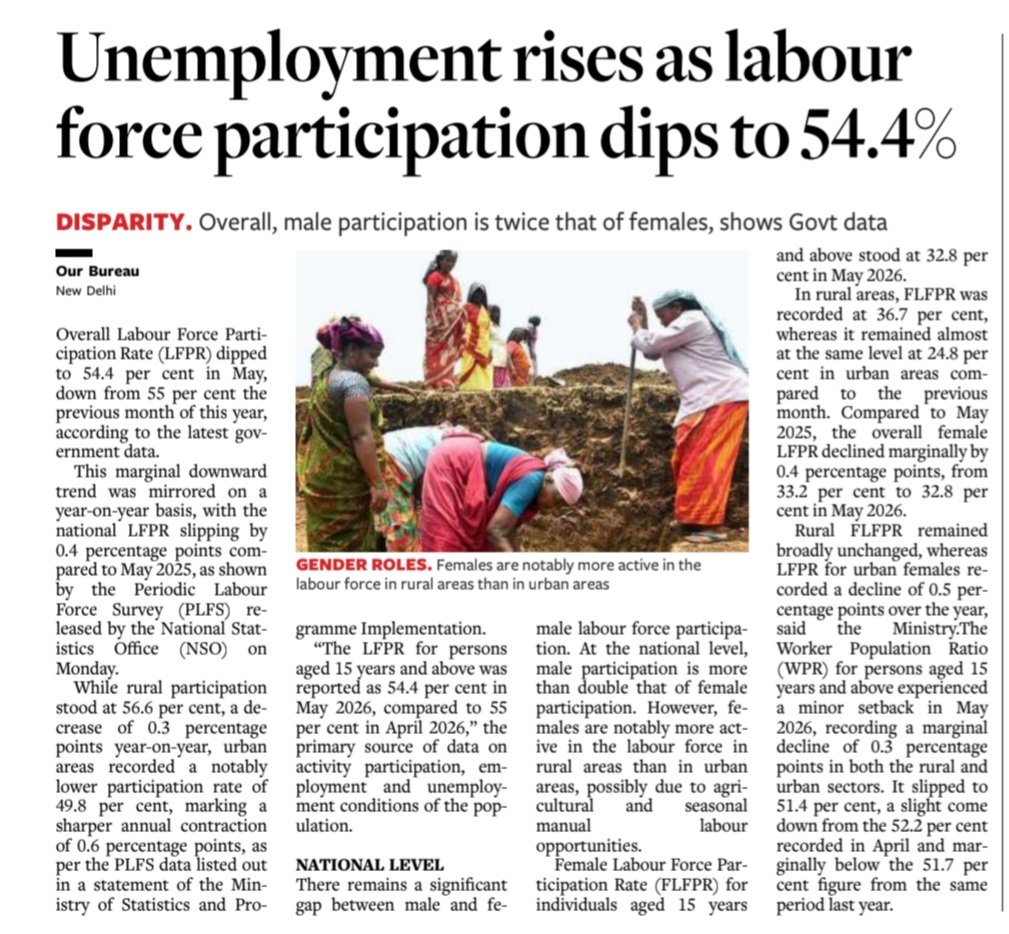
🚩Unemployment rises as labour force participation dips to 54.4%
@Overall Labour Force Participation Rate (LFPR) dipped to 54.4 per cent in May.Overall, male participation is twice that of females, shows Govt data. While rural participation stood at 56.6 per cent, a decrease of 0.3 percentage points year-on-year, urban areas recorded a notably lower participation rate of 49.8 per cent, marking a sharper annual contraction of 0.6 percentage points, as per the PLFS data listed out in a statement of the Ministry of Statistics and Programme Implementation
@Gender disparity growing :Female Labour Force Participation Rate (FLFPR) for individuals aged 15 years and above stood at 32.8 per cent in May 2026.
Females are notably more active in the labour force in rural areas than in urban areas possibly due to agricultural and seasonal manual labour opportunities
🚩MARCHING AHEAD TO A DIFFERENT BEAT
(Thought provoking article which says Gen Z members show great fluidity and speed in responses. As the recent CBSE evaluation crisis unravelled, the sharpest analyses came from students themselves. Their perception and eloquence are indications of their capacity to navigate difficult terrains.Their digital skills help them campaign for causes and influence people on the need for change. The participation of youngsters in the recent Tamil Nadu elections managed to swing the result in favour of a political novice. Their voice was heard on demands for accountability, creation of more opportunities and inclusivity. Many of them even prevailed upon family elders to vote for change.Those in authority need to listen to them and bring structural reforms for a fairer education and exam system. To paraphrase Henry David Thoreau, they are marching to the beat of a different drummer. And they may go farther ahead than the older generation could dream of)
F OR the youth today, increased competition, shrinking oppor tunities and a foggy road ahead are the signs of the times. The impact of unexpected systemic jolts be it the cancellation of the NEET examination or tightening of visa rules for study and work abroad is what they have to deal with. The CBSE exam fiasco, which has affected a huge number of students, is another stark example of the challenges youngsters are up against.
Like every generation before them, Gen Y (Millennials) and Gen Z members are scrutinised for their attitudes and responses. Being digital natives, they have a characteristic online presence, within which reside their sources of information and influence. The choice of courses to study, social interactions, financial transactions, shopping and work are all enabled by digital plat forms. Their decisions, be it watching a movie or making a purchase, are often shaped by research on social media, which is about recommendations. Thus, they are not merely consumers, but are
instrumental in driving demand.
Gen Z workers constitute about a quarter of India's formal corporate workforce. Their behaviour comes in for critical appraisal at the workplace. Rejection of rigid hierarchical structures, choosing conscious 'unbossing' and focusing on expertise over traditional su pervisory roles are shaping their career trajectories. There is a paradigm shift in their approach to work. They are ready to switch jobs, go on short-notice holidays and prioritise work-life balance.
In popular opinion, they are considered entitled and even irresponsible. However, their behaviour is also marked by greater engagement with healthier lifestyles, and concerns over mental health and social responsibilities. Their conversations are more open-ended even as they draw their boundaries. They are willing to do side-hustles, pursue interests beyond the 9-to-5 routine. Entrepreneurship is also a preferred career choice as their risk appetite is considerable. They are more politically aware, conscious of issues of social eq-uity and environmental balance.
Most social commentators observe a high degree of idealism in Gen Z. This translates into roles they play in elections and protests. Their digital skills help them campaign for causes and influence people on the need for change. The participation of youngsters in the recent Tamil Nadu elections managed to swing the result in favour of a political novice. Their voice was heard on demands for accountability, creation of more opportunities and inclusivity. Many of them even prevailed upon fam ily elders to vote for change.
The rise of artificial intelligence as a potential competition for jobs in sectors like coding, finance, legal services, ad vertising and research is changing the contours of the employment landscape. The lack of stability, with a number of employees laid off by Big Tech irrespec tive of talent and contribution, and re-placement of entry-level jobs with Al are causes for concern. At recent gradu ation ceremonies in the US, students
booed those who spoke about the wondrous capabilities of Al.
Elders may consider generations Y and Z to be entitled or irresponsible. But their focus on the immediacy of experience comes amid heightened economic and social challenges. As the recent CBSE fiasco and Tamil Nadu election showed, they are also more perceptive and politically aware
The prediction that India's demo graphic dividend would drive future glo-bal growth had not factored in Al-gener-ated disruption. The readiness to deploy Al in India and the consequential in crease productivity are still works-in-progress. Continuous learning, upskill-ing and reskilling would be the appropriate response. Activating shad ow boards in business organisations would give younger employees an oppor-tunity to share their perspectives. Inter generational conversations could reduce
friction and benefit all stakeholders.
This generation embraces the concept
of YOLO-you live only once. In the midst of heightened economic and social challenges, they lean on the immediacy of experience that may involve spending, travel and gratification. Traditional behaviour like saving for future goals does not hold much of an appeal. What is valued is the memory or the vibe over material possessions. Kindness and altruism are cool. It is also clear that today's youth have not blindly rejected older cultural values instead, they have given a contemporary twist to old forms. They have brought in energy and enthusiasm to bhajan-clubbing and have rediscovered the arts of crochet and knitting. Social media is their go-to space and reels and memes their pre-ferred forms of expression.
Gen Z members show great fluidity and speed in responses. As the recent CBSE evaluation crisis unravelled, the sharpest analyses came from students themselves. Their perception and eloquence are indications of their capacity to navigate difficult terrains. Those in authority need to listen to them and bring structural reforms for a fairer education and exam system.
While their choices like backpacking solo or quitting a job without future plans may exasperate family members, it is perhaps a hack to slow down, observe more and take in what life offers. To paraphrase Henry David Thoreau, they are marching to the beat of a different drummer. And they may go farther ahead than the older generation could dream of.
(Views are personal)
🚩Kerala has the largest number of PSUs now along with TN.
@Number of State PSUs fell down in Gujarat(406 to 139) ,Maharashtra(343 to 98),Uttarpradesh (117 to 46) in a span of 8 years .No wonder ,All these are ruled by BJP Govts
@Kerala registered highest growth among the state wise public sector enterprises from 2016 to 2024 period.
📢Kerala Model is the Alternative Model & Role Model for Protection of PSUs
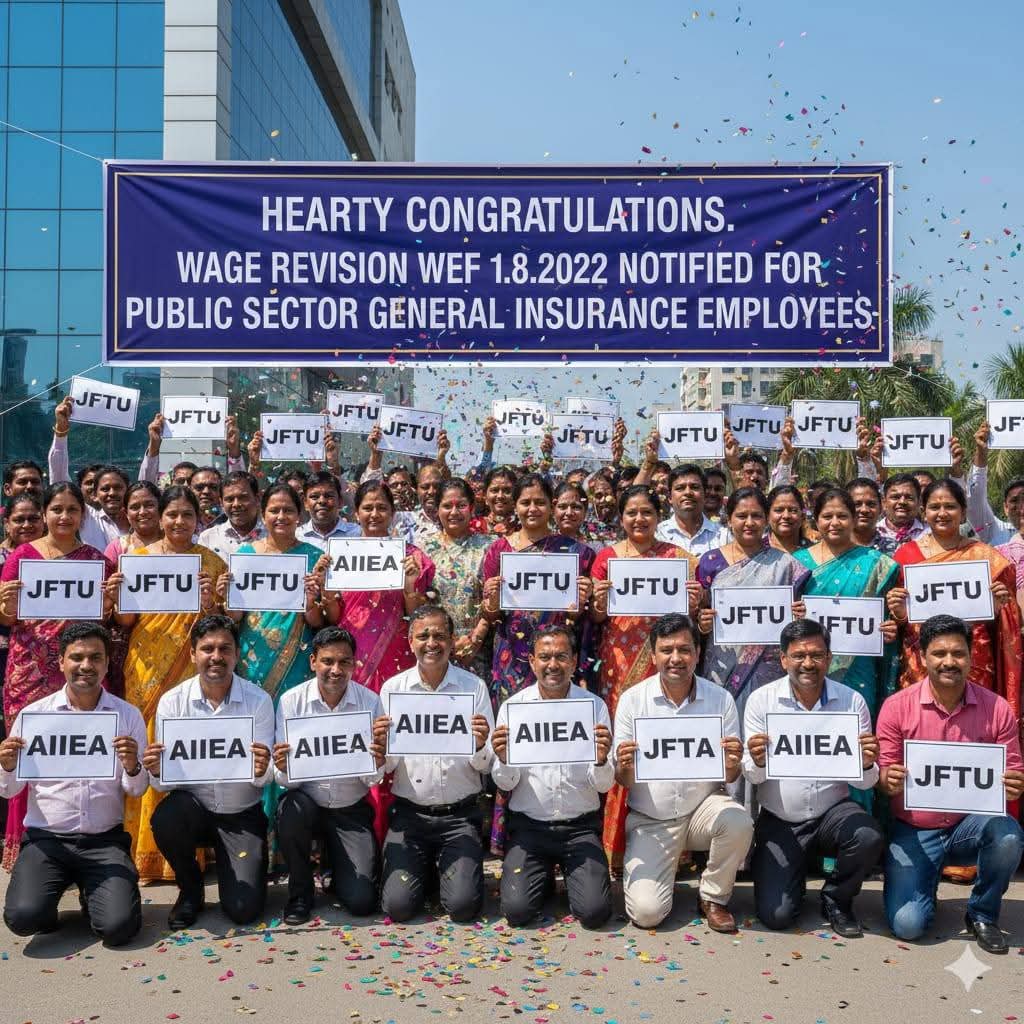
We are extremely happy to inform you that the Gazette Notification for the Wage Revision of PSGI employees has finally been issued late this evening(11.2.2026), after an agonisingly long wait.
We congratulate all employees on securing this magnificent Wage Revision in the most adverse and hostile circumstances.
Tremendous faith in the organisation, unflinching commitment to the struggle, and rock-solid unity have finally paid rich dividends.
The Wage Revision Notification also reinforces AIIEA's conviction that uncompromising struggle against all forms of injustice must continue, irrespective of momentary pecuniary loss or the possibility of being out of favour with the ruling establishment.
We call upon all employees to celebrate this hard-earned victory and march on to the 12th February One-Day Strike with renewed vigour.
Shreekant Mishra
General Secretary
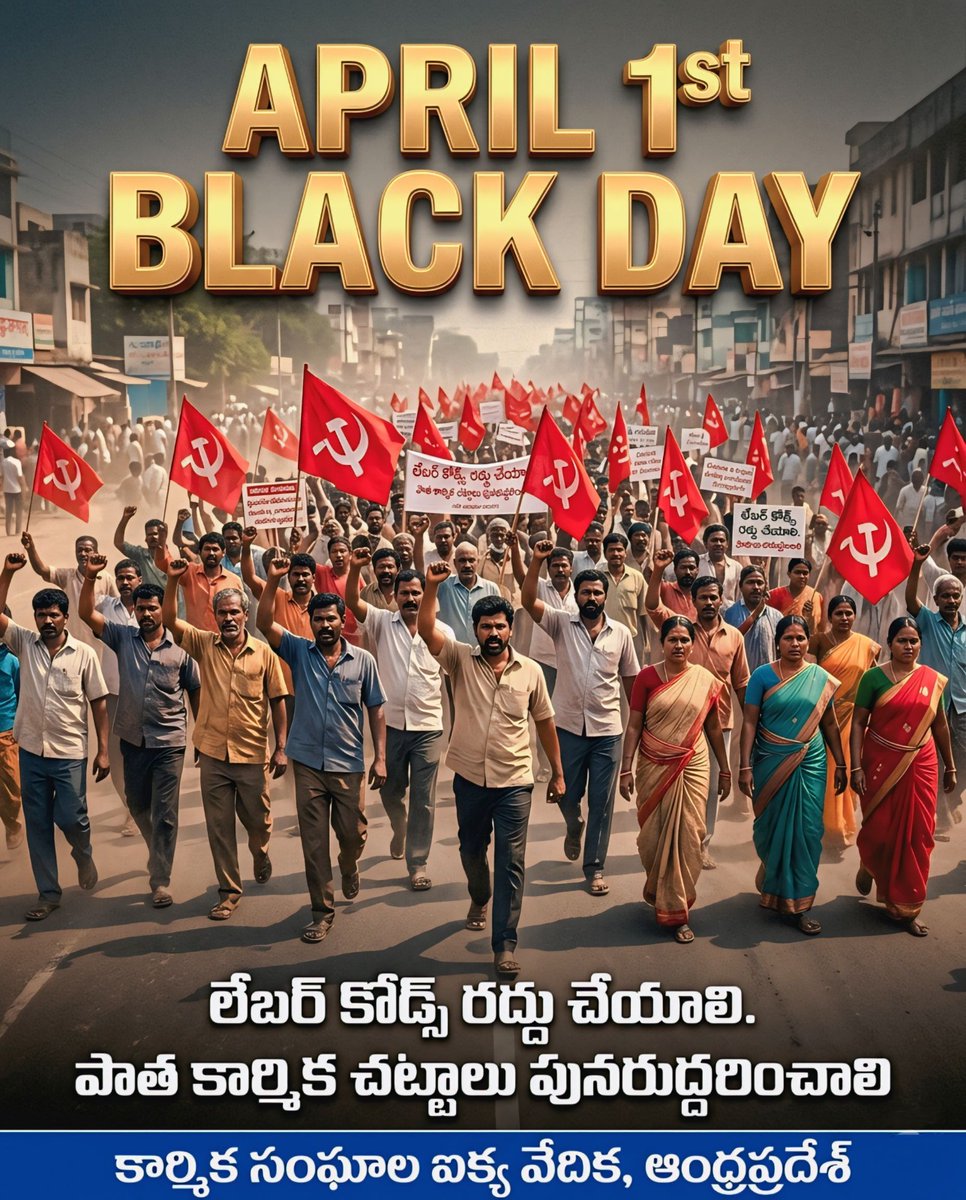
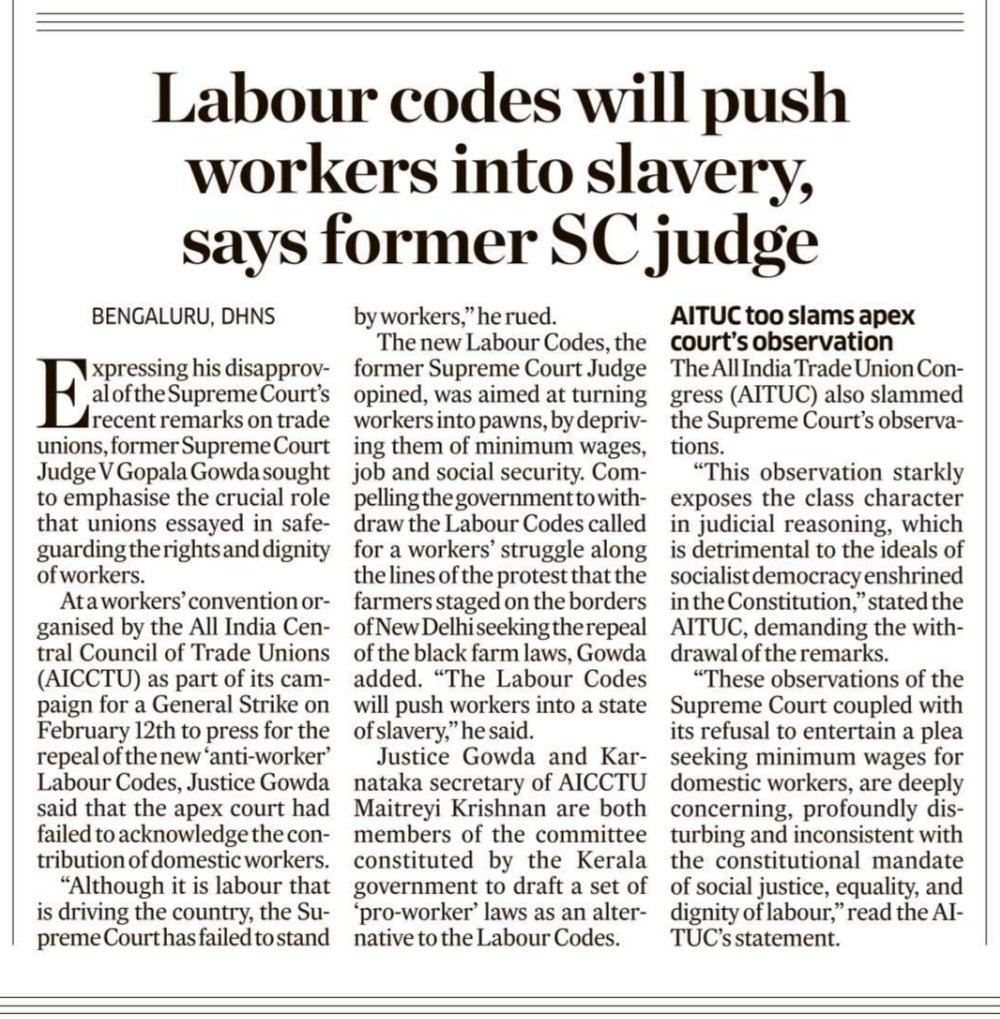
🚩Labour codes will push workers into slavery, says former SC judge Justice V Gopala Gowda
@Expressing his disapproval of the Supreme Court's recent remarks on trade unions, former Supreme Court Judge V Gopala Gowda sought to emphasise the crucial role that unions essayed in safe guarding the rights and dignity of workers.
@ Justice Gowda said that the apex court had failed to acknowledge the contribution of domestic workers.
@Although it is labour that is driving the country, the Supreme Court has failed to stand by workers
@The new Labour Codes, was aimed at turning workers into pawns, by depriving them of minimum wages, job and social security.
@ The Labour Codes will push workers into a state of slavery
@These observations of the Supreme Court coupled with its refusal to entertain a plea seeking minimum wages for domestic workers, are deeply concerning, profoundly disturbing and inconsistent with the constitutional mandate of social justice, equality, and dignity of labour,
@Compelling the government to with draw the Labour Codes called for a workers' struggle along the lines of the protest that the farmers staged on the borders of New Delhi seeking the repeal of the black farm laws
ALL INDIA INSURANCE EMPLOYEES’ ASSOCIATION
LIC BUILDING SECRETARIAT ROAD HYDERABAD 500 004
(E-mail: [email protected])
To,
All the Zonal/Divisional/State/Regional Units
JOIN THE COUNTRYWIDE GENERAL STRIKE ON 12 FEBRUARY 2026 ENMASSE
Against the Atrocious Labour Codes
Against the Concerted Campaign to Weaken Public Sector Insurance IndustryAgainst the Disinvestment of Public Sector Undertakings
Demanding Immediate Recruitment in LIC Demanding Structured Dialogue with Unions on Issues of Employees and Industry
The Secretariat of AIIEA met through the online mode today and took stock of the developments that
have taken place within the industry and outside after the Platinum Jubilee Year 27th General Conference
of AIIEA at Bhubaneswar. The Secretariat decried the Government move to go ahead with the
notification of the four Labour Codes despite vehement opposition of the central trade unions and
independent federations like AIIEA.
The Secretariat congratulated insurance employees throughout the
country for their massive demonstrations during lunch recess on 26th November 2025 against this
obnoxious move. The Secretariat noted that the Joint Platform of Central trade unions comprising ten
major central trade unions and a large number of independent federations including the ones in
insurance and banks have given a call for a countrywide General Strike on 12th of February 2026 against
the Labour Codes.
In keeping with the decision of the 27th General Conference of AIIEA that insurance
employees will be a part of the emerging countrywide struggle against the Labour Codes (the form and
nature of which was left to be decided by the headquarters of the AIIEA in consultation with other
unions), the Secretariat unanimously decided to join the Countrywide General Strike on 12th February
2026 and called upon the employees to make this strike action a historic success. The Secretariat
authorised the Standing Committee (General Insurance) to explore the possibility of joining this strike
action in consultation with other unions in PSGI Companies.
AIIEA has already come out with a Circular (No.25/2025, dated 24 November 2025) and an Editorial in the
January Issue of the Insurance Worker detailing how various provisions of the Labour Codes are inimical
to the rights and welfare of the workers. We’ll certainly come out with some more literature on this.
Suffice it to say for the moment that notwithstanding the labelling of the Labour Codes as ‘Progressive’,
‘Modernising’ and ‘Ground-breaking’ by the lapdog media, the fact remains that these are a clear sell-out to corporate interests. Rather than promoting ‘Ease of Living’, these Codes only hasten the ‘Ease of
Doing Business’. A cursory reading of the Codes makes it amply clear that these Codes restrict the
definition of worker, legalise fixed-term employment, facilitate the process of hire and fire, make trade
union registration extremely difficult, project night shifts for women as a landmark achievement and
nudge the hard-won global norm for 8-hour workdays to 12 hours.
The existing labour laws were
achieved through prolonged struggles of the working class and, with all their flaws, provided some protection to the workers in terms of workplace rights, wages, social security, health, safety and welfare
etc. Labour Codes will drastically curtail all these for the benefit of the employers.
One has to recollect the completely unreasonable and amoral stand of the LIC management during 2024
wage talks not to allow retired employees become a part of the wage talks.
The AIIEA had given
reasoned arguments then that this act of LIC amounted to turning the law of the land on its head and
was a serious breach of industrial democracy. Naturally therefore the Labour Codes will provide the
much needed ideological succour to a management ever willing to trample upon the rights of workers on
some pretext or the other. There is a need to challenge this position; especially in a context where major
policy decisions relating to change in business models and application of technology are being sought to
be pushed through in the name of the ‘changed situation’. We need to make it clear that the long and
glorious journey of the LIC for almost seven decades has been possible because of the support and
allegiance of the workforce, not due to anybody’s bounty or grace.
The Secretariat underlined that any
unilateralism on vital issues relating to the institution and the employees, however pious the intentions
might be, have the potentiality to mar rather than make any positive contribution to the growth and
prosperity of the institution.
The Insurance Laws (Amendment) Bill 2025 has already been passed in Parliament, paving the way
among other things, for enhancement of FDI in insurance from the existing 74 to 100 per cent. Following
this, a clamour has now started for more reforms in insurance by way of the FPO (further disinvestment)
of LIC and privatisation of PSGI companies. This has coincided with the recent findings of the Swiss Re
that insurance premiums are to grow at a rate of 6.9 per cent in India (between 2026 and 2030), against
4% growth in China and 2% growth in the US market. The obnoxious and perhaps unsolicited report of
the IIM Kozhikode to split and unbundle LIC to improve efficiency and disinvest PSGI companies are
attempts in that direction only.
The Secretariat welcomed the unity that has been brought about
amongst the major unions of officers and employees in Banks and public sector insurance industry and
felt that this platform should be harnessed for an effective campaign.
Underscoring the absolute unanimity of the Platinum Jubilee Year 27th Conference of AIIEA at
Bhubaneswar on the need of immediate recruitment in LIC, the Secretariat noted that the matter cannot
brook any further delay.
The meeting noted with dismay that while LIC management and the
government both agree that there is a crying need for recruitment in LIC, the management had been
resorting to unnecessary alibis to shift the goal post and delay the notification process. The meeting
decided that this position was unacceptable and recruitment has to start immediately in the larger
interest of the institution and the policy holders. Given the fact that employment generation and trade
union rights are an anathema to neoliberalism, whose sole purpose is to maximise profit of the capitalist
class, the meeting felt that the attacks mentioned above can only be met through a class struggle of the
working class.
The AIIEA calls upon the employees to wholeheartedly participate in the February 12th
Strike and ensure its all-round success.
With Greetings,
Comradely Yours
Shreekanta Mishra
General Secretary
Com. Chandrasekhar Bose is no more
Red Salute Com. Chandrashekhar Chandrasekhar Bose
With deep sorrow and profound shock we inform that Com. Chandrasekhar Bose, the founder leader of AIIEA, breathed his last today at 3:30. He was 104. He was ailing for sometime and was admitted to a private hospital in Kolkata; it was only yesterday evening that he was discharged from the hospital as there were no visible signs of improvement despite the sincere efforts of a team of doctors.
The passing away of Com. Bose is an irreparable loss to our movement. His life was one of unwavering commitment , integrity and selfless service to the cause of insurance employees under the banner of AIIEA. He was not only a pioneering leader but also a source of inspiration for generations, whose values, vision and sacrifices laid a strong foundation for AIIEA. His contributions will be remembered with gratitude and reverence and his legacy will continue to guide us in the years to come.
AIIEA dips its banner in memory of the great leader and extends heartfelt condolences to his son Com. Somshankar Bose, his daughter -in- law and grandson Surya and all our Comrades and friends who were influenced by his life and work.
Com. Chandrasekhar Bose Amar Rahe...
Shreekant Mishra
🚩On to the Platinum Jubilee Year 27th General Conference of AIIEA at Bhubaneswar....
ALL INDIA INSURANCE EMPLOYEES' ASSOCIATION
LIC BUILDING
SECRETARIAT ROAD
HYDERABAD 500 004
(E-mail: [email protected])
Cir. No. 28/2025
December 22, 2025
To,
All the Zonal/Divisional/State/Regional Units
Dear Comrades,
Re: Platinum Jubilee Year 27th General Conference of AIIEA
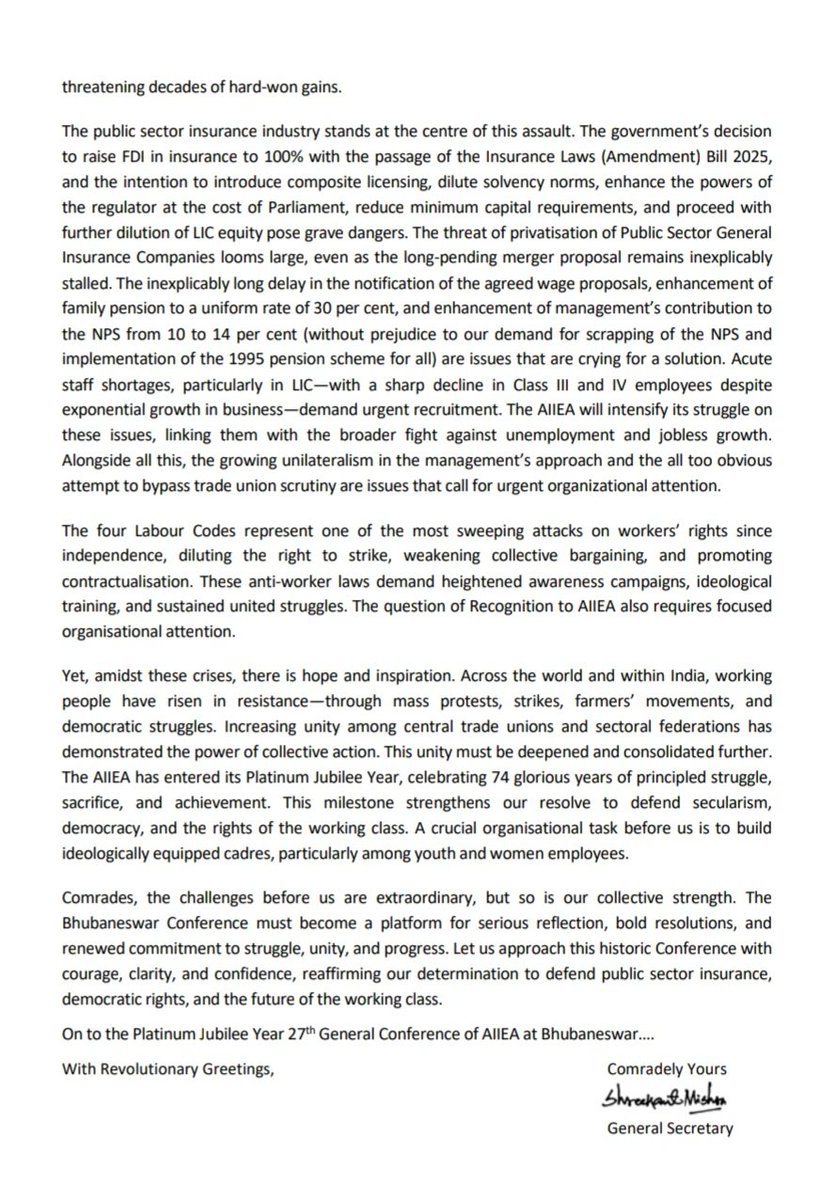
The Platinum Jubilee Year 27th General Conference of our beloved organisation, the All India Insurance Employees' Association (AIIEA), will be held at Bhubaneswar, Odisha, from 28th December 2025 to 1st January 2026. More than 1500 delegates and observers, including a large number of women employees, from across the country are expected to participate in this Conference. A large number of our senior leaders, the former office-bearers of AIIEA, who have steered this organisation in the most tumultuous period in its journey will also attend this Conference. This historic Conference, being held in the Platinum Jubilee year of the AIIEA, assumes exceptional significance as it takes place at a time of profound global and national challenges confronting the working class movement.
Since our last Conference in Kolkata, the global political landscape has undergone sharp shifts towards authoritarianism, exclusionary right-wing ideologies and neo-fascist tendencies. From the resurgence of aggressive nationalism in the United States to the strengthening of the far-right forces in Europe, democratic institutions, labour rights and social justice are under sustained attack. The horrific human catastrophe in Gaza has not only exposed Israel's policy of settler colonialism but it has bared the fangs of US-led imperialism itself. These developments have intensified precarity, forced migration and insecurity for working people everywhere, underscoring the urgent need to defend peace, solidarity, and justice. The contemporary patterns of capitalist development have generated unprecedented levels of material wealth and technological advancement but have also produced a mounting ecological crisis that threatens the very foundations of life.
These global developments resonate sharply within India. Our country is witnessing an alarming consolidation of majoritarian politics that thrives on religious polarisation, suppression of dissent, and fragmentation of society. Democratic norms are being steadily weakened; constitutional institutions face unprecedented pressure; investigative agencies and regulatory bodies are increasingly weaponised. Parliamentary processes are bypassed, civil liberties curtailed, and the right to protest undermined. Communalism is being deliberately used to divert attention from pressing issues such as unemployment, inflation, agrarian distress, and growing inequality.
The economic situation presents a grim picture for the working class. Despite official claims of growth, unemployment-particularly among youth-remains acute, wages stagnate, inequality widens, and informalisation deepens. Public investment in health and education remains inadequate, while wealth and economic power are increasingly concentrated in a few corporate hands. Privatisation and contractualisation continue to erode job security and social protection,
threatening decades of hard-won gains.
The public sector insurance industry stands at the centre of this assault. The government's decision to raise FDI in insurance to 100% with the passage of the Insurance Laws (Amendment) Bill 2025, and the intention to introduce composite licensing, dilute solvency norms, enhance the powers of the regulator at the cost of Parliament, reduce minimum capital requirements, and proceed with further dilution of LIC equity pose grave dangers. The threat of privatisation of Public Sector General Insurance Companies looms large, even as the long-pending merger proposal remains inexplicably stalled. The inexplicably long delay in the notification of the agreed wage proposals, enhancement of family pension to a uniform rate of 30 per cent, and enhancement of management's contribution to the NPS from 10 to 14 per cent (without prejudice to our demand for scrapping of the NPS and implementation of the 1995 pension scheme for all) are issues that are crying for a solution. Acute staff shortages, particularly in LIC-with a sharp decline in Class III and IV employees despite exponential growth in business-demand urgent recruitment. The AllEA will intensify its struggle on these issues, linking them with the broader fight against unemployment and jobless growth. Alongside all this, the growing unilateralism in the management's approach and the all too obvious attempt to bypass trade union scrutiny are issues that call for urgent organizational attention.
The four Labour Codes represent one of the most sweeping attacks on workers' rights since independence, diluting the right to strike, weakening collective bargaining, and promoting contractualisation. These anti-worker laws demand heightened awareness campaigns, ideological training, and sustained united struggles. The question of Recognition to AllEA also requires focused organisational attention.
Yet, amidst these crises, there is hope and inspiration. Across the world and within India, working people have risen in resistance-through mass protests, strikes, farmers' movements, and democratic struggles. Increasing unity among central trade unions and sectoral federations has demonstrated the power of collective action. This unity must be deepened and consolidated further. The AllEA has entered its Platinum Jubilee Year, celebrating 74 glorious years of principled struggle, sacrifice, and achievement. This milestone strengthens our resolve to defend secularism, democracy, and the rights of the working class. A crucial organisational task before us is to build ideologically equipped cadres, particularly among youth and women employees.
Comrades, the challenges before us are extraordinary, but so is our collective strength. The Bhubaneswar Conference must become a platform for serious reflection, bold resolutions, and renewed commitment to struggle, unity, and progress. Let us approach this historic Conference with courage, clarity, and confidence, reaffirming our determination to defend public sector insurance, democratic rights, and the future of the working class.
🚩On to the Platinum Jubilee Year 27th General Conference of AIIEA at Bhubaneswar....
With Revolutionary Greetings,
Comradely Yours
Shreekanta Mishra
General Secretary
🎂 Heartfelt Birthday Wishes to a Legend 🇮🇳
On this momentous occasion, we extend our warmest and most heartfelt birthday greetings to Comrade Chandrashekhar Bose as he celebrates his 104th birthday!
Comrade Bose is not just a person; he is a beacon of dedication, struggle, and inspiration.
As a revered founder member of the All India Insurance Employees' Association (AIIEA), his contributions laid the bedrock for one of the most significant trade union movements in the country.
He is truly a Living Legend of the Insurance Movement in India, whose principled fight has shaped the lives and secured the rights of countless insurance employees.
His life’s work continues to be an immense source of inspiration, not only for generations of Insurance Employees but for the entire working class across the nation.
May his wisdom continue to guide us. We wish Comrade Chandrashekhar Bose continued good health, happiness, and many more years of celebrating his magnificent life and legacy.
#ComradeBose #AIIEA #InsuranceMovement #WorkingClassHero #Birthday #InsuranceSector #WithdrawLabourCodes #FDI #TradeUnion #EmployeesRights
#
The AIIEA condemns Notification Issued for Four Labour Codes
The AIIEA condemns this decision as profoundly undemocratic, anti-worker and pro-employer.
The AIIEA is of the firm understanding that these codes are a devastating attack on the lives,rights, and dignity of workers, threatening to erode hard-won protections for generations to
come. The Joint Platform of Central trade Unions has called upon workers across all sectors to
join a nationwide action of resistance on 26 November 2025, alongside the peasants’ movement
led by the SKM, demanding the scrapping of the labour codes and withdrawal of the draft Shram
Shakti Niti 2025.
AIIEA called upon insurance employees throughout the country to join the growing chorus of protests
against the Labour Codes by holding Gate Meetings and Demonstrations during Lunch Recess on
26th November 2025.
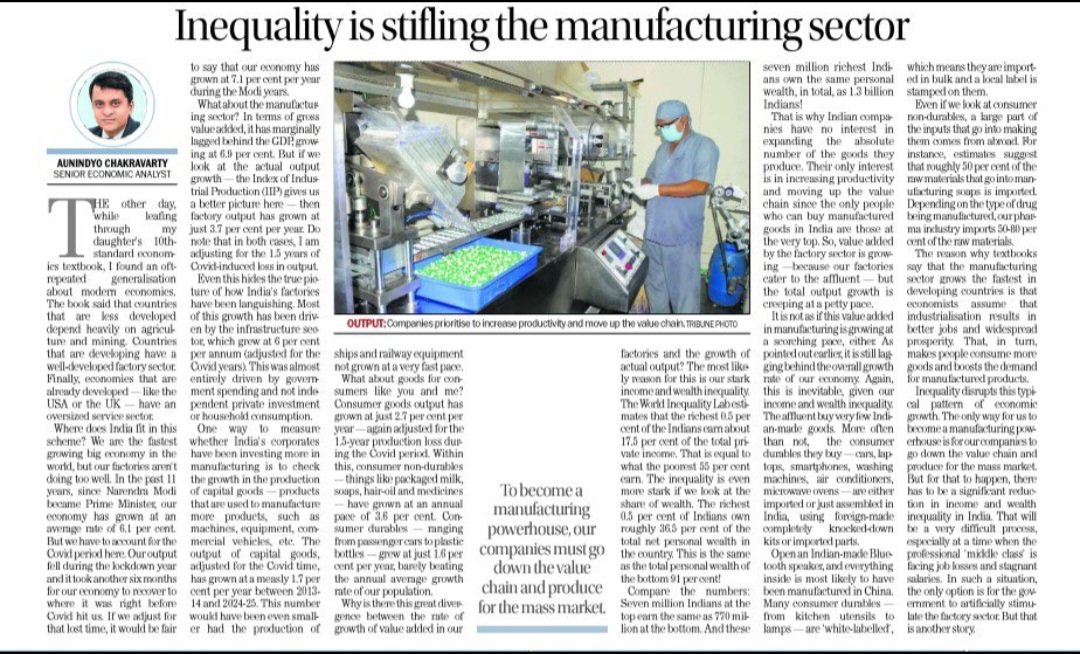
🚩Inequality is stifling the Manufacturing sector
(Excellent article in the Tribune -This article conclude that the only way for us to become a manufacturing power house is for our companies to go down the value chain and produce for the mass market.But for that to happen, there has to be a significant reduction in income and wealth inequality in https://t.co/0WtdlXeJbs Ramkumar in his wonderful presentation in All India Trade union classes organized by AIIEA held at Hyderabad,explained as to how Income inequalities are posing hindrance to development of Manufacturing sector in our country.He gave the example of mass production of small satchets of Consumer items (Shampoo ,Edible oil etc ) in our country ,which is rarity across the https://t.co/hjHEgkbNJi shows lack of purchasing power of the people.)
Countries that are less developed depend heavily on agriculture and mining, Countries that are developing have a well-developed factory sector. Finally, economies that are
already developed like the
USA or the UK-have an
oversized service sector
Where does India fit in this
scheme? We are the fastest
growing big economy in the
world, but our factories aren't
doing too well. In the past 11
years, since Narendra Modi
became Prime Minister, our
economy has grown at an
average rate of 6.1 per cent.
But we have to account for the Covid period here. Our outputfell during the lockdown year
and it took another six months for our economy to recover to where it was right befom Covid hit us. If we adjust for that lost time, it would be fair
Inequality is stifling the manufacturing sector to say that our economy has
grown at 7.1 per cent per year
during the Modi years
What about the manufactur
ing sector? In terms of gross
value added, it has marginally
lagged behind the GDP grow
ing at 6.9 per cent. But if we
look at the actual output
growth-the Index of Indus
trial Production (IP) gives us
a better picture here then
factory output has grown at
just 3.7 per cent per year. Do
note that in both cases, I am
adjusting for the 15 years of
Covid-induced loss in output.
Even this hides the true pic
ture of how India's factories
have been languishing. Most
of this growth has been driv
en by the infrastructure see
tor, which grew at 6 per cent
per annum (adjusted for the
Covid years) This was almost
entirely driven by govern
ment spending and not inde
pendent private investment
or household consumption.
One way to measure
whether India's corporates
have been investing more in
manufacturing is to check
the growth in the production
of capital goods-products
that are used to manufacture
more products, such as
machines, equipment, com
mercial vehicles, etc. The
output of capital goods,
adjusted for the Covid time,
has grown at a measly 17 per
cent per year between 2013
14 and 2024-25. This number
would have been even small
er had the production of Companies prioritise to increase productivity and move up the value chain.
ships and railway equipment
not grown at a very fast pace.
What about goods for con
sumers like you and me?
Consumer goods output has
grown at just 2.7 per cent per
year-again adjusted for the
15-year production loss dur
ing the Covid period. Within
this, consumer non-durables
-things like packaged milk,
soups, hair-oil and medicines
have grown at an annual
pace of 3.6 per cent. Con
sumer durables-ranging
from passenger cars to plastic bottles-grew at just 1.6 per cent per year, barely beating the option rate of our population.
To become a manufacturing
powerhouse, our companies must go down the value
chain and produce for the mass market.factories and the growth of actual output? The most likely reason for this is our stark
income and wealth inequality
The World Inequality Labest
mates that the richest 0.5 per
cent of the Indians control
17.3 per cent of the total pri
vate income. That is equal to
what the poorest 55 per cent
earn. The inequality is even
more stark if we look at the
share of wealth. The richest
0.5 per cent of Indians own
roughly 365 per cent of the
the country. This is the same
as the total personal wealth of the bottom 91 percent!
Seven million Indians at the
top earn the same as 770 mil
lion at the bottom. And these
seven million richest Indi
ans own the same personal
wealth, in total, as 1.3 billion
Indians!
Even if we look at consumer
non-durables, a large part of
the inputs that go into making them comes from abroad. For instance, estimates suggest
that roughly 50 per cent of the raw materials that go into man ufacturing soaps is imported. Depending on the type of drug being manufactured,ourphar
ma industry imports 50-80 per cent of the raw materials
That is why Indian compa
nies have no interest in
expanding the absolute
number of the goods they
produce. Their only interest
is in increasing productivity
and moving up the value
chain since the only people
who can buy manufactured
goods in India are those at
the very top. So, value added
by the factory sector is grow
The reason why textbooks
ing-because our factories say that the manufacturing cater to the affluent but sector grows the fastest in the total output growth is developing countries is thatemeping at a petty pace.
It is not as if this value added
manufacturing is growing at
a scorching pace, either As
pointed out earlier, it is still lagging behind the overall growth rate of our economy. Again, this is inevitable, given ourincome and wealth inequality,The affluent buy very few Indan-made goods. More often than not, the consumer dumbles they buy-cars, laptops, smartphones, washing
machines, air conditioners,
microwave ovens-are either
imported or just assembled in
India, using foreign-made
completely knocked-down
kits or imported parts
Open an Indian-made Blue
tooth speaker, and everything
inside is most likely to have
economists assume that
industrialisation results in
better jobs and widespread
prosperity. That, in tum,
makes people consume more
goods and boosts the demand for manufactured products.Inequality disrupts this typcal pattern of economic growth.
The only way for us to
become a manufacturing pow
erhouse is for our companies to go down the value chain and produce for the mass market.
But for that to happen, there
has to be a significant redus
tion in income and wealth
inequality in India. That will
be a very difficult process,
especially at a time when the
professional 'middle class is
facing job losses and stagnant salaries.