🚨 Can a foreign embassy hire a Kenyan, dismiss them unfairly, and then claim it is above the reach of Kenyan courts? A question about where sovereign immunity ends and a Kenyan worker's rights begin.
Two Kenyan employees sued the Embassy of Sweden over their employment. The Embassy argued that as the mission of a sovereign State, it was immune from Kenyan courts altogether. The Employment Court said no. The Court of Appeal agreed. And now the same question is on its way to the Supreme Court.
The dispute runs to the heart of a hard tension. A sovereign State is not ordinarily answerable to another country's courts. But a Kenyan who works for that State, on Kenyan soil, has constitutional rights too. Whose position prevails? Here is the issue. 🧵
Court Update:
High Court Cites CS Duale for Contempt Over Illegal Construction of Laikipia Ebola Facility.
Today, the High Court vindicated the rule of law by finding Health Cabinet Secretary Aden Duale in contempt of court. Justice Patricia Nyaundi ruled that the government has deliberately violated existing conservatory orders by allowing construction to continue on the proposed US-backed Ebola quarantine facility at Laikipia Air Base. The Court has summoned CS Duale to appear in court tomorrow, June 23, at 11:00 am to explain the failure to comply with the previous court orders.
By finding that CS Duale has, in fact, disclosed all existing, disclosable documents relating to the facility, the Court has shed light on the government’s record-keeping regarding the project. Because these disclosures completely lack any environmental and social impact assessments or safety contingency plans, this finding confirms a deeply alarming reality: the government commenced construction on a high-risk biological quarantine facility without ever conducting the requisite impact assessments or emergency planning.
Katiba Institute brought this contempt application to defend the authority of the judiciary and Kenyans' constitutional right to public participation.
"We are witnessing a profound disrespect for Kenya’s sovereignty and our constitutional rule of law," said @NoraMbagathi, Executive Director of Katiba Institute. "The fact that construction continued in direct violation of a High Court order shows that the government believed it could operate entirely above the Kenyan judicial system. Today’s ruling sends a clear message: public health initiatives must bow to constitutional accountability, transparency, and the rule of law."
Katiba Institute demands the immediate cessation of all activities at the Laikipia site.
@joshuamalidzo
Congratulations to the New Judge President, Gatembu JA of the Court of Appeal
1. Deal with the abuse of Rule 5(2)(b) against ordinary litigants & preferrential treatment of Government.
2. Deal with the 5-7 yrs Appeal lifespan as we know it, as much as you can
3. Time allocation of 5 minutes to argue weighty Apeals before the Court.
4. The Obsession of the CoA with its Rules above anything law
5. The Arrogance of some of those benches towards Advocates. They were all once Advocates, they have not come from a Profession called Judgeship.
🔴🚨BREAKING: CoA says Paying for Land Is Not Enough - Occupation May Matter More Than the Title Deed
Many Kenyans assume that once a land sale agreement collapses, the buyer loses everything and the registered owner automatically keeps the property. The Court of Appeal has now shaken that assumption in Okul v Ondieki [2026]. The dispute revolved around a Nakuru property allegedly sold in 1985. The purchaser paid the agreed consideration, took possession, developed the land, erected rental structures, and remained in occupation for over three decades. Yet the transfer was never completed. Years later, after both the buyer and seller had died, the seller’s family claimed the property as part of the deceased’s estate and argued that no valid transfer had ever occurred.
The Court of Appeal was confronted with a question that keeps many investors, families, and estate administrators awake at night: can a person who never received a title deed still end up owning the land? The answer was a resounding yes. The Court held that where a purchaser enters land pursuant to a sale agreement, openly occupies it, develops it, collects rent, and remains there uninterrupted for the statutory period, that occupation can mature into adverse possession even if the sale transaction itself was never completed. In one of the most consequential statements in the judgment, the Court affirmed that entry into land under an incomplete sale agreement, particularly where the purchaser is not to blame for the failure to complete, can ultimately extinguish the registered owner's rights altogether.
The implication for landowners, investors, succession practitioners, and property developers is profound. A title deed is not always the end of the conversation. If another person occupies your property openly, treats it as their own, develops it, earns income from it, and you fail to assert your rights for years, the law may eventually recognize them rather than you. The decision reinforces a powerful principle in Kenyan property law: ownership is not protected by registration alone; it must also be defended through action. For those dealing with old land transactions, stalled transfers, family estates, or forgotten sale agreements, this judgment is a reminder that time can quietly transfer property just as effectively as a signed transfer form.
Kindly retweet. 🙏
"Detaining a patient for non-payment of a medical bill is unlawful, since a hospital bill is a contractual debt that must be enforced through legal processes and not by holding a patient,"
R.E Aburili J of the High Court at Milimani in Gicheru v The Nairobi Hospital & another;
The insights are on point.
Some of these Judgments cast a big shadow on the willingness of the judiciary to uphold Constitutional dictates when circumstances demand so.
In matters affecting the interests of Judges, the High Court says that the JSC cannot process any complaint against judges until they enact regulations. But when it comes to Gachagua (citizens), the lack of regulations/legislation does not affect the rights.
😁🤭
In employment law, courts have time without number found a termination to be unlawful without ordering reinstatement. What was so difficult in making such an order?
My pupil master, a brilliant litigation guru, always drilled one lesson into me: litigation is never certain, it is always 50/50. I have carried that mindset throughout my practice. Yesterday’s High Court judgment was a timely reminder of that reality.
Tomorrow we Advocates will all go to Court and expect justice and fairness for our clients with the hope of a Prophet Owuor and the faith of a pastor Ezekiel follower. You die, you die, you live you live. It is pata potea. You need it to be a litigation Advocate.
It is now trite law that where two titles exist, the court will not balance equities. It will trace history, chronology, and legality, then decisively protect only the title with a lawful root.
This principle underscores importance of thorough due diligence in land transactions.
BREAKING: Court Draws a Hard Line on Adverse Possession - Years of Occupation, Construction and Silence by the Owner May Still Not Be Enough
In a closely watched land dispute that will resonate with property owners, developers, neighbours and investors alike, the ELC has delivered a powerful reminder in Kjaer v Hellback & another [2026] that adverse possession is not a shortcut to ownership. The case involved a homeowner who sought to acquire a portion of her neighbours' prime Nairobi property after occupying and developing it for years. She argued that she had fenced off the disputed section, planted a mature kei-apple hedge, erected a water tank, built a guest cottage and laid cabro paving, all while the registered owners allegedly watched without objection. To her, nearly two decades of uninterrupted occupation had extinguished the owners' title. But when the property was earmarked for sale and a survey exposed the encroachment, a fierce legal battle erupted over whether long occupation alone could transform a trespasser into a lawful owner.
In a decision carrying significant implications for Kenya's evolving adverse possession jurisprudence, the court rejected the claim and emphasized that the doctrine is governed by strict legal thresholds, not sympathy, assumptions or the passage of time alone. Justice Christine Ochieng found critical inconsistencies in the claimant's account of when the alleged adverse occupation actually began. While she asserted occupation dated back to 2004, evidence revealed that some of the most significant developments on the disputed land, including the guest cottage and paved sections, were only constructed around 2018. Equally important was the unique relationship between the parties: they were not hostile neighbors but close family friends who maintained an access gate between their properties and freely interacted over the years. The court held that such circumstances complicated any assertion that the occupation had been openly hostile, exclusive and adverse for the statutory twelve-year period required by law.
The ruling sends a clear and commercially significant message: adverse possession is not simply about being on someone else's land; it is about proving, with precision and evidence, the exact moment the occupation became unlawful, hostile and inconsistent with the owner's rights. Without that proof, even visible developments worth millions of shillings may fail to confer ownership. The judgment is likely to influence future boundary disputes, neighbor conflicts and land recovery claims by reinforcing that courts will scrutinize timelines, permissions, relationships between parties and the nature of occupation before stripping a registered owner of title. For landowners, the case is a warning not to ignore encroachments. For occupiers, it is a reminder that years of use, construction and investment may count for little if the legal clock cannot be clearly established.
Kindly retweet. 🙏
Ready to file the first case on "marex tort" in Kenya. "Marex tort" is a brand new claim developed by English courts that allows a decree holder to go after a third party who helps the judgment debtor frustate the enforcement of the decree. The English courts have ruled that no defence can be raised againt a "marex tort". @omwanza@NelsonHavi
The biggest problem today for a litigation Advocate is explaining to the client how a Judge arrived at a manifestly unlawful and unjust decision, why a reasonably early hearing date could not be given by the Court, why the Court gave a further mention in November, 2025 and many stupid happenings in Court. The CJ and Judges really do not care about these concerns we have to deal with everyday. They would rather we deal with the concerns before lay-mediators as they recruit more staff, conference and hold seminars over nothing everyday.
Yesterday in Parliament, the Cabinet Secretary for Health, Aden Duale, failed to assure the country that the government’s decision‑making on the Ebola question is within the law and fully under control. The Constitution demands both legality and respect for court orders and public participation.
Listening to him, the message is clear, the court will have its say but the executive will enforce their way.
When a High Court has already issued conservatory orders suspending an Ebola‑related facility, any suggestion that the Executive can press on regardless converts being within the law into a slogan to justify disobedience. Constitutional obedience is not optional and it is not subject to administrative convenience.
Kenyans are entitled to clear, honest answers. Who authorised these arrangements, on what legal basis and with what safeguards for public health and sovereignty? Dismissing concerns as mere alarm while sidestepping these questions undermines public trust in both the Ministry of Health and Parliament’s oversight role.
The right to health under Article 43 must be read together with Articles 10, 94, 95 and 165 on constitutionalism, public participation and the authority of the courts. You cannot promote public health by eroding the very legal framework that protects Kenyans from arbitrary executive action.
The Court of Appeal has dismissed NSSF’s application to suspend the ELRC judgment that declared the NSSF Act, 2013 unconstitutional. In simple terms, the Court has refused to revive an invalid law through interim orders and has insisted that constitutional violations cannot be cured by fear‑mongering about alleged chaos in the pensions sector.
The judges reaffirmed the well‑known Rule 5(2)(b) test which states that an applicant must show both an arguable appeal and that, without stay, the appeal would be rendered nugatory. They accepted that the intended appeal raises at least one arguable point including whether the High Court mis‑characterised the NSSF Act, 2013 as social assistance under Article 43(3) rather than a contribution‑based pension scheme and whether the Bill needed Senate input under Articles 110 and 205. However, they were emphatic that arguability alone is not enough. The Fund had to demonstrate concrete, evidenced risk that a successful appeal would be worthless if stay was denied and it failed to do so.
Crucially, the Court called out NSSF’s alarmist claims of destabilisation, governance quagmire and catastrophic financial loss. The Board alleged paralysis of the Haba na Haba scheme, exposure of over 580,000 informal‑sector members and billions in contributions and even the freezing of emigration and burial grants but placed no audited accounts, actuarial reports or empirical evidence before the Court. Bare assertions could not satisfy the stringent nugatory test, especially where respondents showed that contributions have flowed under Cap 258 for nine years without crisis, refunds, or threats of non‑remittance.
We have formally notified the U.S. State Department and the Department of Health of binding interim conservatory orders issued by the High Court of Kenya on 28 May 2026, which immediately halt the proposed establishment of any U.S.-backed Ebola exposure, quarantine, isolation, or treatment facility within Kenyan borders.
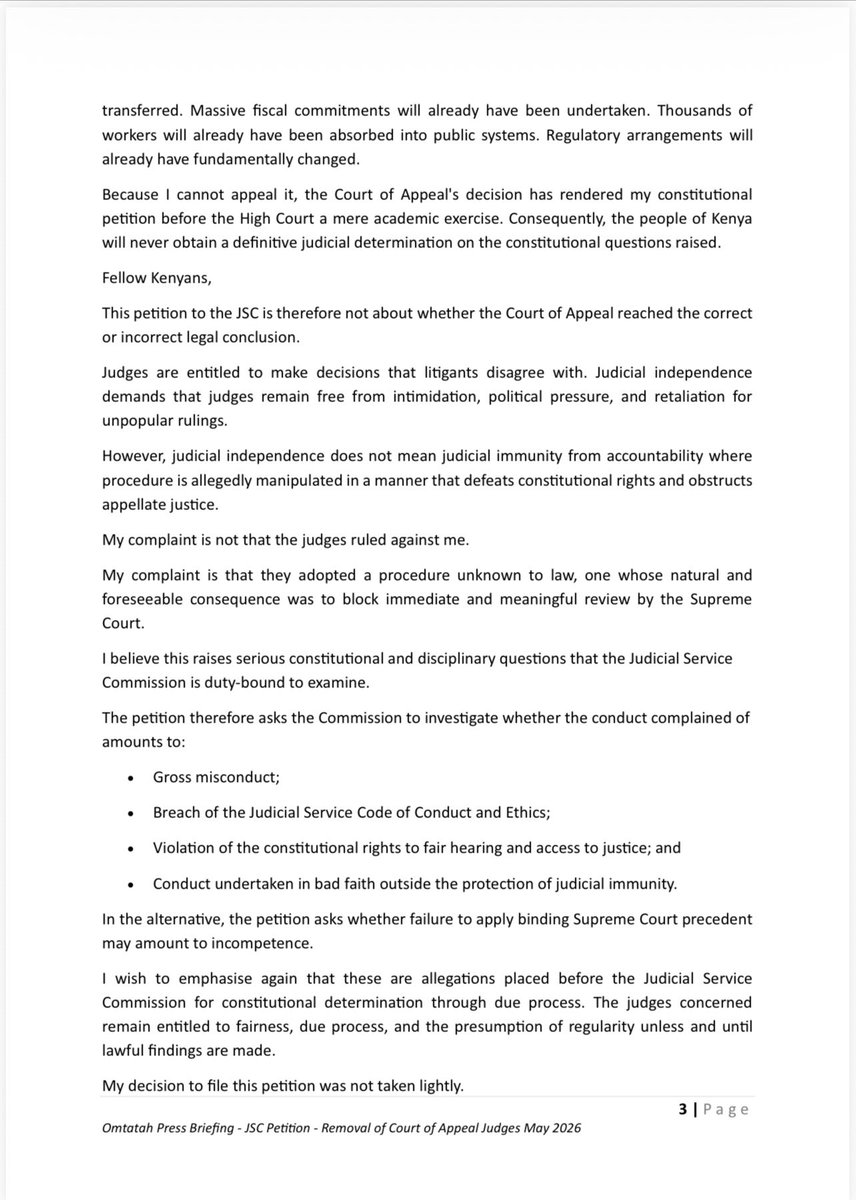
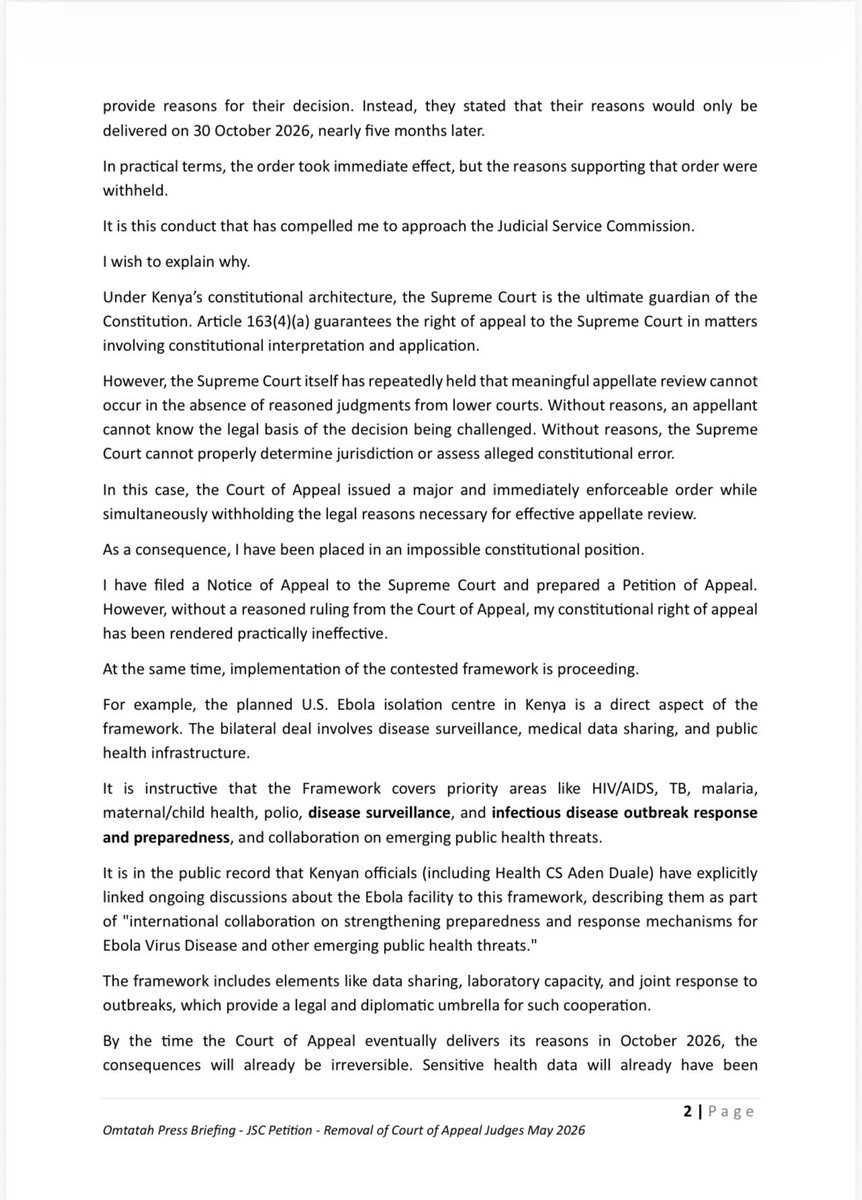
What @OkiyaOmtatah is raising is very Weighty about the conduct of the Court of Appeal judges in issuing abridged versions of their decisions on Rule 5(2)(b). We saw it in the Presidential Advisors case & now in the Kenya US Health Data Cooperation Deal. The court issues a brief version then sets a Full Ruling to a day beyond the time contemplated to Appeal the Ruling effectively to the Supreme Court. Because the day of the abridged version remains the day of Ruling & Appeal time starts to run. Two problems, can one lodge an Appeal to a decision given without reasons. Secondly, if the decision comes beyond the 14 days, is the statutory timeline already defeated. ✅️✅️
Fairly Valid Concerns.
Kenyans deserve justice that is transparent, reasoned, and accountable.
Today, I have petitioned the Judicial Service Commission @jsckenya to investigate three Court of Appeal judges who suspended High Court orders blocking the Kenya-US Health Cooperation Framework, but withheld their reasons for doing so until October 2026.
My concern is not that they ruled against me. It is that an immediately enforceable decision was issued without reasons, effectively frustrating a timely appeal to the @THE_SCOK and denying Kenyans meaningful access to justice.
Judicial independence must be protected. But independence and accountability must go hand in hand. No institution is above the Constitution.
THE HUMBLE PETITION OF OKIYA OMTATAH OKOITI LINK>
https://t.co/36xc3OZdNh








![AssociatesRoba's tweet photo. 🔴🚨BREAKING: CoA says Paying for Land Is Not Enough - Occupation May Matter More Than the Title Deed
Many Kenyans assume that once a land sale agreement collapses, the buyer loses everything and the registered owner automatically keeps the property. The Court of Appeal has now shaken that assumption in Okul v Ondieki [2026]. The dispute revolved around a Nakuru property allegedly sold in 1985. The purchaser paid the agreed consideration, took possession, developed the land, erected rental structures, and remained in occupation for over three decades. Yet the transfer was never completed. Years later, after both the buyer and seller had died, the seller’s family claimed the property as part of the deceased’s estate and argued that no valid transfer had ever occurred.
The Court of Appeal was confronted with a question that keeps many investors, families, and estate administrators awake at night: can a person who never received a title deed still end up owning the land? The answer was a resounding yes. The Court held that where a purchaser enters land pursuant to a sale agreement, openly occupies it, develops it, collects rent, and remains there uninterrupted for the statutory period, that occupation can mature into adverse possession even if the sale transaction itself was never completed. In one of the most consequential statements in the judgment, the Court affirmed that entry into land under an incomplete sale agreement, particularly where the purchaser is not to blame for the failure to complete, can ultimately extinguish the registered owner's rights altogether.
The implication for landowners, investors, succession practitioners, and property developers is profound. A title deed is not always the end of the conversation. If another person occupies your property openly, treats it as their own, develops it, earns income from it, and you fail to assert your rights for years, the law may eventually recognize them rather than you. The decision reinforces a powerful principle in Kenyan property law: ownership is not protected by registration alone; it must also be defended through action. For those dealing with old land transactions, stalled transfers, family estates, or forgotten sale agreements, this judgment is a reminder that time can quietly transfer property just as effectively as a signed transfer form.
Kindly retweet. 🙏](https://pbs.twimg.com/media/HKcLsJjWAAASxAb.png)


![AssociatesRoba's tweet photo. BREAKING: Court Draws a Hard Line on Adverse Possession - Years of Occupation, Construction and Silence by the Owner May Still Not Be Enough
In a closely watched land dispute that will resonate with property owners, developers, neighbours and investors alike, the ELC has delivered a powerful reminder in Kjaer v Hellback & another [2026] that adverse possession is not a shortcut to ownership. The case involved a homeowner who sought to acquire a portion of her neighbours' prime Nairobi property after occupying and developing it for years. She argued that she had fenced off the disputed section, planted a mature kei-apple hedge, erected a water tank, built a guest cottage and laid cabro paving, all while the registered owners allegedly watched without objection. To her, nearly two decades of uninterrupted occupation had extinguished the owners' title. But when the property was earmarked for sale and a survey exposed the encroachment, a fierce legal battle erupted over whether long occupation alone could transform a trespasser into a lawful owner.
In a decision carrying significant implications for Kenya's evolving adverse possession jurisprudence, the court rejected the claim and emphasized that the doctrine is governed by strict legal thresholds, not sympathy, assumptions or the passage of time alone. Justice Christine Ochieng found critical inconsistencies in the claimant's account of when the alleged adverse occupation actually began. While she asserted occupation dated back to 2004, evidence revealed that some of the most significant developments on the disputed land, including the guest cottage and paved sections, were only constructed around 2018. Equally important was the unique relationship between the parties: they were not hostile neighbors but close family friends who maintained an access gate between their properties and freely interacted over the years. The court held that such circumstances complicated any assertion that the occupation had been openly hostile, exclusive and adverse for the statutory twelve-year period required by law.
The ruling sends a clear and commercially significant message: adverse possession is not simply about being on someone else's land; it is about proving, with precision and evidence, the exact moment the occupation became unlawful, hostile and inconsistent with the owner's rights. Without that proof, even visible developments worth millions of shillings may fail to confer ownership. The judgment is likely to influence future boundary disputes, neighbor conflicts and land recovery claims by reinforcing that courts will scrutinize timelines, permissions, relationships between parties and the nature of occupation before stripping a registered owner of title. For landowners, the case is a warning not to ignore encroachments. For occupiers, it is a reminder that years of use, construction and investment may count for little if the legal clock cannot be clearly established.
Kindly retweet. 🙏](https://pbs.twimg.com/media/HKCmPFhW8AE6SKA.png)


