@geekwire You know what would help strengthen the economy of Seattle? Not adding new business taxes that cause businesses to leave Seattle for Bellevue or out of state!
Pocket from $1M to $100m is phenomenal and the why is even more important. We are awash in human feedback and we haven’t had a way to capture it, distill it and make it useful to create understanding loops that drive continual improvement.
Pocket just crossed $100M in Annualized Run Rate.
$1M → $100M in just 7 months, making Pocket the fastest YC hardware company to reach this milestone.
And there are now 270,000+ Pocket devices out in the world.
We’re just getting started.
Pocket just crossed $100M in Annualized Run Rate.
We went from $1M → $100M in just 7 months, making us the fastest YC hardware company to reach this milestone.
There are now 270,000+ Pocket devices out in the world.
I don’t think MSFT or Meta would be pushing this narrative (even though it is right) if they were one of the dominant model providers. In that sense, they are positioning from a weakness and not strength.
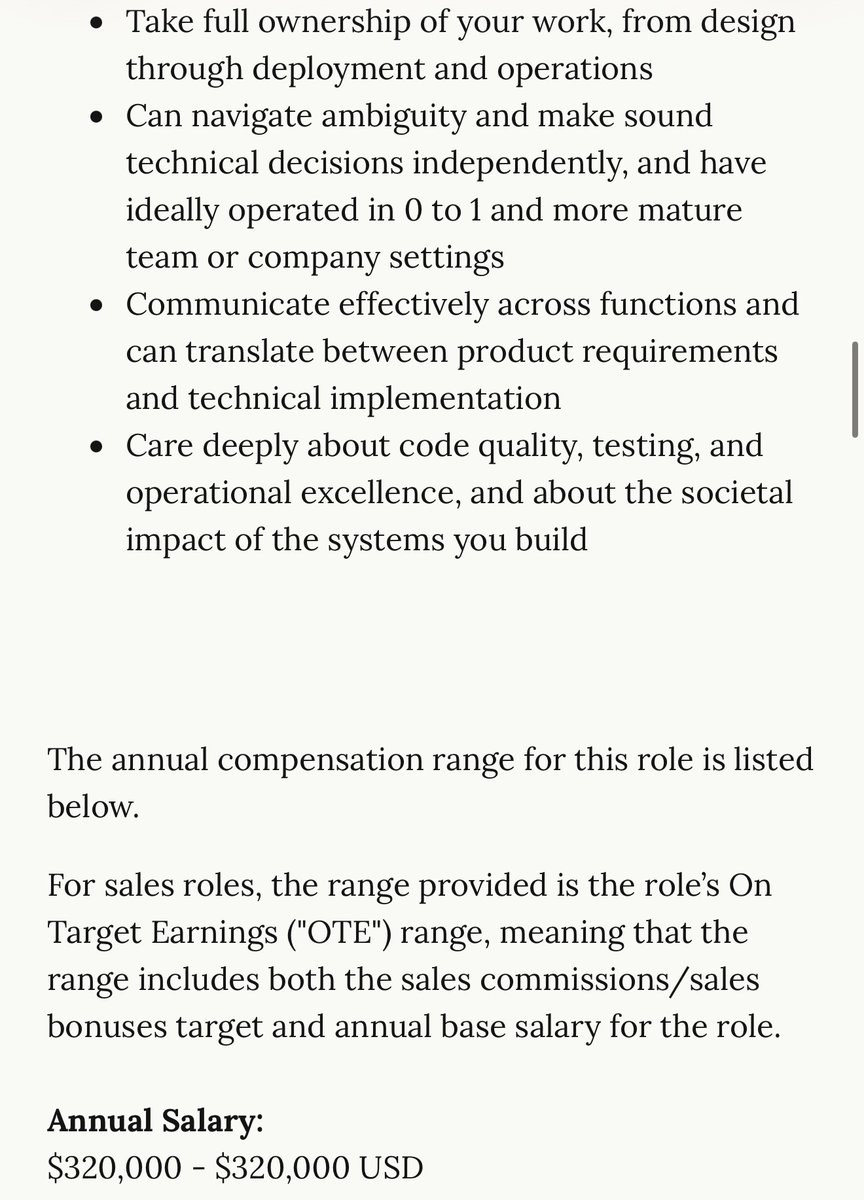
Anthropic has 454 open roles. The company is hiring software engineers at $320K-$405K. Their CEO, Dario, said three months ago that coding is "going away first, then all of software engineering."
The paradox resolves instantly.
Dario's engineers told him they don't write code anymore. They let Claude write it. They edit. They review. They architect. They didn't lose their jobs. They got faster. Anthropic grew from a small research lab to 1,500 employees in four years, adding engineers the entire time.
This has played out five times in computing history. Compilers replaced assembly. Frameworks replaced boilerplate. Cloud replaced server management. Every prediction was the same: most programmers won't be needed. Every result was the same: the number of engineers grew.
The global software engineer pool went from roughly 5 million in 2010 to 28.7 million today. BLS projects 17% growth in US software developer roles through 2033, adding 304,000 positions. The pool is projected to hit 45 million by 2030.
When building software gets cheaper, more problems become worth solving with software. A startup that needed 10 engineers now needs 3. But 50 companies that couldn't afford to build at all now can. The denominator shrinks. The numerator explodes.
Meta's engineering headcount is up 19% from January 2022. Google's is up 16%. Apple, 13%. These companies adopted AI coding tools years ago. They're using Copilot and Claude Code daily. They're hiring more engineers than before those tools existed.
Every generation of "coding is dead" content creates two cohorts: engineers who freeze up, and engineers who build 10x more with the new tools. The second group has won every single time.
Yesterday we announced a handful of new components for the @buildkite platform that make working with AI agents in CI/CD a lot easier:
https://t.co/oAUH0rRPbK
Model providers — which are like pass-through proxies to frontier models like Claude and others that let you drop into an LLM from within a Buildkite pipeline without having to mess with credentials
Universal pipeline triggers — inbound webhooks you can use to invoke pipelines with HTTP requests (think Linear issue → Buildkite run → shiny new pull request)
The Buildkite SDK — a multi-language toolkit (TypeScript, Python, Go, Ruby) that lets you manage your pipelines with general-purpose languages rather than YAML
... and a bunch more. I've written it all up in the following post, and built out a few reference examples to make it easier to kick the tires and get useful stuff done. ✨ Let me know what you think!