Proud to honor the legacy of Launch Complex 36. Rebuilding LC-36A and flying again this year remains our priority. Alongside that work, a separate team is beginning work on LC-36B, the operational home for New Glenn's 9x4. We're sourcing 2,500 tons of steel columns that will be integrated with beams and bracing to form 50'x50'x50’ modules. These modules will be stacked to build the 700-foot-tall launch tower.
Looking for information on whether Gemini can listen in on a phone conversation? We were discussing a certain topic over the phone, and I was surprised to see a response to the topic in my chat history later, even though I hadn't asked Gemini about it. Real Big Brother.
@peter_adderton@JonHodgkins3 Yes, you are right, every MNO will have it. It will be supplied by ASTS and it will be add on exesting plans. Few bucks a month per capita. You are right it is a niche market, that is why SPCX, AMZN, RKLB bought spectrum worth billions $.
$ASTS: Wow perfect timing after yesterday's call!
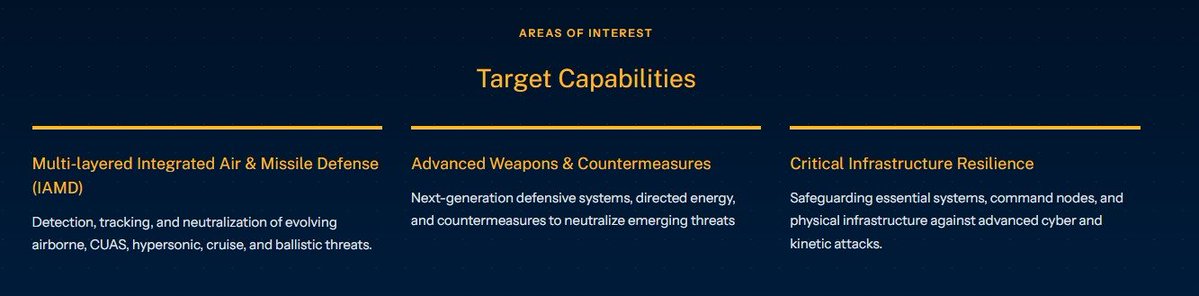
"To defeat a new generation of sophisticated, maneuvering aerial threats, we must build a defensive shield that adapts faster than the adversary," said Guetlein. "We are doing this by cutting bureaucratic red-tape, harnessing innovation through partnerships, and leveraging the true power of the Arsenal of Freedom. We are dismantling the historical walls separating commercial innovation from national defense and short-circuiting the 'Valley of Death' that so often stalls the deployment of critical technologies."
https://t.co/jEdoJIeK7Y
Umowy wykonawcze podpisane - największe w Europie centrum serwisowe śmigłowców Apache AH-64E powstanie w Polsce! Nowoczesna broń, polskie technologie. Tak buduje się bezpieczeństwo!
2/ $ASTS: 🚨 ROTH CAPITAL $108 PRICE TARGET, REITERATES BUY RATING
➡️ New capabilities provide incremental opportunities: The core capabilities of the ASTS constellation provide broadband D2D services to the pre-existing 3B+ subs in the company's 60 MNO relationships. These same capabilities also enable IoT, emergency response (FirstNet and similar services in other international markets) and secure government communications (as demonstrated by recent wins). However, ASTS is developing further capabilities with radar and edge AI that will expand the ASTS offering and expand the existing TAM. These capabilities are expected to be incorporated into its next-gen satellites.
The Switzerland of D2D...a better model: ASTS has established itself as a unique and reliable neutral third-party partner for terrestrial MNOs and governmental organizations. This has translated to 60 MNO relationships covering 3B+ terrestrial mobile subscribers. In addition to ASTS' unique constellation capabilities, the company approaches these relationships as partnerships to extend coverage for its sub base. In contrast, SpaceX (SPCX-NC) has been increasingly open in its approach to "own" the subscriber and even hinting at offering terrestrial capabilities with its spectrum portfolio. This combative approach with MNOs further underscores the unique partnership go-to-market model of ASTS, in our opinion. Consequently, we expect opportunities for ASTS to further expand its MNO and pre-existing mobile subscriber base.
Maintain Buy and $108PT: With commercialization approaching (1Q27) we believe that excitement around ASTS will continue to build into 2H26. We maintain our Buy rating and $108PT, and would use recent weakness as an entry point.
2/ $ASTS: 🚨 ROTH CAPITAL $108 PRICE TARGET, REITERATES BUY RATING
➡️ New capabilities provide incremental opportunities: The core capabilities of the ASTS constellation provide broadband D2D services to the pre-existing 3B+ subs in the company's 60 MNO relationships. These same capabilities also enable IoT, emergency response (FirstNet and similar services in other international markets) and secure government communications (as demonstrated by recent wins). However, ASTS is developing further capabilities with radar and edge AI that will expand the ASTS offering and expand the existing TAM. These capabilities are expected to be incorporated into its next-gen satellites.
The Switzerland of D2D...a better model: ASTS has established itself as a unique and reliable neutral third-party partner for terrestrial MNOs and governmental organizations. This has translated to 60 MNO relationships covering 3B+ terrestrial mobile subscribers. In addition to ASTS' unique constellation capabilities, the company approaches these relationships as partnerships to extend coverage for its sub base. In contrast, SpaceX (SPCX-NC) has been increasingly open in its approach to "own" the subscriber and even hinting at offering terrestrial capabilities with its spectrum portfolio. This combative approach with MNOs further underscores the unique partnership go-to-market model of ASTS, in our opinion. Consequently, we expect opportunities for ASTS to further expand its MNO and pre-existing mobile subscriber base.
Maintain Buy and $108PT: With commercialization approaching (1Q27) we believe that excitement around ASTS will continue to build into 2H26. We maintain our Buy rating and $108PT, and would use recent weakness as an entry point.
1/ $ASTS: 🚨 ROTH CAPITAL $108 PRICE TARGET, REITERATES BUY RATING
ASTS: Tracking Towards an Early 2027 Launch While New Opportunities Double the TAM; Buy
2Q26 results were largely inconsequential, save for an expanding contracted backlog of $1.3B and reinforcement of 2026/27 financial targets ($150-200M and approaching $1B in sales, respectively). More importantly, ASTS continues to track towards an early 2027 constellation commercialization as its launch schedule has been secured and its manufacturing plans track expectations. Additionally, the company has nearly doubled its TAM with expanding opportunities such as dedicated sovereign constellations (such as J-LEO), radar, edge AI and pre-existing opportunities for IoT, emergency response (such as FirstNet) and secure gov communications. We maintain our Buy rating and $108PT.
2026/27 Guidance reiterated: 2Q results, while sequentially progressing, were largely inconsequential with $31.5M of sales attributable to gateway sales and achieving milestones of contracted backlog. This sequential progression is expected to continue, as sales accelerate into 4Q, followed by the anticipated commercial launch of the constellation in early 2027 (1Q27). Consequently, management reiterated its prior 2026/27 financial targets of $150-200M and approaching $1B, respectively. Near-term, this comfort is driven by the expanding contracted backlog, which now stands at $1.3B, with the recent increase attributable to government contracts such as $125M supporting multiple national security applications. Adjusted for the $1.1B July convert (1.65% due 2034), ASTS ended the quarter with $3.7B in pro forma cash and is fully funded through network commercialization.
Operational aspects support an early 2027 commercialization: Importantly, ASTS has secured its launch calendar (10 contracted launches), which provides comfort to the anticipated 1Q27 commercialization of the ASTS constellation. This is largely skewed towards the Falcon 9, but is expected to have Blue Origin's New Glenn back in the rotation by early 2027. Additionally, we believe the company continues its diversification efforts to qualify new launch vehicles (likely by 2027). On the manufacturing front, ASTS has up through Blue Bird 46 into production. Note: 45+ satellites are the required minimum to support continuous constellation coverage. The company is also expanding its manufacturing footprint to approach 1M sq ft of manufacturing space (400k will be added to the existing 500k). We believe this supports capacity for larger satellites and expansion of the constellation beyond an anticipated 90+ satellites.
New Opportunities effectively double the TAM: The ASTS constellation remains unique in its ability to support broadband D2D services as well as IoT, emergency response (FirstNet) and secure government communications. This will be further augmented with other capabilities that will effectively double the TAM. A key element of this is the under-the-radar value of sovereign LEO constellations, such as J-LEO. Additionally, next-gen satellites will add new capabilities such as radar and edge AI functionality. We highlight the following:
➡️ Dedicated sovereign constellations: At present, Japan's Ministry of Communications has agreed in principle to subsidize the Rakuten Group-AST SpaceMobile JV to the tune of 150 billion yen (approximately $926 million) for a new LEO constellation with dedicated Japan capacity. In essence, this provides more global capacity for a global ASTS constellation while establishing sovereignty for national access, in this case Japan. We believe this could create an arms race of sovereign capacity in other G-20 countries for secure dedicated LEO capacity. We also highlight the Vodafone JV which provides favorable access to European spectrum, but could be a precursor to other similar dedicated sovereign or regional capacity. ASTS is the ideal partner for these potential emerging constellations, in our opinion.
$ASTS:🚨 CLEAR STREET $115 PRICE TARGET, REITERATES BUY RATING
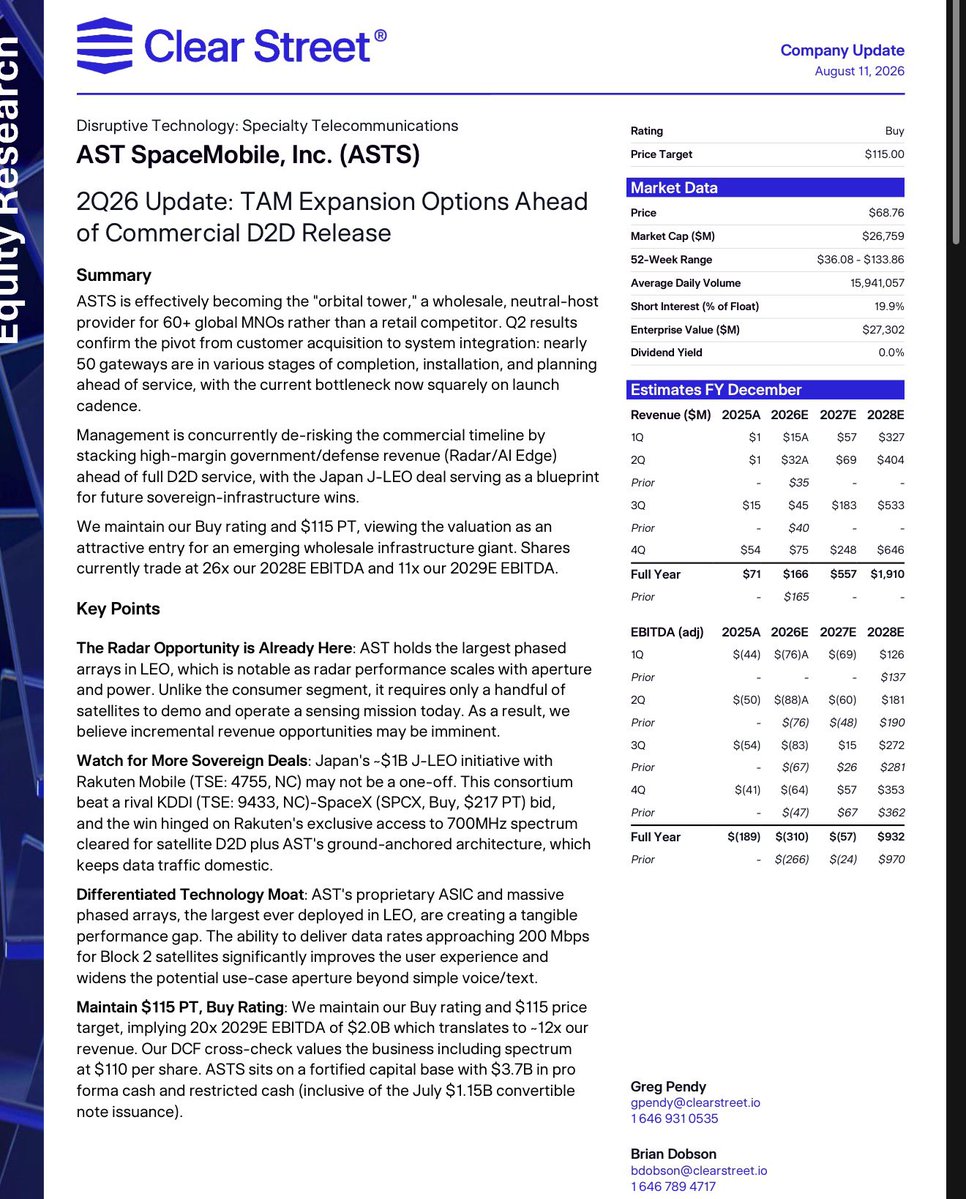
TAM Expansion Options Ahead of Commercial D2D Release
Summary
ASTS is effectively becoming the "orbital tower," a wholesale, neutral-host provider for 60+ global MNOs rather than a retail competitor. Q2 results confirm the pivot from customer acquisition to system integration: nearly 50 gateways are in various stages of completion, installation, and planning ahead of service, with the current bottleneck now squarely on launch cadence.
Management is concurrently de-risking the commercial timeline by stacking high-margin government/defense revenue (Radar/AI Edge) ahead of full D2D service, with the Japan J-LEO deal serving as a blueprint for future sovereign-infrastructure wins.
We maintain our Buy rating and $115 PT, viewing the valuation as an attractive entry for an emerging wholesale infrastructure giant. Shares currently trade at 26x our 2028E EBITDA and 11x our 2029E EBITDA.
Key Points
The Radar Opportunity is Already Here: AST holds the largest phased arrays in LEO, which is notable as radar performance scales with aperture and power. Unlike the consumer segment, it requires only a handful of satellites to demo and operate a sensing mission today. As a result, we believe incremental revenue opportunities may be imminent.
Watch for More Sovereign Deals: Japan's ~$1B J-LEO initiative with Rakuten Mobile (TSE: 4755, NC) may not be a one-off. This consortium beat a rival KDDI (TSE: 9433, NC)-SpaceX (SPCX, Buy, $217 PT) bid, and the win hinged on Rakuten's exclusive access to 700MHz spectrum cleared for satellite D2D plus AST's ground-anchored architecture, which keeps data traffic domestic.
Differentiated Technology Moat: AST's proprietary ASIC and massive phased arrays, the largest ever deployed in LEO, are creating a tangible performance gap. The ability to deliver data rates approaching 200 Mbps for Block 2 satellites significantly improves the user experience and widens the potential use-case aperture beyond simple voice/text.
Maintain $115 PT, Buy Rating: We maintain our Buy rating and $115 price target, implying 20x 2029E EBITDA of $2.0B which translates to ~12x our revenue. Our DCF cross-check values the business including spectrum at $110 per share. ASTS sits on a fortified capital base with $3.7B in pro forma cash and restricted cash (inclusive of the July $1.15B convertible note issuance).
Results From 2Q and Outlook Changes
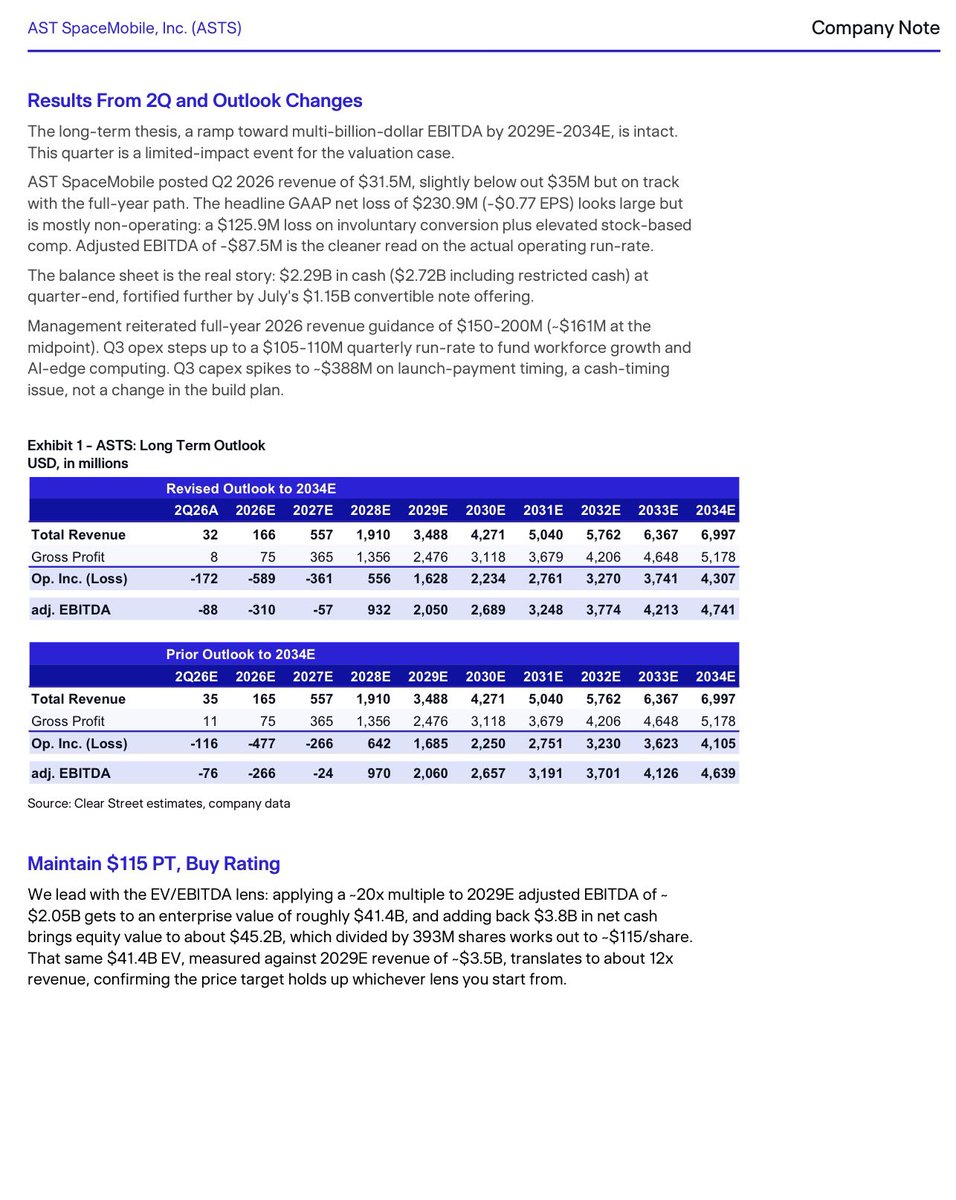
The long-term thesis, a ramp toward multi-billion-dollar EBITDA by 2029E-2034E, is intact. This quarter is a limited-impact event for the valuation case.
AST SpaceMobile posted Q2 2026 revenue of $31.5M, slightly below out $35M but on track with the full-year path. The headline GAAP net loss of $230.9M (-$0.77 EPS) looks large but is mostly non-operating: a $125.9M loss on involuntary conversion plus elevated stock-based comp. Adjusted EBITDA of -$87.5M is the cleaner read on the actual operating run-rate.
The balance sheet is the real story: $2.29B in cash ($2.72B including restricted cash) at quarter-end, fortified further by July's $1.15B convertible note offering.
Management reiterated full-year 2026 revenue guidance of $150-200M (~$161M at the midpoint). Q3 opex steps up to a $105-110M quarterly run-rate to fund workforce growth and AI-edge computing. Q3 capex spikes to ~$388M on launch-payment timing, a cash-timing issue, not a change in the build plan.
Maintain $115 PT, Buy Rating
We lead with the EV/EBITDA lens: applying a ~20x multiple to 2029E adjusted EBITDA of ~$2.05B gets to an enterprise value of roughly $41.4B, and adding back $3.8B in net cash brings equity value to about $45.2B, which divided by 393M shares works out to ~$115/share. That same $41.4B EV, measured against 2029E revenue of ~$3.5B, translates to about 12x revenue, confirming the price target holds up whichever lens you start from.
$ASTS - Transcript from Q2 Earnings call. AI-transcribed.
------------
Good day and thank you for standing by. Welcome to AST SpaceMobile second quarter 2026 business update. Please be advised that today's call is being recorded.
I will now turn the conference over to Max Colbert, Investor Relations manager of AST SpaceMobile Thank you.
You may begin Thank you, and good afternoon, everyone. Today, I'm also joined by Chairman and CEO Abel Avellan President Scott wisniewski, and CFO and Chief Legal Officer Andy Johnson.
Let me refer you to slide two of the presentation, which contains our safe harbor disclaimer. During today's call, we may make certain forward looking statements. These statements are based on current expectations. and assumptions, and as a result, are subject to risks and uncertainties. Many factors could cause actual events to differ materially from the forward looking statements on this call. For more information about these risks and uncertainties. Please refer to the Risk Factor section of AST SpaceMobile's annual report on Form 10-K for the year ending December 31, 2025 with the Securities and Exchange Commission and other documents filed by AST SpaceMobile with the SEC from time to time. Also, after our initial remarks, we'll be starting our Q &A section with questions submitted in advance by our shareholders.
For those of you who may be new to our company and mission. There are nearly 6 billion mobile phones today around the world, but many of still experience gaps in coverage as we live, work, and travel. Additionally, there are billions of people without cellular broadband and who remain unconnected to the global economy. The markets we are pursuing in AST SpaceMobile are massive, and the problem we are solving is important and touches nearly all of us. In this backdrop, AST SpaceMobile is building the first and only global cellular broadband network in space to operate directly with everyday unmodified mobile phones supported by our extensive IP and patent portfolio.
It is now my pleasure to pass this over to Chairman and CEO Abel Avellan who will go through our activities since our last public update.
Thank you, Max. Thanks.
Our execution in 2026 continued to reinforce what we have believed since we created AST. SpaceMobile and invented the space -based cellular. Broadband market. That combining differentiated technology, deep partnership with leading mobile network operators, and a scaled vertical integration.
positioned US to define the future of direct to-device cellular broadband. Our space-based direct-to-device network will be the first of its kind to leverage low-band and mid-band spectrum with broad-band speeds and native cellular application, combining a feature set and technology stack that put US in a category of one.
From the beginning, we designed our network architecture alongside existing mobile network operators. Not as a replacement of them rather than requiring operators to rebuild their infrastructure our architecture and technology extends and complement their existing terrestrial network into space allowing us to integrate efficiently while evolving alongside future 3GPP standards to put this concept simply we're building the direct-to-device network of the future today. In partnership with not in competition with mobile network operators.
This new layer of connectivity that we are creating is not just for addressing gaps in terrestrial network. But it's to create a seamless connectivity experience wherever you live, work, and travel anywhere on the planet.
Spectrum is another area where we believe we have significant competitive advantage. Through a combination of low-band spectrum contributed by our MNO partners and the spectrum we directly control we are building access to the broader spectrum portfolio in the industry with satellite technology capable of tuning approximately 1 1,150 MHz for low-band and mid-band. And in the future, C-band tunable spectrum globally. In the United States alone we are on the path to approximately 100 MHz of the spectrum from a combination of MNO partners provided spectrum and our own access at the spectrum which will be a lead that is difficult for others to match.
In particular, we're combining our over 3,900 patents and patent-pending claims intellectual property and a very large face arrays with our spectrum access. This provides greater network. Capacity, better coverage, and significant flexibility as demand grows. We are confident that our comprehensive spectrum strategy is the winning one, giving us the tech needed to increase subscriber capacity and bring services to target market with our partner MNO's.
Direct-to-device cellular broadband is establishing itself as a new additional connectivity layer. Our differentiated in-orbit technology and scaling direct-to-device cellular broadband network serves as a resilient and reliable source of an additional and new connectivity ledger, serving commercial MNO partners and government agencies alike. Incremented to delivering direct -to- device cellular.
Broadband connectivity, our total addressable market is rapidly expanding. We see several growth opportunities across government communications and non-communications opportunities, including radar Emergency response, Internet of Things, AI, Edge Compute, and other advanced connectivity solutions. We see these markets as beneficiaries of our space -based direct -to-device network.
We recently received an award pending government approvals and final agreements with long-time partner Rakuten regarding the selection for participation in the Low Earth Orbit Southern Infrastructure Development Project, or GLEO, in Japan designed to address the Japanese and Asian markets, with a total expected value of up to approximately $1 billion in non-dilutive non-debt government capital. This followed continued work with FirstNet Emergency and First Responder Networks in the United States with partner AT&T and recent announcement with multiple governments through partners like Vodafone and Rakuten.
Our partner first strategy positioned US as the partner of choice for direct -to device server broadband among mobile network operators our commercial ecosystem is growing. With over 60 MNO partners who cover over 3 billion subscribers globally, including key partners like AT&T. Verizon, Vodafone Rakuten, STC Group, Bell Canada, and Telos.
We are on the cusp of commercial deployment, and we prepare to scale our SpaceMobile service to everyday unmodified smartphones. With certain spacecraft in orbit and approximately 20,000 square feet of combined aperture hardware and approximately 50 gateways globally that are in various stages of completion, installation, and planning and we prepare for better service with key MNO partners in selected markets globally.
In the United States, we have deployed over 3,000 low -band cellular cells we expect to deploy the remaining cells this year to light up the roughly 5,600 cellular cells that cover the United States.
On network deployment, Bluebird 14 to 16 are undergoing final testing as their manufacturing assembly is nearly completed. The recent launch of Bluebird 11 to 13. Demonstrated our ability to rapidly and repeatedly build, launch, and deploy the largest phase array in low-end orbit using advanced composite material for lighter and even bigger satellites. Our largest, newest, fully-composited Bluebird satellites are operating as expected. As we prepare them for their communication and non-communication missions for government and MNO applications.
Our ASIC chip is now in full production. And we are expecting to nearly double the peak data speed of 98.9 MW per second achieved using our in-orbit Block -1 Bluebird satellites. As a reminder, our ASIC is designed to support up to 10 Gigahertz of processing bandwidth per satellite. Which is nearly 10 times improvement from our in-orbit Block 1 Bluebird satellites. Over time, we expect further gains of up to additional 10 times improvement in user experience through AI AI-enabled spectrum management.
Turning to manufacturing, we're in various stages of production and assembly through Bluebird 46 which is in line with the number of spacecraft required for continuous coverage in key markets. A detailed cadence of our deployment plan is shown in the accompanying quarterly presentation found on our IR website. We continue to leverage our 95%. Vertically integrated manufacturing strategy to move at the pace and precision needed to scale a constellation of the largest satellites in Leo at a scale unprecedented in loaded orbits. We currently have over 500 ,000 square feet of manufacturing and operations space globally including our dedicated micro-production facility to help accelerate satellite production as we ramp up into our target cadence of six fully assembled satellites per month. We recently unveiled plans for an additional 400 ,000 square feet of manufacturing and production space in Midland, Texas as we prepare to further scale production for the United States government and our extended time of commercial applications. We've bet our global manufacturing and operations footprint will exceed 1 million square feet of manufacturing capability, capability, with over 900 ,000 square feet residing in the United States once completed. We are proud to be manufacturing the largest satellites in LEO here in the United States and in Texas, where bigger is better.
In summary, HT SpaceMobile is executing across every critical dimension of our business. We have expanded our commercial partners ecosystem now with over 60 MNO partners globally who collectively cover over 3 billion subscribers. Our comprehensive spectrum studies continue to strengthen across our satellite technology capable of tuning to approximately 1 ,150 Megahertz of tunable spectrum with shared MNO spectrum and controlled MNO spectrum total in approximately 100 Megahertz access in the US and over 60 Megahertz access globally. As an early indicator of success from our expanding total addressable market of opportunities we increase our revenue backlog to approximately $1 .3 billion in aggregated contracted revenue.
Agreement with Partners and Contracts Award with the US Horman. These opportunities are supported by our robust balance sheet of more than $3 .7 billion making us well positioned to lead the commercialization of the space based cellular broadband and create a significant long -term value for our shareholders.
And with that, I will hand it over to Scott. Thank you, Abel.
Since our last investor update call, AST SpaceMobile has continued to make great progress in our commercialization efforts. I would like to take you through some of that progress across our M&O and government customers and put in context the business opportunity ahead of US. Which only continues to increase at breathtaking speed.
In the commercial ecosystem, we are viewed as the partner of choice for direct -to device with mobile network operators, as evidenced by the ecosystem we have built, with now over 60 M&O partners globally who collectively cover. Over 3 billion subscribers. Network deployment in key markets with strategic partners is well underway, and our challenge is how to balance deployment of our cellular broadband service into the next set of markets, beyond.
The US Canada, Europe, Japan, Saudi Arabia, and the US government. We are balancing this today with active engagement with more than 20 mobile network operators across over 50 50-country markets.
We are developing these markets together with our partners with an increasingly scaled and programmatic effort with services that are designed to be turned on as Bluebirds come online. These efforts are going to manifest themselves not only in more market announcements with our partners, but also importantly, progress in the delivery and setup of about 50 gateways across 20 markets. In fact, in Europe, you're already starting to see this infrastructure in action, as we recently announced network integration and testing activities across several European countries, with Vodafone Orange, Telefonica, Vodafone. Ukraine, and Deutsche Telekom.
Meanwhile, the regulatory backdrop also continues to support our commercialization efforts and provide a window into how we expect the business to develop. While the US was an early leader on the regulatory front with full commercial service approvals delivered earlier this year. We are seeing good progress internationally in the U.K., Japan, Brazil, and other countries. Meanwhile, we have seen multiple countries provide commercial authorization to use our MSS spectrum assets specifically in the S-band outside the United States. Altogether, these are strong signs of scaling our global cellular broadband network. More spectrum lanes of traffic for our network means more subscribers and better services when paired with our unique technology.
Meanwhile, the US government customer has been a major focus for US and we see great progress this quarter both in terms of revenue capture and building the backlog we drove revenue against several existing contracts and received three new contract awards. Our US government partners view our in-orbit technology as unique, strategic, innovative and flexible with communications and non-communications capabilities. We have foreshadowed the trend of small development contracts becoming larger contracts ahead of still larger operationalization of the capabilities through programs of record. Today, you can see that trend. As we are announcing three new contract awards with funded near-term value of over $100 million in total, expected during 2026 and 2027. We plan to talk more about these awards publicly soon but they represent near-term capabilities that have been in development with the US Department of War for years and leverage our unique in -orbit technology to solve large strategic needs. In general, the backdrop and size of the Golden Dome opportunity, coupled with the Arsenal of Freedom Initiative, remains very strong for companies that have unique capabilities. That can be deployed in the near term and can move fast.
Now taking a step back, I want to take a a moment to discuss the large addressable markets for the company beyond direct advice. We see the opportunity to leverage our unique platform that we have created to dramatically expand the company's total addressable market, leveraging our differentiated technology, deep intellectual property portfolio. Vertically integrated manufacturing, and of course, the comprehensive spectrum strategy. In part, this is now possible because of the maturity of the business and our fortified balance sheet, utilizing the same spacecraft design and ground -based gateways that we're already scaling today. We believe each of these new additional end markets could ultimately become multi-billion dollar annual plus revenue.
Opportunities for AST SpaceMobile In the government and defense market, firstly, we've seen early traction around non-communications including radar. Our spacecraft are uniquely positioned to provide some of these services given the size of the array aperture, the frequencies we serve, and our ability to deploy quickly a global capability for an order of magnitude lower cost than historically possible. This application is the majority of our US. Government revenue to date. Secondly, and this will sound familiar, we have the ability to provide secure communications directly to low-profile low-power devices. This means regular 3GPP devices, but also custom-designed handsets, existing radios headsets, wearables, and drones. This will be with a technology that is already showing broadband speeds over 100 Megabits per second to extremely low-profile and sized devices. These applications will be new to the Warfighter and greatly simplify and improve communications for them in the years to come each of these capabilities can be served with the same in-orbit network of AST SpaceMobile spacecraft, a combined capability that addresses the strategic needs of the US government customer for decades to come.
And apart from defense, we also see a few more funded comms opportunities. First, we are seeing a trend with large countries or regional bodies looking to replicate owned-in-orbit resilient communications. This is born from a desire to have increased operational control of communications over their territory. Given the AST SpaceMobile architecture of landing traffic in-country we are uniquely positioned to serve this need and to add additional layers for this demand, with the Japan J-Leo preliminary award falling into this category. Second, federal emergency and backup is another market taking shape, which you can see from our announcement with Vodafone Ireland, but it has been long planned. Both in the US with FirstNet and in Japan. The 700 Megahertz band in particular is viewed as a federal resiliency frequency and thus is an attractive match for our network. This capability could be used broadly for first responders and also as a large-scale backup during periods of network outage, with Spain and Australia offering some notable recent outages that are driving political need for action.
Thirdly, IoT, or Internet of Things, is an attractive market for cellular and satellite operators which positions US well to provide a unified service across both broadband and narrowband applications with our controlled MSS frequencies combined with extremely-low-cost devices. This is another attractive use of our existing in-orbit network.
One final network I wanted to highlight today is space-based AI edge compute as companies are starting to think about how to service this market in a big way one of the key elements is is ability to deploy and control large structures in space, which is what we do. This is significant power to orbit at meaningful scale and with competitive cost. This provides clear cost and scale advantages for supplying power and compute in space. What you will see from US in the near term is stretching from a bent-pipe network and building additional edge computing capabilities valuable to those networks.
In total, all of these markets represent an expansion of our incredibly strong core direct -to- device total addressable market into new large markets, primarily on a funded basis, leveraging the incredible platform we have built.
Closing out with a quick discussion on Q2 revenue, we achieved over $30 million in revenue during the quarter. More than doubling our Q1 revenue this was driven by a combination of milestone achievements under our US government contracts and commercial infrastructure for our mobile network operator partners. Our commercial and government efforts to date serve as important milestones in our roadmap to much larger opportunities, each with potentially billions of dollars in revenue per year as we scale our business year as we scale our business in Q2 specifically, we delivered against 13 gateways to seven customers across five continents. And we remain confident in our ability to achieve our full year 2026 revenue goals and are reiterating our guidance of $150 to $200 million, supported by contracted programs already underway together with our existing commercial and government pipeline.
Altogether, we're very pleased with the progress we've made across the business. Commercial readiness continues to advance. Government demand continues to expand, our deployment roadmap remains on track, and our operational capabilities continue to scale. These milestones reinforce our confidence as we prepare for commercial service and position AST SpaceMobile for meaningful long -term growth.
I am now happy to pass the call over to Andy to walk through our financial update.
AMBASSADOR JEFFREY SMANN Thanks, Scott and good afternoon, everyone. In the second quarter of 2026. We maintained focus by further fortifying our capital position executing on our commercial objectives accelerating our manufacturing cadence leveraging our growing footprint in Texas and beyond, and expanding our total addressable market, or TAM for additional applications including US government secure communications and non-communications radar Emergency response Internet of Things, AI edge compute, and other advanced connectivity applications.
Revenue in Q2 came in consistent with our internal plans. As I've previously noted, we expect revenue to build sequentially each quarter during 2026 with contributions from both commercial revenue, primarily gateway sales revenue, and US government contracts. I am pleased to confirm that we remain on track to meet our full year 2026 revenue guidance of $150 to $200 million.
With respect to manufacturing, Bluebirds 14 to 16 are ready to ship shortly, while Bluebird 17 through Bluebird 46 are in various stages of production and assembly as we continue scaling. Our production capabilities, building the largest phased arrays in low Earth orbit. Our manufacturing progress positions US well to support. Our current network deployment plan, targeting approximately 45 Bluebird satellites in orbit by early 2027. The strength of our balance sheet, further bolstered with last month's convertible debt offering, positions US not only to complete the full buildout and launch of a constellation of over 100 Bluebird satellites to provide worldwide SpaceMobile service and deploy our controlled spectrum bands on a global basis, but also to pursue an expanding universe of growth initiatives and secure additional access to orbit for our space -based cellular broadband network, including partnerships and or acquisitions to further vertically integrate our business and mitigate risks associated with third party launch providers.
Our intentional focus on investing in the growth of our operations led to higher adjusted operating expenses in q2 2026 as compared to q1 consistent with our expectations as previously communicated. There are during our first quarter 2026 earnings call in may.
Now moving to the operating and capital metrics slide, let's review the key metrics for the second quarter in a bit more detail.
On the first chart, for the second quarter of 2026, we incurred non-GAAP adjusted operating expenses of $119 .1 million versus $91 .2 million. In the first quarter non-GAAP adjusted operating expenses exclude non-cash operating costs and insurance proceeds in connection with our Bluebird loss. The quarter-over-quarter increase of $27 .9 million resulted primarily from an $11 .9 million increase in adjusted cost of revenues due to higher revenue in the quarter, together with a $12 .3 million increase in adjusted engineering service costs, a $3 .1 million increase in adjusted general and administrative costs, and a $600 ,000 increase in R&D costs.
Our Q2 2026 adjusted operating expenses, excluding adjusted cost of revenues, were $95 .9 million. Compared to $79 .8 million in Q1 of 2026. This amount was near the high end of the $85 to $95 million guidance for Q2 adjusted operating expenses that I previously provided. The primary drivers of the increase versus the prior quarter were growth in our workforce, including contractors and consultants, our expanded production facilities, other professional fees, and critical investments relating to artificial intelligence.
Turning towards the second chart on this slide, our capital expenditures for the second quarter of 2026 were approximately $610 million versus approximately. $257 million for the first quarter. This figure was made up primarily of payments made in connection with multiple launch contracts capitalized direct materials and labor for our Bluebird satellites, with the balance relating to facility and production equipment expenditures. This amount for the quarter was just below the midpoint of the guidance of $575 to $650 million that I provided during our last earnings call, which assumed a significant launch payment in Q2 that was originally scheduled to be paid in the first quarter.
For the third quarter of 2026, we estimate that our adjusted operating expenses, excluding adjusted cost of revenues, will increase to the range of approximately $105 to $115 million as we continue to absorb the full quarter of cost of our expanded workforce. And continue growing talent across our organization to scale our efforts to address our expanding TAM as well as pursue the monetization of our L and S-band spectrum usage rights. For the full year of 2026, we expect adjusted OPEX excluding adjusted cost of revenues to average approximately $100 million per quarter or $400 million total for the year.
1/3
$ASTS: When this tweet first came out, the astute followers of the company noticed that the company (for the first time) used the word “spacecraft” to describe the BlueBird Satellites. It was unclear whether this was intended or just another social media typo.
Well, the company gave us the answer today: It was intentional. The Company emphasized that the Bluebirds are not just D2D cellular satellites. Instead, they are spacecraft that operate as the enabling technology backbone to many different applications, including radar, AI edge compute, and IoT. In other words, the TAM is larger than we ever imagined.
Know what you own.
$ASTS is the rebellion against a non-state global regenerative threat to sovereignty.
On the call Abel Avellan confirmed that J-LEO satellites while controlled and paid by Japan is allowed to provide additional connectivity worldwide for $ASTS other partners.
This model scales.
@DebiecKrzysztof Jeden na wypoczynek na pole golfowe leci Boeingiem 747, drugi jedzie motocyklem. Jeden zjadł zęby w armii będąc generałem, drugi chwalił się jak się wywinął od służby wojskowej. Jaki kraj, taki prezydent.
$ASTS 🎯
Investors in $SPCX should ask themselves why Starlink stopped launching direct to device satellites beyond fielding an initial single sat tier. And why such sparse coverage needed a waiver:
Their tech suffers from law of diminishing returns and can not scale.
6 Billion mobile subscribers face coverage dead zones every single day.
@AST_SpaceMobile is closing the connectivity gap for good:
· Works on standard smartphones (no satellite dishes or special phones needed)
· Proven ~100 Mbps download speeds & 5G space calls · Backed by AT&T, Verizon, Google, Vodafone & 60+ global MNOs (we are waiting for you to join the race @deutschetelekom and @TMobile)
· Essential for enterprise, remote travel & disaster relief
Connecting the unconnected, everywhere on🌍
$ASTS #Direct2Device