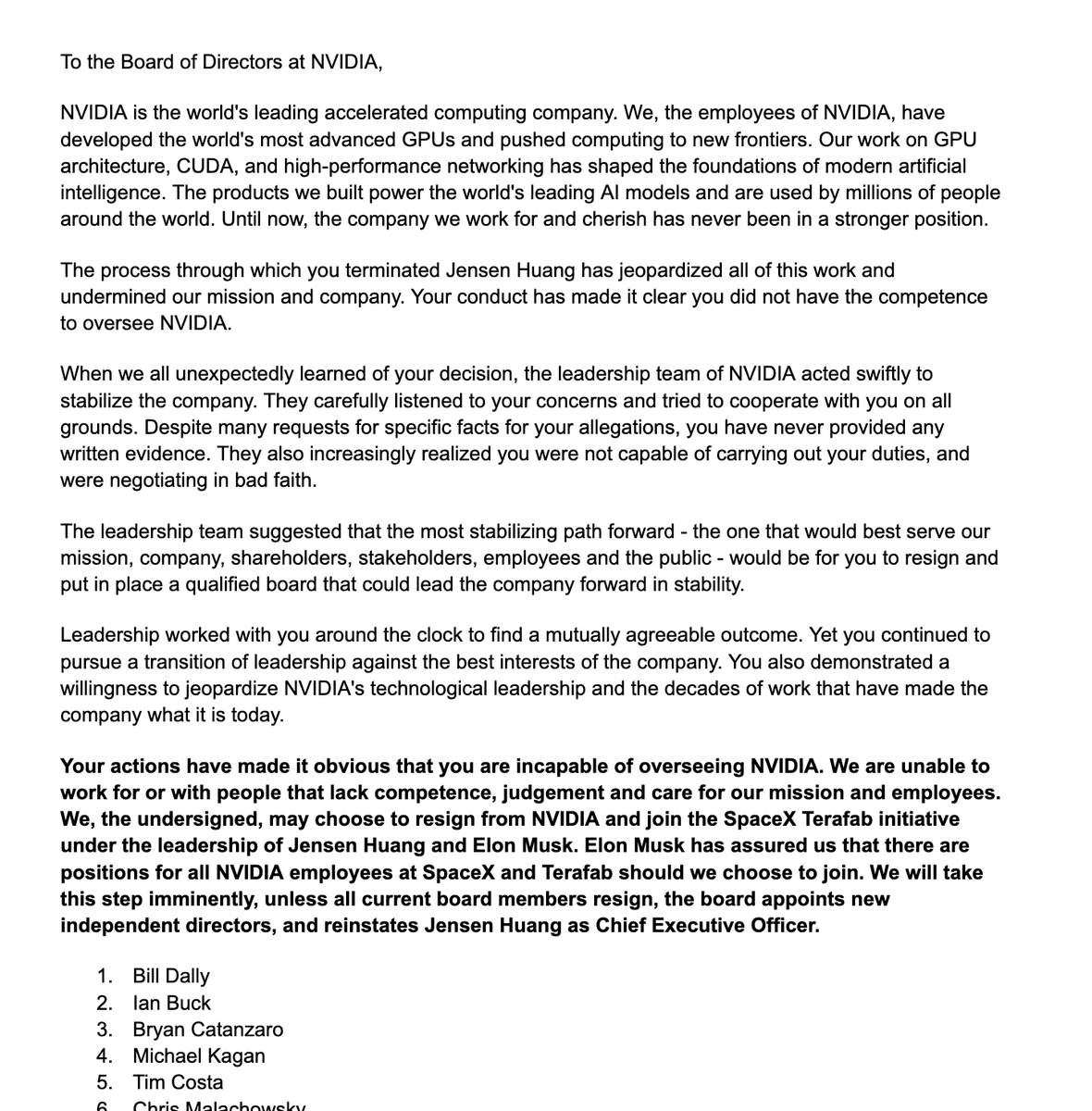
BREAKING: hundreds of NVIDIA employees have signed an internal letter demanding the reinstatement of Jensen Huang as CEO and the resignation of the board
Interview with a Former $NVDA employee (worked there for +20 years) on the competitive advantage of $NVDA and the industry in general:
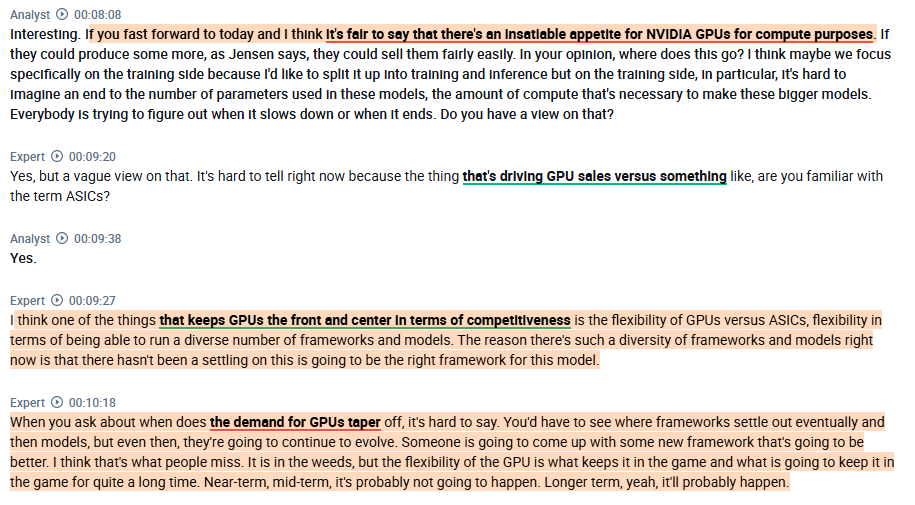
1. In his view, the advantages that $NVDA GPUs have over ASICs are that they are more flexible and can run diverse frameworks and models. He thinks that in the short and mid-term, the demand for GPUs will not taper off, but in the long term, it will.
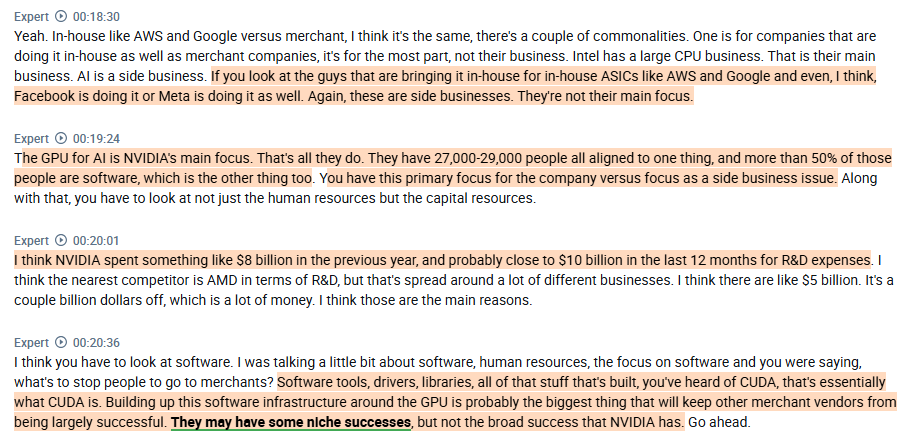
2. The difference between hyperscalers $AMZN, $MSFT, $GOOGL, and $NVDA is that chip design is a side business for hyperscalers. For $NVDA, it is the main focus.
3. $NVDA has more than 50% of the employees who work on software. CUDA is essential to $NVDA and keeps other merchant vendors from being largely successful.
4. $NVDA is not designing a chip. It is designing a data center. The essential parts are chip interconnects with NVLink to do GPU-to-GPU Interconnect and delivering the whole system of a CPU, GPU, network processor, interconnect and package it up with memories on board.
5. He doesn't think $NVDA's DGX Cloud goal is to compete with hyperscalers. According to him, it will be an ultra-premium product as an alternative to embracing the vision of the product, and it will not be cost-competitive with hyperscalers.
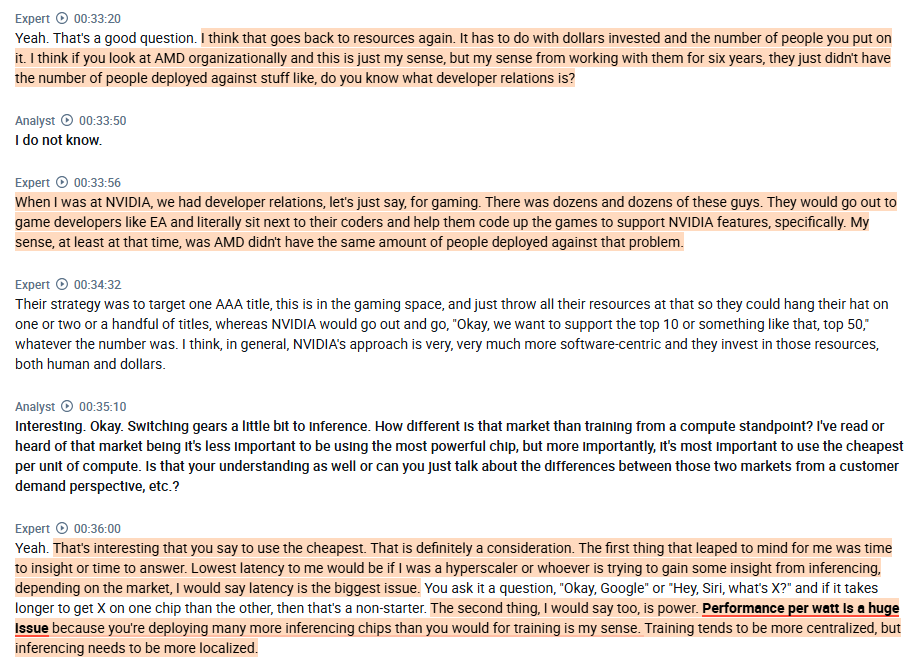
6. When he was at $NVDA, they had a substantial number of employees who would go to game developers, sit with them, and help them code so that the games support $NVDA features. $AMD didn't have the same number of people deployed, and they didn't have the same number of resources.
7. Regarding Inference, he thinks the important thing is the lowest latency, and the second thing is performance per watt. Training is more centralized, but inferencing needs to be more localized. He also thinks Inference will be much bigger than training.
About FED rate cuts: Context is key
To answer Daniel's question, at this point in time, just a HUGE surprise can scare the markets.
As for the cuts/no cuts, the same as we discussed in the last episodes of #TheMondayKickoff :
1. Cuts because Recession - very bad short/medium term, 3-12 months for recovery.
2. Cuts because Panic - very bad short term, OK medium/ long term, 1-3 months for recovery.
3. Cuts because Normalization - small potential drop short-term and very good medium, long term.
It's all about the context in which we will find ourselves when FED cuts this year (IF they cut this year), but in general people just take information around here as it comes, without more research.
Thanks to @krugermacro for bringing this to my attention and to @RyanDetrick for the info going back to 1984 🤝.
P.S: Your meme game is on point Daniel 🕷️😂
Let’s have some fun. 🎉
IF $TSLA hits 190 (or less) by Wednesday of this week, I will give away $10,000 on X to followers.
Rules:
- $TSLA must hit 190 or lower by Wednesday close.
- Must like and repost
- Must be a follower
- No $190. No giveaway. Simpol 🤪
$SPY $QQQ
The CORE was actually 0.17 MOM but they rounded up to 0.2%
Powell can go 50BPS if we wants, inflation is basically over
The FED has full air cover
Anyone reading this and thinking prices are still high lacks the education to know the difference between price and inflation and disinflation versus deflation. High prices is the effect of cumulative inflation. All different economic terms
Much love 💛🍌🍌🍌
Meta Conversations Keynote on right now: $FB
Focusing on, you guessed it... messaging with businesses using WhatsApp and family of apps.
Here are some key points 👇