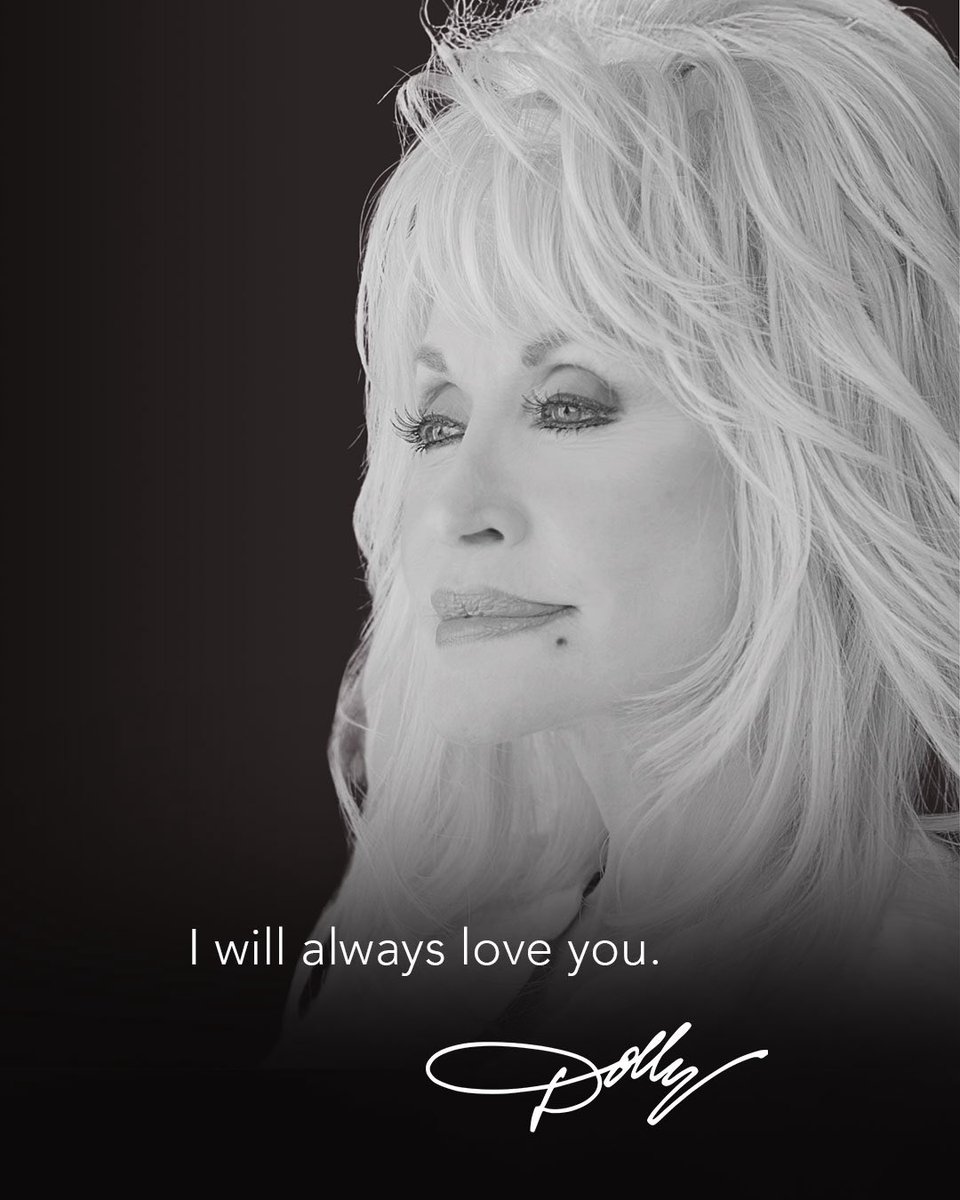
Global icon and humanitarian, Dolly Parton, known to the world as a beloved singer, songwriter, philanthropist, actress, playwright, and author died peacefully today in Nashville, Tennessee. She was 80 years old.
Dolly is preceded in death by her beloved husband of 59 years Carl Thomas Dean (1942 – 2025), her mother Avie Lee Caroline Owens (1923 – 2003), and father, Robert Lee Parton, Sr. (1921 – 2000).
A rhinestone life that shone bright enough for the world to see, Dolly will forever stand as an inspiration not only through her timeless music and prolific songwriting, but also her wit, warmth, and kindness that made us all feel like family. Dolly Parton’s legacy is one of love, compassion, and resilience. With a seven-decade career, she inspired multiple generations of artists and fans with her music and an unwavering commitment to making the world a better place. Her songs will continue to resonate with people of all ages, and her philanthropic work will have a lasting impact.
At Dolly’s request, a small, private service will be held for immediate family. Dolly’s fans and friends from around the world are encouraged to pay tribute to Dolly on social media by tagging @DollyParton or by leaving a message at https://t.co/cLu9I7M2wC
In lieu of flowers the family asks for donations to be made to Dolly Parton’s Imagination Library at https://t.co/arzrqInqJA
every news headline now is like Blueberries Will Kill You. Measles Is Back. Gas Costs Six Dollars. Gwyneth Paltrow Is Selling AI Drone Technology. You Are Being Watched. Three Billion More To Israel. like idk did we do it did we make america great again
@BIackEyeSMITE An extra jar of red thai curry paste, and the promise that if life gets too rough you'll talk to someone. I suppose you can only get one of those at a grocery store, though?
AI is now answering 911 calls in New Orleans.
The AI handles incoming calls and is supposed to analyze and prioritize the calls so that if multiple people phone in about the same incident, the chatbot will handle the repetitive calls about the same incident.
Critics warn that the automatic speech recognition systems may cause problems, the AI may hold hidden biases, and that human 911 responders are needed.
https://t.co/IOTBNG3tby
@acomplexhippie@sovietsarah@JadeK526 Never mind, it did, just a post up. 😅
I'm not saying it's a GOOD option. I'm pointing it out as an ambiguity in the laws. Those kinds of pregnancies could SOMETIMES be carried to term, and in plenty of abortion laws, that's a big deal. That's a place where providers hesitate.
@acomplexhippie@sovietsarah@JadeK526 I promise I know! It looks like my second reply didn't go through for some reason, so I'll short version here: I've read a case study, for example, of an ectopic implanted on a liver. It was viable, carried to term enough for c-section, but deeply unsafe.
@sovietsarah@JadeK526 There's literature suggesting that certain non-fallopian pregnancies, while extremely high risk, can successfully be carried to sufficient term to deliver via c-section. One example I've read about involved implantation on the liver. Both risky, but also possibly viable.
@sovietsarah@JadeK526 See, there's a problem though. The laws in many cases are convoluted or unclear, so even in cases of ectopic pregnancies, doctors may hesitate to act because many of these laws require the pregnant person be actively dying to receive care, and they risk jail time, etc.
@BIackEyeSMITE I eat the "be nice to students" its am everything bagel with sausage and an egg. No cheese because I can't have it, but you do you. If I don't eat breakfast, then some days I won't eat till 9pm, and that makes me cranky. Hence the "be nice to students" 🤣
Years ago, I met a little girl who wore hearing aids and later got cochlear implants. She loved going to the beach. Her mom used to get so frustrated because she insisted on wearing her expensive hearing aids to the shore. Hearing aids and sand (or water!) don’t mix.
“But Mom,” she’d say, “I love hearing the sounds of the ocean.” 🥺
That moment has stayed with me all these years, because it explains something a lot of people don’t realize: Hearing aids and cochlear implants are not the same, and they’re not interchangeable.
Hearing aids simply make sound louder and clearer. They work with the hearing someone still has what we call residual hearing. Even if that hearing is limited, it’s still natural sound. The wind, the waves, laughter all coming through the ear the way the brain was meant to receive it. Many people actually prefer hearing aids for that reason.
Cochlear implants are different. They don’t amplify sound. They bypass the inner ear and send electrical signals straight to the auditory nerve. The brain has to learn how to interpret those signals. For many people, especially in the beginning, it can sound electronic or robotic, like a computer version of sound.
Traditionally, you only qualified for a cochlear implant if you couldn’t get enough benefit from hearing aids. In other words, implants were meant for people who truly couldn’t access sound through amplification anymore. But over time, some doctors have started expanding or stretching that criteria, and sometimes families are encouraged (or pushed?) toward implantation even when there is still usable residual hearing.
When this little girl had her surgery, techniques to preserve residual hearing weren’t common yet. The procedure eliminated the little natural hearing she still had. (Today, some surgeons can preserve it in certain cases, but that wasn’t the norm back then.)
After she was implanted, I worked with her on auditory training to help her brain adjust. I want deaf kids to be able to use whatever devices they have. I hoped she’d get comfortable enough to wear her processors at the beach (but not in the water, of course).
But she didn’t want to.
When I gently asked her why, she looked at me and said:
“It’s not the same, Judi. It’s like a fuzzy computer voice telling me it’s the ocean. It’s not the same.”
Before, when she took off her hearing aids, she could still hear some things. After implantation, when she took off her processors, there was nothing. No sounds at all.
Cochlear implants don’t “restore” natural hearing. They give access to sound in a different way. For many people, that access is incredible and life-changing. But it is different.
I'm not against cochlear implants. But I do want people fully educated on what they really are. They are not a cure for deafness. and they do not always work in the way some people wished. I've seen success with them. And I've seen disasters. My answer when people ask me if a cochlear implant is the right decision: "Results will vary."
She used to love hearing the ocean. Now she no longer can.