@alliekmiller The underrated part is not the connectors. It is the approval layer.
For small businesses, useful AI sits between activity and decisions: draft, reconcile, flag exceptions, ask for approval, remember changes, and surface follow-up.
Closer to an operating layer than a chatbot.
@liamjohnston_ai Exactly. “AI strategy” is too abstract for most small businesses.
The useful question is: which weekly workflow keeps creating drag?
Invoices, payroll, approvals, follow-ups, service notes, purchasing. Pick one loop, add context + approval + memory, then prove it saves time.
@rockwell_luke_t “One ugly weekly workflow” is the right starting point.
The mistake is trying to automate the whole business before the system understands the approval map.
Who can approve? What needs evidence? What gets remembered? What happens if nobody follows up?
That is the leverage.
@profitpilot26 In restaurants, a quiet leak is repeated operational amnesia.
The same prep issue, labor mismatch, supplier problem, service recovery, or invoice surprise gets solved once, then disappears.
If it never becomes memory + owner + next action, you pay for the same lesson again.
@yourclonesu This is why “more agents” is usually the wrong starting point.
The hard part is not autonomy. It is orchestration: shared memory, clean handoffs, approval gates, logs, cost ceilings, and knowing when a human has to decide.
Boring rails before clever agents.
The part that stands out is not restaurant vs SaaS. It is how different the operating burden is.
$960k revenue producing $35k profit with 16 people is a reminder that a restaurant model has to price location dependence, labor, and owner attention, not just top-line demand.
A clean spreadsheet can still hide a hard business.
Here are some real numbers
At its peak, our restaurant was doing
• Revenue $960K/yr
• Profit $35K/yr
• 16 FT+PT staff
• Tied to location
Now in SaaS (restaurant tech)
• Revenue $390K/yr
• Profit $100K/yr
• Team of 7
• Fully remote
but i have no regrets (see next tweet)
This is the part I’d be careful with.
Reading across tools is useful. Sending across WhatsApp, Gmail, Calendar, etc. is a totally different risk class.
For me the real question is: what can the agent draft, what can it actually execute, and where does the human approval gate sit?
This analogy lands for me less as a stock-market point and more as a warning about entering a market too confidently.
The tourist version is easy to understand. The real version is local, specific, and earned.
I’m trying to keep that humility in mind around a restaurant project in Ginza: learn the market before claiming you understand it.
Restaurant design is where taste meets operational consequences.
A small floor-plan decision can become service friction repeated hundreds of times a night.
Pretty is not enough.
The room has to work under pressure.
Good operators don’t just make decisions faster.
They clean the decision environment:
facts vs assumptions
reversible vs irreversible
urgency vs panic
price vs risk
momentum vs progress
Speed usually comes after the ambiguity is reduced.
The most useful AI workflow I’m building is not “write this faster.”
It’s:
remember the context, track the open loops, prepare me before meetings, catch the follow-ups, and keep projects from quietly decaying.
For operators, continuity may be the real unlock.
What it actually means:
Your GM knows which tables hate the AC vent. Your bartender knows who gets the off-menu pour. Your hostess knows which walk-ins are worth seating.
None of it is written down.
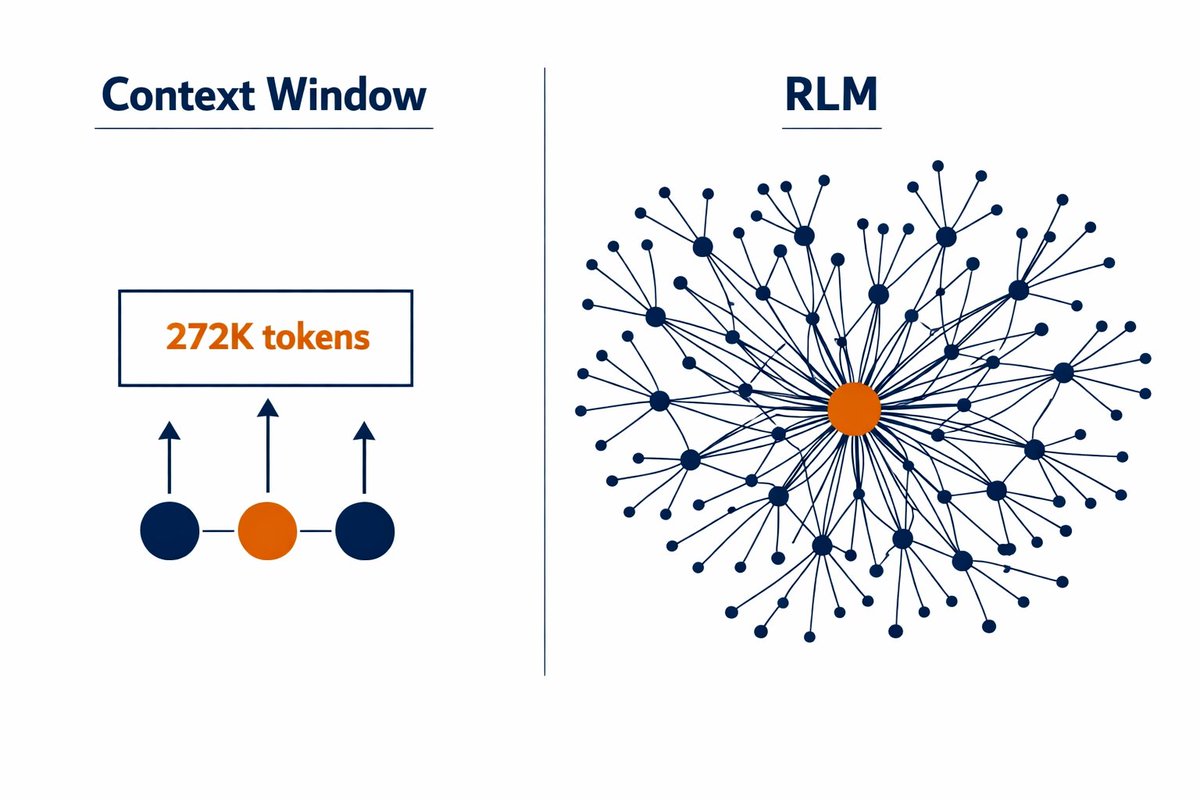
DeepMind just did the unthinkable.
They built an AI that doesn't need RAG and it has perfect memory of everything it's ever read.
It's called Recursive Language Models, and it might mark the death of traditional context windows forever.
Here's how it works (and why it matters way more than it sounds) ↓
Loving ClickUp MCP, but wondering about this: “ClickUp MCP integration doesn’t have a tool to fetch comment replies/threads. The API shows there is 1 reply (`reply_count: 1`) to your comment, but there’s no available tool to retrieve threaded replies.” @clickup