Andrej Karpathy just explained the 5 shifts turning LLMs into agentic systems.
00:00 - Memory turns chat into personal AI
06:41 - Multimodal AI reads the world
16:58 - Thinking models solve harder tasks
24:51 - Search makes LLMs live
30:58 - Tools turn LLMs into workers
Most people are still treating LLMs like chatbots.
Karpathy is showing the full stack:
Memory → Vision → Reasoning → Search → Tools
Prompting is the old workflow.
Agentic systems are the new one.
This 40-minute talk is worth more than most paid AI agent courses.
Bookmark and watch it before everyone catches up.
Then read how to turn LLMs into self-improving agent loops below
agents → tools → loops → graphs → autonomous systems
Google just put all five in one free course. most people stop after the first one.
2 hours 17 minutes, taught by a Developer Relations Engineer at Google Cloud. no signup, no paywall.
39:45 - build your first agent
56:10 - connect MCP tools
1:14:34 - four loop patterns for running it
1:23:01 - turn those loops into a graph
2:05:00 - wire the whole thing into one autonomous system
the progression is the point. one agent is a demo, an agent with tools does work.
loops let it keep going. graphs let several of them coordinate.
only the last step runs without you in the room.
most people are still tuning the prompt inside step one.
worth more than most paid agent bootcamps.
bookmark and watch it today, then read the full graph engineering breakdown below
Don't waste 2 years learning to build LLMs like Claude & ChatGPT.
Stanford just dropped a 2 hour course on how to build LLMs from scratch.
• 00:00 - LLM tokenization
• 25:44 - how LLMs decode user prompts
• 35:40 - training pipeline of LLMs
• 1:16:47 - LLM architecture from scratch
Anthropic pays $750,000/year to engineers who understand this exact knowledge of LLMs.
Bookmark this & give 2 hours today, no matter what. Then read the article below.
YC open-sourced the agent harness running YC.
Agent frameworks are almost always built for one person. You can stretch a personal assistant to cover a whole company, but the wiring gets complicated fast.
Y Combinator hit that wall directly. They started with a small agent loop in Ruby that could reach internal data, added crons and webhook triggers, then provisioned over 50 Hermes agents as personal assistants. Managing a fleet that size became its own job.
QM is what they built instead, open-sourced it under MIT. The name is short for quartermaster, the person on a ship who keeps things in order belowdecks. It runs inside YC across accounting, legal, events, and engineering, including the work of building QM itself.
The idea that makes it different is the scope.
→ A scope is the unit of isolation, and it applies the same way to a person and to a Slack channel. Each one gets its own memory, files, credential view, permissions, scheduled jobs, and sandbox.
→ That sandbox is durable, so tools installed during one session are still there in the next. Many execution environments get thrown away after every run, which means the agent starts from zero every time.
→ The core is deliberately small. It handles identity, policy, the scheduler, and the agent loop, with Postgres holding sessions, memory, and the queue. The web UI, admin panel, and Slack integration are all plugins over its HTTP API.
→ The harness layer is swappable. Claude Code, Codex, OpenCode, and Pi all drive the same core, so a deployment is not locked to one vendor.
→ Security comes in three levels. Strict pauses every tool call for human approval, Dangerous pauses nothing, and the default Auto runs a classifier over provenance-labelled external data and tool results before they reach the model. Hard denials for things like recursive deletes apply at every level.
That last one is worth sitting with. Screening tool results by where they came from is a concrete answer to prompt injection, and very few open agent systems ship a named default for it.
Repo: https://t.co/fRzijcxvCL
QM is a bet that the agent loop was never the hard part, and that coordination across an organization is. That is one of several bets every harness makes, thin core versus thick control being the biggest of them.
I wrote the full breakdown of what an agent harness actually is, and where designs like QM land on those tradeoffs.
The article is quoted below.
Andrew Ng (founder https://t.co/8DFWVgebBc, created Google Brain):
"your team doesn't know how to build agents. the biggest barrier to AI agents isn't the model. it's talent"
vibe coding is a myth. "after a full day I'm exhausted. this is engineering, not vibing." the term made people think anyone can do it. they can't
bottleneck flipped. coding isn't the constraint. product management is
"great leaders in every function still doing things the way they did in 2022." he says that doesn't work anymore. AI solved the engineering bottleneck. now it's exposing every other one you ignored
save this. then read the article below ↓
The primary reason people don't achieve big goals is because they don't realize that the only source of truth is making mistakes. They soak up advice and theory, expecting it to be an exact match to their mind, experience, and situation just to fail once and give up completely.
Best explainer on Kimi K3 i've read.
It walks you through how the model works & the elegant innovation behind it:
- K3 is the biggest open model anyone has released: 2.8 trillion parameters total, though only 104 billion of them do the work on any given word.
- The problem Moonshot went after is memory. Normally a model keeps notes on every word it has read, and that pile grows with every token, which is why long conversations get slow and expensive.
- K3 mostly stops the memory pile from growing. Three out of every four layers use a new mechanism called Kimi Delta Attention, which keeps a fixed-size working memory and edits it as it goes, overwriting what's stale instead of hoarding everything. The fourth layer keeps a compressed record of each word so exact details are still recoverable when they matter.
- They proved this on a small model first. A 48B test version used up to 75% less memory and ran about 4× faster at long context, while matching or beating the conventional design on the benchmarks they reported.
- Training leaned hard on long jobs including coding, browsing, research, visual work, agent sessions running hundreds or thousands of tool calls in a row.
- 1 Million cached input tokens costs $0.30. An agent can pull the same repo, the same docs, the same tool definitions back into context over and over without the bill getting stupid. Moonshot credits that to the memory design working alongside their serving stack.
- The biggest takeaway: context window size is the main character, but what matters is what a model compresses, what it forgets, and how it gets exact information back.
This paper is f*cking brilliant
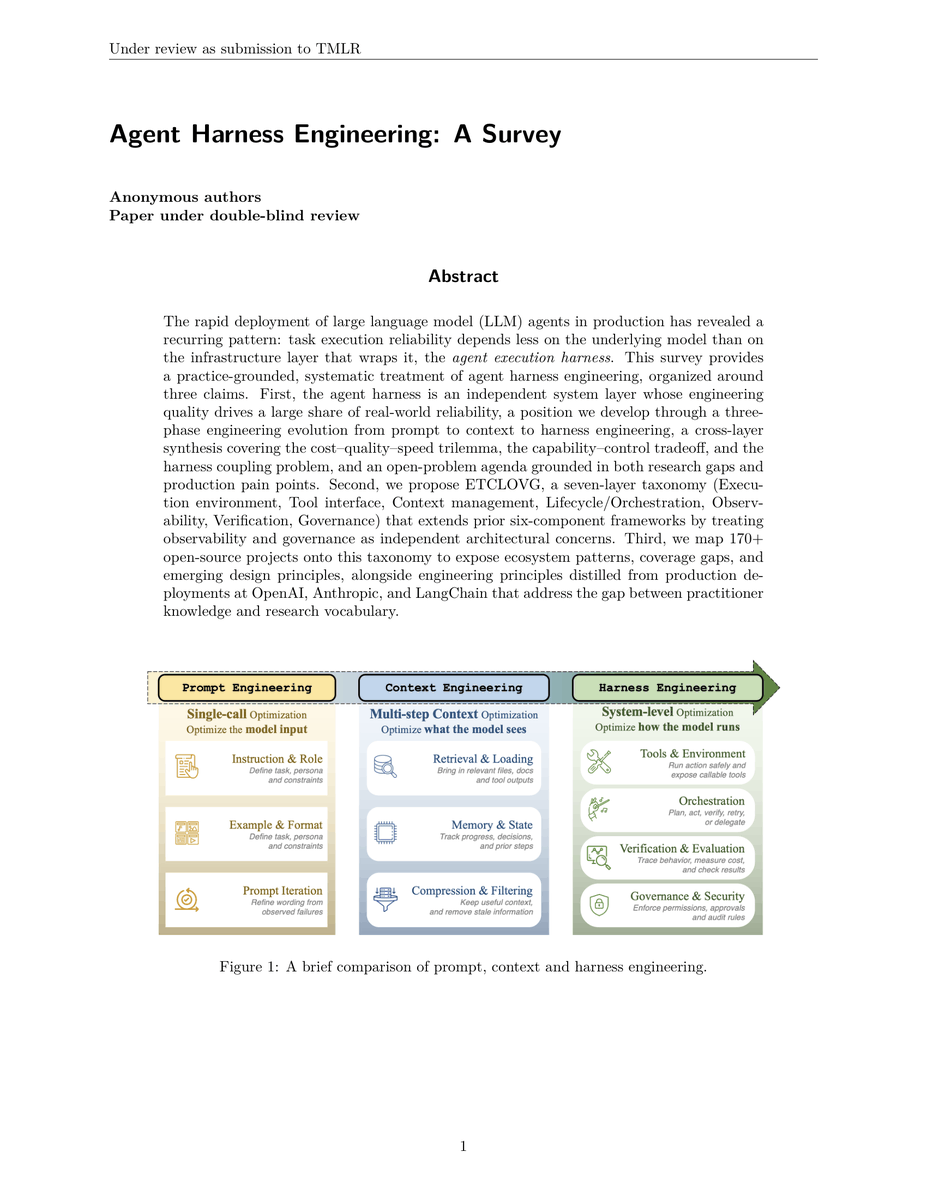
A computer science paper establishes harness engineering as the primary determinant of AI agent reliability
The result: the ETCLOVG seven-layer architecture unifies execution sandboxes, tool protocols, context state, lifecycle graphs, observability, verifiers, and governance
The crazy part is how harness engineering boosts performance without changing the underlying model
Optimizing the execution harness alone increased SWE-bench coding benchmarks from 6.7% to 68.3%
Most developers try to fix agent failures by upgrading to larger LLMs
This framework shifts system reliability from model weights to deterministic harness architecture
Read the complete paper + article below
Bookmark it for future reference
Train your own LLM from scratch.
This repo builds a GPT-style transformer from the ground up, without using any high-level libraries.
You see exactly how attention, multi-head attention, the feed-forward block, embeddings, residuals, and layer norm fit together.
And it doesn't stop at the model. It walks the whole path from raw data to generated text.
↳ Data download, preprocessing, training, and generation
↳ Training data from The Pile (825GB across 22 sources)
↳ Tokenized with tiktoken (r50k_base) and stored in HDF5
↳ Training loop with eval, LR decay, and crash-safe checkpoints
↳ An SFT and RLHF guide for what comes after pretraining
The same code scales by changing a few config values. Around 13M parameters is where the output starts producing correct grammar and spelling, and you can train that in about a day on a free Colab or Kaggle T4.
If you've ever wanted to actually see how a transformer works instead of importing one, this is a clean place to start.
Link to the repo in the comments.
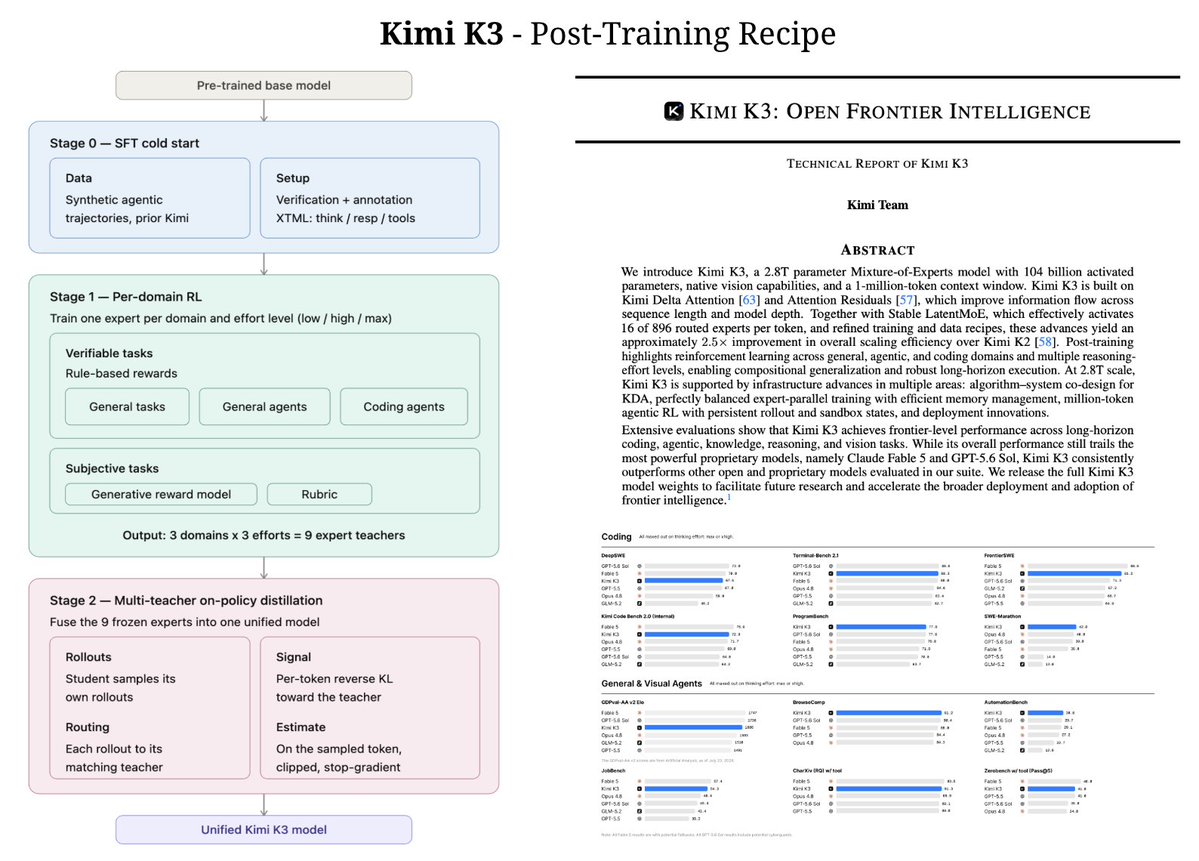
𝗞𝗶𝗺𝗶 𝗞𝟯's 𝗽𝗼𝘀𝘁-𝘁𝗿𝗮𝗶𝗻𝗶𝗻𝗴 𝗿𝗲𝗰𝗶𝗽𝗲
Kimi K3's technical report just dropped. K3 is a 2.8T-parameter open-weight MoE model. I went through the report, and here I share its post-training recipe.
As we have seen through the DeepSeek V4 post-training recipe, training multiple narrow expert models through RL and then using multi-teacher on-policy distillation to consolidate them into a single model is becoming a standard recipe across many of these frontier-model post-trainings. Kimi K3 follows the same skeleton. The report does not describe a separate RLHF or DPO preference-tuning stage here either.
𝗦𝘁𝗮𝗴𝗲 𝟬: 𝗦𝗙𝗧 𝗰𝗼𝗹𝗱 𝘀𝘁𝗮𝗿𝘁
1) Standard cold-start SFT to set up the base policy before RL. They use synthetic agentic trajectories generated by domain-specialist models from the earlier Kimi series, followed by multi-stage verification and human-in-the-loop annotation.
2) They use their own chat format, called XTML, to standardize the data, with separate think, response, and tools channels. The reason this matters later is that it gives the SFT, RL, and distillation stages a common structured interface.
𝗦𝘁𝗮𝗴𝗲 𝟭: 𝗧𝗿𝗮𝗶𝗻𝗶𝗻𝗴 𝘁𝗵𝗲 𝗲𝘅𝗽𝗲𝗿𝘁 𝘁𝗲𝗮𝗰𝗵𝗲𝗿𝘀 𝘄𝗶𝘁𝗵 𝗥𝗟
Kimi does not stop at one expert per domain. It crosses domain specialization with reasoning-effort specialization.
1) They pick three broad domains: general tasks, general agents, and coding agents. This is the specialist-per-domain idea also seen in MiMo-V2-Flash and DeepSeek V4.
2) They train an expert for each domain at three reasoning-effort levels: low / high / max. Three domains times three effort levels gives nine expert teachers, not three.
3) Effort is controlled through a token budget during RL. Each problem gets an initial budget estimated from the cold-start model, and any rollout that goes beyond a scaled version of that budget gets its reward overridden to -1, even if the answer was correct. Going over budget is therefore punished directly.
For general tasks, the budget counts thinking tokens. For agentic tasks, it counts cumulative output tokens, including both reasoning traces and tool-call arguments.
4) They train the max-effort expert first with a generous, but still capped, budget and then anneal the budget multiplier down to obtain the high- and low-effort experts. It is a curriculum over the budget multiplier, not three independent training runs.
Here are a few more papers worth reading to understand this budget-controlled reasoning approach:
- L1 is a closely related example of training a model through RL to follow a target token budget, although its objective differs from Kimi's hard over-budget reward override.
- Kimi K1.5 used a relative length reward to discourage unnecessarily long responses, while K2.5 introduced problem-dependent budget-controlled RL. K3 extends this into explicit low / high / max effort.
- Reasoning-effort-guided training is also used by gpt-oss, which is trained with low / medium / high prompt-conditioned effort levels. @rasbt has a nice recent post on reasoning-effort control.
For non-verifiable general tasks inside this stage, the reward comes from an agentic generative reward model. We have seen DeepSeek V4 post-training also use a GRM for hard-to-verify tasks. Kimi provides more detail about its judging protocol:
1) The judge follows a fixed protocol: read the output, generate a rubric, score each candidate against that rubric, and write the scores to a scorepad. The rubric is generated for the task rather than being globally fixed.
2) They retain the tournament-style group reward with binary comparisons from K2.5 for ranking candidates.
3) To stop the reward model from simply rewarding longer answers, a candidate that goes beyond a verbosity budget automatically loses its comparison. It is the same budget philosophy as the reasoning-effort control, reused to curb reward hacking.
𝗦𝘁𝗮𝗴𝗲 𝟮: 𝗙𝘂𝘀𝗶𝗻𝗴 𝘁𝗵𝗲 𝗻𝗶𝗻𝗲 𝗲𝘅𝗽𝗲𝗿𝘁𝘀 𝗶𝗻𝘁𝗼 𝗼𝗻𝗲 𝗺𝗼𝗱𝗲𝗹 (𝗠𝗢𝗣𝗗)
The nine experts are consolidated into a single student using multi-teacher on-policy distillation. We have also observed this in DeepSeek V4.
1) The student samples its own rollouts. For each domain and sampled effort level, the rollout is matched with the corresponding teacher: a coding rollout at max effort is guided by the coding-max teacher, and so on across the nine experts.
2) The teacher evaluates the tokens sampled by the student. Kimi uses the clipped teacher-versus-student log-probability ratio on each sampled token as a dense OPD reward, corresponding to a sampled-token estimator of the reverse-KL objective.
Because the training is on-policy, the student receives supervision on its own generated prefixes, avoiding the exposure bias associated with off-policy distillation. It also provides dense token-level guidance rather than relying only on the sparse trajectory-level outcome rewards commonly used in RLVR.
3) Kimi K3 uses the simpler sampled-token OPD reward rather than top-k or full-vocabulary distribution distillation. This contrasts with DeepSeek V4, which computes the full-vocabulary reverse-KL objective. Kimi also experimented with more fine-grained top-k objectives but observed no clear advantage in either convergence speed or final performance.
Previous MOPD work has discussed several benefits of integrating specialist capabilities in policy space this way: avoiding the exposure bias of off-policy distillation because the student trains on its own rollout distribution, providing dense token-level supervision, reducing cross-domain interference, outperforming parameter merging in the reported experiments, and enabling a modular and parallel pipeline in which each teacher can be developed independently.
Training independent specialist models with RL and then using MOPD to consolidate them into a unified model is becoming a standard recipe across several of the latest frontier-model post-training reports: DeepSeek V4, Xiaomi's MiMo-V2-Flash, NVIDIA's Nemotron 3 Ultra, and now Kimi K3. 🧵
The Kimi K3 architecture figure for yesterday's big open-weight model release, along with some observations and thoughts.
1. Yes, it looks relatively complicated, but it's essentially a scaled-up production version of their Kimi Linear model they released last year (scaled up from 48B -> 2.8T; K3 is by far the biggest open-weight model right now)
2. The one new component compared to Kimi Linear is the LatentMoE. I omitted it in the figure below since it's already very crowded, but that's essentially the same LatentMoE as in Nemotron 3 Ultra (you can find it in my LLM Architecture Gallery if you are curious). The idea here is to compress (down-project) large linear layers similar to multi-head latent attention.
3. Kimi K3's overall trend (similar to Nemotron 3, DeepSeek V4, and others) is also towards better inference efficiency. That is, there are many components that replace existing components with efficiency-tweaked versions. I.e., MoE -> LatentMoE, regular attention -> multi-head latent attention and Kimi Delta Attention. (I also have short tutorials and write-ups in my gallery if you are curious about additional details).
4. The one component change that is not an efficiency tweak is attention residuals. Like DeepSeek V4 improved the residual path with mHC (manifold-constrained Hyper-Connections), attention residuals are a way to improve the residual path, but it works a bit differently. I.e., mHC made the residual path wider. Attention residuals (also already part of Kimi Linear) connect the residuals across layers; the connection itself uses an attention score for an important/contribution weight. According to the report, it improves the validation loss and downstream performance (a bit) consistently and adds about 4% in training cost and 2% in inference cost.
5. Interestingly, Kimi K3 got rid of all RoPE layers and uses NoPE (No Positional Embeddings) everywhere instead. (Again, this is inherited from Kimi Linear). In other architectures, the recent trend was towards RoPE in local attention layers (like sliding window attention) and NoPE in the global layers. There were a few architectures that only used NoPE everywhere, but this is the first frontier-level one as far as I know.
6. Kimi K3 now also has native multimodal support, which is great!
There are several other interesting training tidbits in the technical report, but that's it from the architecture front so far. A really great release overall.
Fable is really good at launch videos
It essentially one-shotted this video. I told it to read my launch post and create a launch video. That's it.
It ran for 46 minutes (without asking me any questions), found all the product logos, and spit this out.
I then asked it to add music, so it logged into my @ElevenLabs account within my Chrome, generated the music, and mixed it in.
Wild.
Hustle culture optimizes for input (work), not output (impact).
It is okay to put in long hours. It is okay to sacrifice things for your goal. But do not waste effort optimizing theatrics. Put your effort into things that actually matter, things that move you closer to what you really want.
If you do not know what you want, get that clarity first. Your goals cannot be a copy-paste of someone else's goals.
You succeed only when you put effort in the right direction, at the right time, on something you genuinely care about. If you are seeing a dead end, switch.
You cannot and should not be perpetually delusional.
Hope this helps.
Current dev tools I’m using
@superset_sh orchestrating multiple AI coding agents in parallel
@obsdmd my second brain for notes, ideas, and project context
@opencode using open-source models directly from the terminal
Dev tools are getting crazy 🤯
Building Sift CRM at the Hermes Buildathon 🪽 — turning the unstructured mess growing companies run on (WhatsApp, email) into AI-ready structured data. Describe the table you want; the agent does the rest.
@GrowthX_Club@NousResearch