“Nvidia removed Kyber from its roadmap back in early May.”
_
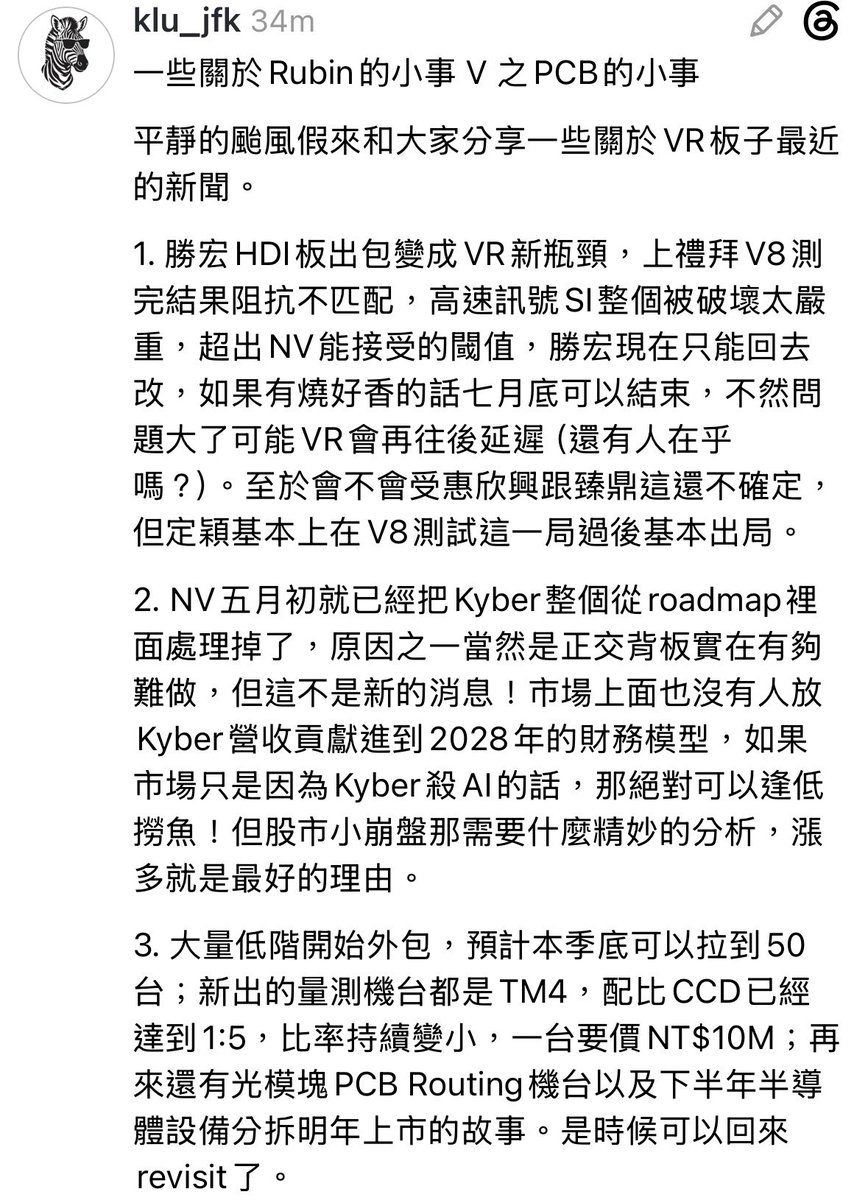
Some Notes on $NVDA Rubin V – A Few Updates on PCBs
here are a few recent developments regarding VR (Virtual Rack) PCBs.
Victory Giant’s HDI PCB issues have become the latest bottleneck for VR. Last week’s V8 validation revealed an impedance mismatch, which severely degraded signal integrity (SI) for the high-speed interfaces, exceeding Nvidia’s acceptable threshold. Victory Giant now has to go back and revise the design. If everything goes smoothly, the issue could be resolved by the end of July. Otherwise, if the root cause proves more serious, VR could face yet another delay (though perhaps few people still care at this point). As for whether competitors such as Unimicron or Zhen Ding will benefit, it’s still too early to tell. However, Dynamic Electronics is effectively out of the race following the V8 testing round.
Nvidia removed Kyber from its roadmap back in early May. One obvious reason is that the orthogonal backplane turned out to be extremely difficult to manufacture. However, this is not new information. More importantly, virtually no one on the Street had incorporated any meaningful Kyber revenue contribution into their financial models through 2028. Therefore, if the market is selling off AI-related names purely because of Kyber’s cancellation, it likely presents a buying opportunity. That said, stock market pullbacks don’t always require sophisticated explanations—after a strong rally, profit-taking alone is often reason enough.
Production outsourcing for lower-end products is accelerating, with capacity expected to reach roughly 50 machines by the end of this quarter. All newly deployed inspection systems are TM4 models, and the CCD-to-machine ratio has already reached 1:5, with the ratio continuing to decline. Each machine carries an ASP of approximately NT$10 million. Looking ahead, there are additional catalysts, including PCB routing equipment for optical modules and the planned spin-off of the semiconductor equipment business in the second half of this year, with a separate listing expected next year. It may be time to revisit the investment thesis.
1/7
TSMC's roadmap is no longer just about smaller nodes.
The bigger message is this:
AI scaling is moving from chip scaling to system scaling.
The next moat is built across four layers:
process
advanced packaging
HBM integration
data movement
That is what investors should watch.
Nomura: Asia AI Semi & Server
> TSMC $TSM has turned highly aggressive, targeting a chip-on-wafer-on-substrate (CoWoS) capacity of 2,000kpcs in 2027F (up from 1,100kpcs in 2026F) to defend against competing packaging technologies.
> Wafer-on-Substrate (WoS) and other small components (PCB/CCL, high-end capacitors, PMICs) will become a bigger bottleneck than Chip-on-Wafer (CoW) through 2H26F and into 2027F.
> Google’s $GOOGL TPU allocation share in CoWoS is expected to rise to 26% in 2027F (up from 23% in 2026F), heavily benefiting its design partner, MediaTek.
> Nvidia's $NVDA share is modeled to slide slightly from 60% to c.55% in 2027F due to the TPU expansion, though it remains the dominant driver.
> Competitors like AMD $AMD and AWS $AMZN face tighter resource allocation; AWS Trainium's CoWoS share is expected to decline year-over-year in 2027F.
> Intel’s $INTC embedded multi-die interconnect bridge with TSV (EMIB-T) is emerging as a primary threat to TSMC due to its large-reticle packaging capabilities. Google is evaluating EMIB-T for its next-gen TPU v9 (collaborating with MediaTek) slated for 2028.
> TSMC launched a 14x reticle size CoWoS roadmap (by 2028E) and is leaning heavily on SoIC (System-on-Integrated-Chips) and CoPoS (Chip-on-Panel-on-Substrate).
> Nvidia's upcoming Feynman GPU (2H28F) is expected to target the first-ever GPU-on-GPU SoIC stack, accelerating the demand for silicon carbide (SiC) carriers and skyrocketing SoIC capacity demand through 2028–2029F.
> Global server revenue growth is now forecast at 74%/65% y-y for 2026F/2027F (up from 43% previously), with AI server growth at 78%/76% y-y and general/CPU server growth at 67%/43% y-y.
Report On The Chinese LineShine (灵晟), Jack Dongarra, Jun 23, 2026 https://t.co/mkDILaB911
Huawei UnifiedBus? https://t.co/fsVawFq5yp
KirbyMM, DATE 2026 Best Paper https://t.co/TEAflZxTea
arXivS for SC26? https://t.co/RGIKU44abu
<= TOP500, Jun 2026 https://t.co/uYqVd36e9u
Rack-to-rack / Cluster-level Interconnects:
#OCS, combined with wavelength routing and large-scale switching fabrics, enables reconfigurable optical paths tailored to specific AI training workloads. This supports flatter or near-flat network architectures. In terms of power efficiency, latency, and scalability, OCS offers clear advantages over traditional electrical switching.
https://t.co/ZSfc3Z1gM9
Here is one attempt to map the ⏳progress around co-packaged optics (CPO) from 2️⃣0️⃣2️⃣2️⃣ through expected developments in 2️⃣0️⃣2️⃣7️⃣.
Over the years, several organizations have developed CPO solutions, including Hewlett Packard Enterprise, Intel, ROCKLEY PHOTONICS LIMITED and IBM. However, Broadcom’s 25.6T CPO demo in 2022 helped bring renewed attention to the topic.
The timeline shows how major players are approaching the space differently: NVIDIA pushing toward micro ring modulator-based CPO switch availability, Broadcom advancing from early demos to 102.4T delivery, Marvell Technology linking CPO with custom XPUs, and RANOVUS Inc. targeting ASIC/XPU integration.
What is also important is the broader ecosystem effort behind CPO. System-level requirements and interoperability standards are shaping up.
Personally, I am curious to see how this advanced technology develops beyond a few large corporations, and howa broader ecosystem can grow around CPO.
❤️Constructive feedback is welcome ❤️
Morgan Stanley: Ibiden $4062.T
> Ibiden is expected to maintain nearly 100% market share in FC (Flip-Chip) packages for Nvidia $NVDA.
> Historically, Intel made up the vast majority of Ibiden's ABF package substrate sales (peaking over 70% around F3/22).
> Nvidia is projected to grow rapidly, becoming the dominant driver of substrate sales, climbing toward 60%+ of the customer mix by F3/29–F3/31.
> Total Sales are projected to more than double from 369.4 bn JPY in F3/25 to 918.7 bn JPY by F3/31, achieving a 16.4% CAGR.
> Operating Profit is expected to surge from 47.6 bn JPY in F3/25 to 216.0 bn JPY by F3/31, a staggering 28.7% CAGR.
> Operating Profit Margin is expected to steadily climb from 12.9% in F3/25 to 23.5% by F3/31.
> Earnings Per Share are forecasted to quadruple, rising from 120.7 JPY in F3/25 to 495.8 JPY in F3/31.
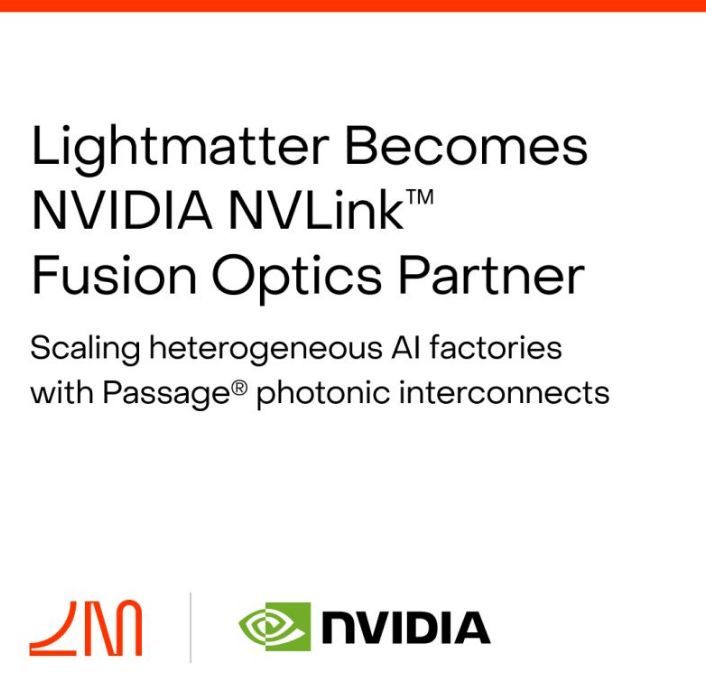
Lightmatter LinkedIn: The scale-up wall is real. To solve it, we’re integrating our industry-leading photonic interconnects into the ecosystem where it matters most. We are thrilled to announce that Lightmatter has become an optics partner in the NVIDIA NVLink™ Fusion ecosystem.
https://t.co/Br3drGy8dG