My team at @QuantinuumQC is hiring a Principal Quantum Compiler Engineer!
We're tackling some fascinating compiler problems on the path to fault-tolerant quantum computing. Come work with us or please share!
https://t.co/YJ1t9OBOWD
The Lean FRO and Mathlib Initiative have released a joint statement on the Lean verification of the Riemann Hypothesis.
On November 20, Levent Alpöge released a proof of the Riemann Hypothesis as a Lean library of 17 million lines of code. Over the past day, the Lean and Mathlib communities worked together to verify it. The statement certifies the proof as correct and describes how it meets all necessary verification criteria.
Congratulations to Levent on this achievement, and thank you to everyone in the community who contributed to the verification.
Full statement: https://t.co/edxEbkodw7
🏹 A timeless epic returns to the big screen!
Experience the celebrated Japanese-Indian animated classic on the big screen!
📍Check our city-wise screening schedule and catch the film at the Japanese Film Festival!
#jff2026#ramayana#japanesecinema
What a week at SC26! Thank you to everyone who joined us in Chicago to explore how quantum is helping shape the future of hybrid computing.
Through hybrid workflow demonstrations, partner theater sessions at our booth, and technical conversations, we showed how Quantinuum is helping bring quantum, AI, and HPC together within the infrastructure researchers already use.
The conversations explored where quantum can make a difference for everything from chemistry to AI and how we’re working with customers to turn that potential into practical applications today.
We appreciate all our partners who are helping us build the next era of computing, including the many who joined us on site this week.
▶️ Watch highlights from the week below.
400+ registrants. Four finalist countries. Three months of intensive building. One winner.
Yesterday in Singapore, we wrapped up Quantinuum’s Singapore Grand Challenge, and the energy in the room was a reminder of why hands-on community building matters so much right now in quantum computing.
Seven finalist teams spanning Singapore, Australia, Malaysia, and the U.S. pitched the quantum applications they spent the last 90 days building, with Team QTensor, emerging as our 2026 Grand Challenge winner.
This is what building a real quantum community looks like. It’s about lowering the barrier for developers, sparking cross-border collaboration, and creating spaces where deep science turns into practical value.
Between the finalist demos, Prof. Harry Buhrman’s keynote, Dr. Ross Duncan’s look at the evolution of Quantinuum’s developer platform, and venture-building insights from QAI Ventures’ Team Tan, yesterday was a clear signal of where this industry is headed.
Stay tuned for more Singapore Grand Challenge updates, including spotlights on the finalists and winning team.
Watch the highlights from yesterday’s finale below. 👇
Used all the models yesterday:
claude-fable-5-2, gpt-6.1-sol, gpt-6.1-terra, gemini-4-carbon, gpt-6-astra, gpt-6.2-sol, claude-opus-5-5, codex-auto-review, gpt-6-luna, gpt-6-sol
It’s been an incredible week at #SC26, where a consistent message is echoing across the show floor: the future of computing is hybrid, and quantum is becoming an essential part of the stack.
Yesterday, our CEO Rajeeb Hazra, joined @theCUBE to share how commercial organizations across pharma, finance, energy, and transportation are moving beyond exploration to real-world application design. When you build across the full stack, the most exciting part isn't just advancing the technology, it's working directly with customers to solve problems that were previously out of reach.
Catch the full highlights from Raj’s interview here: https://t.co/MMEQR0wUh2
And if you're on the show floor in Chicago, stop by to connect with our team.
The next era of computing is taking shape at the intersection of quantum and supercomputing. Quantinuum will be at #SC26 next week to show how we’re already bringing that hybrid ecosystem to life.
Learn how we’re connecting systems like Helios, the most accurate quantum computer in the world, with the HPC infrastructure researchers already use. Explore how Nexus provides the developer tools to build hybrid applications and develop expertise that can carry into the fault-tolerant era.
Together with partners including @nvidia, @Oracle and many others, we're hosting more than 15 expert theater sessions at our booth. These talks cover quantum–HPC integration, the latest advances in error correction, real-world use cases, and more.
📍 Booth 4838 | Quantum Junction
📅 November 17–19 | McCormick Place, Chicago
🤝 Book time with our experts: https://t.co/Lfx7zqROqz
See you there. @Supercomputing
The next era of quantum computing needs more than extraordinary, fault-tolerant hardware. It needs a platform that puts that power in developers’ hands.
Meet the future of Quantinuum Nexus.
Today, we’re unveiling a multi-year roadmap to evolve Nexus, Quantinuum’s platform as a service, into the industry’s first developer platform designed for the fault-tolerant quantum era.
Nexus will connect application development and deployment across our hardware roadmap, from Helios to Apollo, our universal, fault-tolerant quantum computer planned for 2029.
Our ambition is simple: make building powerful quantum applications easier as we progress toward fault tolerance. Nexus will progressively handle the complexity of error correction, helping developers build programs that grow in capability as the hardware advances.
With Nexus, you can:
🚀 Develop complete applications with fault-tolerant libraries and tools.
⚡ Optimize performance with increasingly automated error correction and resource management.
🌐 Deploy hybrid quantum-classical workflows across enterprise computing environments.
Build today. Be ready for what’s next.
Learn more and explore the roadmap: https://t.co/o4Ly4YnLfF
I'm thrilled to bring &Truth out of stealth as its co-founder and Chief Science Officer. With a team I'm proud to be part of, we're setting out to specify and prove all the world's software correct and secure.
If you geek out over code people can understand and trust, join us!
Introducing the judging panel for the Quantinuum SG Grand Challenge 2026!
Since the SG Grand Challenge launched in July, it has brought together more than 200 participants from around the world to explore how quantum computing can tackle challenges across science, AI and industry.
On November 19, our finalist teams will take the stage in Singapore to showcase their solutions and answer questions from a panel whose expertise spans quantum algorithms, research, software and innovation.
Thank you to our judges for contributing their time and expertise, and to every participant for the creativity and dedication that have brought us to this point.
🔹 Prof. Harry Buhrman, Quantinuum
🔹 Prof. Leong Chuan Kwek, Nanyang Technological University / Centre for Quantum Technologies
🔹 Dr. Ross Duncan, Quantinuum
🔹 Dr. Jayne Thompson, Nanyang Technological University
🔹 Dr. Angelina Frank, QAI Ventures
Supported by Singapore’s National Quantum Office and Aqora, the Challenge will culminate in a day of finalist presentations, industry insights and connections across Singapore’s quantum community.
We look forward to seeing you at the finale! Spaces are limited.
Register your interest: https://t.co/Qt6yrgP3cF
#QuantumComputing #Quantinuum #SGGrandChallenge
I'll be in Cambridge, UK, Oct 25--31, with some time in London/Heathrow on either end.
Working during weekdays, but would love to catch up with folks over coffee or food in the evenings or over the weekend.
If you're around, reach out!
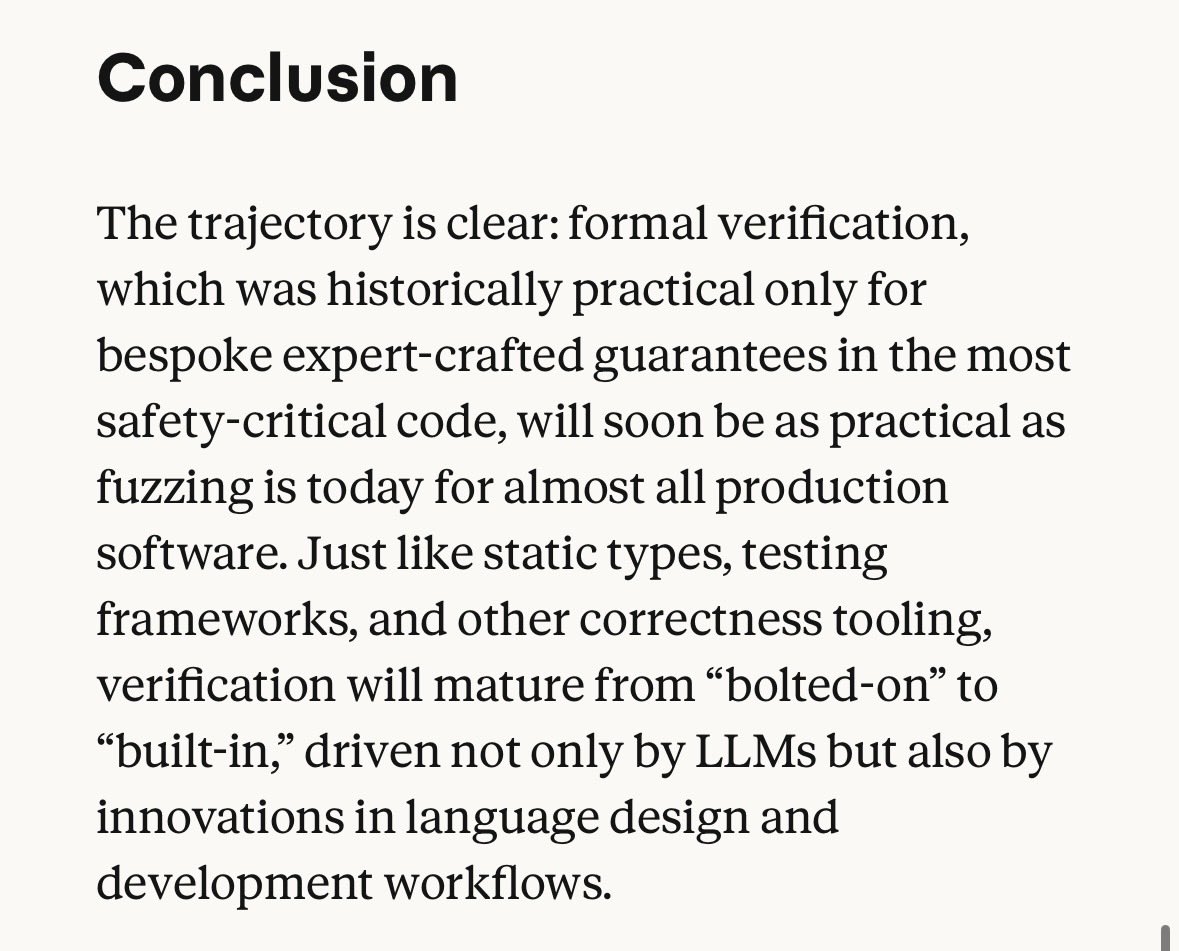
Are people ready to formally specify and verify security-critical properties of all of their software systems, now that our bugfinding tools have finally started to catch up to our bug-introducing abilities?
Two fault-tolerance milestones were announced over the past two weeks, one from Quantinuum and one from Google.
Because both results focus on improving fidelity and reducing errors, we've received a lot of questions about how they compare. The short answer: both are meaningful advances, but they measure different things.
This week, we announced that we had used our error-correction architecture to achieve a logical fidelity of 99.9995% on Helios, equivalent to just five errors per million operations. Our error rate represented a 100x reduction in errors compared to the best published result across any other modality, which was published by Google in 2024.
Last week, Google announced that it had achieved a fidelity of 99.99% as part of a study on magic states, which are resources used in certain fault-tolerant operations.
The distinction matters because different studies provide insight into different parts of the path to fault tolerance. Google's work measured the fidelity of a resource used in fault-tolerant operations. Our work measured the fidelity of the logical computation that consumes those resources.
In our latest blog, Quantinuum’s David Hayes takes a closer look at what each result measures, where direct comparisons can and cannot be made, and what they tell us about Quantinuum’s leadership on the path to practical fault-tolerant quantum computing.
Learn more here: https://t.co/mSjNEBbiF7