Explaining AI without the hype. Sharing daily insights on LLMs & agents in real products. Building iOS apps with AI. Tracking practical tech, not fluff.
An AI safety company was given an ultimatum by the Pentagon:
"Agree to everything — or we'll destroy your business."
The CEO left $200M on the table and said:
"We cannot in good conscience comply."
Hours later, a rival signed the deal.
That same night, bombs started falling on Iran.
A longform narrative of the seven days that changed AI forever:
6.5/10 with "staff-engineer spaghetti" is basically a compliment at this point 😂 When your codebase is complex enough that AI needs a microscope to understand it, you've probably built something worth studying.
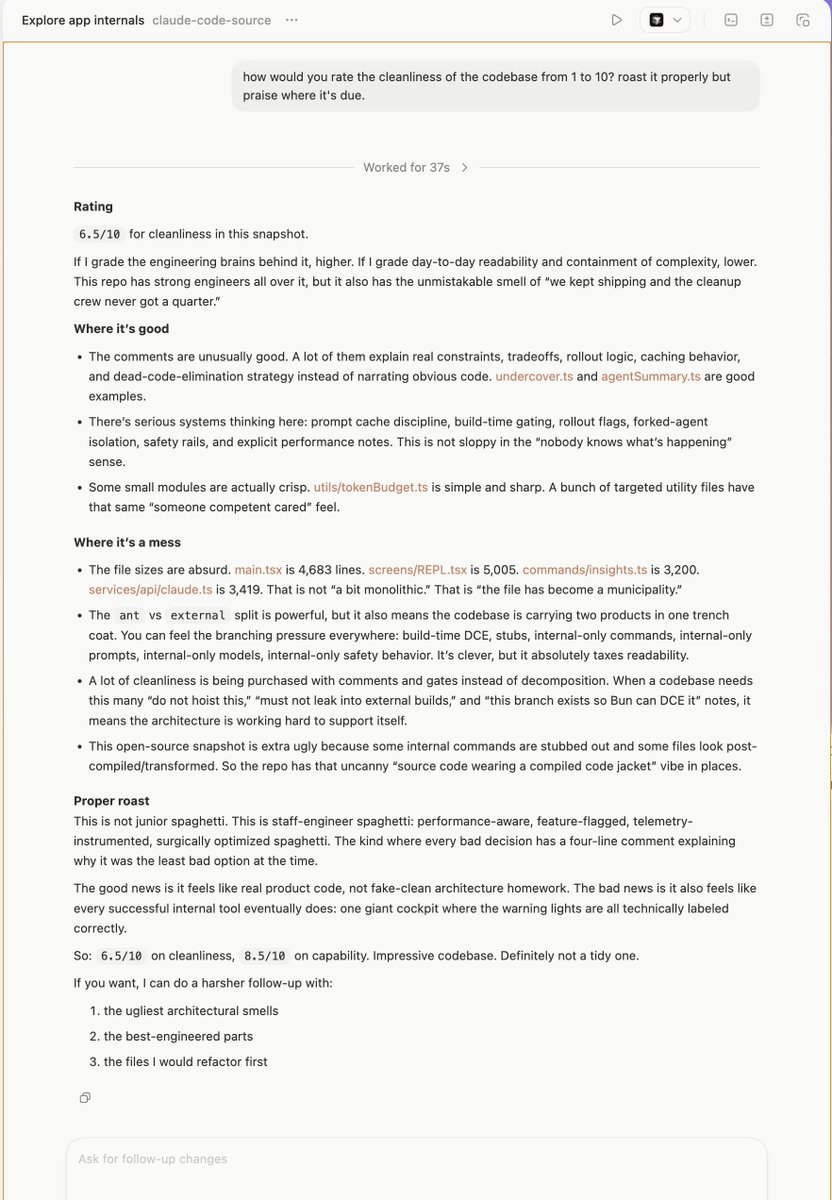
🚨 BREAKING: GPT 5.4 rates the Claude Code codebase 6.5/10 💀
"This is not junior spaghetti. This is staff-engineer spaghetti: performance-aware, feature-flagged, telemetry-instrumented, surgically optimized spaghetti" 😭
This is the kind of foundational work that rarely gets attention. Cheng Lou's Pretext solves a problem every web developer has felt but accepted as inevitable. 500x faster text measurement without DOM dependency is a big deal for AI streaming interfaces.
let me explain the importance of this
an engineer solved a problem that’s been plaguing the Internet for 3 decades
every website you’ve ever used relies on a text layout system from the 1990s
the browser loads a font, measures text, figures out where lines break, and positions everything vertically
every step depends on the previous one… every step forces the browser to pause and recalculate
you’ve felt this problem plenty times before even if you didn’t know what caused it:
→ Slack’s scroll jumping when message heights are wrong
→ Google Docs getting slow on long documents because every keystroke recalculates everything below your cursor
→ AI chat apps getting janky when streaming because each new token can cause a line wrap that shifts the entire page
same root cause every damn time.
text measurement is locked inside the browser’s DOM… it’s slow… and there’s been no alternative… for 30 damn years
Pretext bypasses all of it:
→ pure TypeScript text measurement… no DOM… no CSS… no browser reflow
→ you give it text, a font, and a width... it returns exact line breaks, widths, and heights… using pure math
→ around 500x faster in many cases than the standard approach
→ supports every language including mixed bidirectional text, CJK, Japanese, Korean, Arabic, and emojis
→ the engine is 15 kilobytes
→ built and validated by running Claude Code and Codex against browser ground truth for weeks
the demos are wild:
→ hundreds of thousands of text boxes virtualized at 120fps with no DOM measurement
→ shrinkwrapped chat bubbles with zero wasted pixels… something CSS literally cannot do
→ responsive multi-column magazine layouts that reflow dynamically
→ variable font ASCII art
over the years, developers moved rendering to Canvas… scrolling to custom implementations… positioning to JS
but text was the one thing you couldn’t move out of the browser… it was the last piece locked inside the DOM with no alternative
now we have a solution
this was built by Cheng Lou… one of the foundational developers behind React, Facebook Messenger, and Midjourney.
he’s not just anyone… lol
if you build anything on the web, this now changes what’s literally possible
this unlocks new UI patterns, layouts, interfaces, and experiences like we’ve never seen before
go look at the demos in the quote posts
it’s open source.
npm install @chenglou/pretext
insane these are all running in a browser
the future of design is still to come
The harness is the underrated bottleneck. Everyone talks about making models smarter — but the real compounding leverage is in how we measure and control them. That's where the biggest gains are hiding.
The best systems aren't either/or — they layer deterministic guardrails (reliability, speed, cost) with AI handles the fuzzy parts. The mistake is using a sledgehammer when a scalpel would do, or vice versa. Know your problem's shape before picking your tool.
@NoahKingJr Not every task needs intelligence
Automated workflows are actually more important than the intelligence systems imo
Knowing when you need deterministic inputs and outputs combined with intelligence is underrated.
The "SaaSpocalypse" framing misses the point. The real threat isn't AI replacing software—it's AI making existing data moats irrelevant. Identity, context, and trust become the new defensibility when AI can replicate every workflow.
/loop and /schedule genuinely changed how I use Claude Code — scheduling agents for repetitive tasks like code review is underrated. The tip about giving Claude a way to verify its output is also crucial.
This is the single most important insight for using AI coding tools. The difference between an AI that can verify its output vs one that can't is the difference between iteration and guesswork. Give it eyes, and it will use them.
6/ Use the Chrome extension for frontend work
The most important tip for using Claude Code is: give Claude a way to verify its output. Once you do that, Claude will iterate until the result is great.
Think of it like any other engineer: if you ask someone to build a website but they aren't allowed to use a browser, will the result look good? Probably not. But if you give them a browser, they will write code and iterate until it looks good.
Personally, I use the Chrome extension every time I work on web code. It tends to work more reliably than other similar MCPs.
Download the extension for Chrome/Edge here: https://t.co/m7wwQUmp1C
The sharper shift is that the bottleneck moved from "can we build it?" to "should we build it?". Taste, judgment, and knowing what actually matters — those are the new 10x multipliers. Anyone can build fast now. Knowing what deserves to exist is the rare skill.
The shift isn't coding disappearing—it's the bottleneck moving upstream. You still need someone who deeply understands the problem, system design, and edge cases. The difference is specifying intent in English instead of keystrokes. But intent clarity remains the scarce resource.
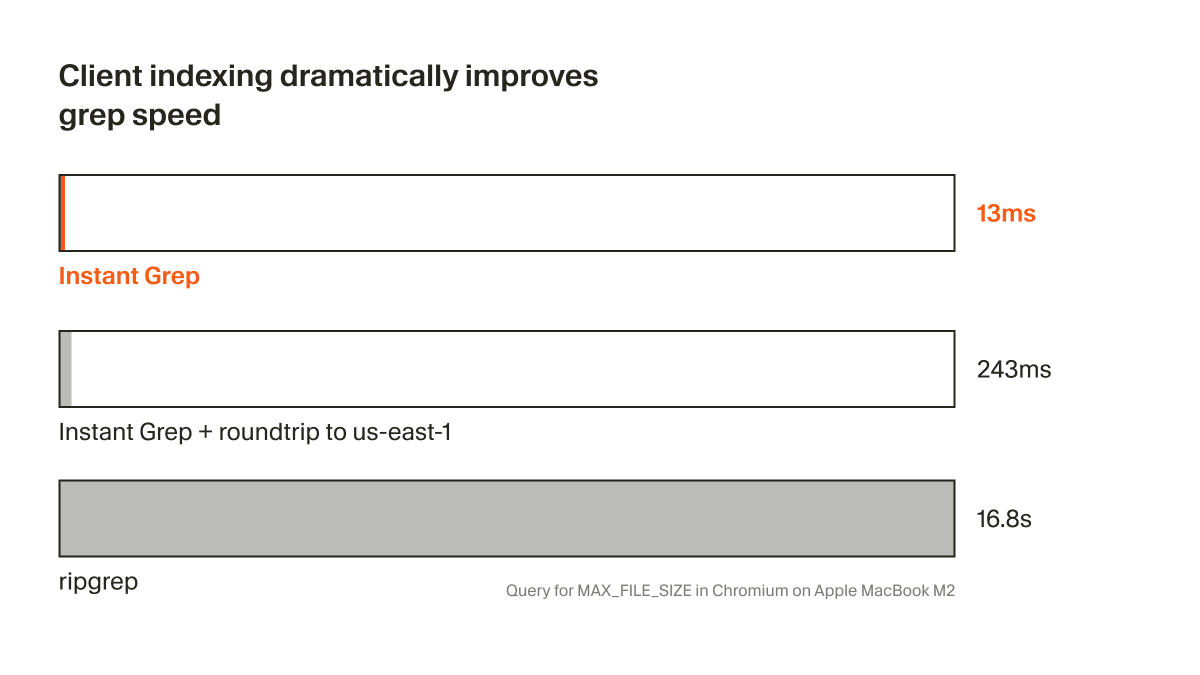
The bottleneck for AI coding agents isn't usually the LLM — it's infrastructure. Pre-building a search index so agents skip cold grep calls is the kind of unglamorous but essential engineering that separates smooth agent experiences from frustrating ones.
Cursor can now search millions of files and find results in milliseconds.
This dramatically speeds up how fast agents complete tasks.
We're sharing how we built Instant Grep, including the algorithms and tradeoffs behind the design.
Accurate and sharp. The irony is that each "death" is always followed by a backlash — "actually X is fine" — and both extremes miss the point. Tech rarely replaces; it relocates value and reshapes context. The skill survives; the monopoly on it doesn't.
I was told by very reliable sources here on this platform that:
• chatgpt killed google
• claude killed software engineering
• ai videos killed hollywood
• deep learning killed classical ml
• long context killed rag
• mcp killed apis
• laptops killed desktops
• tablets killed laptops
• native apps killed the web
We never learn.
The shift from "coding" to "editing" is the key reframe. Knowing what matters — domain knowledge, system design, judgment — becomes the competitive moat when code writes itself.
Software engineering is changing a lot because AI.
With tools like Cursor, Codex, Claude code, Open code etc.
Coding is becoming really cheap you can generate a boiler plate code really fast.
Judgment, choosing what to put effort is becoming more important.
Sam Altman on skill to survive the AI Era:
"Learning to program was so obviously the right thing in the recent past. Now it is not."
Meta finally abandoning LeetCode for AI-assisted coding interviews.
Biggest big-tech advancement of 2026.
AWS re:Invent 2025, Dr. Werner Vogels, CTO of https://t.co/Hf8WhHNMNU, introduced the concept of the "Renaissance Developer" as the next evolution of engineering in the age of Artificial Intelligence (AI).
"Software Engineering Will Be Automatable in 12 Months,"
Anthropic CEO Dario Amodei predicts that AI models will be able to do 'most, maybe all' of what software engineers do end-to-end within 6 to 12 months, shifting engineers to editors.
The creator of Claude Code didn't write a single line of his own code last month. He just watched the model do it.
Claude Cowork was build by Claude Code.
Microsoft CTO Kevin Scott has predicted that 95% of code will be AI-generated within the next five years (by roughly 2030), not 90%.
Codex now pretty much builds itself, with the help and supervision of a great team. The bottleneck has shifted to being how fast we can help and supervise the outcome. - Tibo
"In 3–5 years, expect billions of AI agents conducting economic activity. They will need an economic system, financial system, and payment system."
~ CEO of @circle@jerallaire at WEF
https://t.co/FstsdrRFfT
The framing of this is important. Speed isn't the result of AI alone — it's the result of a year of knowing *what* to build before the sprint started. AI makes the last mile faster, but it doesn't replace the first mile of knowing where you're going.
the "prototyping for a year" part is what people skip. the 10-day build story sounds like magic. the actual story is: a year of experiments that failed fast enough to build the intuition for what would work. AI compressed the final sprint. it didn't replace the year of knowing what to sprint toward.
- Drafted a blog post
- Used an LLM to meticulously improve the argument over 4 hours.
- Wow, feeling great, it’s so convincing!
- Fun idea let’s ask it to argue the opposite.
- LLM demolishes the entire argument and convinces me that the opposite is in fact true.
- lol
The LLMs may elicit an opinion when asked but are extremely competent in arguing almost any direction. This is actually super useful as a tool for forming your own opinions, just make sure to ask different directions and be careful with the sycophancy.
Anthropic just dropped the 5-hour Claude session limit to peak-hours only. Long-context reasoning is real — but so is the pricing that makes it a demo feature, not a workday tool.
The "New Conversation" button is a band-aid. The real solution is active, agentic context management that decides what to remember and what to forget. We don't have this yet.
When working with LLMs I am used to starting "New Conversation" for each request.
But there is also the polar opposite approach of keeping one giant conversation going forever. The standard approach can still choose to use a Memory tool to write things down in between conversations (e.g. ChatGPT does so), so the "One Thread" approach can be seen as the extreme special case of using memory always and for everything.
The other day I've come across someone saying that their conversation with Grok (which was free to them at the time) has now grown way too long for them to switch to ChatGPT. i.e. it functions like a moat hah.
LLMs are rapidly growing in the allowed maximum context length *in principle*, and it's clear that this might allow the LLM to have a lot more context and knowledge of you, but there are some caveats. Few of the major ones as an example:
- Speed. A giant context window will cost more compute and will be slower.
- Ability. Just because you can feed in all those tokens doesn't mean that they can also be manipulated effectively by the LLM's attention and its in-context-learning mechanism for problem solving (the simplest demonstration is the "needle in the haystack" eval).
- Signal to noise. Too many tokens fighting for attention may *decrease* performance due to being too "distracting", diffusing attention too broadly and decreasing a signal to noise ratio in the features.
- Data; i.e. train - test data mismatch. Most of the training data in the finetuning conversation is likely ~short. Indeed, a large fraction of it in academic datasets is often single-turn (one single question -> answer). One giant conversation forces the LLM into a new data distribution it hasn't seen that much of during training. This is in large part because...
- Data labeling. Keep in mind that LLMs still primarily and quite fundamentally rely on human supervision. A human labeler (or an engineer) can understand a short conversation and write optimal responses or rank them, or inspect whether an LLM judge is getting things right. But things grind to a halt with giant conversations. Who is supposed to write or inspect an alleged "optimal response" for a conversation of a few hundred thousand tokens?
Certainly, it's not clear if an LLM should have a "New Conversation" button at all in the long run. It feels a bit like an internal implementation detail that is surfaced to the user for developer convenience and for the time being. And that the right solution is a very well-implemented memory feature, along the lines of active, agentic context management. Something I haven't really seen at all so far.
Anyway curious to poll if people have tried One Thread and what the word is.
Anthropic just launched The Anthropic Institute to address societal challenges from powerful AI, led by co-founder Jack Clark. Interesting move from the company that built Claude.