🕊 My heart and brain connect making me feel morally obligated to encourage people to critically think for themselves, never blindly follow anyone,research
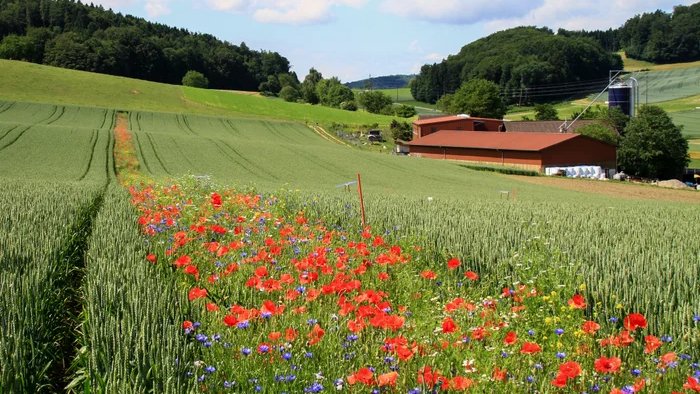
Farmers have figured out that the cheapest pesticide is a strip of flowers.
When you plant wildflowers through a crop field, not just around the edge but in strips running through the middle, you get ladybugs, lacewings, hoverflies, and parasitic wasps living in the field instead of visiting it.
They eat the aphids, the caterpillars, and the mites for free, all summer long.
In controlled trials, fields with tailored flower strips had leaf-beetle numbers 40 to 50% lower and crop damage cut by around 60%, enough to drop below the threshold where spraying was even considered worth it.
The flowers attract a standing army to our fields.
We spent decades engineering chemicals to kill the insects eating the crop, when the insects that eat those insects would have worked for the price of seed.
the trump administration is going to use fucking CYNAIDE bombs on animals??? in their homes??? to get rid of them???? I AM FUCKING LIVID, this shit cannot keep happening!!!
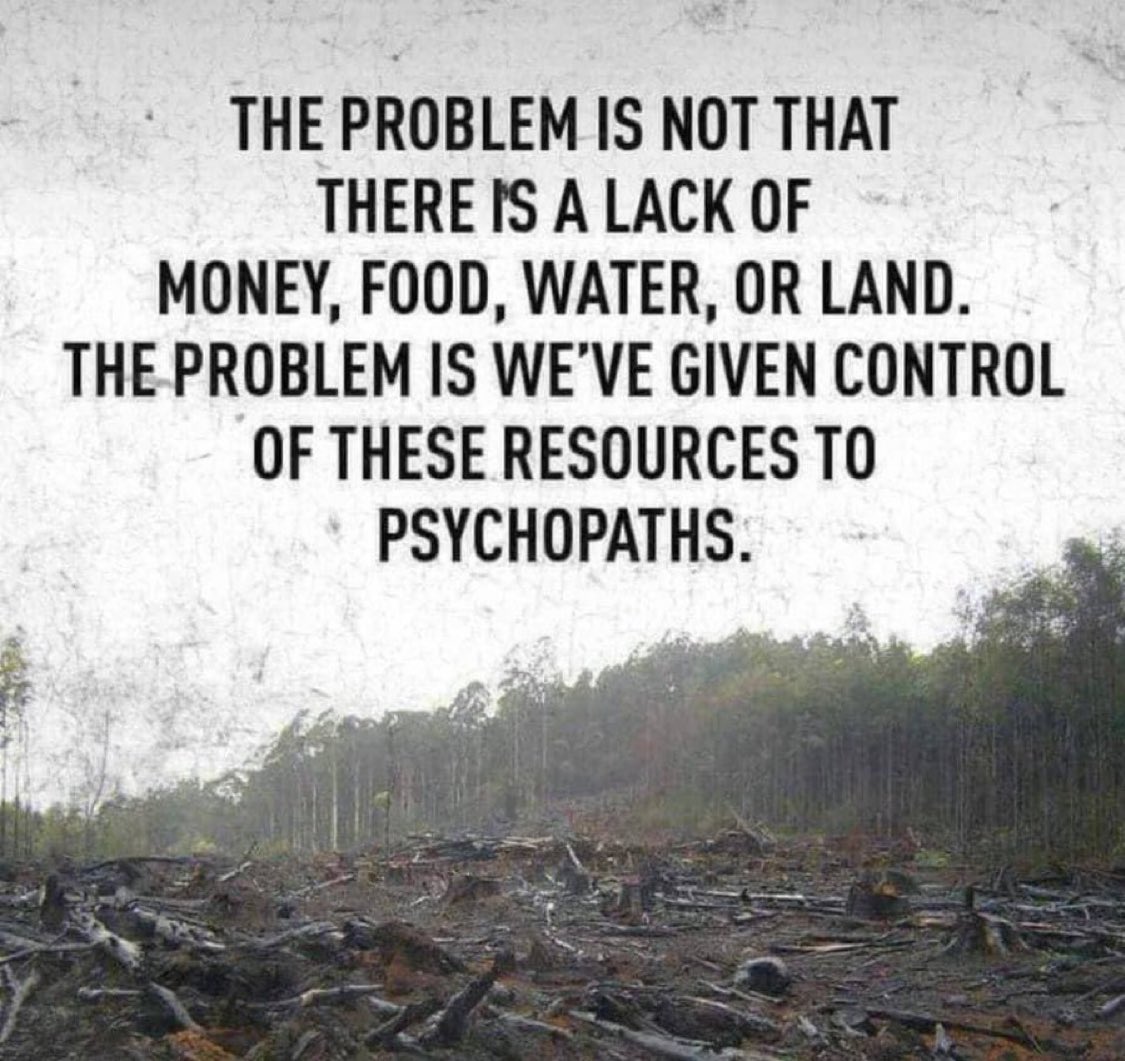
This is indefensible: Spraying glyphosate over wild lands is ecocide, and toxic to humans, of course. But there is one upside: It allows us to see the full corruption of our system, which pretends to be preoccupied with our health, even as it poisons the world behind our backs.
Republican efforts to extinguish the last remaining bison (currently at 0.1% of their former numbers) are truly a crime against America. You literally could not make it up. How any American stands by this is beyond comprehension.
Shame on @GovGianforte
https://t.co/DhLBLnCSpz
Very Important Message!!
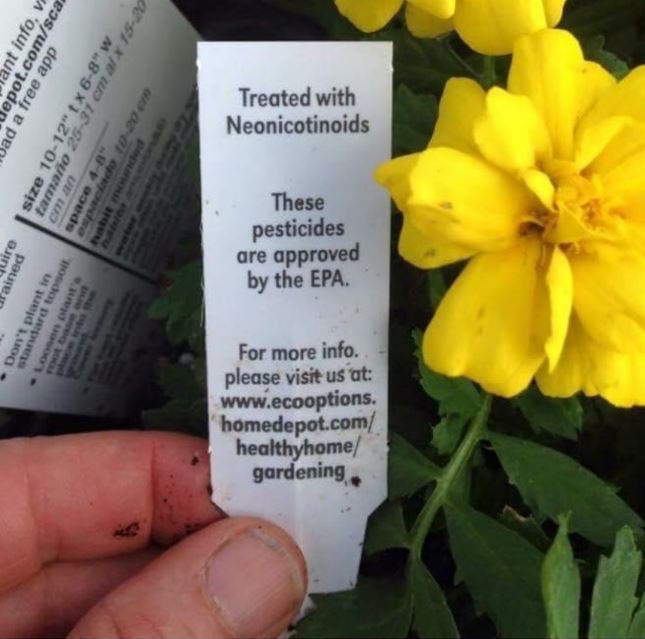
Do NOT, and I repeat do not buy plants treated with Neonicotinoids. Bees take the pollen back to the hive and feed it to the brood.
This is a number one cause of the colony collapse. It's important to NOT buy these plants!
Make sure to share this post!
If we’re Making America Healthy Again, government shouldn't be promoting glyphosate and providing liability immunity for corporations making it.
Thank you to @RepEliCrane for cosponsoring the No Immunity for Glyphosate Act.
Your brain has a circuit that doesn't know you live in a city. Its only job is to monitor whether birds are still singing. Right now, in this room, it is on.
The circuit predates primates. Mammals have been using ambient soundscape continuity as a predator-detection system for roughly 200 million years. Birds stop singing when something larger moves through their territory. For most of mammalian history, a forest full of song meant no large predator was nearby, and the cessation of sound was the warning. Your nervous system never updated this software.
The Max Planck Institute tested the inverse in 2022 with 295 participants. Six minutes of birdsong dropped anxiety with a medium effect size. Six minutes of traffic noise raised depression with the same. The effect worked on subjects who lived in dense urban environments and had no regular contact with nature. The brain still ran the check.
Birdsong sits in the 1,000 to 8,000 Hz range. Your brainstem reads continuous patterns in that band as a signal that nothing dangerous is currently moving through the environment. EEG data shows birdsong at 45 to 50 decibels boosts alpha wave activity by 14.1% relative to silence. Alpha is the brainwave signature of relaxed alertness. Push the same birdsong above 60 decibels and the response flips. Stress markers rise 29%. The circuit only trusts the signal at the volume of quiet conversation, which is exactly the volume birds sing at from a typical distance.
Three things happen simultaneously when the brain registers ambient safety. The amygdala downregulates. The parasympathetic nervous system takes over from the sympathetic. Heart rate variability rises, cortisol drops. The posterior cingulate cortex, which sits at the center of the rumination circuit, quiets down. King's College London tracked this through a smartphone study with over 1,200 participants and found the mood lift lasted hours after the sound stopped. People diagnosed with depression got the same response as healthy controls.
Most of what gets labeled mental fatigue is hypervigilance running in the background. Birdsong tells the circuit it can stand down, and the brain reallocates the freed compute everywhere else.
A quiet park feels different from a quiet office because the parks have sentinels.
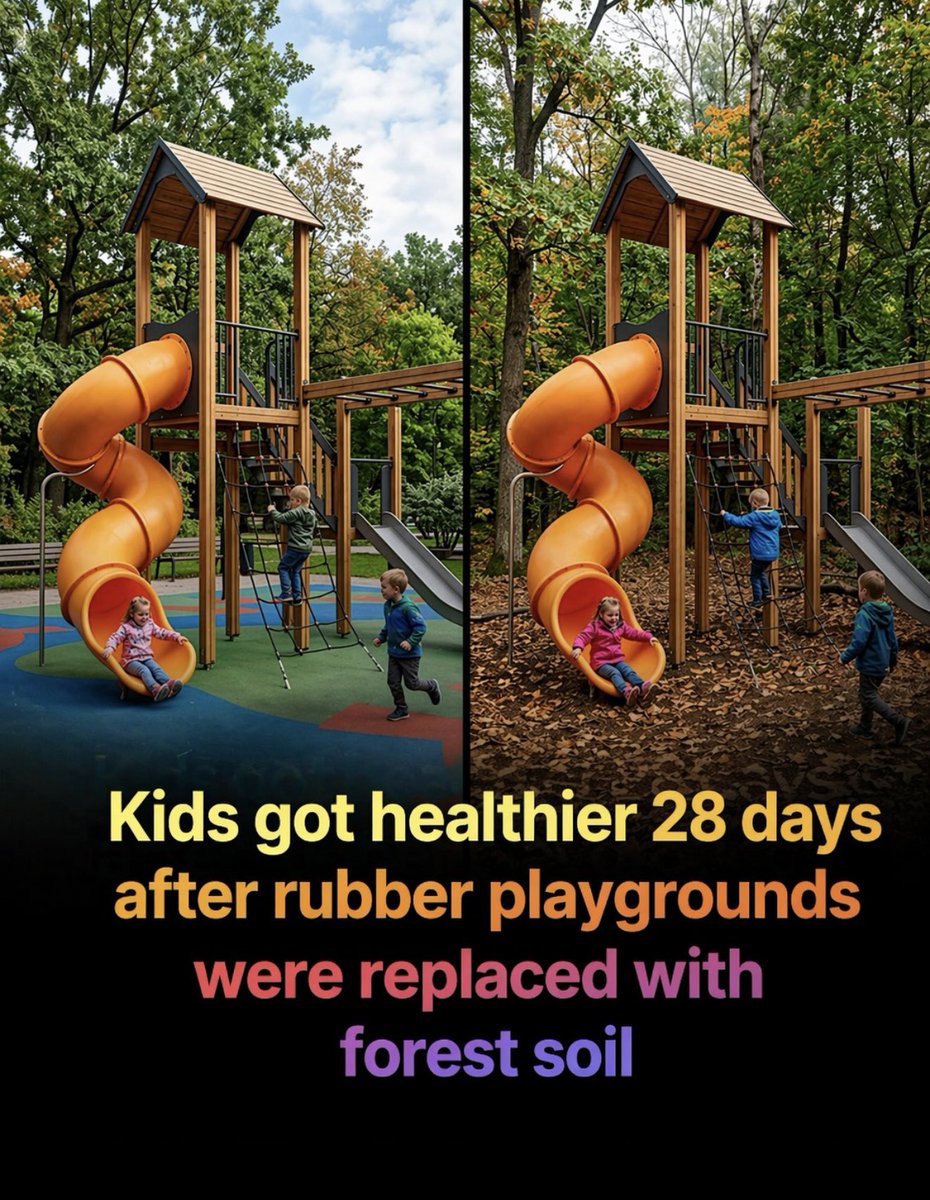
Research in Finland found that simply changing what children play on can quickly influence their immune system.
Scientists redesigned parts of nursery playgrounds by swapping gravel and asphalt for natural forest materials, soil, moss, leaf litter, and native plants, so kids would be exposed to the microbes found in nature. After just 28 days, clear biological differences emerged.
Children who played in these “rewilded” spaces developed a richer mix of microbes on their skin and in their gut. They also showed higher levels of regulatory T-cells, which help the body manage inflammation and reduce the risk of immune overreactions like allergies. These changes were not observed in children who stayed on conventional playground surfaces.
The findings support the biodiversity hypothesis, the idea that limited contact with natural environments, especially in urban life, may be linked to rising allergies and autoimmune conditions.
What stands out is how simple the intervention was. This wasn’t extreme outdoor exposure-just everyday play in a more natural setting. Even small, regular contact with soil and vegetation appears to shape the body’s internal ecosystem and how the immune system develops.
Learn more:
"Dirty Playgrounds: How Rewilding Finnish Schools Transformed
Children's Health." LettsSafari
Glass is one of the rare materials that can be recycled endlessly without losing quality. Its structure doesn’t break down, meaning a bottle can be melted and remade into another bottle again and again, no downgrade, no loss.
That’s very different from plastic. It’s cheaper and lighter to produce, which saves companies money, but the environmental cost is huge, pollution, landfill buildup, and long-term damage to ecosystems.
When recycled properly, glass has real advantages. Using crushed recycled glass (cullet) cuts the need for raw materials like sand and limestone, reduces energy use in furnaces, and lowers carbon emissions significantly. It also means less mining and less strain on natural habitats.
The catch? Recycling only works at its best when glass is clean and sorted by colour. Contamination or mixed glass often pushes it out of the “closed loop” and into lower-value uses instead of new bottles.
Handled properly, glass is one of the strongest examples of a true circular material, something we can keep using without running out or compromising quality.
In 2020, a small city in Wisconsin told its residents they could stop mowing for a month. 435 households joined in. The bees came back the same spring.
Appleton was the first US city to adopt No Mow May. The city council suspended its weed ordinance for the month so residents wouldn't get cited for tall grass. Around 40 acres of lawn across the city went uncut.
Researchers from Lawrence University sampled the unmowed lawns and nearby mowed city parks in the same week. The unmowed lawns had 5 times as many bees and 3 times as many bee species as the mowed parks.
Wisconsin is home to nearly 500 native bee species. Most people have never seen them because they don't live in honeybee hives. They're solitary bees, ground nesters, small black or metallic green insects that fit on a fingernail.
Appleton's unmowed yards gave them food and shelter in the hungry early-spring window when almost nothing else is blooming.
The experiment cost the city nothing. It saved residents fuel and labor. It produced measurable ecological results within 30 days.
Dozens of US cities have adopted the practice since. Has yours?
🌎 it’s EARTH DAY today. I thought I’d show you this!
The FV Margiris, one of the world’s largest supertrawlers. It catches 250 tonnes of fish per day,
Since Brexit, Britain has had the power to stop ships like this from plundering our waters, but we haven’t.
The government says there’s no definition of a “super-trawler,” …. while continuing to let these giants destroy marine ecosystems.
They tax us more to “save the planet” while helping to destroy it 🤡
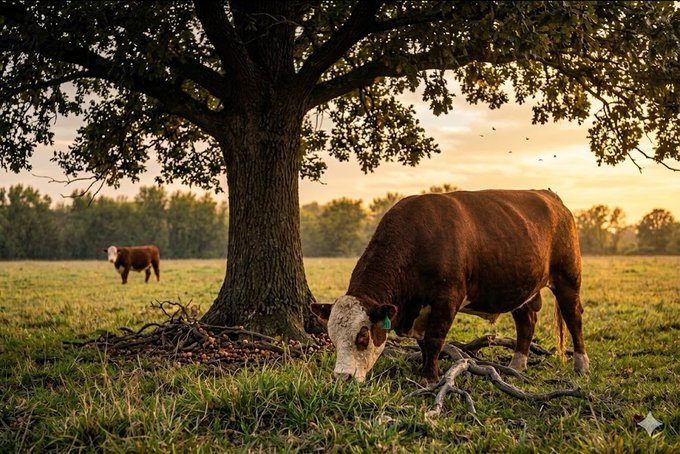
You walk past a field. There is a bull in it. That is what you see. A bull. In a field.
Have a closer look.
The grass under his hooves is deeper-rooted than it looks. Two, three feet down in places, because his grazing has been stimulating root growth for the six years he has been in this field. Those roots are pulling atmospheric carbon into the soil at a rate the climate modellers would weep over if they ever thought to measure it.
The soil itself is alive. A single teaspoon from beneath Gerald contains more microorganisms than there are humans on earth. Bacteria. Fungi. Protozoa. Nematodes. A functioning microbial civilisation built by his manure, year after year, pat after pat, feeding a soil structure that holds rainwater like a sponge.
The earthworms are working. Roughly 400 per square metre under a well-grazed pasture, which is approximately ten times the count in the arable field two hedges over. They are aerating the soil, cycling nutrients, and feeding the badger who patrols the field at night.
The dung beetles are on duty. Up to a hundred species compete for a fresh cowpat in a British summer. They bury it. They break it down. They aerate the ground as they go. Without them the pasture would stop functioning within a year.
The cowpat itself, fresh, supports roughly 300 species of invertebrate in its first week of existence. Flies. Beetles. Wasps. Parasitic nematodes. A small, smelly ecosystem the size of a dinner plate, which Gerald produces ten to fifteen times a day.
The hedgerow around his field is dense because Gerald keeps eating the shoots that try to grow outwards. It supports, in turn, around 2100 species of invertebrate, bird and wildflower. The skylark is nesting in it. The wren is hunting it. The hedgehog is using it as a corridor to the next field.
The yellowhammer is on the gate. The pipit is on the wall. The swifts are working the air above Gerald's head, because the flies around him are what they eat. The barn owl quarters the field at dusk, because the short-grazed grass lets her see the voles.
The wildflowers along his field boundary number, at last count, 31 species. Tormentil. Eyebright. Bird's-foot trefoil. Self-heal. Red clover. The wildflowers support the bees. The bees support the pollination of the next farm's orchard. The orchard supports the apples being pressed in the village.
A horseshoe bat was recorded feeding over the field last August. First record in the parish in thirty years.
The soil beneath Gerald has gained approximately 1.5 tonnes of carbon per hectare per year since he arrived. His field alone has offset the annual emissions of about forty British households.
Gerald does not know any of this.
Gerald is eating grass.
He has been eating grass, continuously, for four years, on the same 12-acre field, and in that time he has supported more biodiversity, more carbon sequestration, and more ecological complexity than most conservation projects with a salaried team and a press office.
He has done it for free. He requires only rain and grass. He has asked for nothing.
People are trying to cancel Gerald for this.
A video from a view years ago, but it resonates on #EarthDay.
An orangutan desperately fights against a bulldozer to protect the last tree in its home.
Most people who plant flowers for pollinators forget one thing.
Bees need water.
A bee that lands on the edge of your pool to drink is a dead bee. They can't swim. A standard birdbath is a drowning trap.
Bees use water for more than drinking. They cool the hive with it. They feed it to larvae.
Mason bees need it to make mud to seal their nest chambers. Some species make 80 water trips a day during nest-building.
When natural water disappears, they end up in pools, ditches, and pesticide runoff.
The pollinator garden you built isn't complete until you give them somewhere safe to drink.