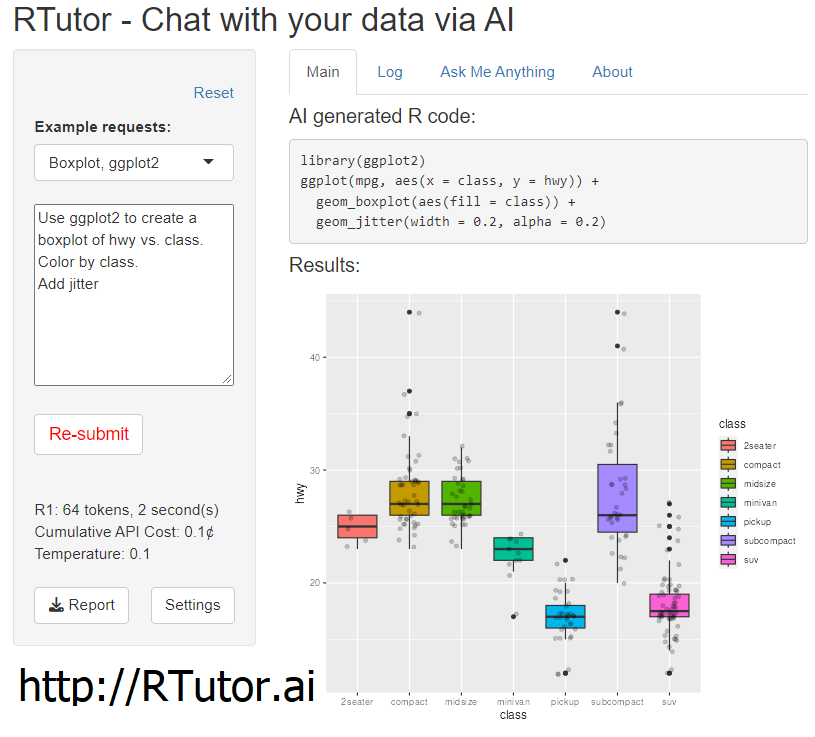
Happy holidays! Introducing https://t.co/Ub3wgs1KVz, an AI-powered app that lets you chat with your data in English! RTutor uses Davinci (#ChatGPT’s sibling) to turn requests into R code, which is executed & results are shown instantly, available as a HTML report in seconds. 1/8
For those interested in studying images in Twitter for academic research purposes, check out this tutorial on image analysis using the #TwitterAPI v2 & AWS
It includes:
-text extraction from images
-object/scene detection
-image content moderation & more https://t.co/eHJGWqiDvn
Our special issue on Images as Data has now been finally officially published! Check it out here: https://t.co/FQFVspOWFt Thanks to our amazing guest editors @CasAndreu @norawwilliams and all authors who contributed to this issue.
@timon_scheuer Hallo @timon_scheuer, das freut mich. Leider wurde das Package von CRAN entfernt, als Alternative würde ich dir DataEditR empfehlen. Wir arbeiten bereits an einem aktualisierten Kapitel. Wenn du mir per Mail schreibst, kann ich dir gerne das vorläufige R-Skript dazu schicken :)
‼️GREAT JOB-OPPORTUNITY 📢
The Department of Communication @uni_mainz is looking for a "Jun Prof of Science Communication" (tenured). Researchers with interest in health, (strategic) environmental, or technology communication are encouraged to apply!
Academic Researchers 🚨🚨 We have a new tool for you that lets you get data from the #TwitterAPI v2 without writing code. Just add your bearer token, build your search queries and download data as CSV or JSON. Try it out and share with other researchers👇https://t.co/c2rwdbvU7L
Students and colleagues who want to get started with #computationalcommunicationscience#ccs often ask which skills they should learn. I made a first attempt to summarize what techniques we use at https://t.co/KjLP4r7ncl (and where to start) https://t.co/WKcnOKu0uC (cc @ica_cm)
Just discovered this new and awesome “Database of Variables for Content Analysis”, edited by @rechtgutgesagt @SabrinaKessler@EddaHumprecht Katharina Sommer-von Schönberg and Laia Castro Herrero @UZH_ch@ZHAW. Incredibly important resource! Check it out: https://t.co/gmrkwW1gOK
This looks great: A GitHub resource that lists popular data cleaning, data viz and stats commands/procedures across different programming languages
https://t.co/39S0Vyvjvq
Early Christmas present: Although our special issue "Images as Data" edited by @CasAndreu and @norawwilliams will only be officially published next year, you can already check out the preprints + code of the accepted articles on our website https://t.co/p4hg5B6z8B #openaccess
As the deadline for #ica22 draws to an end, there's still time to submit to @icahdq’s #scicomm precon “The Science of Science Communication"!
Deadline: 23.01.22
CfP: https://t.co/R1F0FXjjJT
Organizers: @nielsmede @SarahKohler_ @lisabolz@svengesser @franzisca_weder and me
The deadline for #ica22 is coming closer (Nov 5! 😱) and as many of you are probably working on their manuscripts right now, I wanted to share some tips and resources that I find particularly helpful during manuscript preparation. [1/11] @icahdq@ICA_CAT
There's been lots of talk in the social sciences about the replicability of research finding. This is increasingly true in comm. With @CornellUCOMM & @EnvDefenseFund folks, we tried to replicate our prior work on emotional appeals & climate change! (🧵)
https://t.co/CdKjiBOWm8
How do scholars define visual communication? What methods do they use to explore this topic? My latest @qutdmrc research tries to find out by analysing all the research published from 1994-2019 in @VisCommQ and @Sage_VCJ. 👀📷📄 @ICAVisComm@aejmcviscom https://t.co/eDKlNrMYnZ
Wir haben die Sommerpause genutzt, um 134.000 schmutzige Facebook-Anzeigen der Parteien zu sammeln, scannen und auszuwerten.
Hier gehts zu den #TargetLeaks:
🎯 https://t.co/bTnqFtl3kN
How should you start a lit review? Use #litsearchr an #rstats package for automatically searching literature using text-mining and keyword co-occurrence networks. The code allows for reproducible science too! Work by @ElizaGrames https://t.co/BGD1lwSvXv
📑New paper out: @bnemcx & me develop a model about how parties can use #Facebook for digital political marketing (DPM) & provide an exploratory analysis of how 186 parties across 28 EU countries use DPM on FB.
Our paper: https://t.co/NC9En9RgXa
Summary of results in thread:🧵1/n
Very much enjoyed the "#POL11 - Covering Current Political Topics: The Perspectives of Actors, PR, and News Media" panel with great presentations by @k_maubach, Norbert Merkovity, @JohannesThinks, and Francisca Amorim, chaired by Uta Russmann. Check out the recording!
#ECREA2021
@geise_stephanie @regierenpunktde @nrw_sog Bezogen auf die Strategien ist insbesondere eine starke Personalisierung sowie die Nutzung von Negative Campaigning ersichtlich. Gerade die AfD setzt verstärkt auf Angriffe gegen die aktuelle Regierung sowie gegnerische Parteien.
Seit Juni analysieren wir die Online-Wahlwerbung zur #btw21. Erste Einschätzungen zu Akteuren und Strategien haben @geise_stephanie und ich nun veröffentlicht: https://t.co/SdfiRLG0hu @regierenpunktde @nrw_sog
@geise_stephanie @regierenpunktde @nrw_sog Im Artikel betrachten wir die politische Kommunikation (owned media) auf Facebook, Twitter und Instagram. Im gesamten Projekt schauen wir uns zusätzlich die Facebook-Werbebibliothek sowie YouTube und TikTok an. Ergebnisse folgen!