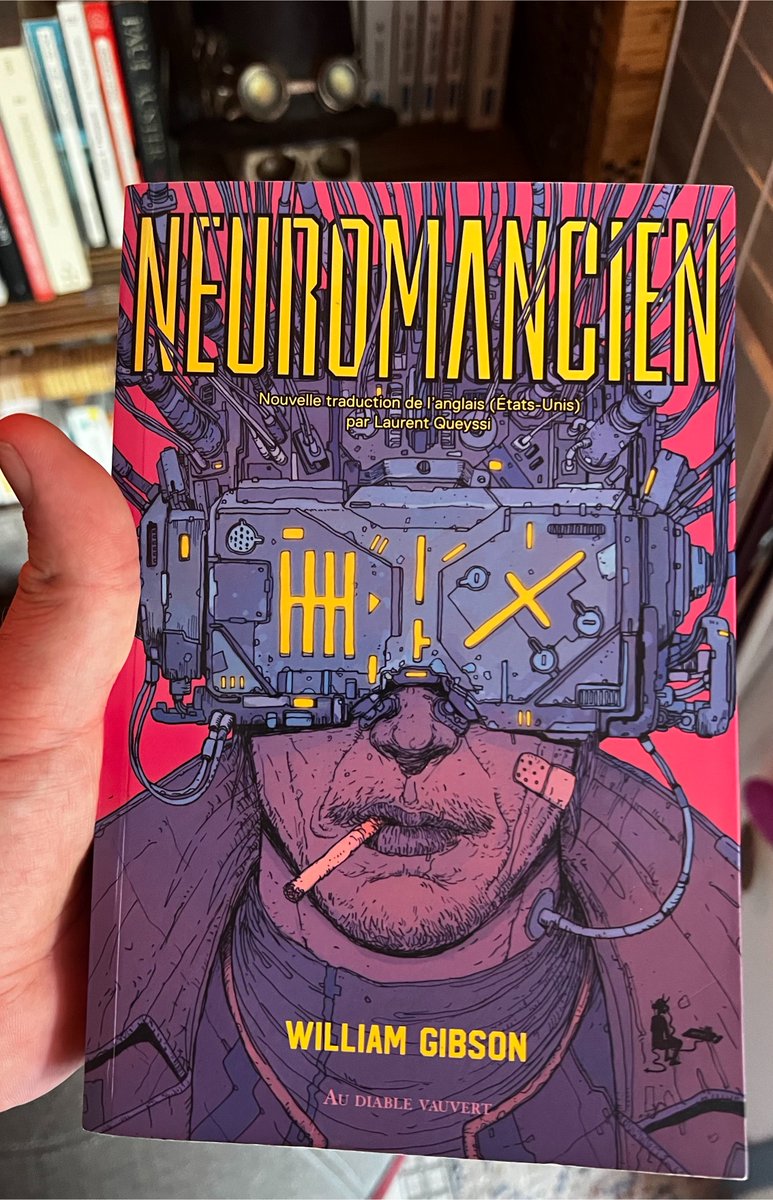
Avant Matrix, Ghost in the Shell et Cyberpunk 2077… il y avait Neuromancien.
Le roman qui a popularisé le cyberespace sera adapté sur Apple TV+ en janvier 2027.
Si vous ne l’avez jamais lu, c’est le moment idéal pour découvrir l’une des œuvres qui ont façonné tout un genre.
Qui l’a déjà lu ? Quel est votre univers cyberpunk préféré ? 🌆💾
most useful skill i've seen this week: 𝗸𝗶𝗹𝗹 𝗔𝗜 𝘀𝗹𝗼𝗽.
coding models move so fast that new products ship with the same AI look. this skill runs an agent audit on your product and strips the AI smell in one pass.
the story behind it:
- the author got tired of roasting AI slop products, so he made a field guide for spotting them
- of course he had to build the guide with AI
- so the anti-slop product could turn into slop at any moment. a perfect loop
- his fix: make it his 𝗺𝗼𝘀𝘁 𝗵𝘂𝗺𝗮𝗻-𝗶𝗻-𝘁𝗵𝗲-𝗹𝗼𝗼𝗽 𝗽𝗿𝗼𝗱𝘂𝗰𝘁 ever. screenshot ugly products one by one, write up why each is slop and how to fix it
he says the hardest part was 𝗸𝗲𝗲𝗽𝗶𝗻𝗴 𝘁𝗵𝗲 𝗰𝗼𝗽𝘆 𝗶𝘁𝘀𝗲𝗹𝗳 𝗳𝗿𝗲𝗲 𝗼𝗳 𝗔𝗜 𝗳𝗹𝗮𝘃𝗼𝗿.
https://t.co/XYykZAhFKK
@amorriscode i don’t really understand what’s the difference with the current extension (that is great too btw)
and is it changing sth for those using claude code CLI?
🚨🇪🇺 LE « CHAT CONTROL » VALIDÉ PAR LE PARLEMENT EUROPÉEN
Le Parlement européen n’a pas réussi à rejeter le projet « Chat Control ».
Seuls 276 eurodéputés ont voté pour le bloquer, alors qu’une majorité absolue de 361 voix était nécessaire.
Le texte est donc adopté et rétablit le dispositif « Chat Control 1.0 », qui autorise les plateformes à analyser volontairement les communications privées afin de détecter des contenus illicites.
Il n'y a aucun meilleur exercice que d'écrire sur papier les idées qu'on a en tête. Les plus grands experts lisent énormément, mais les plus grands penseurs écrivent.
Mon ancien patron lisait 1000/2000 articles scientifiques par an et des dizaines de bouquins de littérature ou d'analyses historiques dans son temps libre. Mais surtout, il avait pris l'habitude de réécrire lui même l'abstract de ce qui lisait, ce qui lui a permis de faire des liens insoupçonnés entre deux configuration apparemment différentes.
Plus généralement, c'est ce que font aussi les grands dirigeants. Dans cette interview, Dario Amodei avoue s'aider de Claude pour la phase de recherche, mais il continue d'écrire lui même ses écrits.
C'est fondamental car celui qui n'est pas auteur de ses idées, de ses propres mots, ne peut avoir d'autorité. Le mot auteur et autorité ont une étymologie commune : auctor et auctoritas.
C'est d'ailleurs la grande tragédie des dirigeants occidentaux, car les idées qu'ils affichent ne sont pas les leurs. Mais c'est une autre histoire.
Je vous partage la transcription de l'interview d'Amodei traduite en français (par Claude).
L'intervieweuse (Emily Chang) : Je sais à quel point vous aimez écrire — vos essais sont connus. Vous servez-vous de Claude pour vous aider à rédiger ?
Dario Amodei : Oui. Je n'en suis toutefois pas encore au stade où j'accepte d'intégrer un texte directement rédigé par Claude, parce que j'ai un style très particulier et que je me montre assez pointilleux là-dessus. Je m'appuie plutôt sur Claude pour réfléchir à mes idées, explorer les grands thèmes, ou repérer des références que je pourrais mobiliser. Il joue donc un rôle d'appui. J'ignore combien de temps il nous reste avant que Claude écrive mieux que moi : nous n'y sommes pas tout à fait, mais cela finira certainement par arriver.
L'intervieweuse : Moi aussi j'aime écrire, et j'ai le sentiment que l'écriture oblige à se débattre avec ses idées ; il y a là une part importante de réflexion critique. Ne risquons-nous pas de la perdre si nous laissons Claude écrire à notre place ?
Dario Amodei : Cela m'inquiète un peu, oui — et c'est d'ailleurs la moitié de la raison pour laquelle j'écris moi-même. J'écris pour un public extérieur, bien sûr, puisque beaucoup de gens me lisent, mais tout autant pour clarifier ma propre pensée, savoir quelle direction prendre ensuite, et créer un point de référence commun entre les autres et moi. Nous sommes encore en train de chercher comment employer l'IA sans sacrifier ces bénéfices. Ma pratique actuelle y parvient, je crois : j'utilise Claude pour la recherche documentaire et pour m'aider à organiser mes idées. Si nous lui déléguions tout de bout en bout — du type « écris-moi un essai sur les risques de l'IA » —, non seulement il n'écrirait pas ce que je pense réellement, mais je perdrais précisément ce bénéfice. À mesure que les modèles progresseront, il existera sans doute une manière de les mobiliser plus directement dans la rédaction tout en préservant ces avantages. Ce sera toutefois une affaire de nuance, pas une réponse unique et tranchée : il faudra en trouver l'équilibre avec le temps.
ELON MUSK EMAILED HIS TEAM: "ANDREJ IS THE #2 COMPUTER VISION MIND ON EARTH, AFTER ILYA SUTSKEVER."
At 22 Andrej Karpathy could solve a Rubik Cube in 16 seconds. he spent the next 17 years cracking a harder pattern: teaching machines to see.
the arc almost nobody traces:
→ at 15 he left Slovakia for Toronto to build quantum computers
→ quit it for AI because he "couldn't get his hands dirty"
→ studied neural nets under Geoffrey Hinton, the godfather of the field
→ did his Stanford PhD under Fei-Fei Li, teaching machines to describe images
in 2012 he wrote that computer vision was "really, really far away."
in 2014 he beat Google best model by hand 5.1% error to its 6.8%.
then it compounded.
→ co-founded OpenAI in 2015
→ Musk pulled him to Tesla to run Autopilot
→ fused 8 cameras into one 3D brain that could actually drive
when Musk poached him, he wrote: "The OpenAI guys are going to want to kill me. But it had to be done."
5 years later he returned to OpenAI, coined "vibe coding," and launched his own school.
now he trains Claude at Anthropic the mind teaching the model to build its own model of the world.
Meta is dangling $100M signing bonuses to poach the people sitting beside him.
and here's the part that should scare you:
one of the sharpest programmers alive just admitted he's never felt more behind.
how do you keep up with a pace this fast?
every claude code skill on your machine, with receipts so real usage mined from your transcripts : local and open source
how many does claude actually use? use this to find out (including a lot of other cool features)
https://t.co/kVgHyMQ9Ki
Seedance 2.0 on OpenArt AI
Prompt:
Main subject: young Korean woman, early 20s, natural everyday appearance, faded charcoal-grey sleeveless crop top, loose high-waisted light-wash jeans, black canvas sneakers, black cord necklace, black wavy hair in a messy side ponytail with wispy bangs. Realistic skin texture, minimal makeup, warm and approachable personality. Maintain consistent identity, clothing, hairstyle, and appearance throughout the entire video.
Location: Authentic Korean residential neighborhood during a calm late morning. Narrow concrete alleys, low-rise homes, small terraces, potted plants, laundry lines, bicycles, utility poles, overhead wires, mature trees casting moving shadows, quiet residential atmosphere. No stores, advertisements, cafés, crowds, or commercial activity.
Visual Style: Ultra-realistic documentary realism. Genuine candid behavior. Natural body language. Unscripted slice-of-life feeling. Strong environmental authenticity. Rich real-world details and believable human motion.
Camera Style: Early-2000s consumer DV camcorder aesthetic. Friend casually recording everyday moments. Heavy handheld shake, imperfect framing, frequent autofocus hunting, lens breathing, exposure pumping when moving between sun and shade, occasional motion blur, subtle rolling shutter, mild digital compression artifacts, faded colors, soft contrast, slight sensor noise. No stabilization. No cinematic camera moves. No modern color grading.
00:00–00:02
Outside a small house entrance. She sits on a low concrete wall adjusting her ponytail with both hands raised. A light breeze moves loose strands of hair. She smiles naturally while the camera struggles to hold focus.
00:02–00:04
The camera follows her into a narrow alley lined with potted plants and concrete walls. She notices a stray cat approaching and crouches down. Framing drifts off-center as the operator tries to keep up.
00:04–00:06
She gently pets and feeds the cat. Autofocus repeatedly shifts between her face and the animal. Morning sunlight flickers through leaves overhead.
00:06–00:08
Small front yard beside her house. She hangs laundry on a clothesline while fabrics sway in the breeze. Exposure changes as clouds briefly pass overhead.
00:08–00:10
On a quiet terrace with a ceramic coffee cup. She sits comfortably watching the neighborhood, occasionally brushing hair behind her ear. Loose handheld side angle with natural camera drift.
00:10–00:12
Close side profile. Someone off-camera greets her. She turns, raises her hand, smiles warmly, and casually says, “Annyeong.” The camera catches the moment slightly late.
00:12–00:15
Walking slowly down a tree-lined residential lane holding her coffee cup. She notices the camera, gives a small genuine smile, then looks away and continues walking. Recording cuts abruptly to black mid-motion as if the camcorder was switched off.
Audio: Natural ambient sound only — morning birds, distant motorcycles, light wind, leaves rustling, faint neighborhood chatter, cat sounds, footsteps on concrete, fabric moving on clotheslines, subtle residential ambience. No music. No sound design. No narration.
Goal: Authentic Korean neighborhood life captured like a forgotten home video from the early 2000s — candid, imperfect, realistic, warm, and deeply believable.
Une clé USB qui te rend invisible sur internet. 👻
Tails, la distrib utilisée par Snowden, force tout le trafic via Tor et n'existe plus une fois éteinte.
#tails#linux#tor#anonymat#techatace