2. The Streetlight Effect:
A drunk searches for his keys under the lamppost, not because he dropped them there, but because that's where the light is.
We measure what is easy, not what is true.
Easy data builds confident fools.
Uzun süredir üzerinde çalıştığım bir projeyi bugün duyurmanın mutluluğunu yaşıyorum.
Bilge ve Yonga: 7-12 yaş çocuklar için 32 kitaplık bir bilgisayar mimarisi serisi. Tamamı ücretsiz, bugün yayında.
Yıllardır üniversitede bilgisayar mimarisi anlatıyorum. Öğrencilerin çoğu bir işlemcinin içinde ne olup bittiğini ilk kez ikinci ya da üçüncü sınıfta duyuyor. Oysa bu konuların özü, doğru anlatıldığında bir çocuğun rahatlıkla kavrayacağı şeyler: bir anahtar açılır ve kapanır, her şey sıfır ve birle yazılır, işlemci bir buyruğu alır, anlar ve yapar.
Seride meraklı bir çocuk olan Bilge ile küçük robot arkadaşı Yonga var. Bilge sorar, Yonga anlatır. Kumdan yonga nasıl çıkar, bilgisayar neden ısınır, önbellek ne işe yarar, bir program nasıl makine diline dönüşür. Her kitabın sonunda kısa bir "Bugün Ne Öğrendik?" özeti var.
426 sayfa, her sayfanın kendi çizimi var. Kapaklarla birlikte 458 özgün görsel. Tarayıcıda okunuyor, isteyen PDF ya da EPUB indiriyor.
Bir şeyi de açıkça söyleyeyim. Bu seriyi birkaç yayınevine anlattım, destek çıkan olmadı, çoğundan yanıt bile gelmedi. Açık erişimi ilke olarak zaten tercih ediyorum, kitaplar bu yüzden ücretsiz. Ama çocukların kitabı eline alıp sayfasını çevirme deneyimini yaşayamıyor olması benim için bir eksiklik.
Ülkemizde yayıncılığın mürekkep ve kağıt masrafını hesaplamanın ötesine geçmesi gerekiyor. Bir eserin değeri satacağı kopya sayısıyla ölçülmüyor.
Basmak isteyen bir yayınevi çıkarsa kapım açık. Tek koşulum, kitapların dijitalde ücretsiz kalması.
https://t.co/o5sHPrIwzT
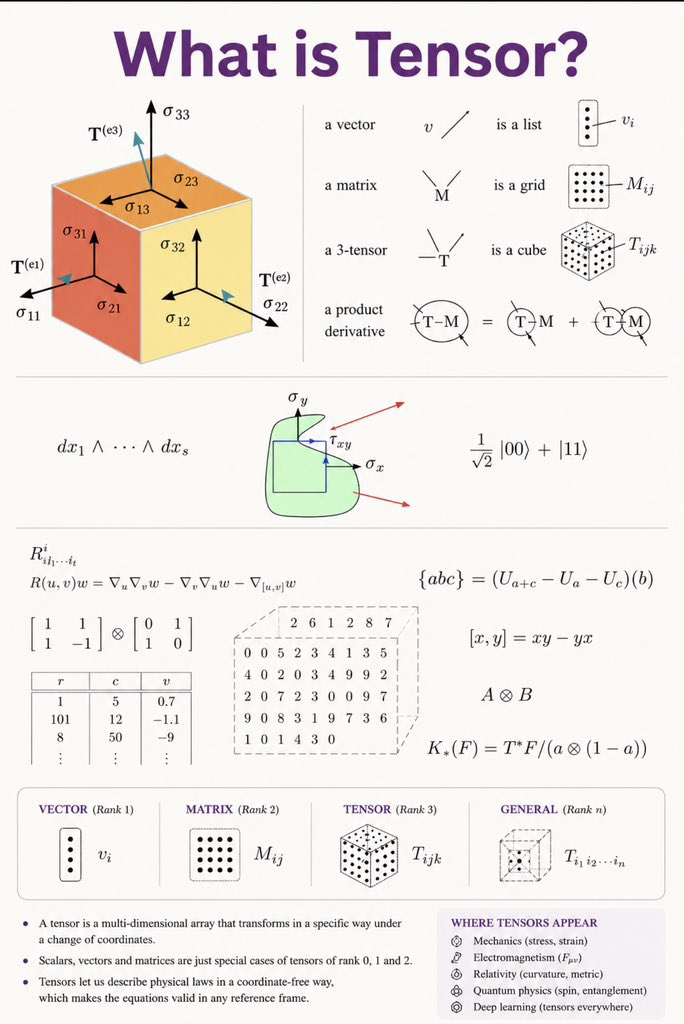
people often think tensors are just bigger matrices.
they’re not.
a matrix is one kind of tensor, just as a vector is another. tensors are the broader idea. they’re mathematical objects that represent relationships across multiple dimensions while preserving those relationships even when you change your coordinate system. that’s why physicists care much more about how a tensor transforms than how it’s stored in memory. the array of numbers is just one representation. the underlying object is independent of your choice of coordinates.
this is what makes tensors so powerful. the stress inside a bridge, the curvature of spacetime, the electromagnetic field, the inertia of a robot arm, and the activations inside a neural network can all be described using tensors. at first glance these seem like completely unrelated problems. mathematically, they’re variations of the same language. tensors let you describe quantities that have direction, interaction, and structure in a way that remains consistent regardless of your point of view.
the deeper lesson is that mathematics evolves by abstraction. numbers describe single values. vectors describe direction. matrices describe transformations. tensors describe relationships in arbitrarily many dimensions. each step isn’t about making mathematics more complicated. it’s about building a language capable of describing a richer reality. that’s why once you understand tensors, you start seeing the same mathematical structure hiding underneath robotics, computer vision, quantum mechanics, relativity, continuum mechanics, and deep learning.
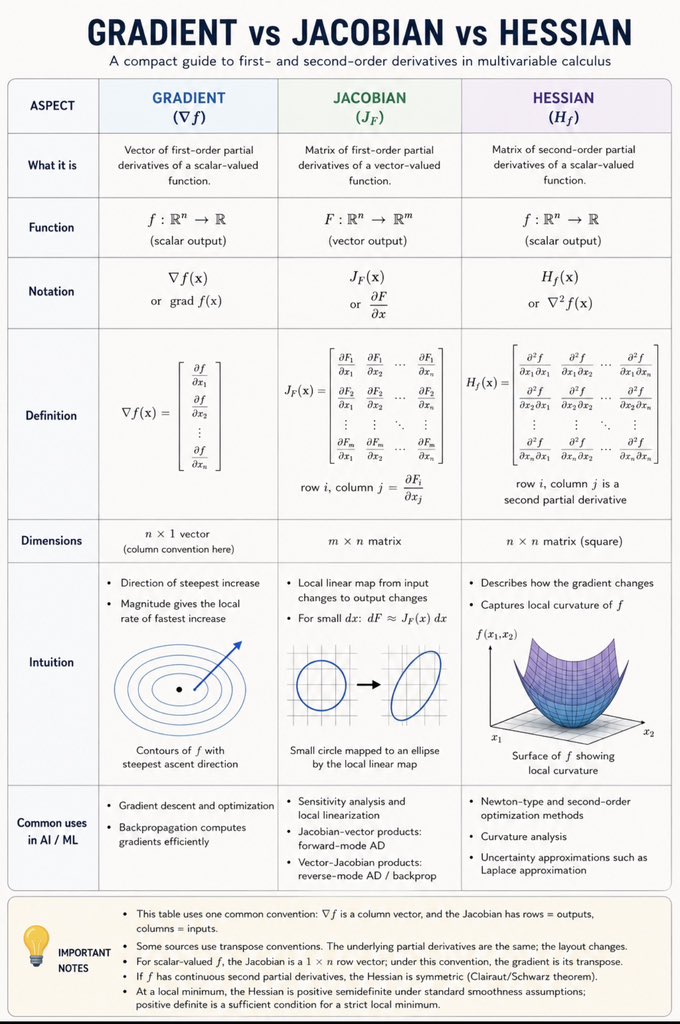
gradient, jacobian, and hessian are really answering three different questions about a function. the gradient asks, “which direction should i move to increase this value the fastest?” the jacobian asks, “if i change the inputs a little, how do all the outputs change?” the hessian goes one level deeper and asks, “how is that direction itself changing?” once you see them as different layers of information instead of different equations, the notation becomes much less intimidating.
imagine you’re hiking up a mountain. the gradient points toward the steepest path uphill. now imagine the mountain itself is constantly changing shape as you walk. the hessian tells you whether the surface is flattening out, becoming steeper, or curving in another direction. the jacobian is slightly different. instead of a single mountain, imagine a machine with many knobs and many outputs. the jacobian tells you how every output responds when you turn each knob. it is the local map between inputs and outputs.
this is why these three ideas appear everywhere in robotics, optimization, computer vision, and machine learning. gradient descent uses the gradient to decide where to move. robot kinematics uses the jacobian to convert joint motion into end effector motion. second order optimization uses the hessian to understand curvature and converge faster. they are not separate mathematical tricks. they are different ways of asking how a system changes, and change is ultimately what engineering is trying to understand.
This is how football should be visualized.
Spain vs. Argentina paints a clear picture
The graph shows real momentum, rendered in 3D, supported by data on goals, shots, xG and more.
Spain are world champions again,
Ferran Torres made sure of it.
Graph by Intelligoal
Arjantin sen nasıl kağıttan bir kaplanmışsın? 80'lerin şiir gibi oyunu ile büyüleyen Maradona'lı Arjantin'inden 120 dak boyunca bir sn oyna(t)mamaya nasıl gelmiş olay? Diego Küba'nın ödülü için ABD'yi umursamazken ne ara ırkçı, üç kağıtla oyun kazanan, Trump oyuncağı oldunuz ?
The Chinese president stood on a stage in Shanghai and laid out China's entire AI playbook in one speech.
It was his first-ever in-person appearance at the World AI Conference. I went through the whole thing and pulled out everything that matters.
- he opened with his signature maxim that great changes unseen in a century are unfolding across the world.
- he said AI development should not be a solo performance by a single country but a symphony of international cooperation.
- he reaffirmed China's commitment to open source AI in the name of openness and shared benefit.
- he warned against overstretching the concept of national security in AI, where one country puts its own security above everyone else's.
- he said China opposes the emergence of new historical injustices in AI, one of the strongest-worded lines in the speech.
- he pledged 5,000 AI training opportunities for developing countries over the next five years, naming ASEAN, the Arab League, the African Union, CELAC, the SCO, and BRICS.
- he committed to giving 30 countries access to a Chinese AI weather system that provides early disaster warnings.
- a day before the speech, 29 countries signed the agreement creating a new World AI Cooperation Organization headquartered in Shanghai.
strip away the politics and one thing stands out to me. he didn't pitch benchmarks or chatbots. he pitched AI as infrastructure, weather warnings for countries that lose thousands of lives to storms they never saw coming, and training programs for regions the AI boom has skipped.
meanwhile most of the Western AI conversation revolves around which lab ships the next frontier model.
I don't care who wins the race. I care whether the computing power reaches the people who need it.
The full speech is below, and it's worth your time.
China open-sourced a model that reconstructs any scene in 3D from a regular video, in real-time.
one camera. no LiDAR. 10,000+ frames without falling apart.
just walk around with your camera and watch the entire world get rebuilt in 3D at 20 fps.
→ runs at ~20 FPS on a single GPU
→ Stable over 10,000+ frames
→ Beats optimization-based methods on benchmarks
→ Works on drone footage, driving videos, indoor walkthroughs
100% open source.
Reşad Ekrem Koçu'nun İstanbul Ansiklopedisi maddeleri dijitalleştirilmiş, bugün fark ettim. Büyük emek var https://t.co/YpyB0H5EdY
Teşekkürler @khasedutr ve @SALT_Online
Görsel Haseki Bostan Hamamı'nın iç mekân illüstrasyonu, emeği geçen Hüsnü & Sabiha Bozcalı olarak kaydedilmiş
“Loop engineering” is a hot buzzphrase after mentions of it by Boris Cherny (Claude Code’s creator) and Peter Steinberger (OpenClaw's creator) went viral on social media. Loops are now a key part of how we get AI agents to iterate at length to build software. In this letter, I’d like to share my 3 key loops, shown in the image below, for building 0-to-1 products. These loops guide not just how I build software, but also how I decide what software to build.
Agentic coding loop: Given a product specification and optionally a set of evals (that is, a dataset against which to measure performance), we can have an AI agent write code, test its work, and keep iterating until the code is bug-free and meets its specification. This idea of closing the loop took off around the end of last year, and it has been a game changer in enabling coding agents to work longer productively without human intervention. For example, over the weekend, I was building an app for my daughter to practice typing, and my coding agent could easily work for around an hour, using a web browser to check what it had built multiple times before getting back to me, without needing my intervention.
The engineering loop executes quickly. Every few minutes, the coding agent might build and test a new version of the software. I hear frequently from developers who are finding new ways to engineer more effective engineering loops. This is an active area of invention!
Developer feedback loop: In this loop, a developer examines the current product and steers the coding agent to improve it. Last year, a lot of developers (including me) were acting as the QA (quality assurance) function for our coding agents, manually finding bugs and then asking the agent to fix them. But with coding agents much more able to test their own code, the amount of time we need to spend on this function has decreased significantly. This allows us to make higher-level product decisions, such as what key features to offer, where the UI needs improvement, and so on.
The developer-feedback loop operates over time intervals between tens of minutes and hours — that's how frequently a developer might review a product and give feedback. In the case of the typing app, I changed my mind a few times about the visual design, what cat costumes she can unlock as she learns (she loves cats), and the user flow for a grown-up to log in and steer the child's learning experience.
When a developer has a clear vision for what to build, it is still a lot of work to translate that vision into a specification for a coding agent to implement. Further, after the developer has seen an implementation, they might update (or perhaps clarify) the spec to steer it toward what they want. If you find that the system repeatedly runs into certain problems, building a set of evals for the agent becomes useful.
AI-native teams are increasingly using AI to help shape product direction, for example, automating the gathering and analysis of usage data, summarizing written and verbal customer feedback, or carrying out competitive analysis. However, for pretty much all the products I’m involved in, I see humans as having a significant context advantage over current AI systems — we know a lot more than the AI system about the users and the context the product has to operate in — and thus humans play a critical role. Many people describe this human contribution as “taste,” but I prefer to think of it as humans having a context advantage, since that gives us a clearer path to helping AI systems get better. This also speaks to why this step can’t be automated: So long as the human knows something the AI does not, human-in-the-loop is needed to to inject that knowledge into the system.
External feedback loop: This includes a wide range of tactics like asking a few friends for feedback, launching to alpha testers, or putting the code into production with A/B testing. These tactics are usually slow, rarely taking less than hours and sometimes taking days or even weeks. This data informs the developer vision, which in turn continues to drive the detailed product spec, which in turn drives the coding agent.
With coding agents speeding up software development, more engineers are starting to play a partial product management role. For many engineers who are growing into this role, the hardest part is shaping the product vision and striking a balance between building (bridging the gap between vision and spec) and getting user feedback to evolve the vision. It is important to do both!
I will write more about how to do this in future posts, but for now, I find it encouraging that engineers are playing an expanded role (just as product managers and designers now do more engineering).
[Original text: The Batch]
10 free textbooks from MIT, Stanford, and Berkeley that you can download legally right now.
→ Introduction to Linear Algebra - Gilbert Strang, MIT
The textbook behind the most-watched math course in history. 20 million views on OCW. Every ML engineer learned this math from one quiet professor.
https://t.co/Q5ZHXrBuD1
→ Mathematics for Computer Science - MIT 6.042
Proofs, discrete math, probability. The actual foundation of CS that nobody tells undergrads about until it's too late.
https://t.co/FOLUDXTubX
→ Convex Optimization - Stephen Boyd, Stanford
Used in every serious ML and control systems course on earth. Cambridge University Press gave Boyd permission to keep it free on his own site.
web. stanford. edu/~boyd/cvxbook/bv_cvxbook.pdf
→ CS229 Machine Learning Notes - Andrew Ng, Stanford
Not the Coursera version. The actual Stanford graduate course notes. Dense, precise, and the closest thing to a grad school education you can download in one PDF.
https://t.co/De8lcX59zt
→ An Introduction to Statistical Learning - Stanford / USC
The book three statisticians from Stanford and USC made free because they wanted everyone to learn it. 290,000 people have taken the companion course on edX.
https://t.co/TusQK9FDOc
→ Computational and Inferential Thinking - Berkeley Data 8
The textbook behind Berkeley's most popular course. Data science from scratch, built to be understood without a math degree first.
https://t.co/xD2XAE49WA
→ Dive into Deep Learning - Berkeley / Amazon
Jensen Huang called it "excellent." 500 universities across 70 countries use it. Every concept runs as live code directly in the browser.
https://t.co/GJfBeDtJVO
→ Introduction to Probability - Blitzstein & Hwang, Harvard
The official textbook of Harvard's Stat 110, which has been called the best probability course ever put on YouTube. Free second edition online.
https://t.co/8dVzOUZDlH
→ The Elements of Statistical Learning - Hastie, Tibshirani, Friedman, Stanford
The graduate-level version of ISLR. Springer makes it free as a PDF. Researchers keep a copy permanently in their downloads folder.
https://t.co/PzdmjooaZW
→ MIT OCW Online Textbooks Index - 45+ books across every department
One page. Every free MIT textbook organized by subject. Algorithms, physics, economics, engineering. All open access.
https://t.co/eAjUcYzNa0
Save this before someone makes them take it down.
(They won't. But save it anyway.)
In nearly 5 years of modern generative ai, this is the first book I’m seeing with a super high level of coverage and comprehension.
> language modelling
> inference optimisation
> RL and its methods
> system scaling
> applied concepts like agentic ai, rag, memory
> environments and benchmarking
These fields have a subtle boundary differentiating them, but ultimately overlap in modern applications. Agents require system scaling, memory needs inference optimisation, rl requires understanding of environments and benchmarks.
For the first time in my exp, all in one place. Found this on paperswithcode[.]co
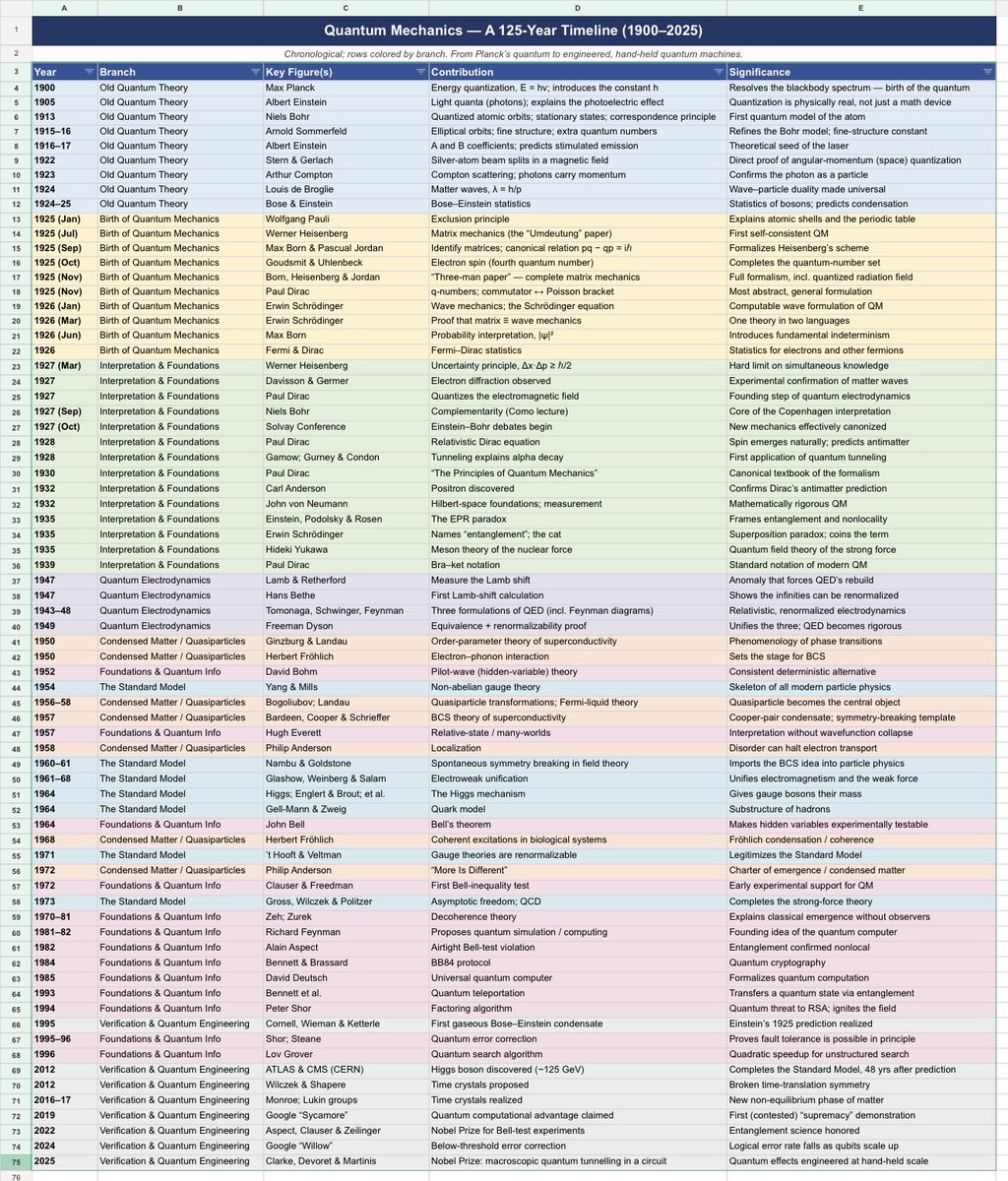
Quantum mechanics turns 100 this year. I put the whole history on one sheet — 72 entries, 1900 to 2025.
Planck kicks it off in 1900. The core of the theory gets built in about 18 months across 1925-26: matrix mechanics, then wave mechanics, then the proof they’re the same theory, then Born’s probability rule and uncertainty….After that it stops being a single field. It splits into QED, condensed matter, particle physics, and quantum information — four separate bodies of work coming off one root.
I colored the rows by branch so you can actually see those tracks running at the same time instead of flattening them into one line.
Every row is just the year, the people, what they did, and why it mattered.
It runs all the way to where things stand now: error-corrected qubits and a 2025 Nobel for quantum tunneling in a single circuit. A century of physics you can scan in a couple of minutes.
Zamanında Harvard’daydım, kalabilirdim döndüm.
Dünyayı değiştirecek 35 bilim insanı arasında olabilirdim, 25 ayrı kanseri tek bir kan testinden yıllar öncesinde teşhis edebilecek, risk analizi yapacak bir teknoloji 5 yıl önce geliştirdim, validasyon için bırakın yatırım bulmayı kimseye anlatamadım.
ABD ‘de olsaydım işler belki farklı olurdu lakin kalmayı tercih ettim.
O yüzden kimse tebrik etmedi, bilmiyor diye çok da şey etmeyin, biz kimi biliyoruz ki işimiz düşmeden. Utkan Hocayı tebrik ederim yolu açık olsun…






![AndrewYNg's tweet photo. “Loop engineering” is a hot buzzphrase after mentions of it by Boris Cherny (Claude Code’s creator) and Peter Steinberger (OpenClaw's creator) went viral on social media. Loops are now a key part of how we get AI agents to iterate at length to build software. In this letter, I’d like to share my 3 key loops, shown in the image below, for building 0-to-1 products. These loops guide not just how I build software, but also how I decide what software to build.
Agentic coding loop: Given a product specification and optionally a set of evals (that is, a dataset against which to measure performance), we can have an AI agent write code, test its work, and keep iterating until the code is bug-free and meets its specification. This idea of closing the loop took off around the end of last year, and it has been a game changer in enabling coding agents to work longer productively without human intervention. For example, over the weekend, I was building an app for my daughter to practice typing, and my coding agent could easily work for around an hour, using a web browser to check what it had built multiple times before getting back to me, without needing my intervention.
The engineering loop executes quickly. Every few minutes, the coding agent might build and test a new version of the software. I hear frequently from developers who are finding new ways to engineer more effective engineering loops. This is an active area of invention!
Developer feedback loop: In this loop, a developer examines the current product and steers the coding agent to improve it. Last year, a lot of developers (including me) were acting as the QA (quality assurance) function for our coding agents, manually finding bugs and then asking the agent to fix them. But with coding agents much more able to test their own code, the amount of time we need to spend on this function has decreased significantly. This allows us to make higher-level product decisions, such as what key features to offer, where the UI needs improvement, and so on.
The developer-feedback loop operates over time intervals between tens of minutes and hours — that's how frequently a developer might review a product and give feedback. In the case of the typing app, I changed my mind a few times about the visual design, what cat costumes she can unlock as she learns (she loves cats), and the user flow for a grown-up to log in and steer the child's learning experience.
When a developer has a clear vision for what to build, it is still a lot of work to translate that vision into a specification for a coding agent to implement. Further, after the developer has seen an implementation, they might update (or perhaps clarify) the spec to steer it toward what they want. If you find that the system repeatedly runs into certain problems, building a set of evals for the agent becomes useful.
AI-native teams are increasingly using AI to help shape product direction, for example, automating the gathering and analysis of usage data, summarizing written and verbal customer feedback, or carrying out competitive analysis. However, for pretty much all the products I’m involved in, I see humans as having a significant context advantage over current AI systems — we know a lot more than the AI system about the users and the context the product has to operate in — and thus humans play a critical role. Many people describe this human contribution as “taste,” but I prefer to think of it as humans having a context advantage, since that gives us a clearer path to helping AI systems get better. This also speaks to why this step can’t be automated: So long as the human knows something the AI does not, human-in-the-loop is needed to to inject that knowledge into the system.
External feedback loop: This includes a wide range of tactics like asking a few friends for feedback, launching to alpha testers, or putting the code into production with A/B testing. These tactics are usually slow, rarely taking less than hours and sometimes taking days or even weeks. This data informs the developer vision, which in turn continues to drive the detailed product spec, which in turn drives the coding agent.
With coding agents speeding up software development, more engineers are starting to play a partial product management role. For many engineers who are growing into this role, the hardest part is shaping the product vision and striking a balance between building (bridging the gap between vision and spec) and getting user feedback to evolve the vision. It is important to do both!
I will write more about how to do this in future posts, but for now, I find it encouraging that engineers are playing an expanded role (just as product managers and designers now do more engineering).
[Original text: The Batch]](https://pbs.twimg.com/media/HMEtxp3bsAARJdi.jpg)

![TheGlobalMinima's tweet photo. In nearly 5 years of modern generative ai, this is the first book I’m seeing with a super high level of coverage and comprehension.
> language modelling
> inference optimisation
> RL and its methods
> system scaling
> applied concepts like agentic ai, rag, memory
> environments and benchmarking
These fields have a subtle boundary differentiating them, but ultimately overlap in modern applications. Agents require system scaling, memory needs inference optimisation, rl requires understanding of environments and benchmarks.
For the first time in my exp, all in one place. Found this on paperswithcode[.]co](https://pbs.twimg.com/media/HLuhEeJbgAA1ukW.jpg)