Introducing Claude Opus 5.5, the first model in our new Claude 5.5 family.
It performs at the level of Claude Fable 5.1 for most tasks, and costs 40% less to run than Opus 5.
Introducing Claude Fable 5: a Mythos-class model that we’ve made safe for general use.
Its capabilities exceed those of any model we’ve ever made generally available.
Introducing Claude Opus 4.6. Our smartest model got an upgrade.
Opus 4.6 plans more carefully, sustains agentic tasks for longer, operates reliably in massive codebases, and catches its own mistakes.
It’s also our first Opus-class model with 1M token context in beta.
Introducing Claude Opus 4.5: the best model in the world for coding, agents, and computer use.
Opus 4.5 is a step forward in what AI systems can do, and a preview of larger changes to how work gets done.
Come join Avatar’s poster session tmr 11am-2pm at
West Ballroom A-D #7010
We will be there for walk-throughs, questions, and random brainstorming about the future agent systems! @james_y_zou, Shiyu, @kaidicao
Thrilled to share that we've closed $28M in funding, led by @CRV, with continued support from @wing_vc and @saranormous. Also excited to onboard strategic partners @SnowflakeDB and @databricks!
https://t.co/TNsK3zSkoM
Building the world’s best models for RAG and search 🧵🧵🧵:
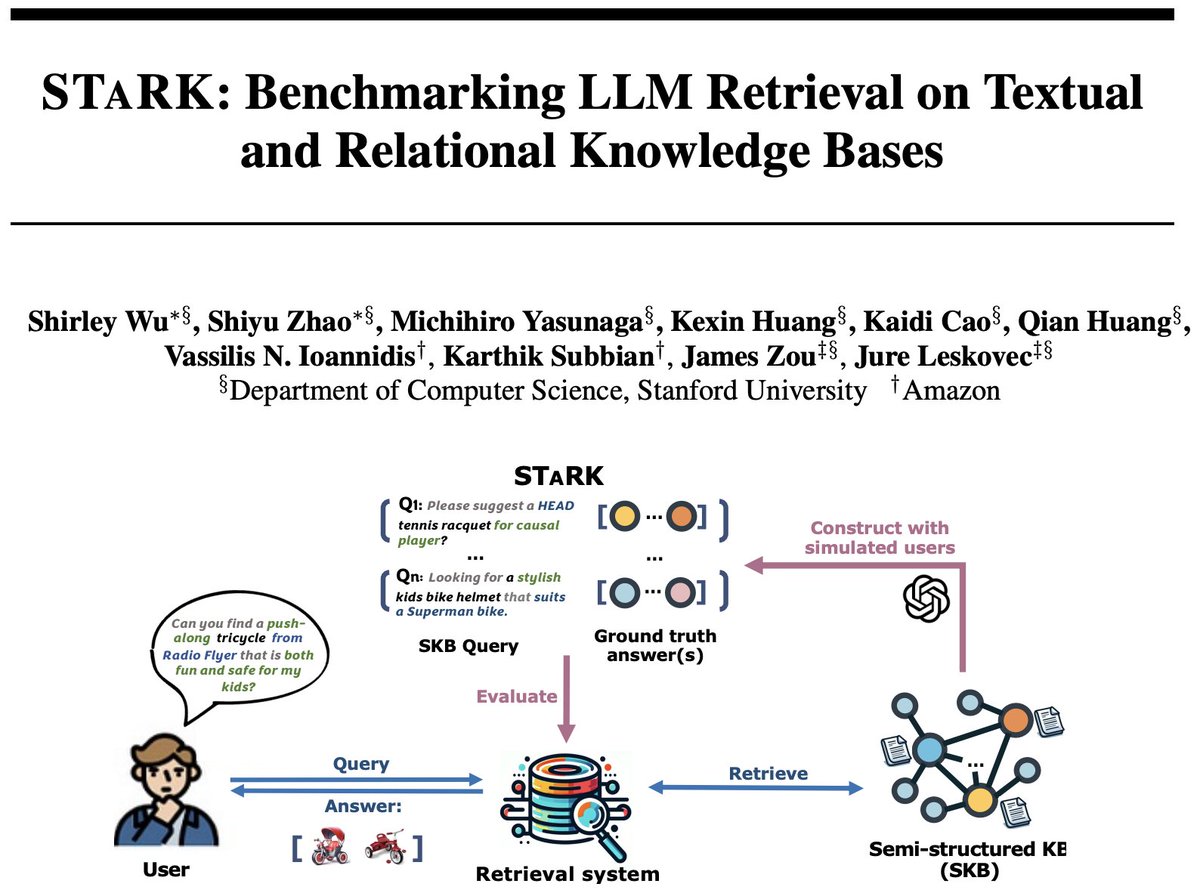
Thrilled to release 🌟STaRK 🌟 - A large-scale LLM retrieval benchmark on semi-structured knowledge bases.
While LLMs excel at reasoning and semantic retrieval, they struggle with more complex tasks. Especially when real-world user queries require a combination of unstructured (text) and structured (relational) knowledge. How do we track the capability of LLM-driven systems in handling such tasks❓
STaRK features large-scale knowledge bases with natural-sounding, diverse, and useful queries, which involves a blend unstructured and structured information. Moreover, we develop 📷 an automatic pipeline to generate the ground truth answers.
STaRK presents significant opportunities by offering a comprehensive retrieval testbed on 🎁product recommendations, 📜academic paper searches, and 💊precision medicine inquiries.
Spoiler Alert!
With STaRK, we found that current LLM retrieval systems CANNOT accurately retrieve information
➡️ More powerful systems are needed!
Preprint: https://t.co/ozAIaaq6uO
Github: https://t.co/GY8fq89piM
Check out our PyTorch Frame tech report https://t.co/Pye2z6qTjZ
We aim to push tabular deep learning to handle complex multi-modal, multi-tabular data, beyond conventional single-tabular data. We do so by seamlessly integrating PyTorch Frame with LLMs and Graph Neural Nets!
🚀🎉 Excited to announce 🌟 PyTorch Frame 🌟 - our new open-source initiative in PyTorch! Dive into multi-modal tabular deep learning like never before!
Link: https://t.co/EA1lxSAYZV
#PyTorch#OpenSource (1/6)
Can deep learning work on small data with far more features than samples? We present PLATO: a method that achieves the state-of-the-art on such datasets by using prior domain information! https://t.co/GdsqIHRL8a 🧵
Published in #NeurIPS2023 with @ren_hongyu@kexinhuang5@jure
At #ICLR2023 we introduce AUTOTRANSFER, the innovative few-shot AutoML solution that rapidly finds an optimal architecture by transferring design knowledge between ML problems. AUTOTRANSFER brings big efficiency improvements by exploring far fewer designs.
https://t.co/9YDVrrhaTI
📣It is time to rethink graph databases in the era of GNNs and neural reasoners. In the new work with @michael_galkin , @michaelcochez , @zhu_zhaocheng , and @jure we explore the concept of Neural Graph Databases (NGDBs)!
📜https://t.co/8dhAmW1v04
🌐https://t.co/pXzXH5Ff4I
🧵1/n
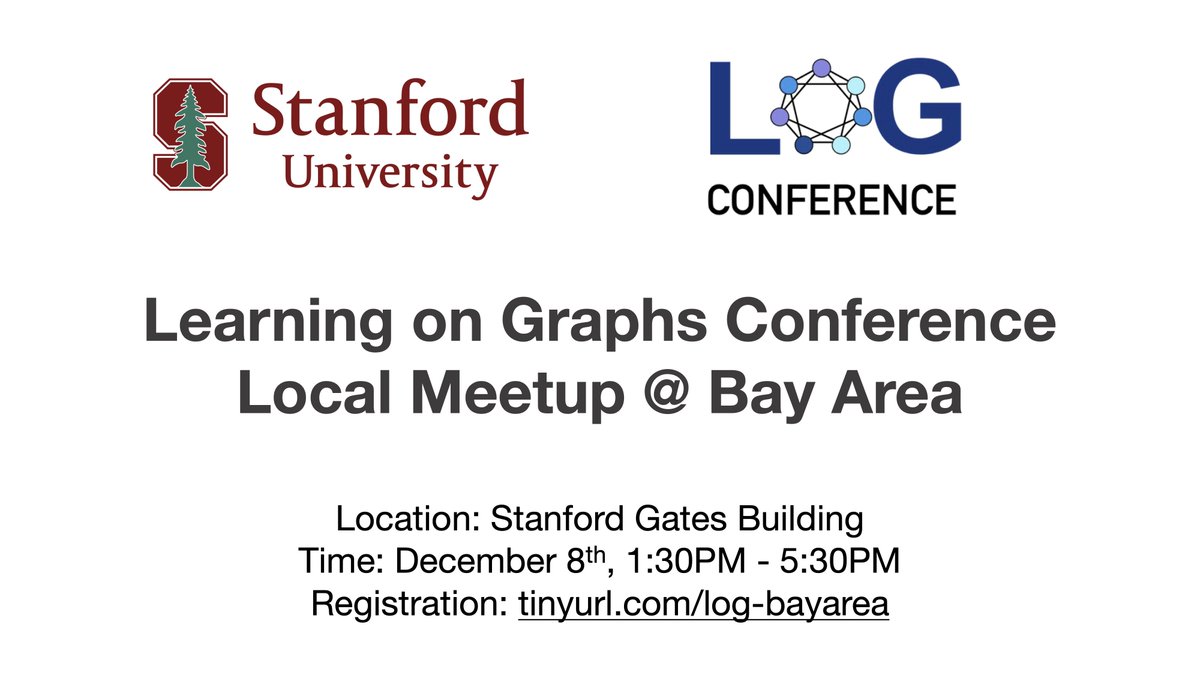
We are hosting a @LogConference bay area local meetup! Come to Stanford to learn about exciting new research in LOG and hang out with graph ML folks! Register here: https://t.co/0VhW3g6wiS
with @jure @MinkaiX @kaidicao Lata Nair
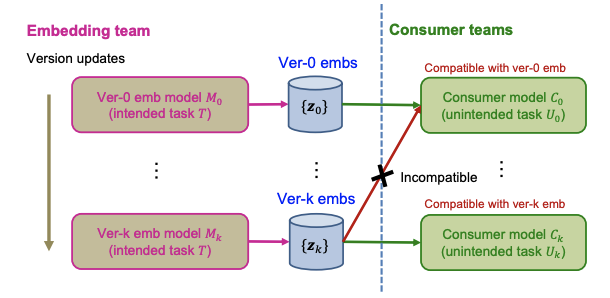
If you are at #KDD2022, check out our poster and talk on "Learning Backward Compatible Embeddings"!
We present a setting/solution to ensure backward compatibility of embeddings for downstream models even when the embedding version is updated over time. @kaidicao will present!
Excited and honored to share that our #ICML2022 paper, “Causal Conceptions of Fairness and their Consequences” (w/ @jgaeb1, Ravi Shroff, and @5harad) has received an outstanding paper award!!! See 🧵for key findings and results
Paper: https://t.co/IMCj1VMBQx 1/17
Very excited to share our KDD 2022 paper "Learning Backward Compatibility Embeddings."
We formulate a unique challenge of using embeddings in large industrial organizations and present an effective solution to it.
Paper: https://t.co/52NfFbgp5P
Code: https://t.co/RiNqOUB9BY
Happy to share that our work has been accepted to #ICLR2022! We introduce a novel open-world semi-supervised learning setting and propose ORCA method that simultaneously recognizes existing and discovers novel classes. W/ @kaidicao and @jure
Paper: https://t.co/lFlLgA5ASg