What's bigger, GLP1s or AI?
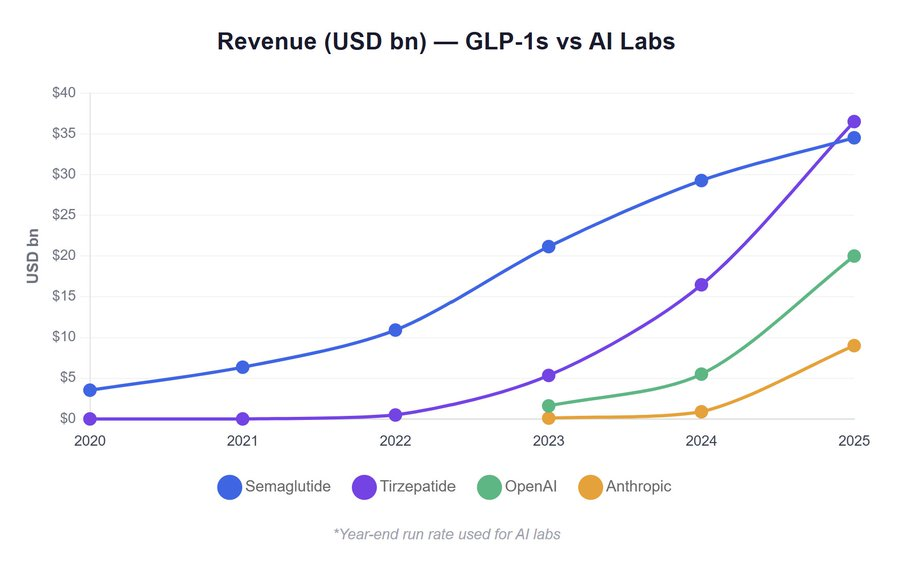
Semaglutide alone (one single peptide) generated $34.6B in sales in 2025. OpenAI hit $20B revenue that year.
So a single peptide out-earned ChatGPT by 1.7x. And that's before Eli Lilly's tirzepatide, which added another $25B.
Actually, the numbers hold up. Global peptide therapeutics market reached ~$52B in 2025 (Precedence Research, Towards Healthcare reports).
Consumer AI revenue (ChatGPT Plus/Pro subs, similar apps like Perplexity/Claude consumer tiers, etc.) is far lower—OpenAI's full ARR hit $20B+ but includes heavy enterprise/API; pure consumer-facing estimates top out under $15B total across players.
Peptides already outsell it, and they're early-stage with GLP-1 boom ahead.
The amount of money your company can make is directly related to the amount of incremental revenue your customers believe you help them make. Revenue your customers believe you help them make is therefore a better KPI than your revenue because you can always figure out how to optimize your pricing over time. And your customers will almost never churn as long your product continues to help them make a lot of money. Let me know if you can find an example at scale (companies with over $1b in revenue) where this is not true.
Gamma crossed $50M ARR with 28 employees and more cash in the bank than we had raised ($23M)
In hindsight: We got here because we ignored common VC advice.
Examples of glaringly bad advice that you should ignore to save you $10M+ and years of time, like we did for Gamma:
1/ NEWSFLASH 🚨: @Career_Karma has been acquired by @ClimbCredit
We built Career Karma to help millions of people navigate their careers. Climb shares that mission and will take it even further, helping learners not just find programs but get the financial support to start them.
This move allows our team to go all in on @OutRivalAI
https://t.co/dnCiBSwy3C
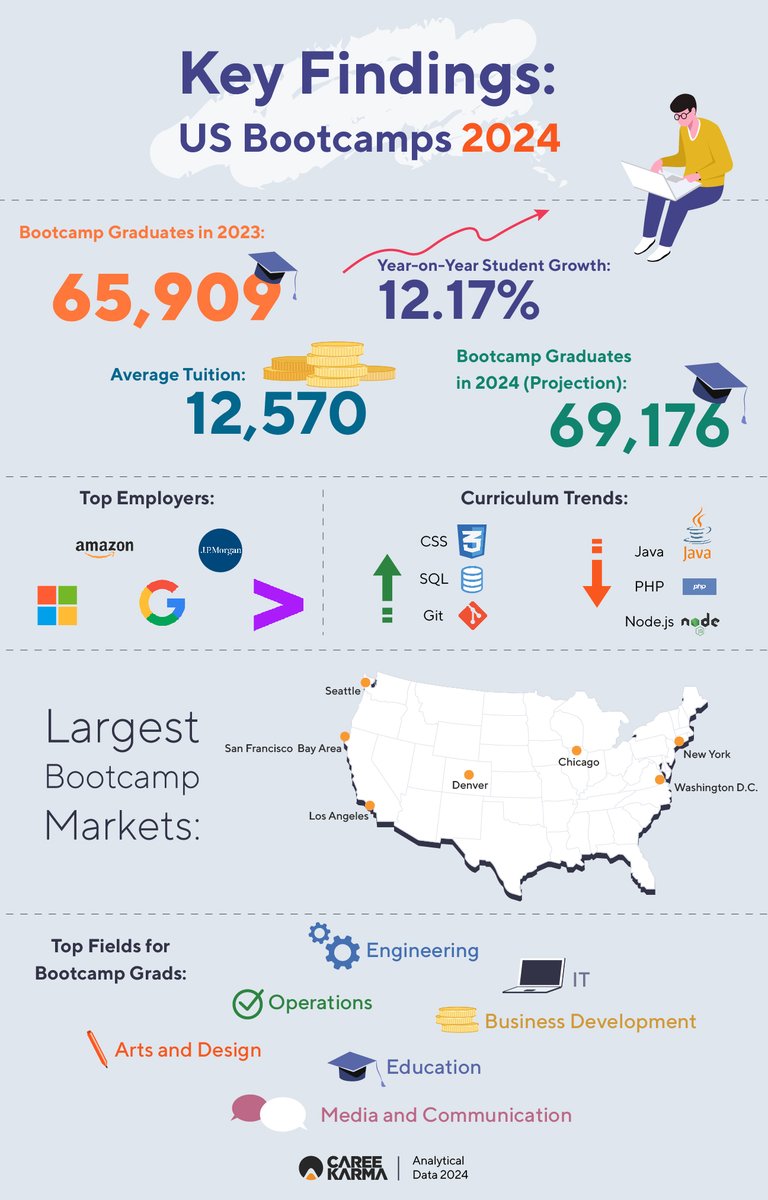
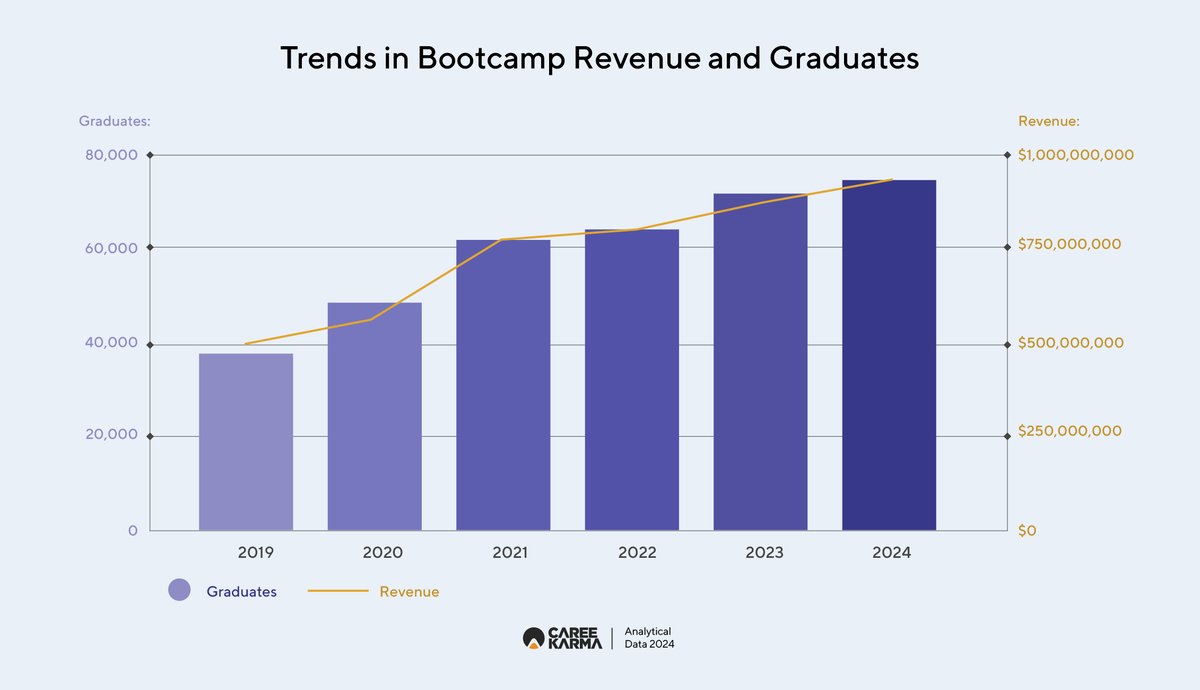
The coding bootcamp industry grew 12.7% in 2023. Although growth may slow in 2024, we foresee rising student demand for skills training as job training programs adapt to economic challenges. Here's how the market has evolved since 2018.
https://t.co/BsXaG55lPV
The fastest-growing coding bootcamps in 2023-2024 are adapting to tough economic times. From university partnerships to embracing AI, here’s how they’re shifting strategies to attract students and stay competitive. https://t.co/BsXaG55lPV
6/ In the report, we also cover Challenges from MOOCs, Lifelong Learning and Stackable Credentials, Expanding from B2C to B2B, Public-Private Partnerships, Adapting to the AI Revolution, and more
https://t.co/dJPpmY4i20
Enjoy!!
5/ Compared to previous reports, the number of bootcamps offering income share agreements (ISAs) has dropped significantly. In 2023, ISAs were offered by 23 percent of schools; now, just 5 percent provide this option.
4/ If our projection holds up, the all-time coding bootcamp alumni population will reach 427,670 by the end of the year. In this scenario, 2023 and 2024 combined would account for 31.6 percent of the entire alumni body since the inception of the industry in 2012.
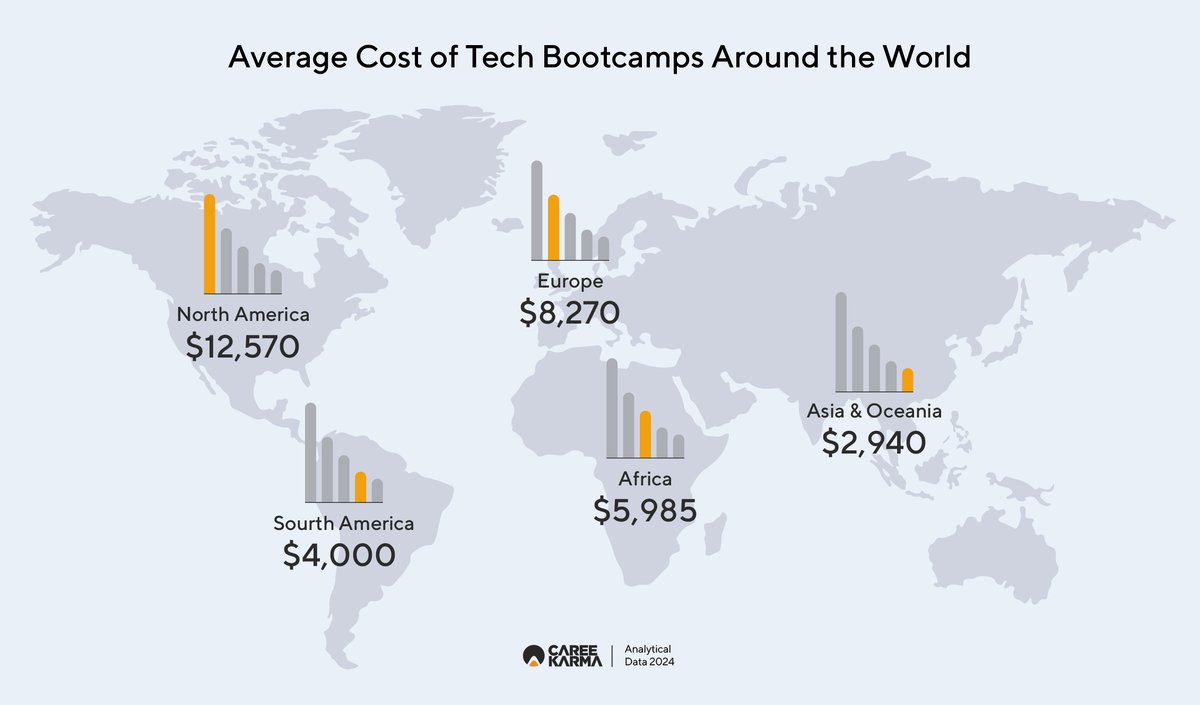
3/ A global perspective on tech education costs: the average tech bootcamp in North America costs $12,570, a figure that has stayed stable in recent years. This is much higher than other regions, with Europe—the second most expensive—averaging 34% less.
2/ The fastest-growing coding bootcamps in 2023-2024 are adapting to tough economic times. From university partnerships to embracing AI, here’s how they’re shifting strategies to attract students and stay competitive.
1/ Today, the @Career_Karma team drops the State of the Bootcamp Market 2024 and here is how the market has evolved since 2018.
The coding bootcamp industry grew 12.7% in 2023 and we foresee rising student demand for skills training as job training programs adapt to economic challenges.
https://t.co/TMt8cEKmiy