Excited to see my first solo-authored paper online. I examine the effect of gender on bill approval & find that women are less likely to gain approval for their bills not because they are women, but because they lack access to leadership positions.
https://t.co/zLNBEAIrpB
We’re thrilled to announce our new Academic Advisory Board, bringing together some of the brightest minds to provide insight, data, and rigorous thinking to enhance our campaigns. Excited to collaborate and learn from their expertise!
👩🎓https://t.co/fhjqn2w72m
👀 NEW BLOG ALERT 👀
Event hosted by @CoffeHilde and @KaitlinSenk both affiliated with the Department of Politics, Languages + International Studies at @UniofBath 🎓
Full blog written by Dr Kaitlin Senk 👉 https://t.co/jYX8mkh82b
#5050parliament#womeninpolitics#finance
Our new paper on human rights treaty ratification is available on FirstView @PoliticsGenderJ. We find that women’s legislative representation leads to an increase in the ratification of HR treaties (with Nicholas Coulombe and Jessica Edry). Read more here: https://t.co/wOB6Guawcw
Today the team were at a roundtable looking at "Finance as a Barrier to Women entering politics".
Katie presented our work, reflections & stories from women on the front line. Great to be with partners intent on the change we need!
Finance is a Feminist Issue 💥
We are now seeking nominations for the George Hallett Award, which is for a book published at least 10 years ago that has made a lasting contribution to the literature on representation & electoral systems. Deadline is May 15, 2024. https://t.co/bT8nFZFRB2
Very excited to announce that I have wrapped up my first week as a Lecturer in Politics at @UniofBath. Really looking forward to being part of such a supportive and welcoming department @PoLIS_Bath!
Hiring in comparative politics? Job candidate @Emily_Elia is an expert in Latin American politics, focusing on mass and elite political behavior and institutions, electoral accountability, and corruption. More info about teaching and research here: https://t.co/qUTJxJO05E
Hiring in peace and conflict studies? Job candidate @Gladzu 's (Gladys Zubiria) research focuses on the role of third parties in post-conflict outcomes and peace sustainability. Alongside her research, Gladys has a strong passion for teaching. https://t.co/YIhAGkS8LE
Are women as effective as men at passing legislation? In @LSQjournal, @KaitlinSenk uses causal mediation analysis to show indirect effects of gender on bill approval: women are marginalized from institutional positions associated with higher approval. https://t.co/pRHxplU1Zm
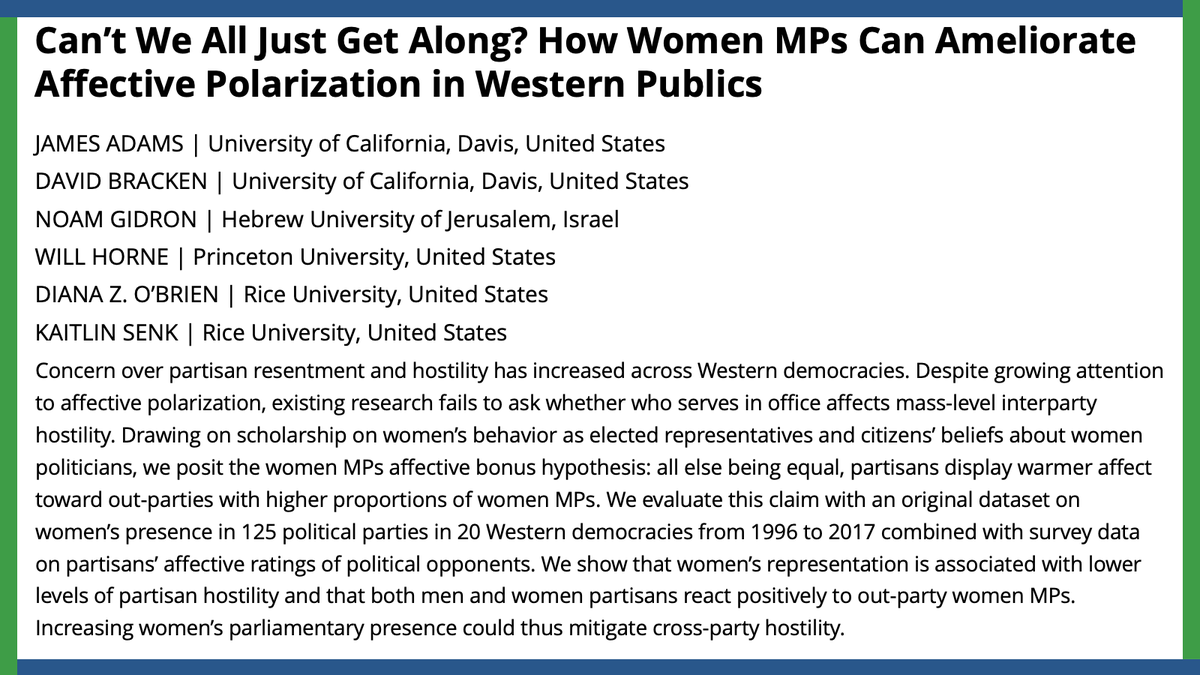
Congratulations James Adams, @DaveB90, @NoamGidron, Will Horne, @dianazobrien, & @KaitlinSenk, 2023 Klingemann Prize winners for "Can’t We All Just Get Along? How Women MPs Can Ameliorate Affective Polarization in Western Publics" in @apsrjournal! More at: https://t.co/KeMQswleNT
Is mass-level interparty hostility affected by the gender of those serving in office? James Adams, @DaveB90, @NoamGidron, @rwillh1, @dianazobrien, & @KaitlinSenk find women’s representation reduces partisan hostility.
#APSRNewIssue#PoliSciResearch
https://t.co/WMsylPivdh
New APSR article co-authored by UCD Prof. Jim Adams, UCD grad. student @DaveB90 along with @NoamGidron, @RWillH11, @dianazobrien, and @KaitlinSenk on "How Women MPs Can Ameliorate Affective Polarization in Western Publics." Great work!
https://t.co/UjgSmthLOj
👀 @dianazobrien, @KaitlinSenk & coauthors find ⬆️ in women's descriptive representation is associated with ⬇️ partisan hostility and ⬆️ positive ratings for out-party female MPs. Check out their work in the APSR https://t.co/zzDqUpYZJS & The Guardian https://t.co/lO96tepowm!👏
Interested in field work with elites? @ietchacq & I are putting together a panel for @IPSA_Elites and today is the final deadline for paper submissions. Come join us in Buenos Aires this July! Submit here: https://t.co/n97us03gLf
@IPSA_RCLS@W_inLS@ipsa_aisp@womenalsoknow
Fantastic to see research by @KaitlinSenk from @exeterpolitics showing nominating and electing more female politicians can help to diffuse polarisation and reduce levels of hostility and distrust mentioned as part of this editorial
https://t.co/EkHXxTUZpK
So excited to see this chapter from my dissertation in print @PGI_WPSA! I find that more senior women legislators are more likely to introduce women’s rights legislation. This means that political security is one factor which explains variation in women’s substantive rep.
What prevents women legislators from prioritizing the interests of women? @KaitlinSenk identifies this factor as being a sense of political security, meaning that senior women legislators are more likely to substantively represent women.
Read more here: https://t.co/1O9YcershU