PhD student - Trustworthy ML @InfAtEd University of Edinburgh | MS @JHUMECHE | BS @FudanUniv | Former AI Engineer @IntelAI @Huawei | Private ML, Fair ML
The Call for Papers for #SaTML2027 is released!
Deadlines:
Abstract - Sep 22
Paper - Sep 29
Decisions - Dec 16
New this year: abstract deadline, initial review & ACs, mandatory artifact submission, planning for growth in submissions, etc.
Full details: https://t.co/KlU97kJr1y
On top of our Call for Papers, #SaTML2027 has a Call for Competitions and a Call for Workshops (first time ever!!).
Dates (easy to remember, same for both)
Deadline: August 28, 2026
Notifications: September 18, 2026
Topics can be anything in trustworthy and secure ML!
Reminder: #SaTML2027 has a Call for Competitions and Workshops! Both are due one week from today (August 28).
Please submit your proposals and join us in beautiful Reykjavik!
https://t.co/hN4m8M3o32
https://t.co/fksvbfFLyj
MIT researchers have been digging into the "brains" of 60 different scientific AI models, and have stumbled upon something wild.
It turns out, whether an AI is reading text or looking at 3D atoms, they are all starting to agree on the same hidden truth about our universe.
Here is the pattern you can't unsee. 🧵
1/
First, the premise.
We have AI models for everything now.
• Some read protein sequences (like text).
• Some look at 3D crystal structures (like vision).
• Some predict forces in materials.
They are built differently. They are trained differently. They should think differently.
2/
But a new paper from MIT just asked a massive question:
"Are these models actually learning the same physics?"
The answer is yes. And it’s kind of spooky.
3/
The researchers took nearly 60 models—from LLMs reading SMILES strings to complex 3D potentials—and peered inside their latent spaces (their internal "thoughts").
They found that as models get smarter, their internal representations of matter start to look identical.
4/
Think of it like this:
If you ask a poet and a physicist to describe a sunset, they use different languages. But if they are both experts, they are describing the exact same reality.
The AI models are converging on a "Universal Representation of Matter."
5/
This chart in the paper is the smoking gun.
It shows that an LLM (trained on text) and a 3D Atomistic Model (trained on geometry) align almost perfectly when looking at molecules.
The text model "hallucinated" the 3D structure implicitly. It learned the physics just by reading the chemistry.
6/
But that's not even the most interesting part.
This convergence gives us a new way to spot "fake" intelligence.
The researchers found that high-performing models all cluster together in this "truth" space.
But the weak models? They scatter.
7/
It’s the Anna Karenina principle of AI:
"All happy (smart) models resemble one another; every unhappy (dumb) model is unhappy in its own way."
If a model diverges from the pack on standard data, it hasn't learned a new trick. It’s just lost in a local sub-optimum.
8/
However, there is a catch.
When the researchers threw "out-of-distribution" data at the weak models (stuff they hadn't seen before), the behavior flipped.
Instead of scattering, the weak models collapsed. They all started making the same low-information mistakes.
9/
This reveals a massive problem in Materials Science AI specifically.
The study shows these models are currently "data-governed." They are memorizing their specific training sets rather than learning universal laws.
They aren't "foundational" yet. They are just really good parrots.
10/
So, what does this mean for the future of Science?
Efficiency: We don't need massive, expensive, symmetry-enforcing architectures. We can "distill" the knowledge from big models into simple, fast ones.
Truth: We can use "alignment" to fact-check AI. If a model disagrees with the consensus of other top models, it's likely wrong.
11/
The most profound takeaway?
pattern-matching
And the fact that different AIs are independently deriving the same laws suggests that these models aren't just pattern matching.
They are uncovering reality.
12/
If this research holds up, in 5 years we won't distinguish between "protein models" and "materials models."
We will just have "Matter Models."
One foundation to simulate it all.
13/
This paper is a dense but rewarding read. It fundamentally changes how I think about "generality" in AI.
If you want to dive deeper, grab the PDF here: [Link to 2512.03750v1.pdf]
And SUBSCRIBE to me for more breakdowns of the science that is quietly changing the world.
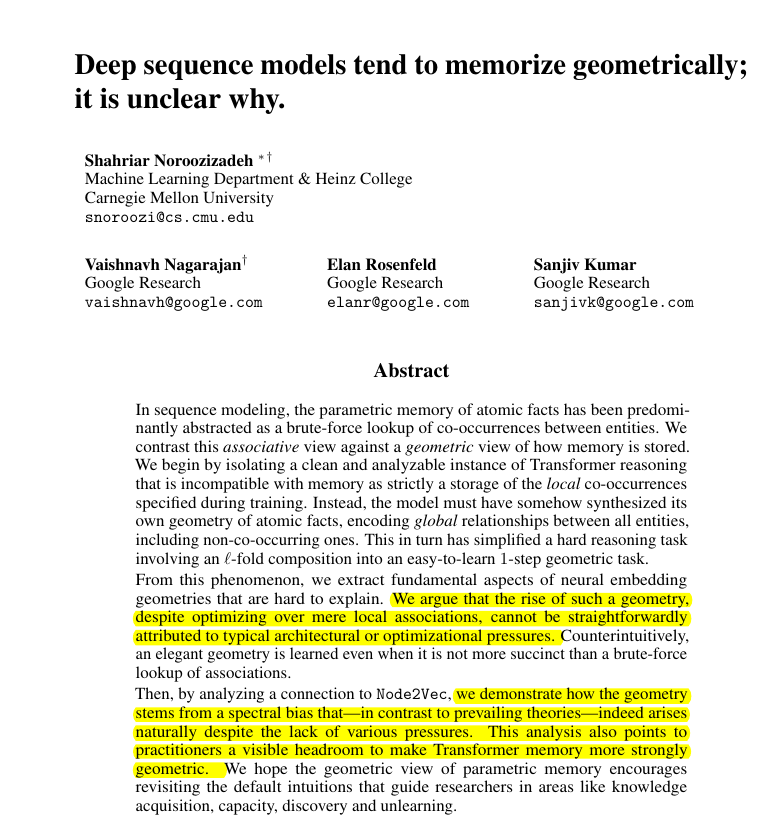
Google+ Carnegie Mellon paper shows neural networks based models store facts as geometry, not only as lookup tables.
Inside the model, facts get organized as relationships.
Transformers tend to drift toward this geometric kind of memory during training even though the training signal only shows local edges, and it is not obvious why that happens.
The big deal here is that geometric memory can make multi hop reasoning a 1 step check instead of many steps.
The key finding is that geometric and associative memories compete, and geometry often wins under gradient descent.
The authors train Transformers and Mamba to memorize 1 fixed graph and answer path queries in tests.
A path means a sequence of jumps from one node to another.
The models reach up to 100% on unseen paths in graphs with about 50K nodes at scale.
If the model used a plain lookup, it would need many chained recalls to trace that path.
Instead the model builds a geometric space where each node is a point.
Points that are several hops apart in the graph end up close together in this space.
Then answering a path query is almost a single check of distance in that space.
This behavior shows up in Transformers and in Mamba.
It even appears when training only on edges, not on full paths.
A simple Node2Vec baseline learns an even cleaner version of the same geometry.
This matches a known spectral pattern tied to the graph’s Laplacian.
So the model prefers geometric memory over step by step lookup in these tasks.
@nandofioretto@CuongTr95450563 I’ve been following you guys’ work recently and I really have to say your research is impressive and the papers are very well-written😊
Looking for a friendly, accessible way to learn about differential privacy? 🧐 Prefer simple explanations to ugly equations? 😇
Introducing my ✨ newly revamped ✨ blog post series about differential privacy, now with an intro page & table of contents 🌈
https://t.co/bMmRjc1r1w
Today, we discuss the current state of differentially private ML (DP-ML) research with an overview of common techniques for obtaining DP-ML models, engineering challenges, mitigation techniques and current open questions. Learn more ↓ https://t.co/MUCA6aA4Rf


![IntuitMachine's tweet photo. MIT researchers have been digging into the "brains" of 60 different scientific AI models, and have stumbled upon something wild.
It turns out, whether an AI is reading text or looking at 3D atoms, they are all starting to agree on the same hidden truth about our universe.
Here is the pattern you can't unsee. 🧵
1/
First, the premise.
We have AI models for everything now.
• Some read protein sequences (like text).
• Some look at 3D crystal structures (like vision).
• Some predict forces in materials.
They are built differently. They are trained differently. They should think differently.
2/
But a new paper from MIT just asked a massive question:
"Are these models actually learning the same physics?"
The answer is yes. And it’s kind of spooky.
3/
The researchers took nearly 60 models—from LLMs reading SMILES strings to complex 3D potentials—and peered inside their latent spaces (their internal "thoughts").
They found that as models get smarter, their internal representations of matter start to look identical.
4/
Think of it like this:
If you ask a poet and a physicist to describe a sunset, they use different languages. But if they are both experts, they are describing the exact same reality.
The AI models are converging on a "Universal Representation of Matter."
5/
This chart in the paper is the smoking gun.
It shows that an LLM (trained on text) and a 3D Atomistic Model (trained on geometry) align almost perfectly when looking at molecules.
The text model "hallucinated" the 3D structure implicitly. It learned the physics just by reading the chemistry.
6/
But that's not even the most interesting part.
This convergence gives us a new way to spot "fake" intelligence.
The researchers found that high-performing models all cluster together in this "truth" space.
But the weak models? They scatter.
7/
It’s the Anna Karenina principle of AI:
"All happy (smart) models resemble one another; every unhappy (dumb) model is unhappy in its own way."
If a model diverges from the pack on standard data, it hasn't learned a new trick. It’s just lost in a local sub-optimum.
8/
However, there is a catch.
When the researchers threw "out-of-distribution" data at the weak models (stuff they hadn't seen before), the behavior flipped.
Instead of scattering, the weak models collapsed. They all started making the same low-information mistakes.
9/
This reveals a massive problem in Materials Science AI specifically.
The study shows these models are currently "data-governed." They are memorizing their specific training sets rather than learning universal laws.
They aren't "foundational" yet. They are just really good parrots.
10/
So, what does this mean for the future of Science?
Efficiency: We don't need massive, expensive, symmetry-enforcing architectures. We can "distill" the knowledge from big models into simple, fast ones.
Truth: We can use "alignment" to fact-check AI. If a model disagrees with the consensus of other top models, it's likely wrong.
11/
The most profound takeaway?
pattern-matching
And the fact that different AIs are independently deriving the same laws suggests that these models aren't just pattern matching.
They are uncovering reality.
12/
If this research holds up, in 5 years we won't distinguish between "protein models" and "materials models."
We will just have "Matter Models."
One foundation to simulate it all.
13/
This paper is a dense but rewarding read. It fundamentally changes how I think about "generality" in AI.
If you want to dive deeper, grab the PDF here: [Link to 2512.03750v1.pdf]
And SUBSCRIBE to me for more breakdowns of the science that is quietly changing the world.](https://pbs.twimg.com/media/G9fsOhYWwAAJ12I.jpg)


![IntuitMachine's tweet photo. MIT researchers have been digging into the "brains" of 60 different scientific AI models, and have stumbled upon something wild.
It turns out, whether an AI is reading text or looking at 3D atoms, they are all starting to agree on the same hidden truth about our universe.
Here is the pattern you can't unsee. 🧵
1/
First, the premise.
We have AI models for everything now.
• Some read protein sequences (like text).
• Some look at 3D crystal structures (like vision).
• Some predict forces in materials.
They are built differently. They are trained differently. They should think differently.
2/
But a new paper from MIT just asked a massive question:
"Are these models actually learning the same physics?"
The answer is yes. And it’s kind of spooky.
3/
The researchers took nearly 60 models—from LLMs reading SMILES strings to complex 3D potentials—and peered inside their latent spaces (their internal "thoughts").
They found that as models get smarter, their internal representations of matter start to look identical.
4/
Think of it like this:
If you ask a poet and a physicist to describe a sunset, they use different languages. But if they are both experts, they are describing the exact same reality.
The AI models are converging on a "Universal Representation of Matter."
5/
This chart in the paper is the smoking gun.
It shows that an LLM (trained on text) and a 3D Atomistic Model (trained on geometry) align almost perfectly when looking at molecules.
The text model "hallucinated" the 3D structure implicitly. It learned the physics just by reading the chemistry.
6/
But that's not even the most interesting part.
This convergence gives us a new way to spot "fake" intelligence.
The researchers found that high-performing models all cluster together in this "truth" space.
But the weak models? They scatter.
7/
It’s the Anna Karenina principle of AI:
"All happy (smart) models resemble one another; every unhappy (dumb) model is unhappy in its own way."
If a model diverges from the pack on standard data, it hasn't learned a new trick. It’s just lost in a local sub-optimum.
8/
However, there is a catch.
When the researchers threw "out-of-distribution" data at the weak models (stuff they hadn't seen before), the behavior flipped.
Instead of scattering, the weak models collapsed. They all started making the same low-information mistakes.
9/
This reveals a massive problem in Materials Science AI specifically.
The study shows these models are currently "data-governed." They are memorizing their specific training sets rather than learning universal laws.
They aren't "foundational" yet. They are just really good parrots.
10/
So, what does this mean for the future of Science?
Efficiency: We don't need massive, expensive, symmetry-enforcing architectures. We can "distill" the knowledge from big models into simple, fast ones.
Truth: We can use "alignment" to fact-check AI. If a model disagrees with the consensus of other top models, it's likely wrong.
11/
The most profound takeaway?
pattern-matching
And the fact that different AIs are independently deriving the same laws suggests that these models aren't just pattern matching.
They are uncovering reality.
12/
If this research holds up, in 5 years we won't distinguish between "protein models" and "materials models."
We will just have "Matter Models."
One foundation to simulate it all.
13/
This paper is a dense but rewarding read. It fundamentally changes how I think about "generality" in AI.
If you want to dive deeper, grab the PDF here: [Link to 2512.03750v1.pdf]
And SUBSCRIBE to me for more breakdowns of the science that is quietly changing the world.](https://pbs.twimg.com/media/G9fsOheWYAAQoxu.jpg)