Introducing Claude Fable 5: a Mythos-class model that we’ve made safe for general use.
Its capabilities exceed those of any model we’ve ever made generally available.
A French engineer who lives quietly in Paris has spent 30 years writing software that the entire internet now runs on without knowing his name.
He wrote the code that streams every YouTube video, every Netflix show, every TikTok clip. He wrote the code that runs the virtual servers underneath AWS, Google Cloud, and Microsoft Azure. He calculated more digits of pi than anyone in history. He has no Twitter. He has no marketing. He just keeps shipping.
His name is Fabrice Bellard.
Here is the story, because almost nobody outside the systems programming world knows what one man has built.
Fabrice was born in 1972 in Grenoble, France. He studied at École Polytechnique, the top French engineering school. He never went to Silicon Valley. He never built a startup empire. He just wrote code.
In 2000 he started a project called FFmpeg, an open-source multimedia framework for encoding, decoding, and streaming video. He was 28. The project did one thing nobody else had done well. It handled every video and audio format that existed, in one library, on every operating system. He led it himself for years.
Today FFmpeg is the invisible engine of the internet. YouTube uses it. Netflix uses it. VLC uses it. Chrome and Firefox use parts of it. Every Android phone, every iPhone, every smart TV, every video editing tool you have ever touched runs FFmpeg somewhere underneath. If you have watched a video on a screen in the last 20 years, Fabrice's code processed it.
He was not done.
In 2003 he started QEMU, a machine emulator and virtualizer. He wrote it solo until version 0.7.1 in 2005. QEMU lets you run any operating system on any other operating system. It became the foundation of modern virtualization. KVM, the Linux kernel hypervisor, runs on top of QEMU. Every major cloud provider, AWS, Google Cloud, Microsoft Azure, IBM Cloud, runs virtual machines on infrastructure built around it. The Quick Emulator is the most cited piece of cloud infrastructure code on Earth.
He kept going.
In 2001 he won the International Obfuscated C Code Contest with a small C compiler that grew into TCC, the Tiny C Compiler. TCC can compile and boot a Linux kernel from source in under 15 seconds. In 2004 he calculated the most digits of pi ever computed at the time, using a personal desktop computer and an algorithm he derived himself called Bellard's formula. In 2011 he wrote a complete PC emulator in pure JavaScript that runs Linux in your browser, a project called JSLinux that engineers still cannot believe is real.
In 2019 he released QuickJS, a small but complete JavaScript engine that fits where V8 cannot. In 2021 he released NNCP, a neural network based lossless data compressor that immediately took the lead on the Large Text Compression Benchmark.
Then he turned his attention to large language models. He built TextSynth Server, a web server with a REST API for running LLMs locally. He released ts_zip and ts_sms, compression utilities that use language models to compress text and short messages at ratios traditional algorithms cannot reach. He released TSAC, a very low bitrate audio compression system. In December 2025 he released Micro QuickJS, a new JavaScript engine for microcontrollers, separate from QuickJS, designed for environments with almost no memory.
Fabrice co-founded a telecom company called Amarisoft in 2012, where he serves as CTO. Amarisoft builds 4G and 5G base station software used by carriers and labs around the world. He has been running it for over a decade while continuing to ship personal projects from his own home page at bellard dot org
He has no Twitter. He has no Instagram. He gives almost no interviews. His personal website is a flat list of projects with no styling, no fonts, no marketing copy. Just titles and links.
A quiet French engineer who never moved to Silicon Valley wrote the code that quietly runs the internet.
He is still shipping.
Introducing the OpenAI Deployment Company, which will help businesses maximally succeed with their deployments of AI.
Starting with 150 Forward Deployed Engineers and Deployment Specialists, and $4 billion of initial investment from 19 partners.
“I don’t think I’ve typed a line of code since December.”
When Andrej Karpathy said that, most people treated it like a crazy AI quote.
@garrytan treated it like a question:
“What happens when one person operates like an entire software team?”
Then he built gstack.
And honestly… this repo feels less like a dev tool and more like a preview of where software is going.
Not AI as autocomplete.
AI as:
- CEO
- Staff engineer
- QA lead
- Security reviewer
- Designer
- Release manager
- Browser operator
- Parallel execution layer
All coordinated through structured workflows.
The craziest part is the numbers.
Garry says his current pace is ~810× higher than his 2013 output — normalized for logical code changes, not inflated AI LOC.
Same person.
Same brain.
Different tooling.
That’s the shift everyone is underestimating right now.
The winners in the next era probably won’t be the people who code the fastest.
They’ll be the people who can direct, review, and orchestrate AI systems the best.
A few things in gstack that genuinely stood out to me:
→ /office-hours challenges your product assumptions before you build
→ /autoplan runs CEO + design + eng reviews automatically
→ /qa opens a real browser, tests flows, finds bugs, and fixes them
→ /review catches production-level issues before shipping
→ /pair-agent lets multiple AI agents collaborate together
→ parallel AI sprints running at the same time across projects
This is the first open-source repo in a while that actually made me stop and rethink how software teams will work 2–3 years from now.
We’re moving from:
“AI helps developers code”
to
“developers operate systems of AI workers.”
That’s a very different future.
100% Open-source
Link in comments 👇
America’s real superpower is its education system. Its top universities have consistently produced founders behind globally important, world-changing companies.
What stands out most: in this entire list, only one university outside the United States appears at a comparable scale.
If a country wants to become a global leader, it should aim to see its universities represented here ...
One guy. One Navy ship. One file. 1 trillion databases.
He built it alone in 2000. And gave it away forever. 🤯
Meet D. Richard Hipp 🇺🇸
> American developer. Born 1961 in North Carolina.
> In 2000, working as a contractor on a US Navy destroyer.
> Got frustrated with bulky databases that needed servers and setup.
> Built SQLite in his spare time ~ a single-file database engine.
> No server. No installation. No configuration. Just one file.
> 25 years later, every iPhone, Android, Mac, and Windows PC runs SQLite.
> Powers Chrome, Firefox, Safari, WhatsApp, iMessage, Skype.
> Runs inside Tesla cars and commercial airplanes. 🚀
> Over 1 trillion SQLite databases active worldwide today.
> Put the entire codebase in the public domain. Zero royalties forever.
> Trillion-dollar companies use his code. He's never charged a cent.
> Still maintains it full-time with a tiny team of 3.
> Pledged free support and updates until at least 2050.
> No VC money. No acquisitions. No spotlight. Just code.
Every app on your phone runs his invisible masterpiece.
Most engineers build for fame. He built for forever.
Database GOAT. 🐐
No one knows your struggles better than the Almighty. The silent battles you fought, the tears you shed at night, the burden on your shoulders; He’s aware of them all. Pull yourself together and keep going because it will get better.
A 25 year old just turned $225 million into $5.5 billion in 12 months.
Here’s exactly what he bought.
Leopold Aschenbrenner got fired from OpenAI in April 2024.
He spent the next few months writing a 165-page thesis predicting AGI by 2027.
Then he launched a fund and put his money where his thesis was.
He bought zero Nvidia. Zero Microsoft. Zero Google. Zero Amazon.
He bought what AI actually runs on.
Bloom Energy (BE), power infrastructure for data centers. Up 1,422% in one year.
Lumentum (LITE), optical components that move data between chips. Up 1,331%.
Sandisk (SNDK), storage. Up 3,130%.
CoreWeave (CRWV), GPU cloud infrastructure. Up 166%.
Iris Energy (IREN), AI computing and data centers. Up 583%.
The thesis was simple: every AI company needs energy, bandwidth, storage, and compute.
Nobody was buying those. Everyone was buying the AI companies themselves.
He was right.
His fund now manages $6 billion. Backed by Patrick and John Collison of Stripe and former GitHub CEO Nat Friedman.
I’m adding this to my watchlist.
Every time he files a new 13F, we will break it down here.
Turn on notifications so you don’t miss the alert, this is VERY important.
Many people will wish they followed us sooner.
How we prompt AI is very different in 2026 than 2022 when ChatGPT came out.
I'm teaching a new course, AI Prompting for Everyone, to help you become an AI power user — whatever your current skill level.
It covers skills that apply across ChatGPT, Gemini, Claude, and other AI tools. How to use deep research mode for well-researched reports on complex questions. How to give AI the right context, including more documents and images than most people realize you can provide. When to ask AI to think hard for several minutes on important decisions like what car to buy, what to study, or what job to take. And how to use AI to generate images, analyze data, and build simple games and websites.
I also cover intuitions about how these models work under the hood, so you know when to trust an answer and when not to.
Along the way, you'll see flying squirrels, a creativity test, some of my old family photos, and fireworks.
Join me at https://t.co/tcQc4iJAJG
A deadly Black Mamba is snatched mid-air by a Snake Eagle… but the hunter becomes the hunted as the snake twists free and locks onto the eagle’s talons in a brutal struggle. Before either can escape, lions arrive on the scene, turning the chaos into a full-scale battle-leaving the trapped eagle with almost no chance of breaking free.
#videosvuvu
Finally the kind of role models Pakistani youth needs: Sualeh Arif.
Not property dealers, tax evaders, bank defaulters, rent seekers, born into wealth etc.
But a self-made kid from a middle-class family in Karachi. Studied at MIT, started a hugely impactful company, changed the way people write code, now worth over $ 1 Billion at the age of 26!
https://t.co/rLzJibEWcb
Today we're announcing LevelUp: a free, four-week training program that takes people with no prior experience and prepares them to work as fiber technicians on data center construction sites across the US.
We built this program with CBRE because the fiber technician field, and the broader construction industry, is facing a nationwide shortage at a time when data center demand is higher than ever.
How it works:
🔧 Classroom instruction, hands-on labs + team activities covering transferable technical skills
🎓 Graduates have the opportunity to work at Meta's US construction sites through our contractor network
🤝 Open to everyone from recent high school grads to mid-career professionals
Since 2010, Meta's data center projects have supported 30,000+ skilled trade jobs during construction + 5,000+ permanent operational roles. LevelUp is about building the pipeline to keep that going.
Learn more: https://t.co/9XluD5IHbz
@SyedMMehdi@FaisalAMalik3 Who are you telling manners, arrogant inefficient ineffective useless, coward bastards who don't know anything in their entire lives. Quran clearly mentioned they'll loose their lands, inshAllah near end of days not by Pakistanis or Iranis but by Indians, Jews and Christians.
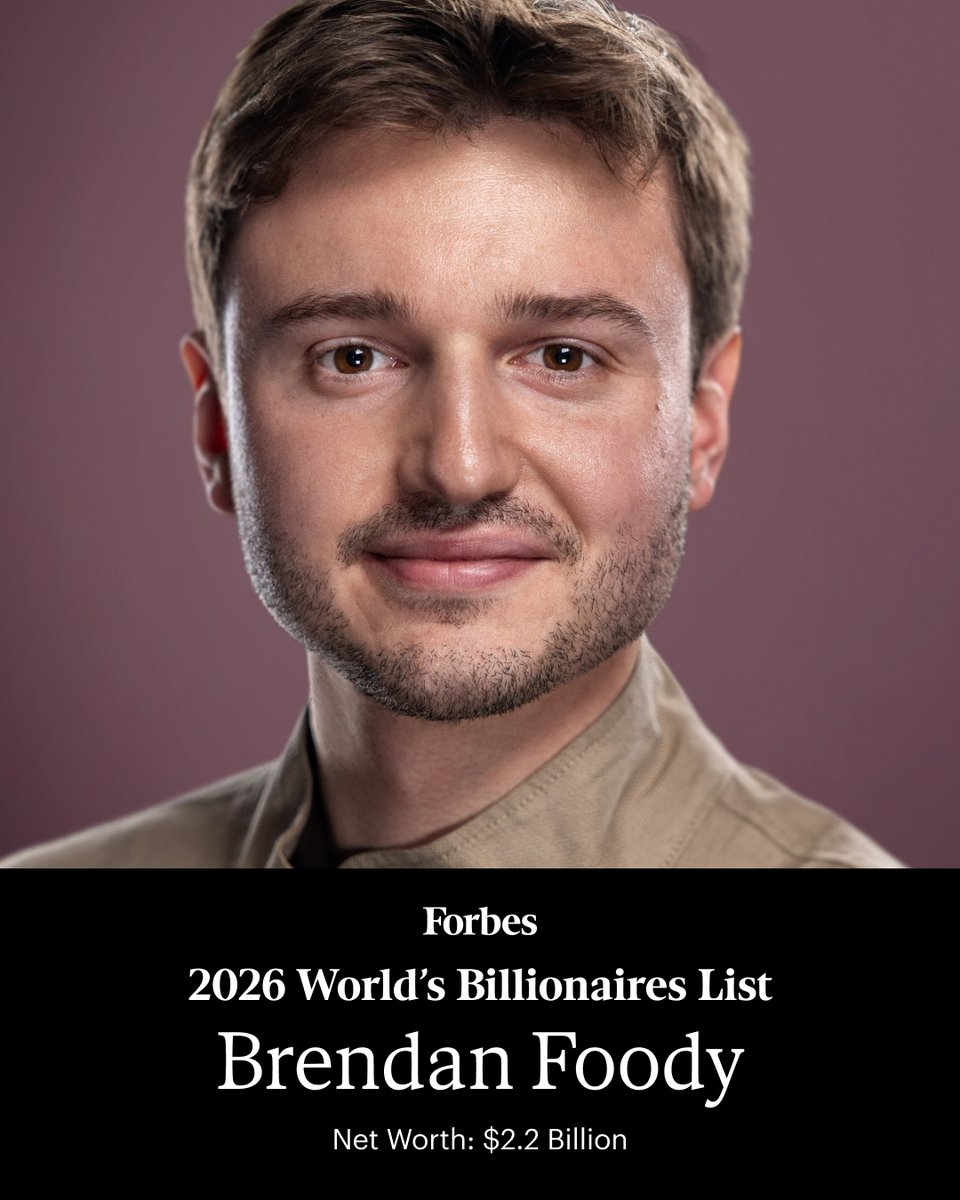
At 22, Brendan Foody is among the world’s youngest self-made billionaires.
His startup Mercor helps Silicon Valley’s biggest AI labs train their models and reached a $10 billion valuation in 2025. See the full #ForbesBillionaires list: https://t.co/JYn52gRk2z
📸: Cody Pickens for Forbes