"...و نوصيها بتقوى الله و الإخلاص فى السر و العلانية و بلزوم السنة و اجتناب البدعة و ان تشغل سرها بالذكر و الفكر فى خلالها و ان لا تميل إلى الدنيا و لذاتها و ان لا تخاف فى الله لومة لائم.."
Hello world!
Israel is deliberately starving 2 million civilians.
Half of them children.
Trapped. No food. No escape.
Gaza has now reached Stage 5 malnutrition: the final, irreversible stage.
This isn’t war.
It’s calculated extermination.
It’s a Holocaust.
If you'd rather donate to an organization, please avoid international charities, which are providing zero aid to Gaza right now. The @sameerproject continues to be vouched for by Palestinians within Gaza. Please check their feed and donate generously.
Ahmed's 6 children are starving and his wife suffers from bipolar (verified & genuine). That's 8 people you can feed with your donations:
https://t.co/aoMZjjjrJP
Many Gaza fundraisers are being ignored due to the algorithm. Head over to https://t.co/ST5h1GOSil then click on "verified accounts" to access a searchable directory of verified fundraisers. Pick one, donate, and share it with your network.
A story not for children, but about one.
It was nearly midnight.
In Gaza, night no longer brings peace. It does not descend like a blanket, but presses down like a weight. Heavy. Breathless. Suffocating.
The silence it brings is not one of calm, but of abandonment. It stretches across the ruins like dust settling on a corpse.
People do not sleep because they are rested. They sleep because they are too broken to remain awake.
Beneath this wounded sky, torn and trembling, a boy walked alone.
He was very small. So small that the sack he dragged behind him scraped softly along the ground.
The sound was barely louder than the voice he used to call out into the void.
Inside the sack was water. Not clean. Not sealed in bottles. Not pure.
Just small plastic bags, clumsily tied, filled with whatever passed for drinkable.
A fistful of water. A fistful of life. Sold for one shekel.
“Drinking water, one shekel!”
He cried out again and again. But not like a merchant selling his goods.
It was the voice of someone pleading to be noticed.
His voice was thin, like a flame flickering in a wind that offered no mercy.
No one answered.
The street, like the world, remained empty.
Perhaps he could not return to the tent until they were all sold.
Perhaps someone was waiting for him, a younger sibling, a hungry mother, someone clinging to life by the fragile thread of his coins.
Or perhaps no one was waiting.
Perhaps his father was already dead.
Perhaps his mother had followed.
Perhaps he had outlived them all.
He looked about nine, though grief had stolen time from his face.
Dust clung to his bare feet.
On his cheek, a single tear had dried long ago.
It had not been wiped away, not even noticed.
No one had seen it fall.
In other parts of the world, children were asleep at that hour.
They were wrapped in warmth, whispered to in love, surrounded by peace so normal they could not imagine it ending.
But this boy, this quiet, dusty child, wandered through a land that had been sentenced to die.
And still, he was trying to live.
No fairy tale would touch him.
No miracle was coming.
No angels watched from above.
Only the night remained , long, merciless, and indifferent.
At the corner of the street, he sat down.
Three bags remained in the sack.
He did not cry.
Children like him have learned that the world does not recognize the tears of those it has chosen to forget.
Above him, the moon peered through the smoke.
It looked down like an eye that sees everything and judges nothing.
And then, one last time, his voice rang out, softer than before:
“One shekel for a bag of water…”
Still, no answer.
Far away, in gilded rooms, men slept beneath silk sheets.
Pens moved across paper. Ink sealed decisions.
Declarations were signed and promises were drafted.
But none of that light,not even a flicker
, reached the boy with the bag of water.
He remained in the dark.
Still waiting.
Still hoping.
Still surviving, not from strength, but from a quiet refusal to disappear.
And that is where the story ends.
There is no redemption.
No pity. No rescue.
Only a child. A sack.
And a silence that now belongs to all of us.
#GazaGenocide
They came at dusk: a woman and two children.
Not walking, exactly. Drifting, as if carried not by their own will but by a force more ancient and merciless than gravity. The kind of force that drives insects toward flame or the lost toward confession.
One of the children pulled a basket behind, its wheels scraping over the stones like bones. Neither spoke. Their silence was not shy, but inherited. The kind passed from womb to womb in times of war.
The woman looked at me, not as one human to another, but as someone standing trial on Judgment Day, stripped of all defense.
“Is this a clinic?”
“Yes.”
“Do you have medicine?”
“Yes.”
“Is it free?”
“Yes.”
She entered, as if even the floor needed permission to bear her weight.
She sat before me. Her presence was not loud, but unbearable. She did not look tired, but ancient, like someone who had traveled not just for days but through time itself, through the centuries of betrayal that humanity has inflicted upon itself.
I said nothing. She said nothing. The silence held.
Then she whispered, “My feet and back hurt.”
What a simple phrase. And yet it carried the weight of exile.
My feet and back hurt.
Of course they did.
She had been carrying two children, a basket, and the unspoken grief of the earth.
“Is this new?” I asked.
“No, habibi. It’s from walking. We’ve been walking a long time.”
Walking. Such a gentle word for such a violent act. She had walked over corpses and rubble, over forgotten treaties and abandoned neighborhoods. She had walked across the graves of promises.
And I, me, a doctor. What could I do? Open a drawer? Offer a pill? I could not suture history. I could not anesthetize the world’s cruelty.
So I gave her painkillers. Like a priest sprinkling water on a burning house. And vitamins, why not? A placebo for the soul, perhaps more for mine than hers.
She stood, nodded, and left.
I should have returned to my notes, to the work. But I sat there, staring at my hands. Those impotent, trembling hands. I wondered if I had just witnessed something sacred or something obscene.
Then she returned.
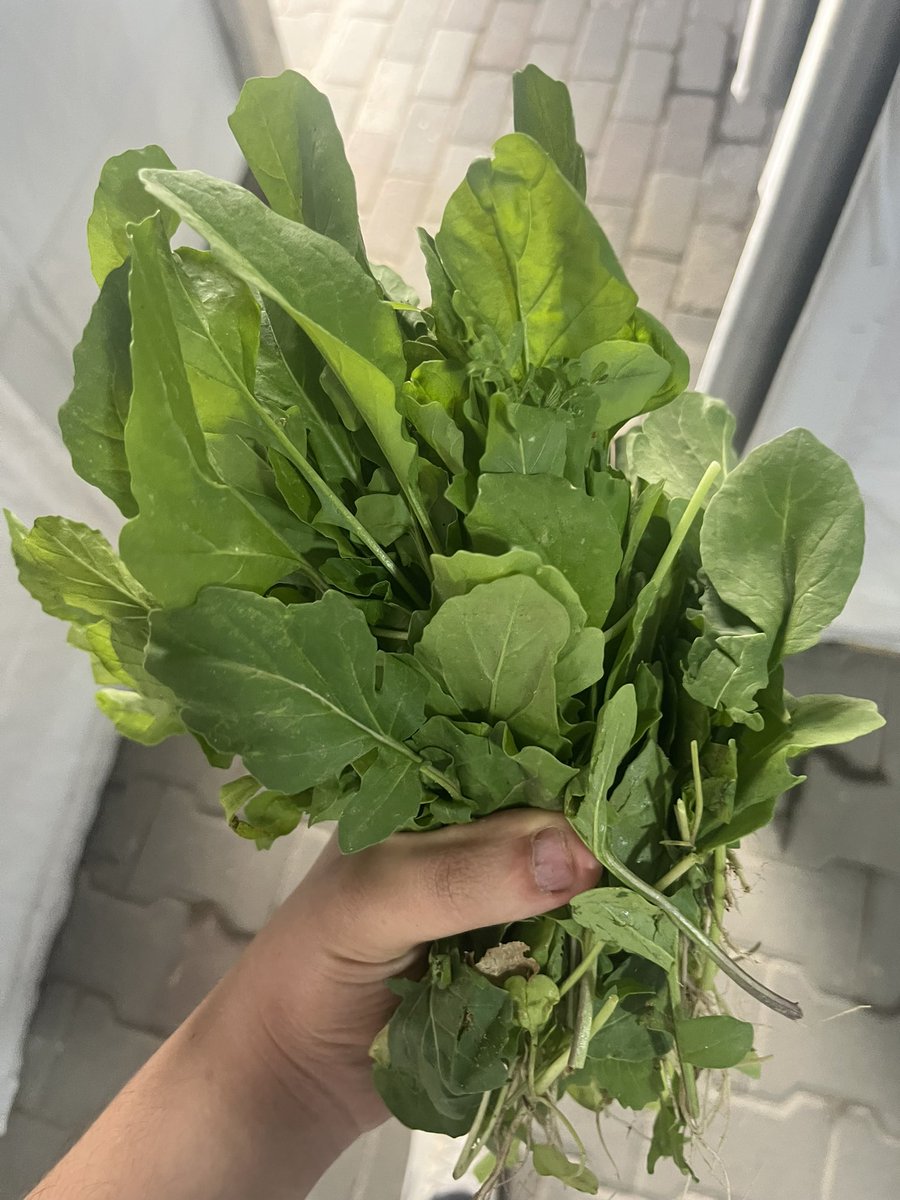
In her hands was a bundle of arugula. Earth still clung to the roots.
“This is for you,” she said.
I refused. My pride would not allow it. But pride dies in the presence of grace.
She insisted. “It’s from my heart,” she said. “We’re farmers. From Beit Lahia. We picked it before we left. I still have some.”
And in that moment, I saw her. Not the woman, but the truth.
So I took it. Not for the leaves, but to protect what little dignity remained in the world.
She left again.
But she had left something behind. A scream without sound. A sermon without words.
And in that clinic, surrounded by antiseptics and broken instruments, I, the doctor, broke.
Not from pity. But from the unbearable truth that someone who had nothing still found a way to give everything.
#GazaGenocide
NEW -- We obtained documents showing how a UK company has sent over 1,000 ammo cases to Israel amid the Gaza genocide.
The cases were delivered to an Elbit factory which produces mortars for the IDF.
My latest with @wereontheditch in @declassifiedUK:
https://t.co/r0qJrA9sba
GHF says it fed Gaza.
Nine million meals, they boast. Three per person, they say. It sounds precise. It sounds generous. It sounds like salvation.
It is not.
The truth? No one I know has received a single bite. Not I, not my family, not the neighbors whose cupboards have been bare for weeks. Ask around, and the answer is the same: silence from the kitchens, hunger in the streets. At least 80% of the people here have seen nothing.
But the numbers are printed. The press releases are sent. The donors are satisfied. The world reads “nine million meals” and moves on.
That is the function of the lie. Not to fool the hungry, but to comfort the distant.
Meanwhile, trucks trickle in. A man working at a distribution point told me that in four days, only seven trucks arrived. GHF claims to deliver 300,000 meals a day. The gap between the number and the truth is not a mistake. It is policy.
This is not aid. This is theater.
And the purpose of the theater is simple: to create the illusion that the machine is working. To convince the world that Gaza is being fed, while it is, in fact, being starved, efficiently, methodically, and now, invisibly.
Once, lies were spoken with shame. Now, they are printed with logos and signed off by press officers.
And when suffering is buried under spreadsheets, when starvation is wrapped in statistics, then the lie becomes more powerful than the bullet. Because it kills not just the body, but the witness.
#GazaGenocide #Madleen