Our thoughts on the importance of AI sovereignty.
1. Your AI sovereignty dictates your institution���s future. Sovereignty is the precondition for choice. Relinquishing sovereignty transfers the future choices of your institution to others, who are likely to exploit it for their gain and your loss.
2. Data retention is your treasure. Transfer it at your own peril. Your ability to win is dictated by your ability to recognize and use your unique edges, and you keep winning by compounding the underlying data to generate new insights. Transferring that data hands over access to your pre-existing winning plays and yields the means of production for new ones.
3. Tokenmaxxing hijacks your value orientation and decreases your institutional fortitude and intelligence. The pursuit of high token usage incentivizes disposable scripts over robust software — with the addictive feeling of false progress. There is a reason why those selling tokens refuse to charge based on value.
4. Controlling your weights is controlling your fate. Weights are the distilled form of hard-won, accumulated institutional knowledge. If you let others control your weights, you are allowing them to migrate the alpha of your business to theirs.
5. There is no contradiction between sovereignty and alpha. The architecture that maximally preserves sovereignty is one that enables institutions to own their tribal knowledge, and to compound it as alpha.
6. Politicizing the technical issues involving sovereignty is what your adversary wants. Techno-politicization is the wellspring of false sovereignty. Techno-politicization drives decisions that seem to reduce dependency, but ultimately limit agency — especially on the battlefield in the West.
7. Real expertise is existential. Allowing politics or favoritism to determine your technical decisions rewards whoever is best at politics, not whoever is right. Listen to those closest to the problems, not those speaking most compellingly about them.
8. Learn from institutions that are winning or that have consistently delivered. Institutions facing existential threats do not have the luxury of making technical decisions based on political preferences.
9. Only listen to institutions, countries, and people who have a proven record of being right. A track record of correctness is the best and only signal for future correctness. Judging something as right or wrong based on who you like is exceedingly misguided.
Responsible AI can’t be bolted on at the end.
Michael Adams of the @PalantirPrivacy team showed off Palantir’s AI Use Case Manager.
Bringing together privacy, data lineage, risk assessments, testing, and auditability can be embedded from use-case design through production.
The presentation was live streamed from the UN Global Conference on AI, Security & Ethics.
This a very exciting step towards the vision of leveraging "any storage" and "any compute" within AIP
Seamlessly connect in your @databricks assets, and deliver operational AI with @PalantirTech
People often tend to inflate reputations after death; memory turns to myth.
Here's one small, factual addendum, two months after her passing: Snowmass docs record Meenakshi asked nearly twice as many questions as anyone else.
https://t.co/Kwl0RrIMcb
We've taken just the first step in this journey @kevansf@genophoria@iamjohnnyyu. And many more stellar scientists have since joined our team to make this a reality.
Check out our team and stay tuned for more heavy hitters joining early '23. https://t.co/pL7xRKr1Bz
There she goes!
The last 747 has left our Everett factory ahead of delivery to Atlas Air in early 2023. #QueenOfTheSkies
Photos: Boeing/Paul Weatherman
50 years ago today, Apollo 17 launched, the last of that era of human exploration.
And today, Apollo’s twin sister Artemis is returning from her first voyage to the moon. 🚀
Here are eight of our Apollo 17 LM artifacts brought back from the lunar surface: https://t.co/a24qJsPuVW
Don’t know the facts/biases involved here, but a decent example of a short and straightforward accounting of the failing of a (AI) startup after 8 years.
https://t.co/wV5VUFDNBV
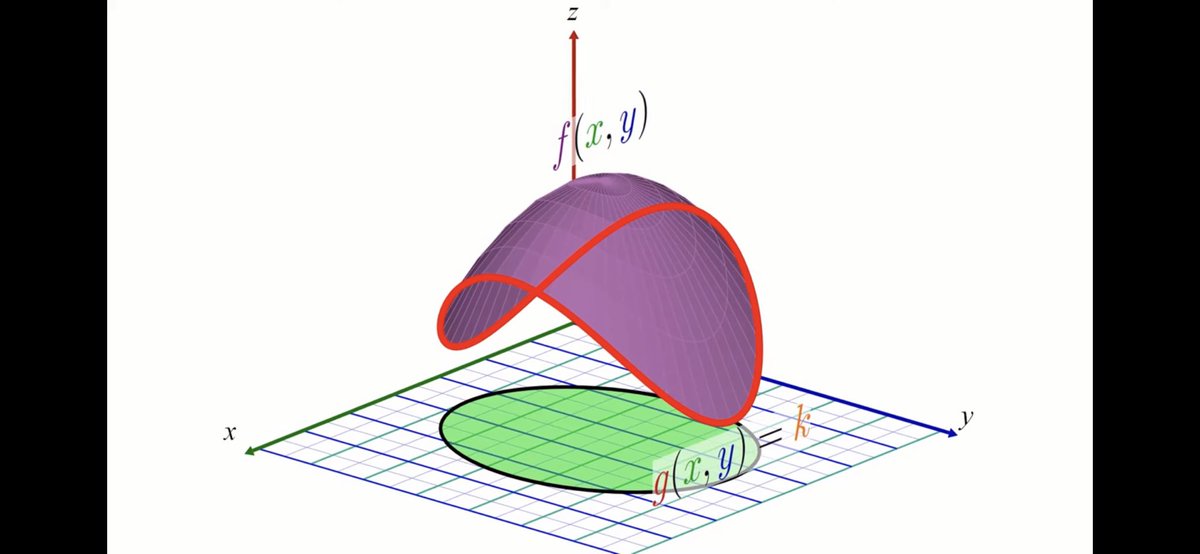
Here is a great explanation of the Lagrangian multiplier (the intuition of which is typically not given). 🧵
The problem: maximising a function f(x,y) under a constraint g(x,y)=k (the point has to be on the red curve).