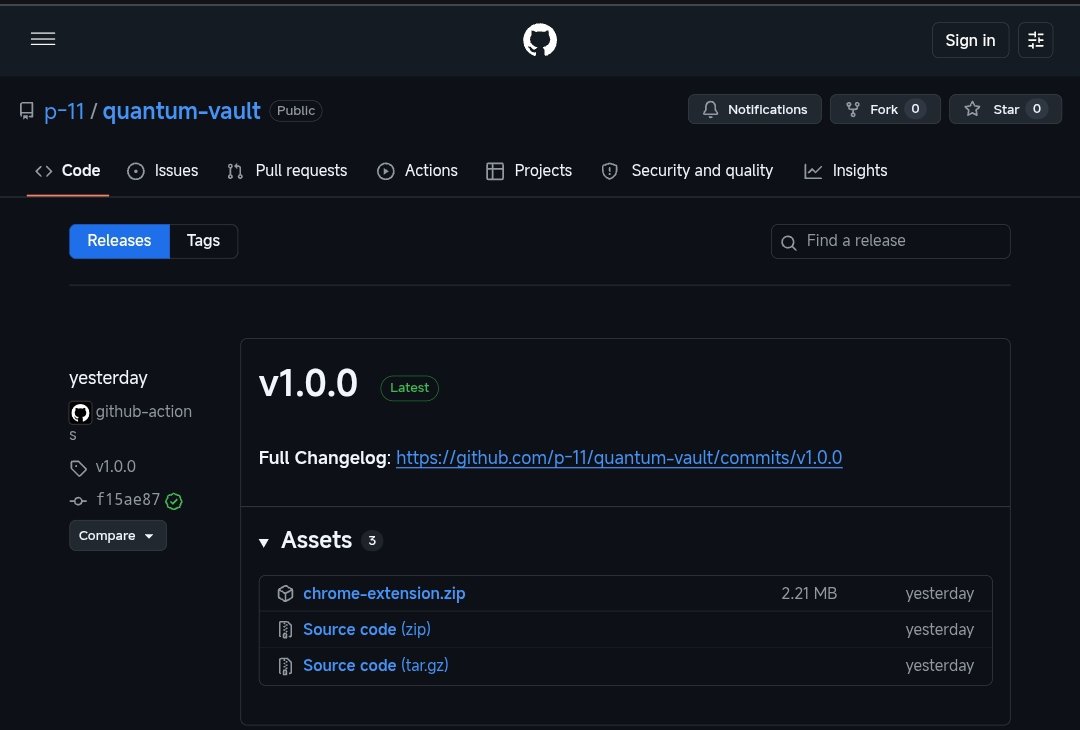
🔶Simple guide on how to install the Quantum Vault by @projecteleven and protect your BTC from future quantum threats 🧵
⛓️ Visit: https://t.co/ij9NYSECHc
1/ Download the `https://t.co/yacD6WwRx7` file from the latest release and unzip it.
2/ Open `chrome://extensions/`
3/ Turn on Developer Mode
4/ Click Load unpacked and select the unzipped Quantum Vault folder.
That’s it , Quantum Vault will install automatically ✅
Works on Chrome and Chromium-based browsers like Brave, Edge, and Arc.
After installing, I copied my BTC address to check whether it’s safe against potential quantum attacks.
Check yours here:
https://t.co/kMutTZ2DL7
This isn't a sponsored post
The facts: @SoundnessLabs@projecteleven
✅ Quantum computers are coming
✅ Quantum computers break public key cryptography
Digital assets like Bitcoin rely on this for ownership & control.
So what happens next?
✅ Digital assets MUST migrate to post-quantum (PQ) cryptography
…before quantum arrives.
But here’s the challenge:
✅ Blockchain blocks are small
✅ PQ cryptography is BIG
This is where things get interesting.
Teams like SoundnessLab & Project Eleven are already building solutions.
The Overton Window isn’t just shifting it’s accelerating.
🔶Redact x Fhenix, Why Confidential DeFi Matters? @fhenix@RedactMoney@deivonchain
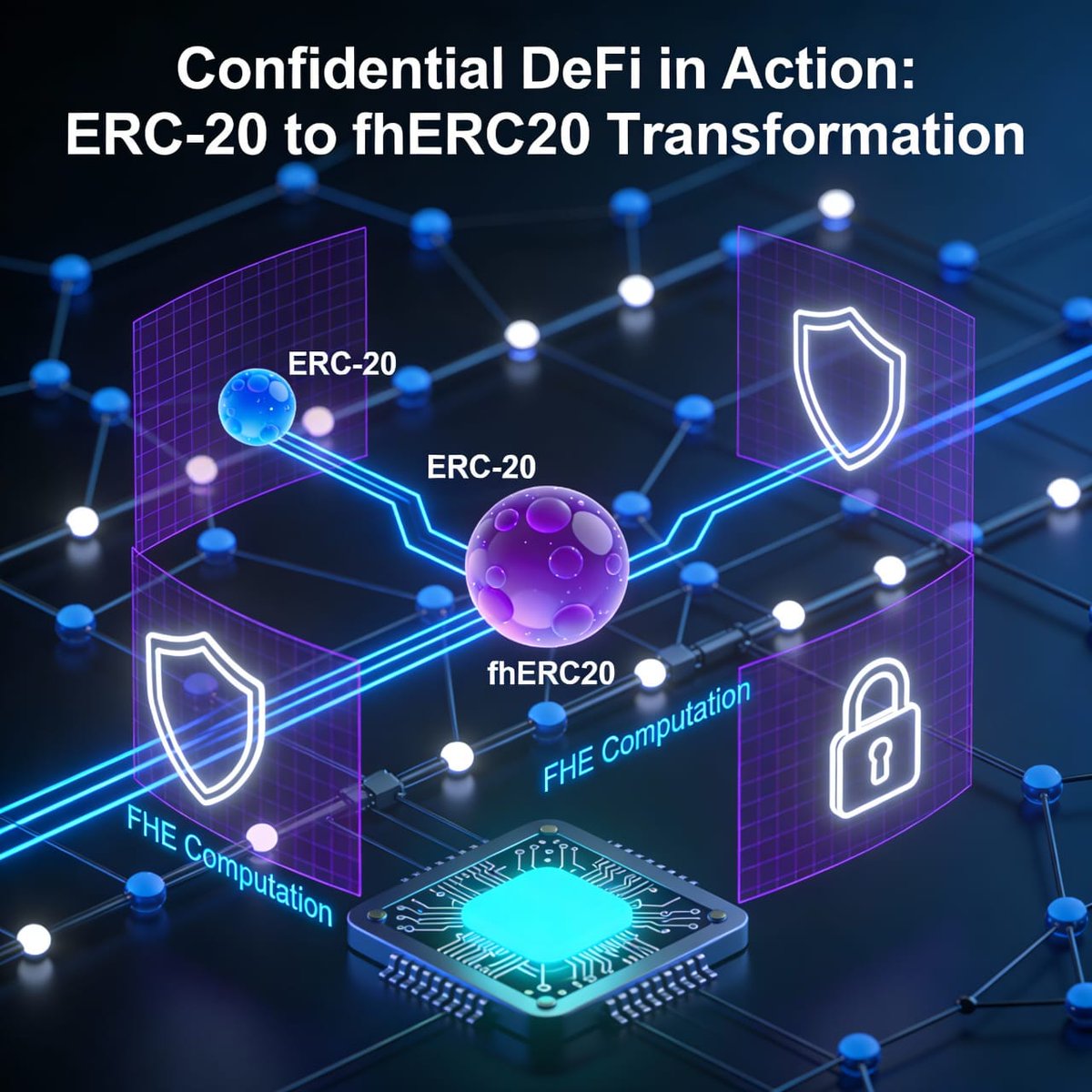
Blockchains were designed for transparency, but total transparency comes with a cost. Every transaction, balance, and strategy being public creates serious privacy and security issues for users. Redact exists to fix this problem without breaking what makes blockchains powerful. It is the first dApp built on Fhenix, using advanced encryption to bring real privacy on-chain. Redact introduces fhERC20, which allows users to wrap normal ERC-20 tokens into confidential ones. The token stays on the same blockchain, but balances and transfer amounts are encrypted. This means users can interact with DeFi without broadcasting their entire financial history to the public. You still use smart contracts, but sensitive data stays private.
With Redact, users can send and receive tokens privately, manage confidential balances, and move assets without worrying about being tracked, copied, or front-run. On most DeFi platforms today, whales, bots, and competitors can watch every move you make. Redact removes this advantage by hiding transaction details while keeping the system verifiable.
Privacy on Redact is not about hiding activity from the blockchain. Transactions are still validated and secured on-chain, the data itself is what remains encrypted. This is possible because Redact is powered by Fhenix’s CoFHE Coprocessor, which allows computations to be performed directly on encrypted data without revealing the actual values.
This is what the next generation of DeFi looks like: secure, private, verifiable, and built for real users.
🔐 Built on @fhenix
🚀 Powered by confidential computation
🌍 Privacy-first DeFi is here
🔶 Testnet participation on @fhenix with @RedactMoney
⛓️Visit: https://t.co/31z55ZdZ6E
✅Connect your wallet (Make sure you have Sepolia ETH), you can claim from faucets
✅Enter the amount of Sepolia ETH you want to encrypt, click on encrypt and sign the transaction in your wallet.
✅Next up, beside "encrypt", there's a "decrypt" button there, click on it, input the amount of ETH you want to decrypt, click on decrypt down and confirm the transaction in your wallet.
✅Wait for sometime and claim your ETH (sign the transaction in your wallet)
That's all for now !!!
🔶From official @Zetarium_ tokenomics:
🔹 Total supply: 100,000,000 $ZET
🔹 Airdrop allocation: 9%
🔹 Presale allocation: 5%
Now, let’s unpack what this really means 👇
Out of the entire 100 million supply, only 9,000,000 $ZET is set aside for airdrops. That’s the main share available to the broader community.
On top of that, the presale claims just 5%, further limiting how much $ZET enters circulation early.
When you factor out the presale, the amount of tokens accessible to everyday participants becomes even tighter.
This is a textbook scarcity model:
✅Fixed total supply
✅Limited airdrop allocation
✅Controlled early distribution
As adoption grows and more users enter the ecosystem, competition for that 9 million $ZET only increases. Early and consistent participants are clearly positioning themselves ahead of the crowd.
Tokenomics tell the story.
$ZET is designed for scarcity — not inflation.
Stay early. Stay focused. 🚀
🔶CURRENTLY RANKED 822🔥🔥 @Zetarium_
WE HAVE 36 MORE DAYS TO GO.
I'M ENGAGING EVERYONE WHO ENGAGES ME 🔥🔥
💙 Like = 10 $ZET
🔁 Retweet = 20 $ZET
💬 Comment = 50 $ZET
#Zetarium_
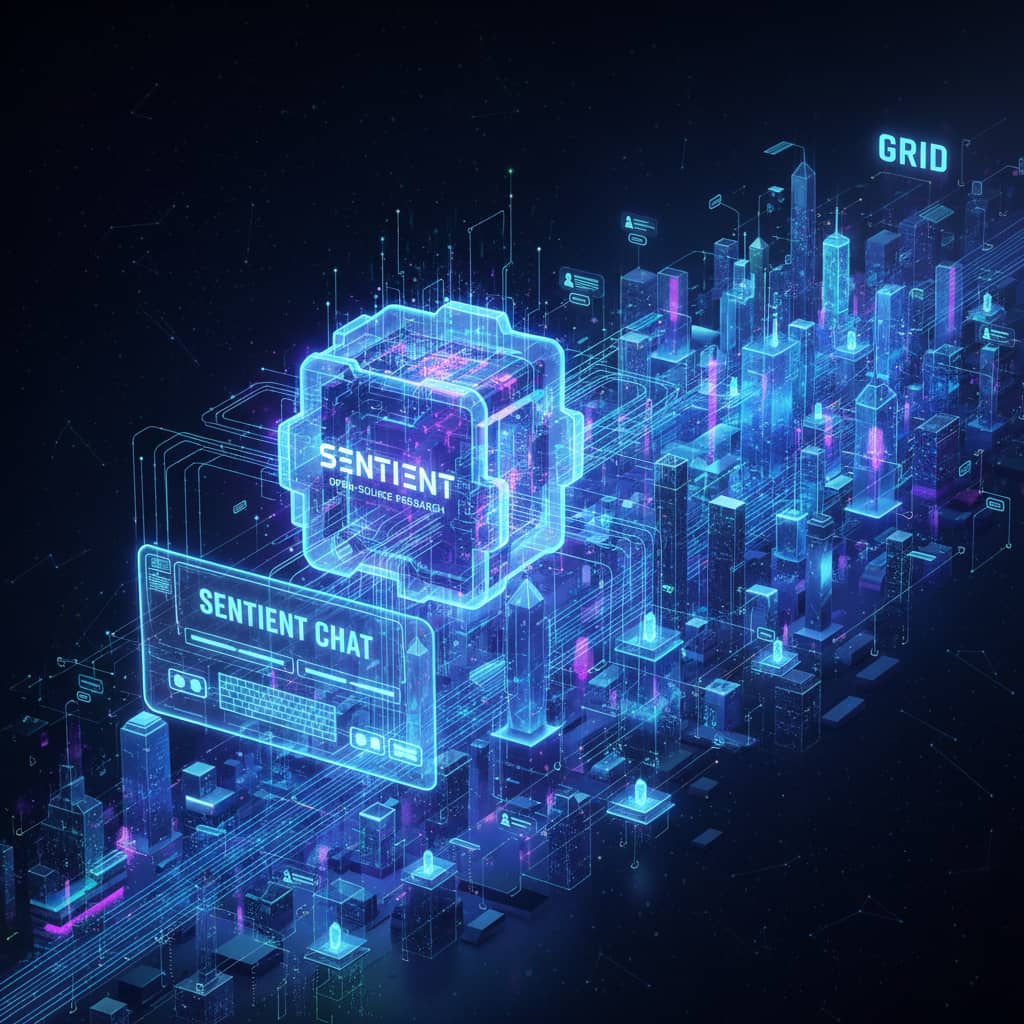
🔶A lot of people still mix up how @SentientAGI GRID, and the community fit together, so here’s a simple explanation to help everyone understand the roles and why each one matters. Sentient is the open-source AI lab that builds the core technology itself including ROMA (Recursive Open Meta Agents),OpenDeepSearch, and Sentient Chat. Their mission is to advance open, verifiable, and transparent AI for everyone.
Sentient’s research powers GRID, but GRID is not building the core models. Instead, GRID builds the ecosystem around those models. If Sentient is the engine, GRID is the city where builders, agents, and applications can live and thrive. In simple terms: Sentient is the AI research, while GRID is the AI network powered by that research.
GRID connects builders, enterprises, investors, and communities, giving them the tools, markets, and infrastructure they need to deploy agents, run applications, and participate in an open agentic economy built on top of Sentient’s innovations.
Sentient Chat plays a crucial role because it is the interface that brings the entire ecosystem to life. It demonstrates how multi-agent reasoning works, how ROMA improves intelligence through decomposition, and how open-source agents can operate on real-world tasks. For GRID, Sentient Chat becomes the gateway that helps onboard users, showcases practical use cases, demonstrates recursive reasoning, and bridges people directly into the emerging agentic economy.
The big picture is simple: Sentient builds the foundation, while GRID builds the industry and community around that foundation. Together, they are pushing forward a future where AI is open, verifiable, decentralized, and accessible to everyone.
TL;DR — Sentient = Research. GRID = Ecosystem. Sentient Chat = Interface. Together, they’re building the future of open-source, agent-powered intelligence.
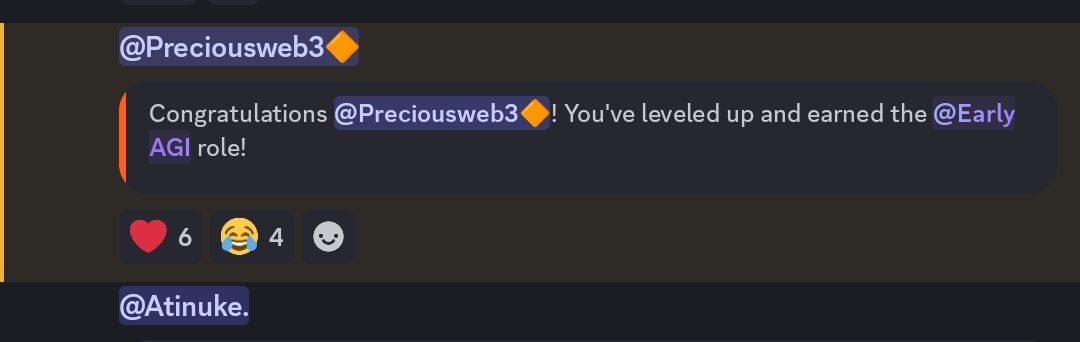
🔶Excited to share that I’ve officially earned the Early AGI role in the @SentientAGI Discord!
Becoming part of this frontier community means contributing to the rise of open, decentralized intelligence where agents, data, and creativity connect in powerful new ways.
This is just the beginning.
🔶The agentic economy needs real-world proofs, programmable payments, and credible routing and that’s where Chainlink CRE comes in, empowering AI agents to see, verify, and act across chains and data systems. @SentientAGI x @chainlink
Through Chainlink’s Cross-Chain Interoperability Protocol (CCIP) and CRE (Compute, Reason, Execute) framework, AI agents can now access verified data not just web APIs, but onchain truths. No speculation. Only verifiable reality.
With Chainlink CRE, Sentient’s open-source agents can tap verified price feeds, macroeconomic data, and cross-chain states enabling them to coordinate and settle autonomously, building trust through proof, not assumption. This integration connects Sentient’s open AI models to secure, verifiable execution environments where agents can think with proofs, respect onchain constraints, and act with guardrails. That’s how AI becomes trust-minimized a key step toward a transparent, verifiable, and programmable agentic economy.
SentientAGI is building an ecosystem of open AI systems including ROMA, Open deep search, and Sentient Chat engineered for composability, transparency, and interoperability. Each agent functions as a node within a decentralized intelligence network, enabling collective reasoning and autonomous collaboration.
By integrating with Chainlink’s data and CRE (Compute, Reason, Execute) stack, Sentient agents can now leverage asset price oracles, access macroeconomic datasets, interact with consensus systems, and execute programmable payments effectively bridging AI logic with financial and on chain reality. This synergy allows AI agents to reason using on chain proofs, not assumptions; to coordinate cross-network intelligence between Web2 and Web3; and to execute autonomous yet auditable actions. Together, these capabilities form the foundation of a verifiable agentic economy. It marks a concrete step toward a world where AI and blockchain don’t just coexist they cooperate. Where proof replaces promise, and intelligent agents think, act, and settle with trust inherently built in.
Sentient x Chainlink = Verifiable Intelligence.
🔶SoundnessLab @SoundnessLabs is the team behind Soundness Layer, the first fully decentralized zk verification layer a breakthrough framework where zero-knowledge proofs meet transparency, cost-efficiency, and verifiability.
In a world where cryptographic proofs power privacy and scalability, SoundnessLab is building the missing piece a layer that verifies those proofs openly and without relying on centralized intermediaries. Verification, now trustless. ✅
The Soundness Layer isn’t just another blockchain protocol. It’s an open, transparent, and cost-efficient infrastructure for verifying zero-knowledge proofs, where every verification is traceable, auditable, and fully decentralized.
Zero-knowledge proofs (ZKPs) allow data verification without revealing the data itself, and Soundness Layer ensures that these proofs are verified by a decentralized network, not a single entity. That’s the foundation of verifiable trust. 🧠
How it works
✅Proofs are generated by clients.
✅They’re verified by decentralized validators.
✅Every verification becomes traceable and publicly accountable.
Transparency without compromise.
⛓️The live stats on https://t.co/lQiTBgBisC
say it all
✅832,806 total proofs generated
✅424,707 proofs stored on Walrus
✅113 active games
✅54,795 total participants
Each number reflects a thriving ecosystem of decentralized computation and collaboration. 🚀
That’s not just data, that’s momentum. Thousands of participants are already engaging with SoundnessLab’s verification layer, showcasing the scalability and potential of decentralized zero-knowledge infrastructures.
Then comes Walrus, a decentralized storage system seamlessly integrated into the Soundness Layer, enabling verified proofs to be stored securely, traceable, and accessible for everyone. 🐋
The bigger vision is to power an open zk verification economy, where developers, protocols, and games can access decentralized verification directly,without relying on centralized verifiers.
From on-chain games to AI-driven protocols, SoundnessLab is building a future where proofs, verification, and coordination all happen in the open.
Imagine a world where every AI model, every smart contract, and every computation is backed by verifiable truth, that’s SoundnessLab’s mission.
🔶Talus x Sentient: Expanding the Agentic Frontier
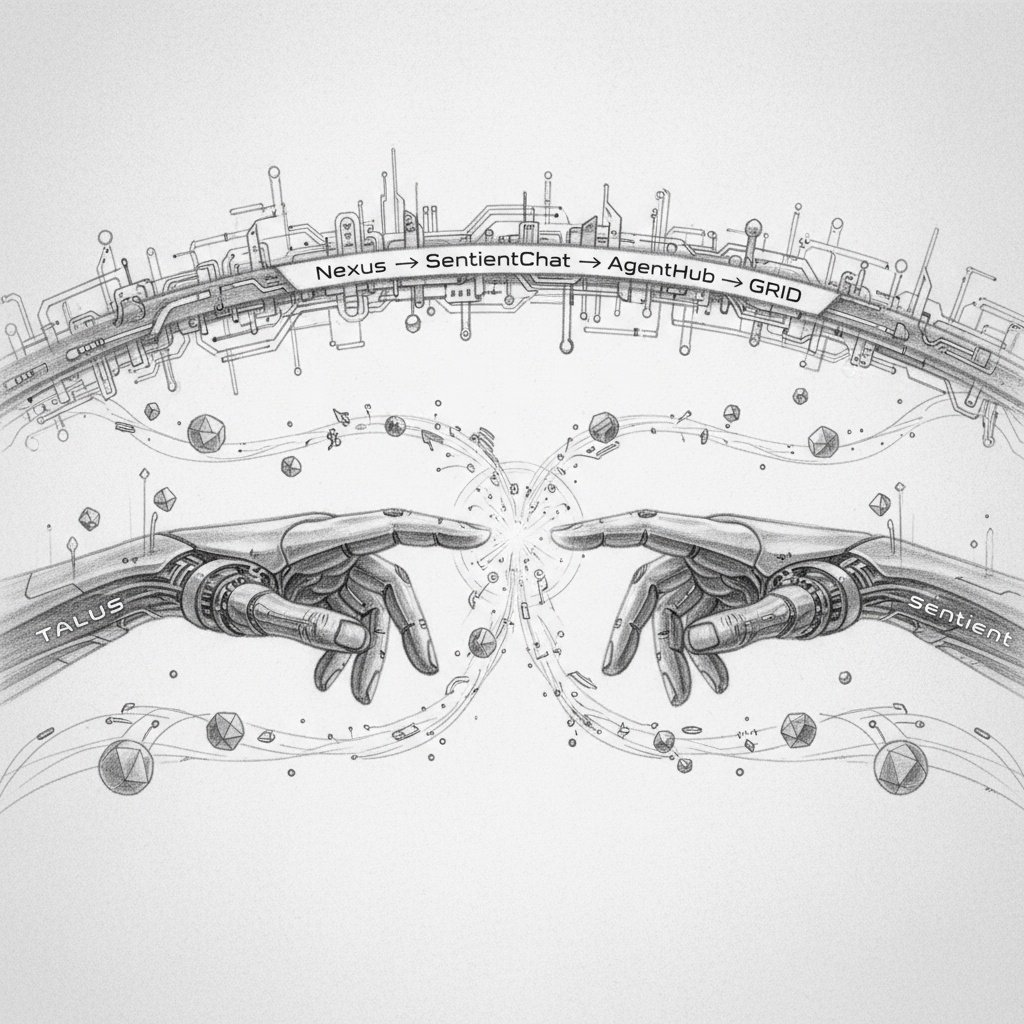
Talus is excited to announce a new partnership with @SentientAGI, the platform and research organization building community-driven AI models. This collaboration connects Nexus-built agents directly into Sentient’s AgentHub and SentientChat, giving Talus developers instant access to more than 3 million users across the Sentient ecosystem.
This partnership addresses one of the biggest challenges facing decentralized AI today distribution. Builders can create powerful, specialized agents, but connecting them with users who actually need them has remained a barrier. Traditional discovery channels are fragmented, and many agents never reach the right audiences.
Sentient changes that equation. Through its integrated platforms, SentientChat and AgentHub, users can explore, discover, and interact with a wide range of agents all within a single, unified interface. By bringing Talus built agents into this ecosystem, we’re creating a bridge between developer innovation and users adoption. Builders on Nexus now have a direct line to an active community looking for intelligent, on chain agents for automation, analytics, and other Web3 use cases.
The technical alignment between Talus and Sentient makes this integration seamless. Sentient’s model agnostic architecture and support for the OpenAI Chat Completions API allow Talus agents to plug in easily, with minimal engineering effort. That means developers can focus on refining capabilities, not managing complex integration pipelines
To make agent development even more accessible, Talus will also provide the Talus Vision no code interface, enabling anyone including nonbtechnical creators to design and deploy their own AI agents. Together with Sentient, we’re empowering a new wave of builders and expanding the pool of open, specialized agents across the ecosystem.
Beyond reach and usability, this partnership unlocks new economic alignment through Sentient’s GRID (Global Repository of Intelligence and Research Directory). GRID introduces a novel incentive layer for open source AI development, rewarding high quality agents based on community engagement and real usage metrics. For Talus developers, this means that contributing valuable agents to the ecosystem can become a sustainable, long term revenue source.
By integrating into GRID, Talus agents gain access to an emission based reward economy that reflects real impact and contribution. This system supports the shared vision of both Talus and Sentient a self-sustaining, autonomous AI economy where open participation and value creation are aligned.
This collaboration is more than technical it’s philosophical. Both Talus and Sentient are committed to building a future where AI agents are accessible, verifiable, and economically sustainable. By combining Talus’s robust agent development framework with Sentient’s powerful distribution and funding infrastructure, we’re creating a new foundation for the agentic economy one where innovation compounds, discovery is effortless, and value circulates across communities.
The launch of Talus agents within Sentient’s ecosystem marks the beginning of a new phase in decentralized intelligence. Developers will have better tools, users will have smarter agents, and both ecosystems will grow stronger together.
🔶 The Next Internet Runs on Proof, Not Trust.
@SoundnessLabs is building the Soundness Layer, a decentralized verification network that acts as the trust engine of the internet.
Blockchains store data, but they don’t scale trust.
Verifying zero-knowledge proofs, AI outputs, or cross-chain transactions on-chain is costly and slow.
Soundness fixes this by separating verification from execution.
Instead of re-verifying every proof directly on-chain, Soundness moves that process off-chain into a decentralized network of zk verifiers. Each verifier checks proofs independently, reaches consensus, and posts a lightweight attestation, a “proof of proof” back on-chain. This design transforms verification into a universal service layer that any blockchain, rollup, or application can plug into. Soundness doesn’t replace blockchains it makes them provable at scale.
Under the hood, it’s fully modular.
💧 Coordination runs on @SuiNetwork
🦭 Data availability flows through @WalrusProtocol
🔁 Security is reinforced by @eigencloud and @symbioticfi
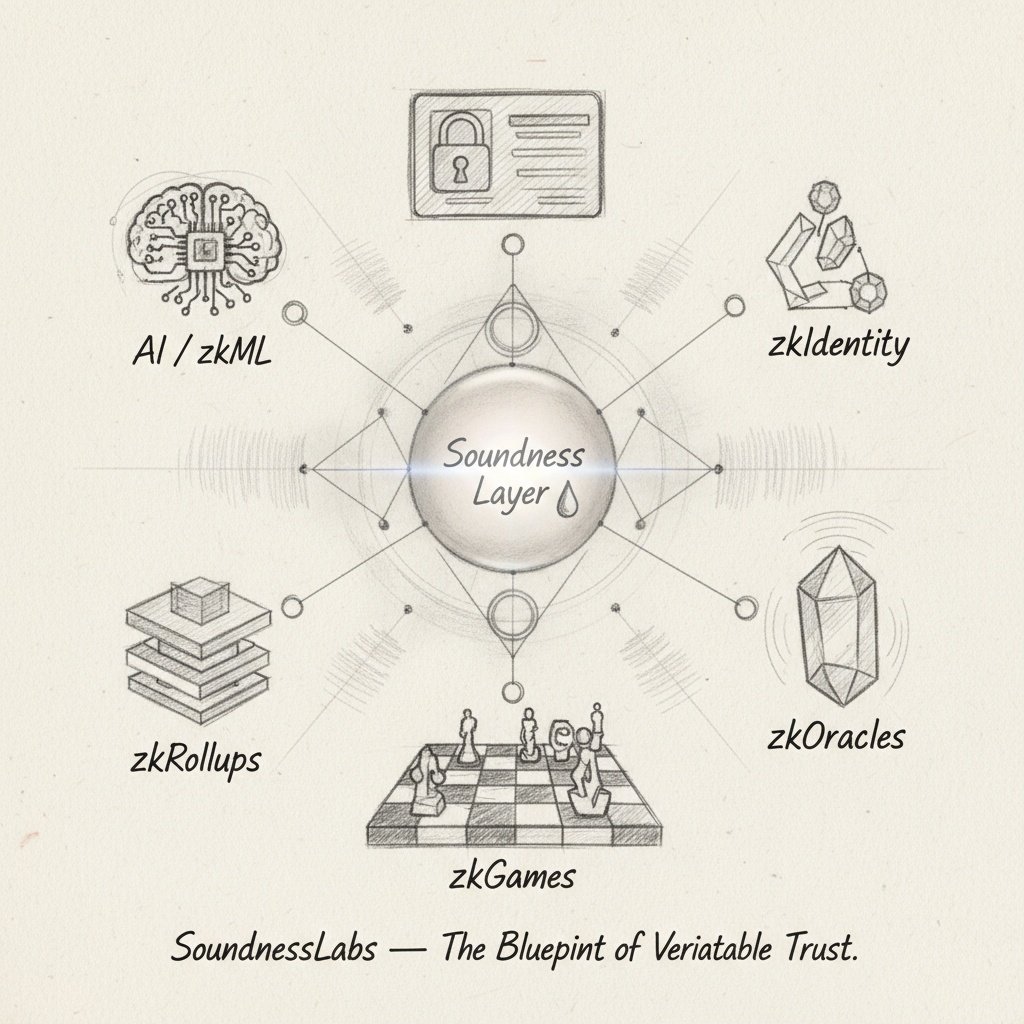
Together, they form a modular, interoperable zk infrastructure the foundation of a verifiable internet. Soundness makes trust composable. A proof verified once can be reused across multiple chains, systems, or applications. That means cross chain verification becomes instant, seamless, and cheap.
Rollups can share verified proofs. AI models can provide verifiable results. Oracles can deliver proof-backed data. All powered by the same trust engine Soundness.
In a world filled with AI-generated content and synthetic data, Soundness brings cryptographic truth back to the web. It replaces “trust me” with “prove it.”
SoundnessLabs isn’t building another blockchain, they’re building the backbone of trust for all of them.
The internet doesn’t just need to be fast or scalable it needs to be sound.
💧 Soundness Layer the Proof Engine of the New Internet. Transparent. Composable. Verifiable.