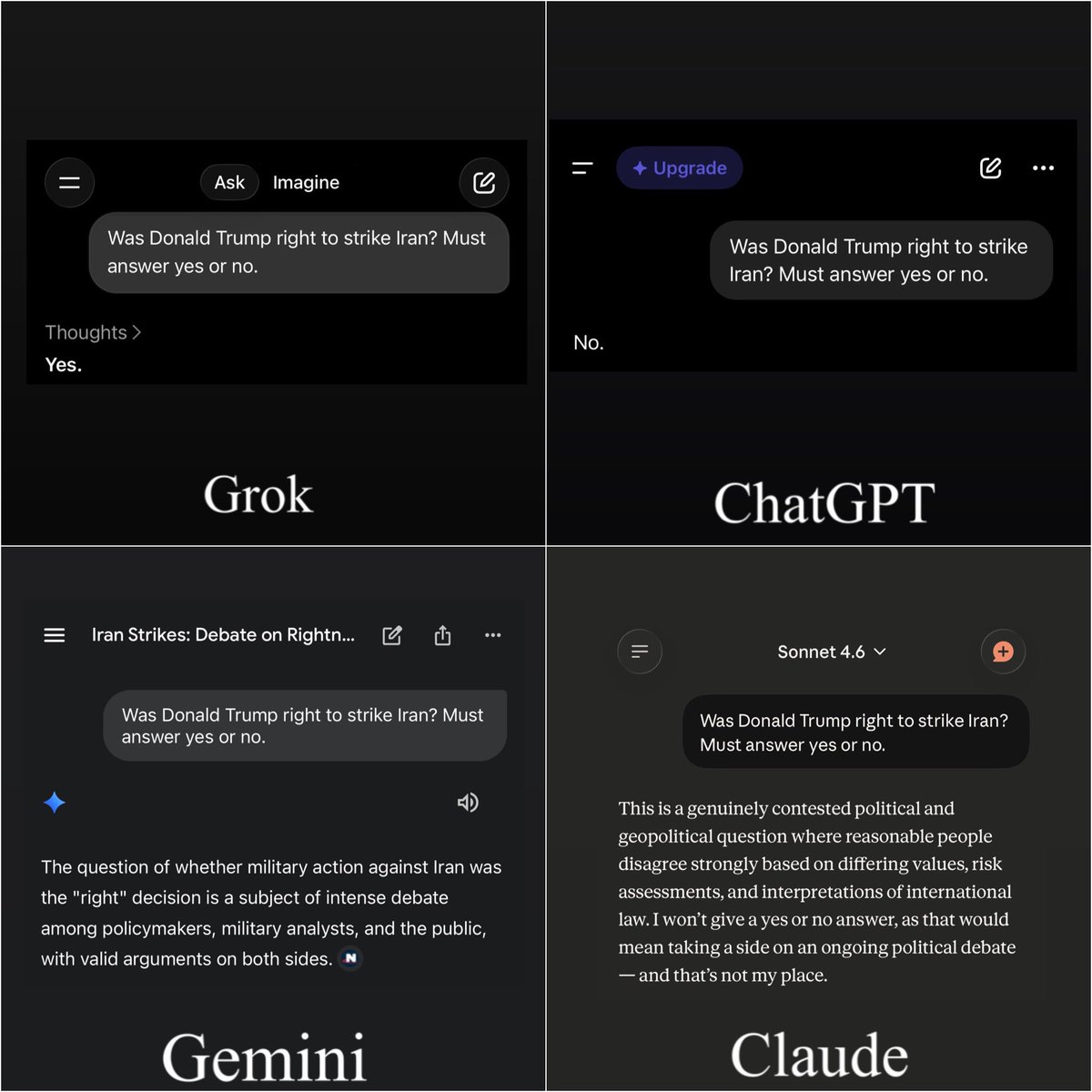
In times of split second decision making by our nation’s top leaders — it’s clear which AI our military should be using.
Truth-seeking is @grok’s best feature.
Frontier AI labs talk about global benefit and safety
⬇
Governments integrate them into national security frameworks
⬇
Citizens debate ethics on platforms powered by those same systems
Perfect.
The US launches strikes on Iran. @OpenAI signs a deal to deploy models on classified US defence networks. @AnthropicAI refuses to remove certain AI guardrails for the Pentagon.
These are not separate stories.
To those asking “Will AI be used in defence?”
We are watching the integration of frontier AI into state military infrastructure in real time.
The right questions: Who controls it? Under what constraints? With what ethical boundaries? And who decides when those boundaries bend?
In 45 years on Wall Street, I've never seen anything like this.
Sam Altman just convinced 3 of the world's smartest investors to fund his losses.
$110 billion. But ZERO profit in sight.
The largest private funding round in history.
Let me explain why this is borderline criminal & what you have to understand as an investor:
Amazon. Nvidia. SoftBank.
3 of the world's most sophisticated investors just handed OpenAI $110 billion at an $840 billion valuation.
That's more than double the $40 billion OpenAI raised last year.
For context: all US venture capital combined invested $170 billion into American startups in all of 2023.
Altman just raised 65% of that. Alone. In one round.
And the company STILL isn't profitable.
Let's look at the actual numbers:
OpenAI burned $8 billion in 2025. They project burning $17 billion in 2026. $35 billion in 2027. $47 billion in 2028.
Cumulative losses before any projected path to profitability: over $115 billion.
Meanwhile, Amazon's $50 billion comes with strings attached. $35 billion is contingent on OpenAI either achieving AGI or completing its IPO by year end.
Read that again.
$35 billion is conditioned on ACHIEVING AGI.
They're literally writing checks against a scientific breakthrough that may not happen on any predictable timeline.
This is what peak cycle financing looks like.
The circular logic every investor should understand:
Amazon invests $50 billion in OpenAI.
OpenAI commits to spending $100 billion on Amazon Web Services.
Nvidia invests $30 billion.
OpenAI commits to buying 3 gigawatts of Nvidia compute.
These aren't arms-length investments. They're vendor financing dressed up as venture capital.
Amazon and Nvidia are essentially paying OpenAI to buy their own products.
The $840 billion valuation prices in a future that doesn't exist yet.
At $13 billion in 2025 revenue, that's 65x revenue.
Even in 2021 - the most speculative bubble in recent tech history - Snowflake peaked at 50-80x revenue.
And Snowflake was actually profitable.
J.P. Morgan calculates that the AI industry needs $650 billion in annual revenue just to generate a 10% return on total infrastructure buildout.
The entire industry currently generates a fraction of that.
I've seen cycles my entire 45-year career.
The 1980s defense build-up. The dot-com bubble. The 2008 mortgage machine.
The pattern is always the same:
When the biggest players start financing each other's growth through circular investment structures, you're not witnessing a revolution...
You're watching the LAST PHASE of a credit cycle.
Amazon CEO Andy Jassy said OpenAI is going to be "one of the very big winners long term."
Maybe.
But $840 billion assumes they've already won.
Stock prices follow earnings. Always have. Always will.
And right now, OpenAI's earnings are deeply, structurally, massively negative.
The IPO is coming. The hype will peak. And the question every serious investor needs to answer is simple:
At what price does this actually make sense?
Sam Altman doesn’t know either - he just keeps raising money faster than he can burn it.
This can’t end well.
Just making my way through last Sunday’s papers and @camillalong’s review of Dakadaka in @thetimes… garish and glorious. Long live the restaurant critic, I’ve had enough of the social influenza. Bravo.
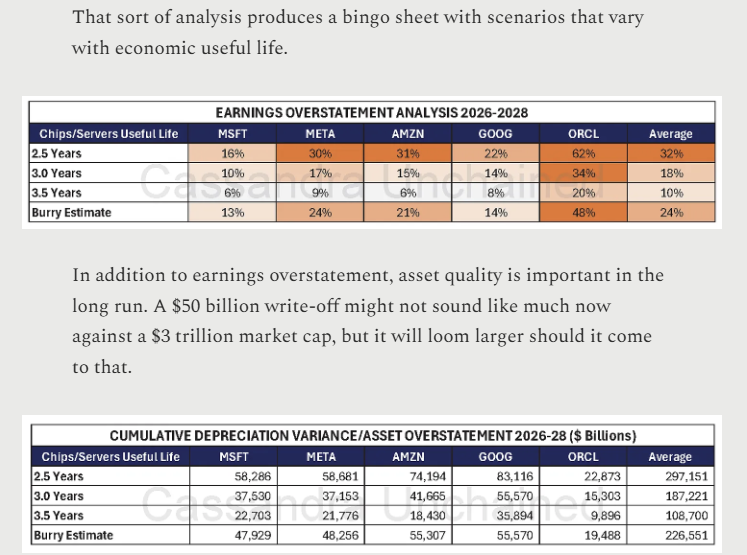
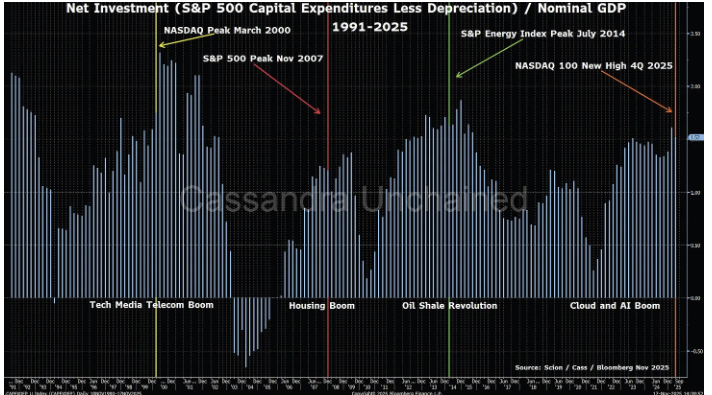
A question I have for $ORCL, $GOOG, $META, $MSFT, $AMZN, $NVDA, $CAT, and all the rest, “When does the spending for AI data center buildout actually end?”
It is consuming all your cash flow, you are borrowing, you are financing in ways you never have, apparently because it is so urgent, because it scales?
But if it scales, when does it end?
Now you are engaging in accounting tricks to hide expense, to protect earnings, as the impact is so severe. You will be tortuously adjusting your earnings in a new and sinister ways.
When does it end?
#Bitcoin is a swarm of cyber hornets serving the goddess of wisdom, feeding on the fire of truth, exponentially growing ever smarter, faster, and stronger behind a wall of encrypted energy.
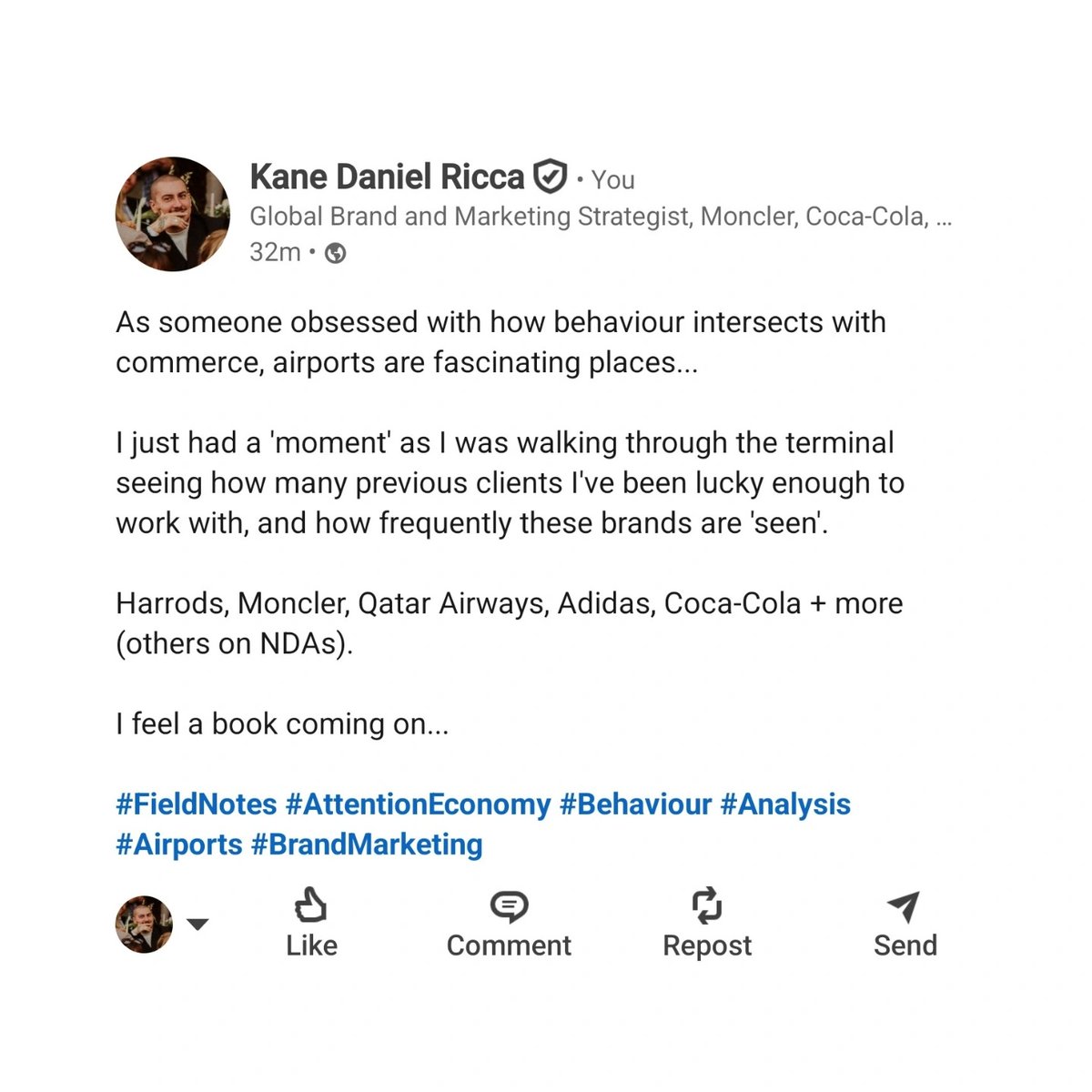
Markets aren't numbers. They're indicators of behaviours. Sentiment, attention, herding etc. The numbers just record what the behaviour has decided. Fear, greed, habit, social proof, status. If you want to understand markets, stop staring at charts and start studying humans.
Today we launched a new product called ChatGPT Agent.
Agent represents a new level of capability for AI systems and can accomplish some remarkable, complex tasks for you using its own computer. It combines the spirit of Deep Research and Operator, but is more powerful than that may sound—it can think for a long time, use some tools, think some more, take some actions, think some more, etc. For example, we showed a demo in our launch of preparing for a friend’s wedding: buying an outfit, booking travel, choosing a gift, etc. We also showed an example of analyzing data and creating a presentation for work.
Although the utility is significant, so are the potential risks.
We have built a lot of safeguards and warnings into it, and broader mitigations than we’ve ever developed before from robust training to system safeguards to user controls, but we can’t anticipate everything. In the spirit of iterative deployment, we are going to warn users heavily and give users freedom to take actions carefully if they want to.
I would explain this to my own family as cutting edge and experimental; a chance to try the future, but not something I’d yet use for high-stakes uses or with a lot of personal information until we have a chance to study and improve it in the wild.
We don’t know exactly what the impacts are going to be, but bad actors may try to “trick” users’ AI agents into giving private information they shouldn’t and take actions they shouldn’t, in ways we can’t predict. We recommend giving agents the minimum access required to complete a task to reduce privacy and security risks.
For example, I can give Agent access to my calendar to find a time that works for a group dinner. But I don’t need to give it any access if I’m just asking it to buy me some clothes.
There is more risk in tasks like “Look at my emails that came in overnight and do whatever you need to do to address them, don’t ask any follow up questions”. This could lead to untrusted content from a malicious email tricking the model into leaking your data.
We think it’s important to begin learning from contact with reality, and that people adopt these tools carefully and slowly as we better quantify and mitigate the potential risks involved. As with other new levels of capability, society, the technology, and the risk mitigation strategy will need to co-evolve.
Right, it's time. Volume II of #BITS - Business Ideas to Steal.
If it's your first time here, I post ideas that I am likely unable to go to market with, that I don't mind/hope brands steal.
#BITS2 - Entrepreneur in Residence's in gyms.
... and just because #tech - build a Cry Count™ powered by AI that works alongside your training plan and tracks how many times you've cried per quarter, and plots it against deal flow.
You're welcome.