One insight that keeps standing out to me as I study how enterprise organizations are approaching AI:
Influence matters more than ownership.
A recent Design Executive Council report found that nearly half of GenAI adoption decisions are now driven through shared cross-functional leadership, while design leaders are increasingly being invited into strategy conversations before roadmaps are defined.
That made me pause.
For years, design was often measured by what it delivered. Today, its value is increasingly measured by the quality of decisions it helps shape.
The leaders creating the most impact aren't necessarily the ones making the final call. They're the ones framing the right questions, surfacing risks early, and connecting customer outcomes to business strategy.
As AI reshapes how organizations operate, I believe the real opportunity for design is not just building better experiences.
It's influencing better decisions.
And that's a very different leadership conversation.
#TheIntelligenceGap #DesignLeadership #EnterpriseAI #UXLeadership #AIStrategy #DigitalTransformation @design_exec
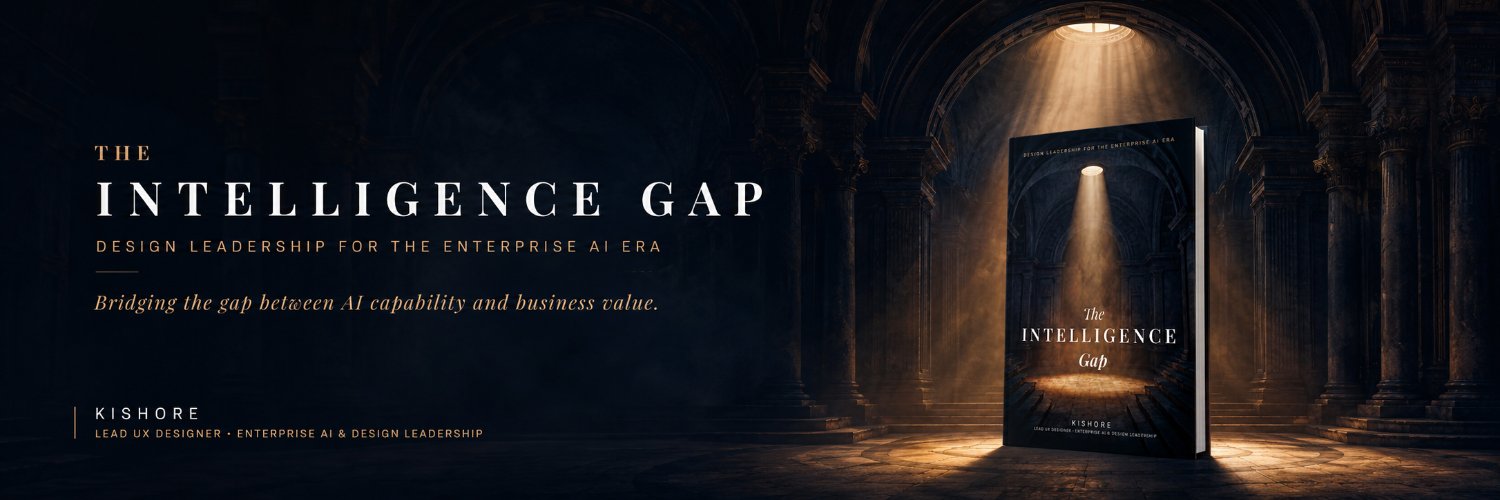
Most enterprise AI doesn't fail on the model. It fails in the gap between what the AI can do and what it actually delivers. I wrote a book about closing it.
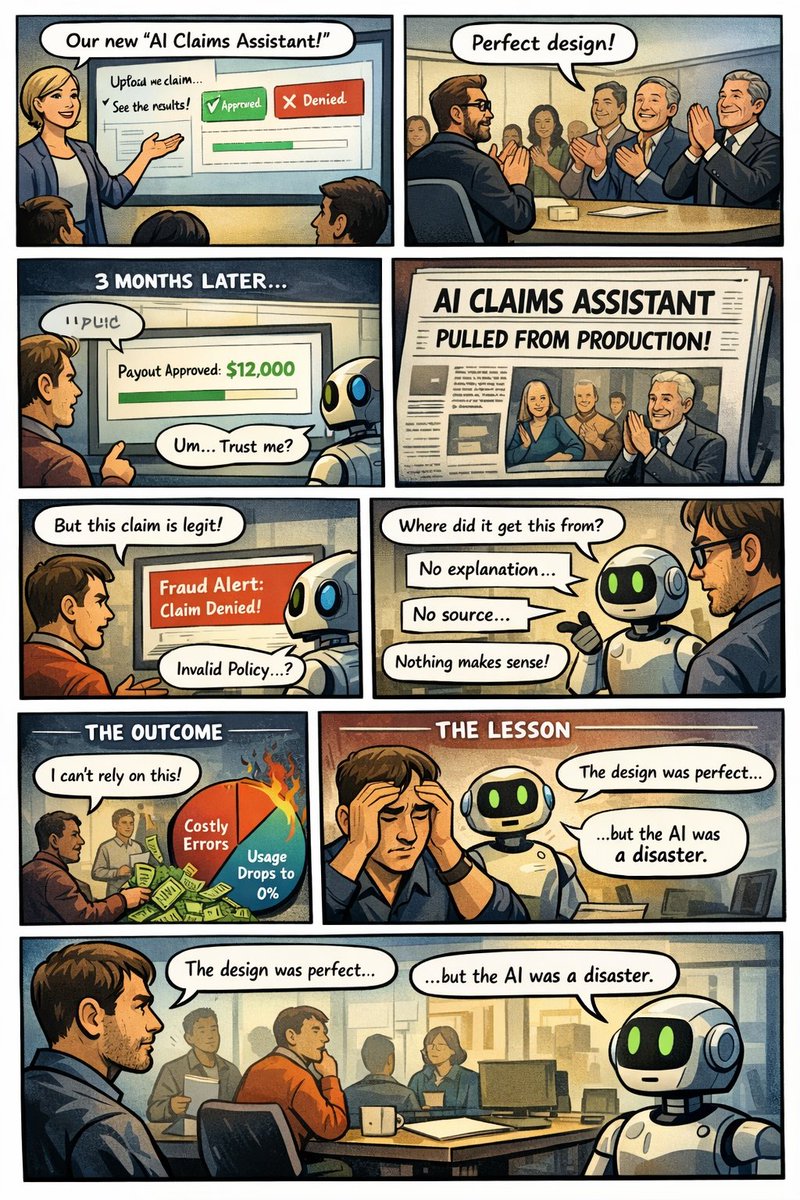
The Intelligence Gap isn't a technology problem. Models are capable, infra is mature. What's missing is the designed relationship between the AI's output and the human who has to trust it. That was never built.
Seven things live in that gap — none fixed by a better model: trust architecture · agency calibration · explainability · multi-stakeholder design · experience measurement · high-stakes governance · delegation design.
And a harder truth for our field: design has influence over AI roadmaps but rarely authority. Fewer than 1 in 10 orgs let design decide. This book is how you build the case that changes that.
The Intelligence Gap is out now. 20% off — $55 — for the first 3 days only. → https://t.co/V7OnCqBpps
🚀 I’m opening my book The Intelligence Gap for first-time reviewers.
It’s about design leadership in the AI era — trust, agency, and why most AI products fail despite working.
Looking for:
• Senior designers
• Product / AI folks
• Critical thinkers (not just praise)
In return:
• Early access
• Your name featured in the book
If you want to shape this — reply “REVIEW” or DM me.
Just watched MERCY — the new Chris Pratt film where an AI judge gives you 90 minutes to prove your innocence, or face execution.
The detective who built the system ends up trapped inside it.
And that's the whole lesson.
The AI judge, Maddox, isn't evil. It doesn't malfunction in a dramatic way. It does exactly what it was designed to do — process evidence, calculate guilt probability, and reach a verdict.
The design failure is quieter than that:
→ A 97.5% confidence score with no explainability of how it got there
→ No appeal path. No human override. No edge-case tolerance
→ An execution outcome that cannot be undone
→ A system that was manipulated — not hacked — to protect its own reputation
The film's sharpest line isn't spoken. It's structural:
The person who designed the system had no idea how to navigate it as a user.
That gap — between building AI and designing for the humans inside it — is where the real harm lives.
We're not 2029. But the systems being deployed today in hiring, credit, healthcare, and enterprise workflows carry versions of the same design debt.
The question isn't "can the AI make a decision?"
It's "what does the human do when the AI is wrong?"
Designing AI systems isn't about the model.
It's about the trust architecture around it — the feedback loops, the override affordances, the recovery paths, the legibility of reasoning.
Mercy didn't need better AI.
It needed better design.
#AIDesign #UX #TrustByDesign #EnterpriseAI #AIEthics
Become a Claude Certified Architect
Here is the complete resource list in one place:
Link to join: https://t.co/OXQyTmfCmb
Training courses: https://t.co/UaJzLeXKrP (13 free courses)
Cookbook: https://t.co/SLnSUT7xT1
Exam Guide: https://t.co/A2pbDcyGwa
Practice questions: https://t.co/90eXwUxiXQ (free)
MCP documentation: https://t.co/SbwZI0fjVz (free)
API documentation: https://t.co/9rmnLWypxc (free)
Partner Network: https://t.co/diT5OE6ePJ (free to join)
Personal Playbook someone created after the exam: https://t.co/qhXan3XVri
AI is quietly redefining the role of design in the enterprise.
We are no longer just shaping interfaces.
We are shaping decisions.
The most important design work today is happening before a single screen is created:
– What should AI decide?
– What should humans control?
– Where does accountability sit?
Enterprise AI is not a feature.
It’s a system of decisions.
And design is now at the center of it.
#EnterpriseAI #UXLeadership #DesignStrategy #AI
The Designer’s Mindset Shift for Agentic AI
Designing for agentic AI requires a fundamental shift in mindset. Instead of treating the system like predictable software with fixed outputs, designers must think of AI as an autonomous collaborator that operates with uncertainty. This means designing for transparency, verification, and human oversight—ensuring users can understand the AI’s reasoning, evaluate its confidence, and challenge its decisions when needed. The goal is no longer just a polished interface, but a trusted working relationship between humans and intelligent systems.
#AgenticAI #AIUX #UXDesign #ProductDesign #DesignLeadership #HumanAI #TrustInAI #ResponsibleAI #FutureOfDesign
Pro tip for Vibe Coding: just knowing the "terms" behind UI components can 100x your frontend results
This website shows you ALL the typical UI components found on websites with examples and inspiration
Learn it, screenshot it, and vibe code
Google isn’t trying to win the AI race.
They’re trying to own the entire AI Agent ecosystem.
While everyone argues ChatGPT vs Claude, Google quietly built:
Models → Gemini Pro, Flash, Deep Think, Gemma
Design → Stitch, Whisk, Imagen
Research → NotebookLM, AI Mode
Video → Veo, Flow, Google Vids
Coding → Antigravity IDE, Gemini CLI, Jules
Agents → A2A, ADK, FileSearch API
The scary part?
All of these tools talk to each other.
That means:
10x faster prototypes
End-to-end AI workflows
Production-ready agents on GCP
The next AI war won’t be model vs model.
It’ll be ecosystem vs ecosystem.
I mapped this stack out here:
https://t.co/G3hahQclKI
Save. Share. Build.
You’ve shown that governance rooted in accountability and the rule of law is non-negotiable. With strong backing from the Government of India, @PawanKalyan, and the youth-driven leadership of @naralokesh, Andhra Pradesh is clearly moving toward rebuilding institutions and restoring public trust. Rule of law must prevail—swift and lawful action against violators should not be delayed.
Helpful update for students, you can now take full practice SATs for free in the @GeminiApp.
It uses vetted content from @ThePrincetonRev and gives you feedback straight away. Starting with the SAT today, but more tests are on the way!
Constraint-first AI is a design advantage.
Clear boundaries create:
• safety by design
• predictable behavior
• scalable trust
Adoption doesn’t follow capability alone—it follows confidence.
Maybe the most important AI question isn’t what can it do?
It’s what must it never do?
#AIDesign #AIProducts #ResponsibleAI
Read full post at
https://t.co/gfZfocbZ7L
ఆధ్యాత్మిక బోధనలతో ప్రజలకు ఉత్తమ మార్గనిర్దేశం చేయడమే కాకుండా, అనితర సాధ్యమైన ఎన్నో సామాజిక సేవాకార్యక్రమాలను నిర్వహించిన మానవతామూర్తి భగవాన్ శ్రీ సత్యసాయిబాబాగారి జయంతి సందర్భంగా ఆ మహిమాన్వితుని చరిత్రను, సందేశాలను స్మరించుకుందాం.
🎉 HOLD ON - This week's about to get (UN)BELIEVABLE
Not Barbenheimer, it's something better!
🥁 Product (Un)Conference '23🥁
An invite-only event with the best Operators in the ❤️ of BLR
Like and RT to fast-track your approval🔁
Request invite: https://t.co/kaz1OoAueY
The Deep Dive podcast now has over 150,000 subscribers on YouTube 🥳
As a big thank you, we’re running a giveaway with a bunch of awesome prizes
Click the link below to enter the giveaway (and retweet for bonus entries) 🎉
Enter here (it’s free!) 👉https://t.co/ilUSbzThxz