@chr1sa@khanacademy Perhaps the teacher's role is outdated. If information is fully accessible and distractions are holding students back, perhaps the teacher should be closer to a coach (focusing on motivation, inspiration, EQ to ignite student curiosity).
Google Gemini 2.0 realtime AI is insane.
Watch me turn it into a live code tutor just by sharing my screen and talking to it.
We’re living in future.
I’m speechless.
Tesla's Optimus Bot makes my brain hurt.
Tesla's CEO @elonmusk recently made comments that having 1 billion humanoid robots doing tasks for us by the 2040s is not out of the question.
At first glance this sounds absolutely ridiculous and completely impossible, but once we start thinking more deeply about this claim, the tone starts to shift from "impossible" to "oh shit this might actually happen".
Let me walk you through how I'm thinking about it.
The form factor of a humanoid robot will likely remain unchanged for a really long time. A human has a torso, two arms, two legs, feet, hands, fingers, etc. Every single physical job that exists around the world is optimized for this form factor. Construction, gardening, manufacturing, housekeeping, you name it.
That means that unlike a car (as an example), the addressable market for a product like the Tesla Bot will require little or no variations from a manufacturing standpoint. With a car, people need different types of vehicles to get their tasks done. SUVs, Pick Ups, compacts, etc. There’s a variation for every use case.
This adds complexity to the manufacturing process of a car, and due to this complexity, you are limited to how many units you can crank out of a factory. Not to mention that over time, folks will expect their cars to look different, perform better, have new creature comforts, etc. This requires new manufacturing processes, techniques, etc.
But with a humanoid robot, the form factor will be able to remain the same for much longer than a car. This is because every manual job out there is optimized for the form factor of a human - or in this case, a humanoid robot that functions the same as a human.
What this means is that the manufacturing complexity of a humanoid bot will be much less than a car, and the units that one will be able to crank out over time through the same sized factory will only increase as efficiency gets better over time.
Knowing this, let’s try and put into context if the 1 billion number is possible by doing some rough math.
If we use data from the US Bureau of Labor Statistics, ~60% of all civilian workers in the US have a job that requires standing or walking for a majority of their time. This means that ~60% of civilian workers have a job that is also optimized for a humanoid robot.
There are about 133 million full time employees in the US. Applying the 60%, we can assume there are about 80 million jobs that are optimized for the form factor of a human or humanoid robot. Knowing that the US has about 5% of the total global population, and we conservatively assume that the rest of the world has the same breakdown of manual vs non-manual labor, we get about 1.6 billion jobs that are optimized for a human or humanoid robot. The real number is likely to be significantly higher due to still developing nations, but it’s still quite the number.
And thus, from a total addressable market standpoint, 1 billion humanoid robots roaming around the planet performing jobs for us doesn’t seem out of the question. If the global population continues to increase (fingers crossed), this number increases as well.
Next, let’s address if manufacturing this many units is something that’s possible.
Let’s use two vastly different, but very much needed products in today’s world to find how likely this is: cell phones and cars.
Cell phone manufacturing peaks at around 1.5 billion per year globally, which took roughly 15 years to reach. That means that over the course of 5 years, you’d have made enough cell phones for every single human on earth. Car manufacturing peaks at around 100 million units per year.
These two products fall under what's called 'complex manufacturing'. They each have a bunch of parts that are associated with them, and a giant supply chain that feeds all the needed materials for manufacturing. However, the biggest differentiator quite obviously, is the size and style of manufacturing needed for both.
The amount of space and labor needed to manufacture a single car vs a single cell phone is orders of magnitude larger. If we use iPhone manufacturing out of Foxconn’s Zhengzhou plant as an example, the plant can produce a peak of 500,000 iPhones PER DAY in a facility that’s about 5.4 million square feet. At peak capacity, this is about 180 million iPhones per year, assuming no shutdowns and issues that can arise. Even if the number was half of this, you’ll quickly see that the difference is staggering.
If we use Tesla’s Fremont plant, which is one of the most efficient car factories in the world, it makes about 650k cars per year in the same exact footprint of 5.4 million square feet.
This means that Apple can make 280 times more iPhones in the same footprint as Tesla can make cars.
To put the size of one of these factories in perspective, the earth has 1,597,675,921,459,200 square feet of land mass. One of these factories takes up roughly 0.000000004% of the total land mass of planet earth.
In other words - there’s a lot of room to make stuff, and in this case, a lot of rooms to make bots.
In very rough terms, the size of a humanoid robot is somewhere between a cell phone and a car. This is a vast oversimplification, but I want to make clear that the number of robots that a company can manufacture is not limited by how many factories are needed, or the size of said factories.
If we assume a similarly sized factory that can make something on the order of 2,000,000 robots per year, you would need 500 factories to crank out 1 billion robots per year. That’s still only 0.000007% of the total land mass on the planet for all 500 factories.
Not to mention that the product in question, a humanoid robot, will also be used to manufacture itself. You won’t need to put out an ad to hire more people to help manufacture them. You just make more of them. And the more you make, the more that can be made. They’ll be made faster, in tighter spaces, and in greater numbers. The only limiting factor is how many bots you can make, and how many factories you can throw up to make them (which the bot will also make).
You see where I'm going with this?
Lastly, let’s address if a humanoid robot will have the demand necessary to reach 1 billion units. This is where the concept of what we think of as an economy, money, and work becomes weird to think about.
If we think about the raw materials needed to make a humanoid robot, we are talking about a battery that’s likely 1/10th to 1/5th the size of one in an electric vehicle, actuators, plastics, metals, cameras, screens, wires, and other miscellaneous parts. All in, even including exotic materials and parts, the cost is not likely to exceed $20k to $30k for materials and parts. At the start, the manufacturing process will likely double the cost of the bot (or more) as companies figure out the proper techniques to make one of these things.
However, over time costs will go down dramatically as the supply chain spools up and manufacturing processes are honed in. This applies to any manufacturing process that has ever existed.
I think it’s reasonable to expect the cost of one of these bots, all in, to be somewhere in the order of $25k to $50k per unit in the medium term. I would love to be challenged on this and greatly welcome the feedback.
Let’s assume it costs Tesla $50k to make one of these at a run rate of 1 million units per year. As their investments in AI technology begin to pay off, the jobs that the bot can do will transform from simple tasks - like surveillance in a parking lot, or picking up things on one end of a warehouse and putting them down on another end - to more complex tasks like building, gardening, housekeeping, and the like.
However, even if we assume a simple task like surveillance, it makes a lot of economic sense as a business to buy a humanoid robot instead of hiring an individual for the same task.
The average starting salary of a security guard in Texas is about $14.50 an hour, or roughly $30k per year. If we assume a life expectancy of a Humanoid Robot to be somewhere around 5 years (likely to be much longer), it means that the decision comes down to hiring a security guard position over 5 years for $150k, or purchasing a humanoid robot that will be significantly less expensive.
If it costs $50k to build one, Tesla can make anywhere between $1 and $99k and it’ll still be cheaper than a human security guard over 5 years.
Even if Tesla decided to charge $100k for a humanoid robot, a business would save $50k over 5 years in labor costs, per security guard. In addition, the business would not have to worry about healthcare, injuries, or workplace conflicts. And on top of that, Tesla would make $50k in pure profit from each bot that's sold.
The math gets weirder if a) Tesla sells the bot for less than $100k or b) the Bot lasts longer than 5 years, making the return on investment even larger for the business.
The math gets wilder still as the complexity of the job increases, and with it labor costs
For example, the average car plant worker in the US makes somewhere around $65k per year. However, the cost of the bot would remain exactly the same as the example above. There’s nothing new the bot needs to have from a materials perspective - it just needs to learn how to make the movements. Tesla’s AI brain will learn how to do this over time, and it’ll be as simple as a software update - no different than getting the new iOS update on our iPhones.
If we use the same math example as above, the car manufacturer would have to solve for this equation:
- Pay a person $325k over 5 years (plus healthcare, benefits, etc) or...
- Buy a Tesla Bot for $100k (or less), saving the company $225k (or more) over 5 years, and making Tesla $50k (or more) in the process.
In this example, Tesla could get away with charging double, and it would still save the car manufacturer a ton of money. This will either lead to a) deflation due to lower costs of manufacturing or b) massive profit increase for both the manufacturer and Tesla as labor efficiency increases. This dynamic warrants an entirely different post.
And as we’ve found out from above, the cost of the bots will likely go down over time as the bots start building the bots, removing tons of costs out of the process, removing the need for rest, vacation, and workplace injuries, and the capability to make the manufacturing processes a lot more dense, and faster, which will crank out more bots per factory, further lowering costs, etc. etc. etc.
Or we can use an example from our daily lives - how many of us would buy or rent a robot so that you never have to worry about dishes, laundry, lawn care, cleaning up the house, moving stuff, etc.? Think about the time this frees up at home to spend on whatever you’d like. What’s the price one is willing to pay? Is that price more than how much it costs to build a humanoid robot?
Let’s assume we can rent a humanoid robot for $500 a month to do all our chores and then some. Over 10 years, that’s $60k in revenue, which will cover the costs of a bot at $50k per unit. Would you do it? What if manufacturing processes are ramped up to a point where you can rent one for $250 a month? $100 a month?
This is where my brain starts to hurt. Actually, it started to hurt by the time I finished writing the third paragraph.
I hope this helps contextualize just how game changing this technology will be in the future. I firmly believe this isn’t a question of if - but when. There are no fundamental bottlenecks from a technological perspective that will keep this from becoming reality.
With the advent of AI, Tesla’s lead in leveraging this technology to understand the physical world, advancements in manufacturing capability, and human ingenuity, we are giving birth to what’s likely to be the most fundamental shift to the human economy in recorded history.
In one stroke, we are drastically reducing the costs associated with making things in the real world while freeing up massive amounts of time from jobs that a humanoid robot will be able to do better, faster, and much longer.
Will this be a good thing? What will we do with all the time that we’ll have? Will we struggle with purpose? What will happen with the concept of money when robots can build and do anything for us at almost no cost?
Time is running out for us to figure this out, because one thing is for sure - the robots are coming whether we like it or not, and if the past is anything to go by, this change will come much faster than any of us realize.
Hey, I'm ex-Reddit advisor and sold a community platform to WeWork.
I noticed something BIG recently if you're looking to build cash-flowing internet businesses:
There are 1.8B active users in Facebook Groups in 2024
But I've noticed 95% of paid communities are dead. RIP. There's something new taking its place.
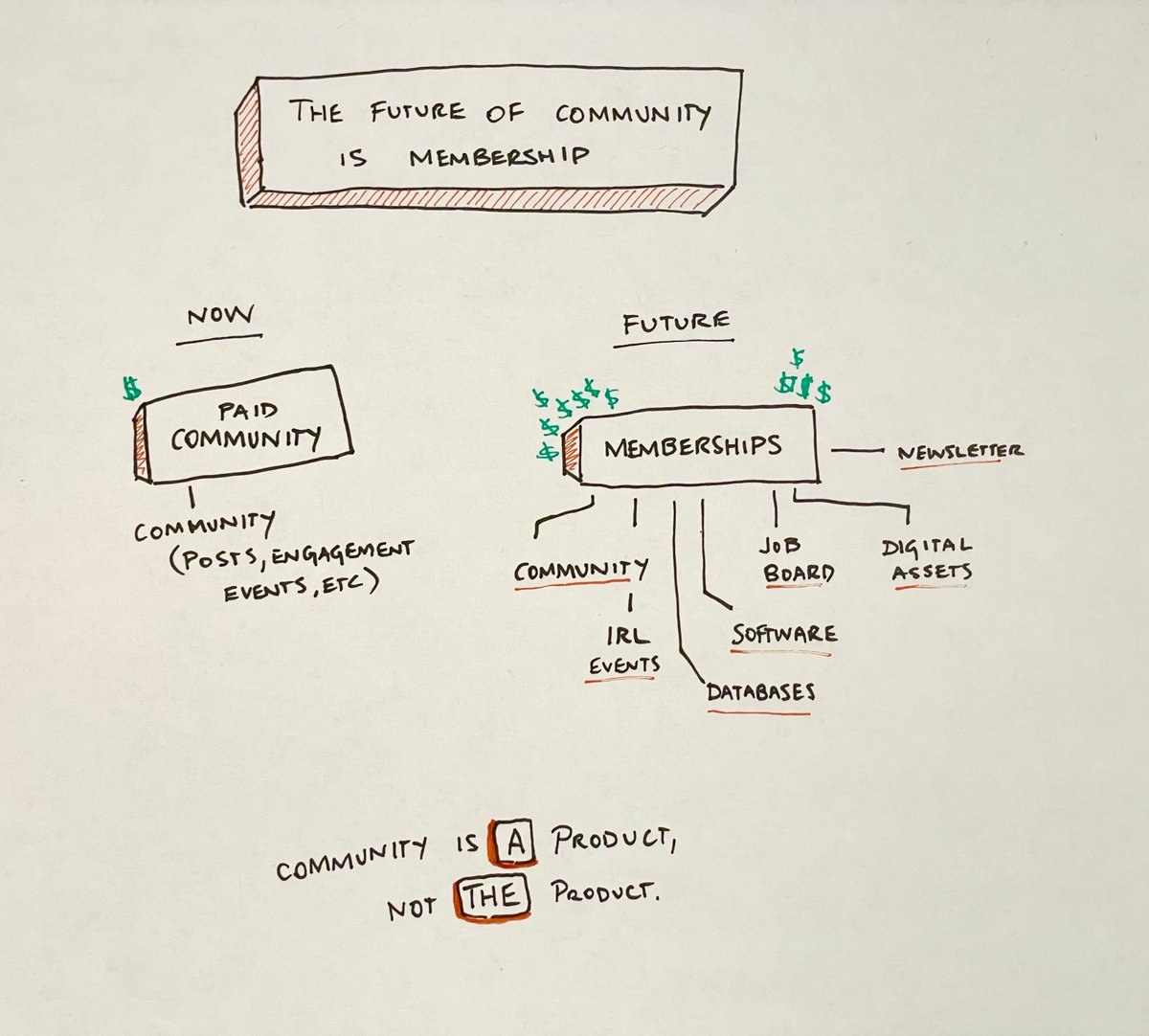
Memberships are the new internet community.
Let me explain… grab a coffee it's worth understanding
When 2020 hit, the world moved to internet communities.
Facebook Groups skyrocketed to 1B+ active users. Discord hit $15B valuation.
Group chat was the new social network.
Now, most of these communities were free.
But naturally, people wanted to monetize these communities.
"Pay us a monthly fee and you’ll get access to a community."
Every Tom, Dick and Harry were selling paid communities.
Money was flowing. Until it wasn't.
Retention was the major issue. People just weren’t coming back and would rather spend their money on IRL things like going to Coachella or traveling to Europe.
Turns out selling a velvet rope wasn’t the right product for monetizing most of these communities.
Something has shifted over the last 18 months. The communities that are actually working aren’t communities, they’ve become memberships.
What’s the difference? Let's break it down.
A paid community is paying for access to:
1. Community
The team is usually a community manager or a founder + community manager
A membership includes things like:
1. Community
2. Paid newsletter
3. Discounts & deals
4. IRL events
5. Software
6. Job boards
7. Digital assets (templates, resources etc).
8.Etc
The team is usually founder, community manager, content team, product team.
Here's how to think of it:
A membership is a swiss army knife, a paid community is a spoon.
Sometimes a spoon is helpful, especially when you’re trying to eat a hot soup.
But try cutting a rib steak with a spoon. You’ll be there all night. Good luck!
Memberships are 10x more versatile, 10x more value, 10x more word-of-mouth and 10x better retention
The memberships that outperform have 2 things in common:
1) A strong identity (being a part of something, rallying behind a mission)
2) People who are trying to get from point A to point B (a transition needs to occur)
I’m spending a lot of my energy thinking about memberships:
Because I believe that there will be some mega businesses that might look like “silly little memberships” right now that blossom into some mega memberships in the future.
Community is the currency of the new internet and memberships is how you’ll get paid.
And make the most impact.
The future of internet communities are memberships.
You heard it here first.
Are you seeing the same thing I am?
Communities dying, memberships thriving....
Where community is A product, not the product
@chamath Not to mention the lack of control and oversight at that scale. Can a company that size create AGI responsibly? Seems like a tech deep water horizon oil spill waiting to happen
My notes from Anna Wintour’s biography turned into maxims:
1. Hire talented people as found, not as needed.
2. Taste is as rare as a unicorn.
3.Your employees should describe you as “easy to understand.”
4.Pretend to be completely in control and people will assume that you are.
5.Have a sharp eye for the weaknesses of others.
6.Combine ruthless efficiency with hyper competence.
7.If you’re not early, you’re late.
8.Get to the point.
9.Emails don’t need a subject line.
10. A blueprint for building power in media: Ads, Advice, Relationships, Money
https://t.co/dp8vtuMASH decisive.
12.Powerful people associate with valuable brands.
13.Control all the ingredients.
14. Meticulously make friends with people who are the best in their field.
15. Nobody should know your niche as well as you.
16. Keep a strict professional schedule.
17.Recruit hungry young people.
18. Make decisions quickly.
19. Master the terse memo.
20. Read voraciously.
21. Always act in service of your mission.
22. Founders want information. They don’t want to be told what to do.
23. Passion, purpose, and discipline are universally admired.
24. Killing products is necessary to teach your team your standards.
25. Create an environment where excellence is expected.
26. People judge you by your performance so focus on the outcome.
27. Be the first to leave.
28. Be frank about your ambition. People can’t help if they don’t know what you want.
29. Quality over feelings.
30. The founder’s job is to make sure it’s done right.
31. Have no qualms about being completely focused.
32. Talent routinely makes the mistake of being self-absorbed instead of being of service.
33. Stay close to the money.
34. Money comes naturally as a result of service.
35. Media can invent celebrity.
36. The only predictable thing about you should be your passion for your product.
37. Self-confidence is contagious. Self-doubt is too.
38. You get two minutes, the second is a courtesy.
39. Control the guest list.
40. Resist any cheapening of the brand, however popular and lucrative it might be in the short term.
41. Relationships last longer than money.
42. Build up your entire industry and you rise automatically.
43. Repetition is the foundation of clarity of thought.
44. Don’t try to handle stress. Learn to enjoy it.
45. The story of the father is embedded in the daughter.
The most important question about a new project isn't how much you'll enjoy it.
It's whether it will interfere with existing priorities that matter to you.
An opportunity that seems compelling in isolation is a mistake if it leaves you overextended.
https://t.co/IPT9HUyXZW