The top .1% of users are playing with local LLMS
This will 10x every 12 months....
Until Apple, Dell and MSFT have one on your local device BY DEFAULT in 2028
This takes the local hardware spec race from irrelevant for 99% of users to critical.
Going to be insane.
@TMTLongShort if millions of rational agents can gather information about an asset and evaluate it thoroughly and objectively, an asset’s price shouldn’t stray far from its intrinsic value.
The volume of people able to regularly achieve above-average risk-adjusted returns will diminish rapidly with ai - information and analysis will no longer be restricted to a few.
Most people think 1 or 2 steps ahead, in 3-5 years we’ll be competing with super intelligence lol. My Tesla robot will think of me as a dumb pet.
Always enjoy your takes. What say ye :)
The entire frame of "becoming a better you" assumes there are two of you. The one here now (not good enough) and the one out there (finally worthy). That separation is invented, built on a confused premise that an individual is definable and that happiness is achieved when certain conditions are met. Everything built on top of this way of thinking inherits the same neurosis.
Close your eyes, and for 1 minute try to control the thoughts that arise… beliefs can be changed, our way of over identifying can change… despite what she means, controlling thoughts presumes a level of agency that is experientially absurd lol
Anything that can be automated on a computer can already be automated. Not only have I already made multiple versions of very popular advertising Saas products in a single day, but I’ve already built workflows that effectively use browsers to engage in multiple platforms effectively. I say this simply to let you know that the capabilities will become even easier and we are 6-months to a year away from mass adoption.
@NiP73 Peace of mind & clarity of where the industry is headed. Client performance that is not subject to human error in ad accounts. Consistency in execution informed by that which Meta alone can not see.
You can now build in a weekend what used to take a team six months. So can everyone else. The question is no longer whether you can build it, it's whether you own anything that prevents someone else from replacing it.
In theory, AI lets everyone own productive capital for the first time in history. In practice, the bottleneck isn't the intelligence itself. It's the complementary assets that make intelligence valuable: proprietary data, distribution, compute infrastructure, capital, physical execution, and regulatory position.
When access to AI is universal but access to what makes the tool valuable is concentrated, the ownership dynamics still compress toward the few.
Anything that can be built purely through automation (or code) has no moat. Each day it is getting easier for anyone to be able to build or access a near-identical version.
The emerging economy increasingly resembles three archetypes: landowners, sharecroppers, and traders.
The landowner controls the productive infrastructure. The sharecropper builds on infrastructure they don't own. The trader doesn't own the farms, but owns the information layer that connects fragmented markets.
If you build a layer of intelligence on top of infrastructure you don't own, you are a sharecropper on someone else's land.
Your crops may be strong today, but the landlord can farm it themselves whenever they choose.
If what you own is the logic layer, the decision framework connecting data points, that's valuable today, but potentially replicable tomorrow.
Physical products have one structural advantage worth noting. Atoms are harder to replicate than bits. That's a moat AI doesn't fully erode, even with robotics. For at least the next several years, AI will massively intensify competition in digital domains while leaving physical scarcity comparatively intact.
The mistake many make is assuming this means physical brands automatically win. They don't.
Physical brands only win when they control scarcity elsewhere in the value chain (otherwise, as Meta & Google costs continue to go up, margins will be squeezed).
Long-term winners will concentrate ownership in a small number of scarce layers.
They'll own infrastructure or platforms that others depend on. Compute, marketplaces, distribution networks, payment rails, developer ecosystems. These become the new landowners, extracting rent from entire ecosystems built on top of them.
They'll control physical-world constraints. Manufacturing capacity, supply chains, energy production, logistics networks, access to scarce materials. As intelligence gets commoditized, control over execution often becomes more valuable, not less.
They'll own proprietary data that can't easily be replicated, creating compounding information advantages through unique datasets or network effects.
They'll become the trusted interface between business owners and AI. Most business owners don't want to learn attribution models, optimization logic, or deployment details. They want someone they trust to interpret complexity and tell them what to do. They lack bandwidth, and they seek emotional certainty alongside strategic clarity. That relationship layer is extremely difficult to automate, though will be competitive nonetheless.
Or they'll operate in domains where automation is structurally limited or socially resisted (child care, hospice, meditation, political leadership, performance arts, athletics).
The resolution is simple.
Ownership of something scarce is the moat.
The question every operator and builder should be asking right now isn't "Will AI take my job?"
It's: "Do I own something scarce that allows me to maintain pricing power?"
We built an agent that handles:
- forecasting tied to a brands P&L
- cross channel budgeting
- organic recommendations & influencer tracking / recommendations
- cretive briefing and creative design for videos and images
- campaign and ad set optimizations
- deploys ads, pauses and turns them on as needed
- Reporting against plan and on the creative and keyword level
- It connects to all platforms and can execute changes across the web
All wrapped by our knowledge base, same one we used to scale Jolie from $50k/month to $4m/month, so no generic answers and it focuses on profitability.
While this is novel today, it will be a commodity tomorrow.
We built an agent that handles:
- forecasting tied to a brands P&L
- cross channel budgeting
- organic recommendations & influencer tracking / recommendations
- cretive briefing and creative design for videos and images
- campaign and ad set optimizations
- deploys ads, pauses and turns them on as needed
- Reporting against plan and on the creative and keyword level
- It connects to all platforms and can execute changes across the web
All wrapped by our knowledge base, same one we used to scale Jolie from $50k/month to $4m/month, so no generic answers and it focuses on profitability.
While this is novel today, it will be a commodity tomorrow.
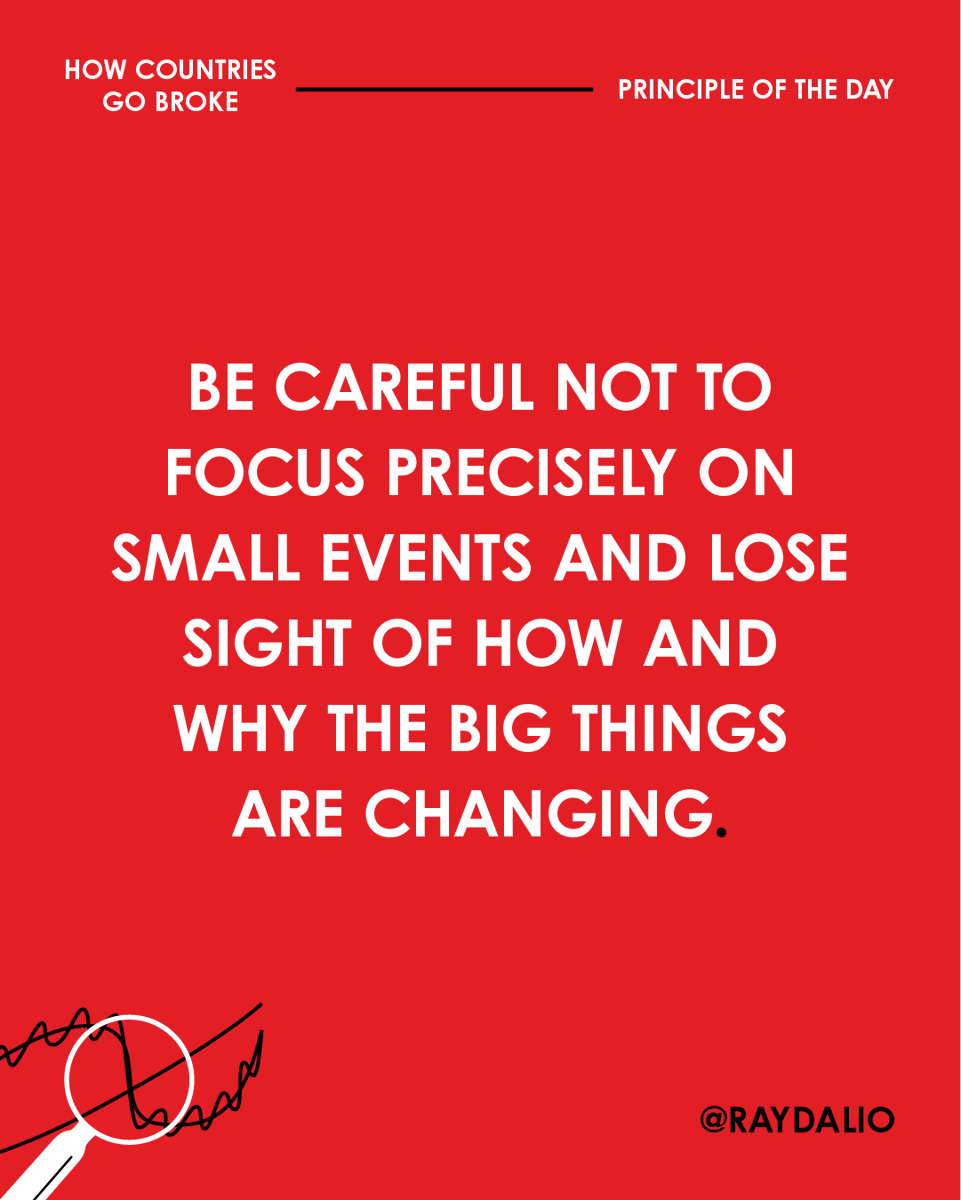
People who try to see things up close and precisely typically miss the most important things because they are preoccupied with looking for precision. Also, if you look at things up close, you will never see the most important big things. So, when looking for the big things, pay attention to the big things. So, to see the processes and cycles and the template they provide us, you need to pay attention to the biggest and most important changes that have happened, keeping in mind the reasons for the big changes and the big differences.
For a picture of where we are headed and what we should do, you can order my new book, How Countries Go Broke: The Big Cycle, here: https://t.co/mLYq3X0OIf