Check out our latest manuscript @GoogleQuantumAI demonstrating verifiable quantum advantage!
- Beyond-classical complexity
- Large measurable observable signal
- Sensitive to evolution dynamics -> application to Hamiltonian learning
details in the 🧵
https://t.co/fUPh7ljV5L
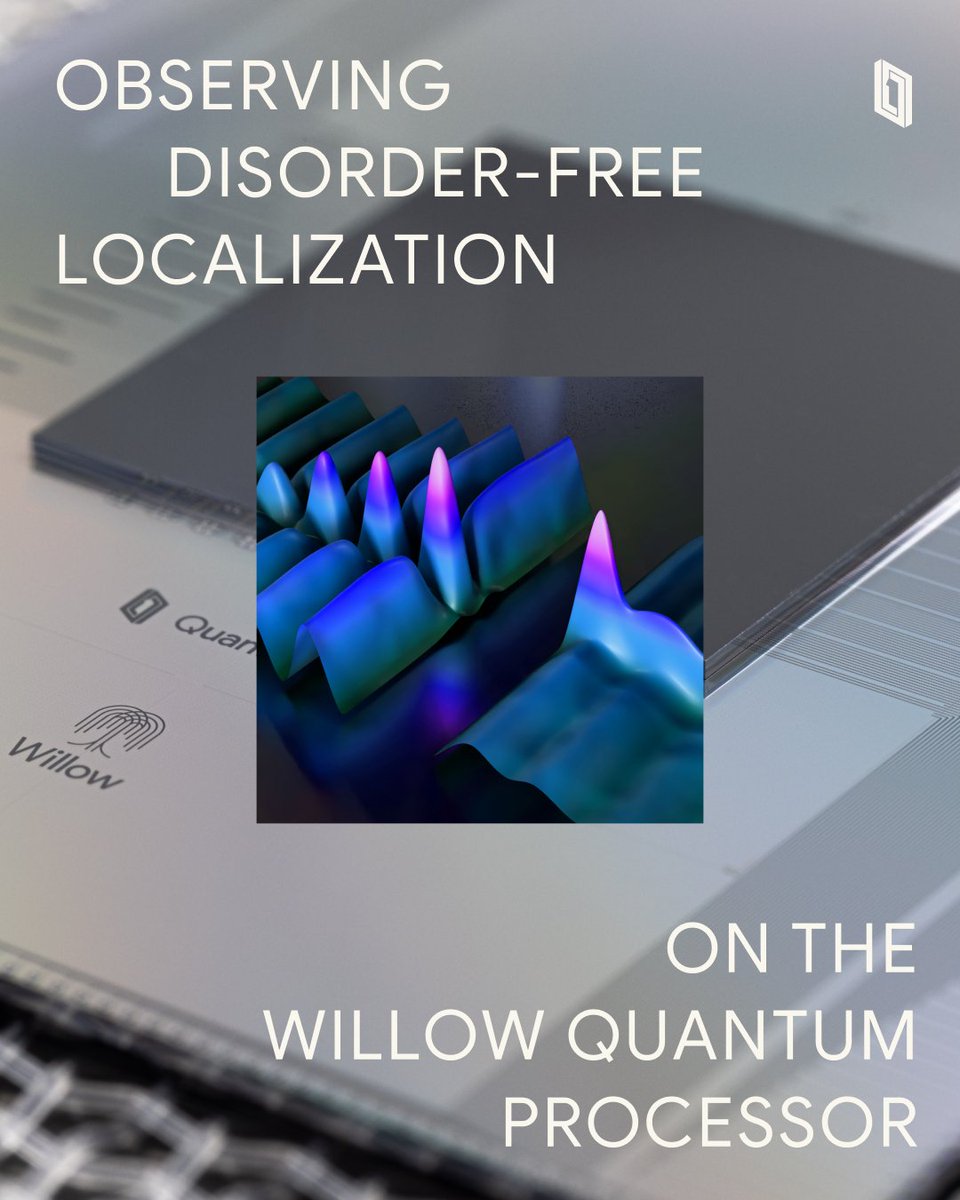
Studying particle diffusion in quantum systems is a major classical computing challenge. Our Willow processor was used to demonstrate disorder-free localization via a quantum algorithm which offers a polynomial speedup for disorder sampling.
Read more: https://t.co/MGbd2EFpaW
A scientific dialogue. Building on Bulchandani, Burnell & Sondhi, we implemented a scalable GHZ game. This result has sparked theirs on classical strategy upper bounds. Excited to see where this conversation leads.
Our work https://t.co/Lynn7D7F3k, theirs https://t.co/i5ZVXA6DuT
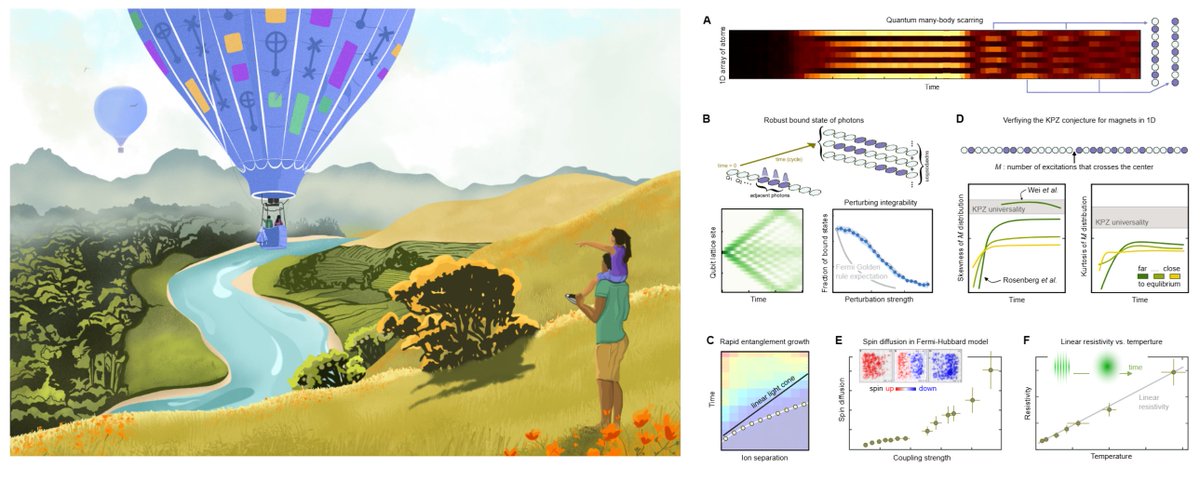
Our @ScienceMagazine perspective : have quantum simulators already found new physics ?
Think hot-air balloons: tricky to fly, not very steerable, but once aloft can drift into unexplored territory and make real “discoverinos.”
https://t.co/tOyC3KETBU
https://t.co/DtKT4ds5nR
New breakthrough quantum algorithm published in @Nature today: Our Willow chip has achieved the first-ever verifiable quantum advantage.
Willow ran the algorithm - which we’ve named Quantum Echoes - 13,000x faster than the best classical algorithm on one of the world's fastest supercomputers. This new algorithm can explain interactions between atoms in a molecule using nuclear magnetic resonance, paving a path towards potential future uses in drug discovery and materials science.
And the result is verifiable, meaning its outcome can be repeated by other quantum computers or confirmed by experiments.
This breakthrough is a significant step toward the first real-world application of quantum computing, and we're excited to see where it leads.
We also demonstrated that OTOCs are sensitive to small variations in the underlying unitary evolution. This sensitivity is utilized to "learn" the phase of a two-qubit interaction in our system. Our results indicate a viable path to practical quantum advantage.
The other consequence of many-body interference is classical complexity. The second-order OTOC is dominated by constructive interference between Pauli strings that form large loops in configuration space, resulting in high classical simulation complexity even for supercomputers.
First- and higher-order OTOCs exhibit complex many-body quantum interference effects. The forward and backward evolutions partially reverse the effects of chaos and amplify the quantum signal measured at the end. This signals amplification makes OTOCs more efficient to measure.
Check out our latest manuscript @GoogleQuantumAI demonstrating verifiable quantum advantage!
- Beyond-classical complexity
- Large measurable observable signal
- Sensitive to evolution dynamics -> application to Hamiltonian learning
details in the 🧵
https://t.co/fUPh7ljV5L
We measure the expectation value of an observable, called the out-of-time-order correlator (OTOC). OTOCs quantify the quantum butterfly effect by measuring how a perturbation impacts the reversibility of the dynamics. We use these signatures to probe the details of the system.
It's been a privilege to work closely with Michel on my last couple of projects. I'm super excited about all the cool science we're gonna do in the coming years 🎉
We're excited to share our latest research, published in @Nature, about a new approach to quantum simulation that combines both analog and digital techniques. This breakthrough allowed us to make a new scientific discovery: https://t.co/FSqfGrzcbF 🧵
It's been super cool to partially delve back into the physics I explored during my PhD, now with the benefit of more advanced tools and techniques.
https://t.co/m63iHngiwW
I'm very excited to share our results on studying thermalization and criticality on an analog–digital quantum simulator here at @GoogleQuantumAI!
https://t.co/Gaw2vFRHQo
Furthermore, by adiabatically ramping the qubit energies and couplings, we are able to generate tunable thermalized states by changing the initial state excitation configuration. This allows us to observe the crossover from area- to volume-law entangled states.
Two experiments on topological ordering in Kitaev model. A @TU_Muenchen team uses @GoogleQuantumAI Willow processor, explores the emergence of Floquet topological ordering. The Harvard team simulates fermions with this model.
https://t.co/yBUrk4lUxV
https://t.co/rpxypG17zZ
Dear academic colleagues ! (particularly early career quantum professors !)
https://t.co/VnXKBXeiha is accepting Research Scholar applications, to support research in areas relevant to Google ( including quantum).
https://t.co/ZWyLPFUVCK
(deadline: January 27, 2025)
Many-body localization(MBL) in the absence of disorder?
MBL is often linked to disorder. We show a disorder-free system achieving localization via quantum parallelism, enabling efficient disorder averaging. https://t.co/Kuq1WIMZd4
In @Nature, we show a "stable computationally complex phase" is reachable with current quantum processors. Even with noise, these quantum computers can perform calculations that are beyond the capabilities of classical supercomputers. art design by @SayoStudio