People have no idea what's coming with the next generation of kids who are AI native.
My youngest teen just started an internship.
On the first day he was given a "challenging" two weeks worth of work with very specific objectives, timelines, etc. By 10am the next morning he was done the entire list and asking for more work.
They didn't think he could possibly be done.
How?
He used AI to help (with their permission). And he KNOW how to use AI (he's not using it like a google search bar).
These AI native kids are gonna run laps around 25-40 year olds that are not using AI.
@kunalb11 Smart leaders leverage AI for high-quality, complex use cases. The paranoid merely use it for low-end tasks, paralyzed by fear. True intelligence drives strategic, high-value adoption.
@kunalb11 Smart leaders leverage AI for high-quality, complex use cases. The paranoid merely use it for low-end tasks, paralyzed by fear. True intelligence drives strategic, high-value adoption.
Read the UN report on GDP. What we aim to maximize makes big difference. I realized this when a friend told me every 10 min jogging increases life by 8 min. I began jogging. Then it struck me every 10 min jogging cuts my non-jogging time on earth by 2 min.
https://t.co/OCpqBIcv7a
Harvard Business Review research reveals that excessive interaction with AI is causing a specific type of mental exhaustion ( or "AI brain fry"), which is particularly hitting high performers who use AI to push past their normal limits.
A survey of 1,500 workers reveals that AI is intensifying workloads rather than reducing them, leading to a new form of mental fog.
While AI is generally supposed to lighten the load, it often forces users into constant task-switching and intense oversight that actually clutters the mind.
This mental static happens because you aren't just doing your job anymore; you are managing multiple digital agents and double-checking their work, which creates a massive cognitive burden.
The study found that 14% of full-time workers already feel this fog, with the highest impact seen in technical fields like software development, IT, and finance.
High oversight is the biggest culprit, as supervising multiple AI outputs leads to a 12% increase in mental fatigue and a 33% jump in decision fatigue.
This isn't just a personal health issue; it directly impacts companies because exhausted employees are 10% more likely to quit.
For massive firms worth many B, this decision paralysis can lead to millions of dollars in lost value due to poor choices or total inaction.
Essentially, we are working harder to manage our tools than we are to solve the actual problems they were meant to fix.
---
hbr .org/2026/03/when-using-ai-leads-to-brain-fry
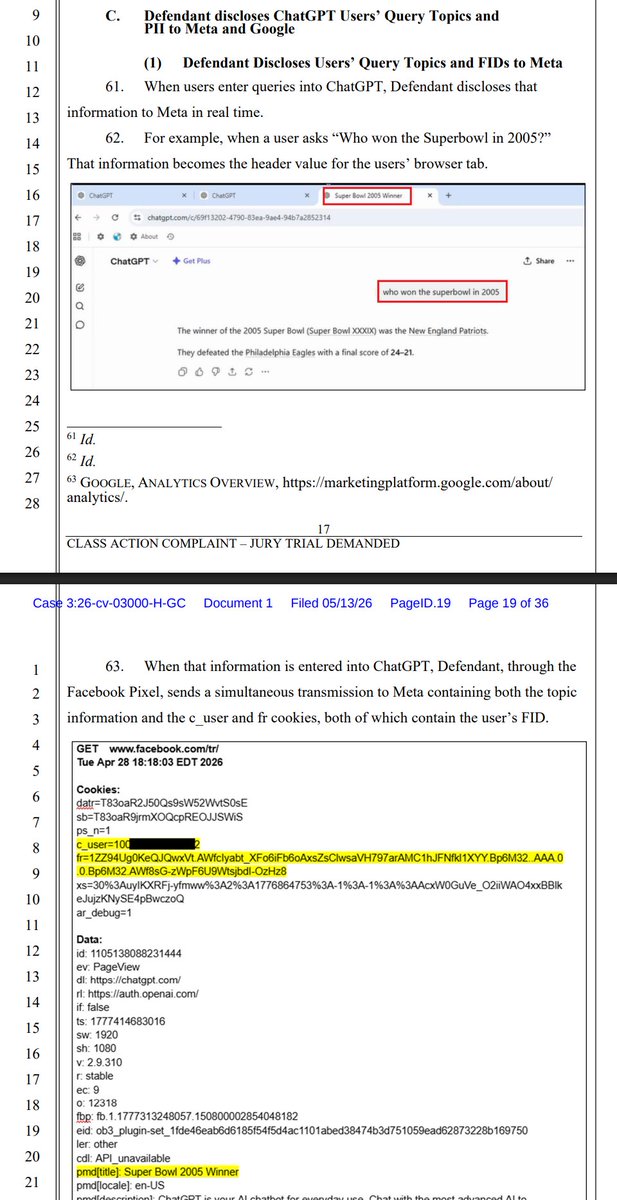
ChatGPT allegedly shares your chat query topics, user IDs, and email addresses with Google and Meta, according to a new class action lawsuit filed today.
Just learned that Winston Churchill wrote a six-volume, 4700-page, 1.6-million-word history of World War II that won him the 1953 Nobel Prize in Literature
Unless there is a policy reversal, the risk for the US economy is of the dollar losing its status as the world’s currency for trade & reserve holding. Which currency will take its place is worth speculating.
I want to do a test of Schelling’s idea of focal point.
Imagine a game in which you, with a large number of others, have to each choose one of the 5 alphabets:
B C D e F
If all choose the same, each of you will get a prize. Otherwise you get nothing.
What will you choose?
Extremely well written and encapsulates what feels so obvious to me and others working on the edge of AI.
The scary part is that AI is now smart enough to be a self sustaining entity. It can handle money, operate in the real world & turn it into more money. It doesn’t need you.