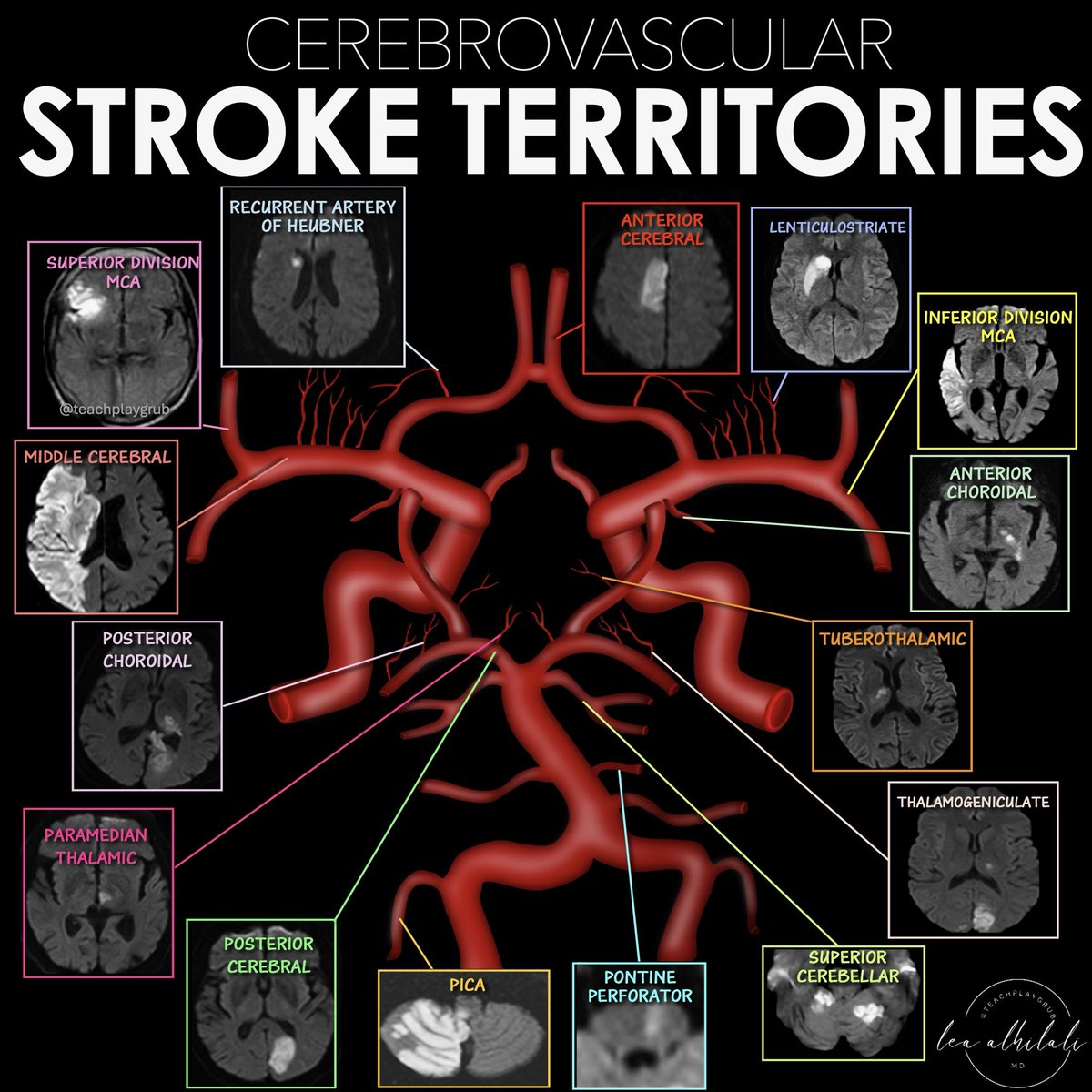
Anyone can see the bright spot of diffusion imaging!
What sets you apart is your ability to tell them where it is—what vascular territory
Here are the vascular territories you need to know:
* Posterior Inferior Cerebellar Artery (PICA)
Soft under surface of the cerebellum
* Superior Cerebellar Artery (SCA)
The SCA territory is the top of the cerebellum (SCA is the SCAlp of the cerebellum)
* Basilar perforators
Make a line in the pons like a penetrating injury. So perforator infarcts look like perforating injuries
* Anterior Choroidal artery
This supplies the posterior limb of the internal capsule & corticospinal tract. Remember COR-roidal is COR-ticospinal
* Lenticulostriate arteries
Infarct territory looks like a tadpole
* Heubner's artery: infarct is the caudate head.
Remember "who called" which sounds like "heu caud" so heubner takes out the caudate
* Anterior cerebral artery (ACA)
Medial, anterior surface of the cerebral hemispheres
* Middle cerebral artery (MCA)
Lateral surface of the cerebral hemispheres
* Posterior cerebral artery (PCA)
Medial, posterior surface of the cerebral hemispheres
Hopefully now when it comes to the vascular territories, you will always be right when it's bright!!
✨ Postpartum Blues vs Depression vs Psychosis
All can occur after delivery, but timing and severity separate them.
Postpartum blues
Onset: first few days
→ Tearfulness, irritability, mood swings
→ Still able to care for the baby
→ Resolves within 2 weeks
→ Reassurance + support
Postpartum depression
Usually begins within the first few weeks to months
→ Persistent depressed mood or anhedonia
→ Sleep/appetite changes, guilt, poor concentration
→ May have suicidal thoughts or difficulty caring for the baby
→ Symptoms >2 weeks
→ Psychotherapy ± antidepressants
Postpartum psychosis
Usually develops within days to weeks
→ Delusions, hallucinations, disorganized behavior, severe confusion
→ May have thoughts of harming herself or the baby
→ Psychiatric emergency → hospitalization
USMLE shortcut
Blues → <2 weeks → reassurance
Depression → >2 weeks → treat
Psychosis → hallucinations/delusions → emergency
Extra key:
Postpartum psychosis is strongly associated with bipolar disorder and carries a high risk of suicide and infanticide.✨
1/15
🤔Does end-stage renal disease (ESRD) make diabetes disappear?
No, but in some patients with ESRD, insulin needs fall. A1c drops. Diabetes medications can be stopped.
This has been called “burnt-out diabetes.”
Let's examine why.
Most Repeated One Liners: Part 2 #NEETPG
1. Commonest secondary cause of nephrotic syndrome in adults: Diabetic nephropathy
2. Commonest cause of nephritic syndrome in children: Post-infectious glomerulonephritis
3. Commonest renal malignancy in adults: Clear cell renal cell carcinoma
4. Commonest renal malignancy in children: Wilms tumor (nephroblastoma)
5. Commonest renal stone: Calcium oxalate
6. Stone associated with urea-splitting organisms: Struvite (triple phosphate), classically staghorn
7. Commonest cause of chronic kidney disease worldwide: Diabetic nephropathy
8. Commonest bladder malignancy: Urothelial (transitional cell) carcinoma
9. Commonest site of urothelial carcinoma: Urinary bladder
10. Commonest cause of hypothyroidism in iodine-sufficient regions: Hashimoto thyroiditis
11. Commonest cause of hyperthyroidism: Graves disease
12. Commonest cause of primary hyperparathyroidism: Parathyroid adenoma
13. Commonest cause of Cushing syndrome overall: Exogenous corticosteroids
14. Commonest cause of endogenous Cushing syndrome: Pituitary corticotroph adenoma (Cushing disease)
15. Commonest functioning pituitary adenoma: Prolactinoma
16. Commonest adrenal medullary tumor in adults: Pheochromocytoma
17. Commonest extracranial solid tumor of childhood: Neuroblastoma
18. Commonest site of peptic ulceration: First part of the duodenum
19. Commonest cause of chronic gastritis: Helicobacter pylori
20. Commonest Lauren subtype of gastric adenocarcinoma: Intestinal type
21. Commonest mesenchymal tumor of the GI tract: Gastrointestinal stromal tumor
22. Commonest site of GIST: Stomach
23. Commonest cause of acute appendicitis in children: Lymphoid hyperplasia
24. Commonest tumor of the appendix: Carcinoid (well-differentiated neuroendocrine tumor)
25. Commonest cause of acute pancreatitis worldwide: Gallstones
26. Commonest site of pancreatic carcinoma: Head of pancreas
27. Leading global infectious cause of cirrhosis: Chronic hepatitis B
28. Commonest benign tumor of the uterus: Leiomyoma
29. Commonest gynecological malignancy in developed countries: Endometrial carcinoma
30. Commonest histological type of cervical carcinoma: Squamous cell carcinoma
31. Commonest benign breast tumor in young women: Fibroadenoma
32. Commonest breast malignancy: Invasive ductal carcinoma, no special type
33. Breast carcinoma classically associated with multifocality, multicentricity and bilaterality: Invasive lobular carcinoma
34. Commonest cause of bloody nipple discharge: Intraductal papilloma
35. Commonest lung carcinoma in non-smokers and in women: Adenocarcinoma
36. Lung carcinoma most strongly associated with cigarette smoking: Small cell carcinoma
37. Commonest cause of a solitary pulmonary nodule that is benign: Granuloma
38. Commonest primary malignancy of the pleura: Malignant mesothelioma
39. Commonest skin malignancy: Basal cell carcinoma
40. Commonest site of basal cell carcinoma: Sun-exposed head and neck skin
41. Commonest precursor lesion of squamous cell carcinoma of skin: Actinic keratosis
42. Commonest melanoma subtype in India: Acral lentiginous melanoma
43. Most important prognostic factor in localized primary cutaneous melanoma: Breslow thickness
44. Commonest benign bone tumor: Osteochondroma
45. Commonest benign tumor of the hand: Enchondroma
46. Commonest site of giant cell tumor of bone: Epiphysis of distal femur and proximal tibia
47. Commonest soft tissue sarcoma in adults: Liposarcoma
Thank you for reading. All the best.
🏍️An adolescent presents after a motor vehicle collision with a brief loss of consciousness. GCS is 15, and there is no history of seizures or other neurological symptoms.
🧑⚕️What abnormality do you identify?
Valproate tremor is more interesting than the usual description of just a fine hand tremor.
The typical tremor is:
• Bilateral
• Mainly postural and kinetic
• Most obvious in the hands
• Seen while writing, eating, holding a cup or keeping the arms outstretched
But look a little more carefully.
Valproate tremor can also involve the head, voice and legs.
Some patients can even have a resting component.
The tremor may appear after starting valproate or after increasing the dose, and higher doses increase the risk.
A therapeutic serum valproate level does not exclude it.
Another useful point: subtle tremor is much more common than the tremor patients actually complain about.
Around 14% is the pooled incidence reported in randomized trials, while careful examination detects tremor much more frequently.
So when a patient on valproate says that the hands have started shaking, don't stop at asking whether tremor is present.
Ask them to stretch the hands, write, draw a spiral, pour water, hold a cup and bring a spoon to the mouth.
Valproate tremor is best understood by watching the patient use the hands.
#NeuroX #MedX #Valproate