Solving all of human disease in alphabetical order Alzheimer's, ataxia-telangiectasia, autism. Professional iconoclast. International outlook. Politics separate
Some of us might take issue with characterizing it as “pretty solid”. I actually wrote an entire book unpacking the evidence and while there were a few sticks left standing here and there, the evidence in support of the current biomarkers came away looking flimsy at best.
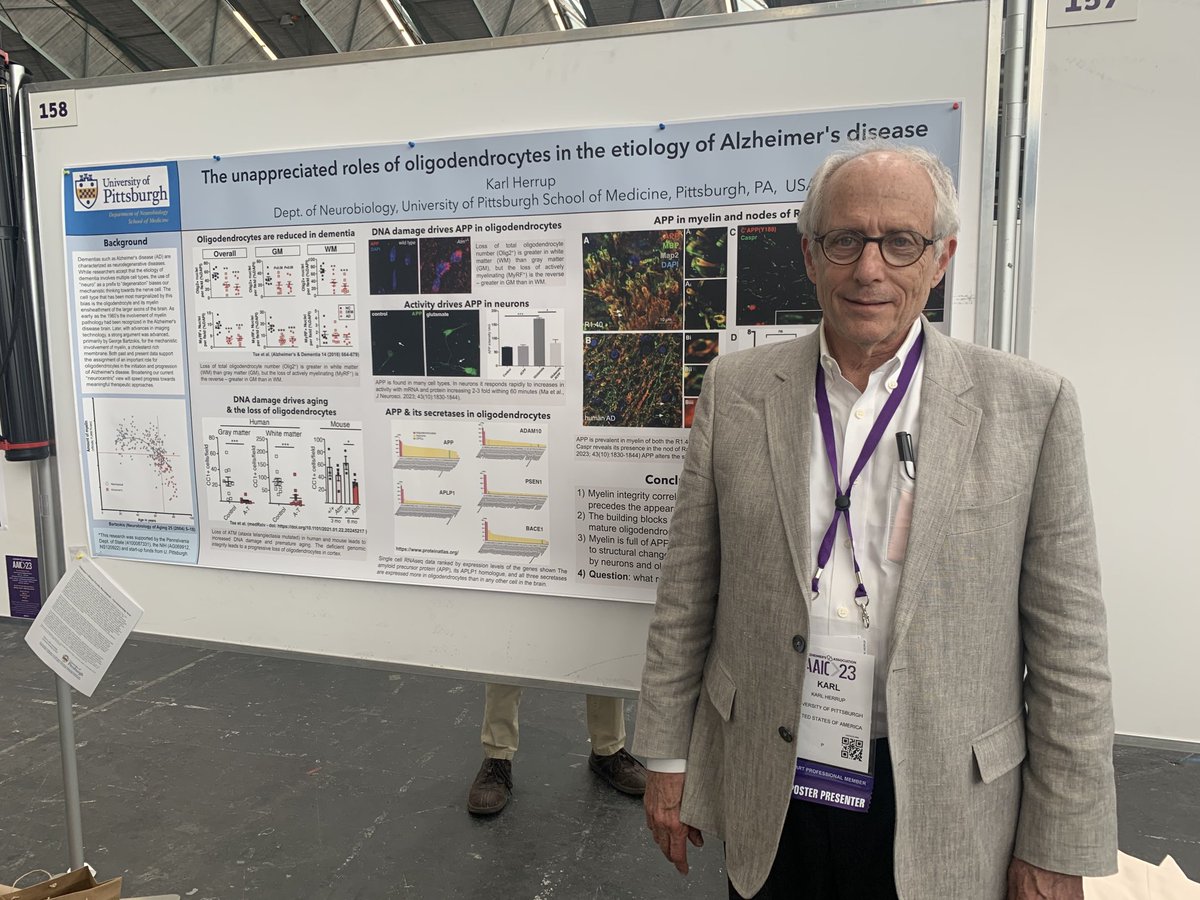
We agree. I made the tau comment mostly because I worry about the fuzzy way we define AD (made even worse by Jacks presentation at #AAIC23 ). We are quick to ascribe causality to correlation and need to be more careful.
@KarlHerrup@KarlHerrup, I just want to be sure we align, here. We all agree that not all dementia involving tau agregates are AD, right?
https://t.co/eZDiwP7khm
I was trying to point out that if you reject amyloid as a defining feature of AD (which I do), dementia resembling AD can also be induced by tau alone. The clinical presentations in AD and FTD are of course different but I submit there is lots of biology left to work out
The problem is the assertion that when the tau stage of AD is reached there is always amyloid. If AD is defined by amyloid this is not an informative statement. Amyloid has to be present or it isn’t AD.
@nvillain_alz@KarlHerrup I’m with @nvillain_alz here; I’m not entirely sure I understand how this is a problem. We all recognize non-AD tauopathy in the form of FTLD-tau, and I’m unaware of anyone to suggest all tauopathy is AD or how MAPT mutations are relevant for AD neuropathological change.
Help me out here. If AD is defined by amyloid then you can’t have *any* stage of the disease without amyloid. Mutations in Mapt show that you can have tau-driven dementia. But these dementias are not AD by definition. So isn’t this a bit of circular logic?
Statistically significant but clinically trivial slowing of #Alzheimer’s decline is not “improvement” Slightly less bad doesn’t mean good. And the hazards are frighteningly real. I am quite worried that there will be needless deaths. I sincerely hope I’m wrong.
Sorry, I’ve got to weigh in here. Today’s was an inevitable decision - baked into the cake a while ago when #Leqembi’s predecessor, #Aduhelm, was given the fast track by the FDA based on lowering amyloid.
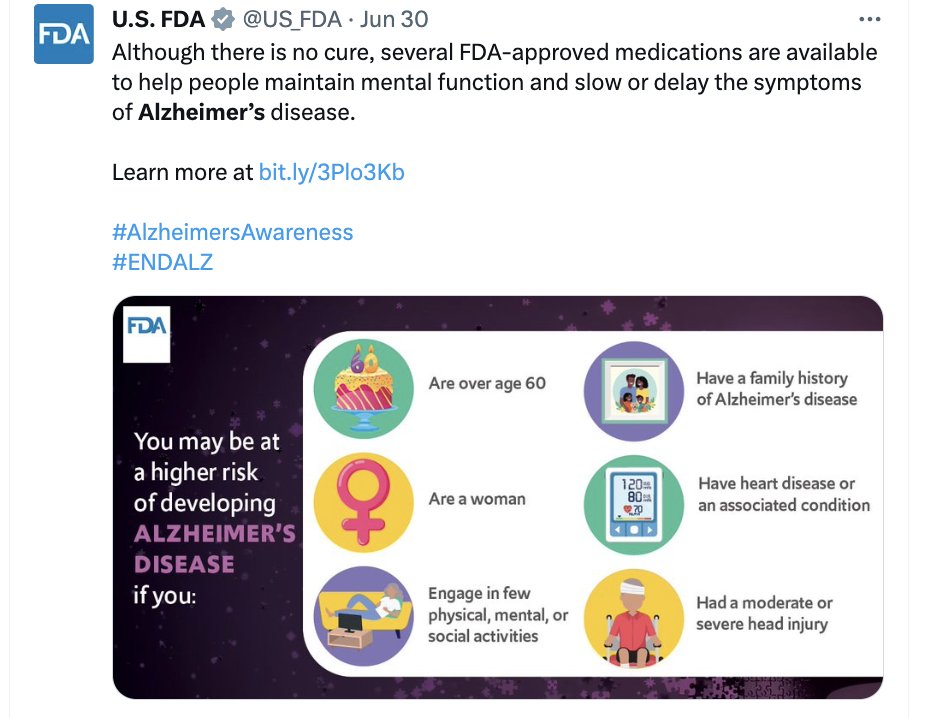
Is there an FDA-approved drug to maintain mental function in Alzheimer's? I see this tweet from FDA (pic) and did a double take to ask this question.
Where I'm coming from I know the recent beta-amyloid drugs are still pending clinical outcomes. I thought at most you could say they show promise in slowing overall decline, which is different from saying they maintain function. So what drug maintains function?
So, I think I'll click the link to find out. The link take me to a page with brochure that mentions aducanumab. No mention of lecanemab. I guess the brochure is old? It also mentions cholinesterase inhibitors. Maybe it's the latter.
However, I wouldn't know from the brochure, which doesn't even mention the PIs or link to clinical information.
How helpful is this? Is this really where FDA should be focused? Can they keep up? Or can we just ask our doctors and use other sources?
Maybe I'm a stickler, but I expect more from a science-based agency, and I don't think they can keep up on brochures like this or if it's even their job.
I will be at #AAIC23 in Amsterdam wearing this. If you're coming & would like one, DM me with your size (S, M. L, XL,...). I need to order by Monday (3 July) so hurry. They cost me US$16 each, but they're free to attendees who promise to wear them (donations welcome of course)