This post on the benefits of Vishnu Sahasranamam parayanam reminds me of my own journey with this timeless practice.
I learnt the Vishnu Sahasranamam in 1998. For most of the years since, I chanted it on special days: Ekadashi, some Saturdays, occasions that called for it. I enjoyed it every single time. A remarkable calm would come over me the moment I finished. And yet, despite the benefits I experienced, I somehow never found the discipline to do it daily. Twenty-eight years of an experience I valued, and I still let it stay occasional.
This year, faced with some challenges, I felt I needed that calming anchor rather than merely admiring it and chanting it occasionally. Since the beginning of the year I have chanted it every day, and I am truly glad the discipline finally came.
Somewhere in these months it stopped being something I do. I now feel incomplete on a day I have not chanted it.
What prompted me to start in the first place was Adi Shankaracharya’s Bhaja Govindam, where he exhorts us: “Geyam Gita nama sahasram.” Recite the Bhagavad Gita and the thousand names.
My reaction to that verse was not devotional. It was closer to an economist’s instinct about revealed preference. Here is Adi Shankara, arguably the finest philosophical mind India has produced, a man who dismantled every competing school of thought before he was thirty. He could have prescribed anything. Out of the entire corpus available to him, he pointed to two texts: the Gita, and the thousand names. When someone of that calibre narrows the field so sharply, the sensible response is not to argue. It is to try it.
So I began. And I have really enjoyed chanting it every time in these 28 years.
If I were to offer one thing to anyone starting out, it would be this. I try to chant it meditatively. Not racing to finish, but listening to the sound of each word as I say it, attention resting on the syllable being uttered right now. Done this way, the stotram becomes an anchor to the present moment, which is the hardest place to keep the mind and the only place from which anything useful gets done. The names do the work. You only have to listen.
I write this mainly for the young. Somewhere along the way, many of our brightest students have absorbed the idea that a practice like this belongs to a different India, one they have outgrown. That you can have rigour or you can have the stotram, and choosing the first means quietly setting down the second. It is a false trade, and it costs them something.
Which is why I am glad to share Prof. Kamakoti’s thoughts on the Vishnu Sahasranamam parayanam. Hear him in his own words. A computer scientist who has built his career in computer architecture, embedded systems and cybersecurity, now leading one of the most demanding technical institutions in the country. Nothing about that life required him to give this up.
To any student who has wondered whether the two can sit together, there is your answer.
Some things are best understood not by debating them, but by trying them with sincerity and consistency. Whether you come to the Vishnu Sahasranamam through devotion, through philosophy, or simply as a contemplative practice, I have found it a remarkable source of focus and inner energy.
My thanks to Prof. Kamakoti for prompting this reflection.
Om Namo Bhagavate Vasudevaya.
A 21-year-old woman took all 5 anti-rabies injections and rabies immunoglobulin after a dog bite. Still she died of rabies.
Here are the real reasons why the vaccine sometimes fails and what we must fix.
1. Stitching the bite wound
Look at how human traffickers operate in plain sight, without any fear of the law or a shred of humanity:
On June 18, a minor girl in Sriganganagar boarded an e-rickshaw from her friend's house to her home. The driver, who was on the payroll of human traffickers, was tasked with identifying, manipulating, and earning the trust of vulnerable girls among his passengers. He would then deliver them to specific hotels designated by the traffickers in exchange for money. The traffickers would subsequently sell these girls to clients as part of an organized prostitution syndicate.
This e-rickshaw driver, Rambabu, delivered the girl to Hotel Joy Inn, trapping her in a horrific, multi-day criminal network. Over the following five days, the hotel owners repeatedly handed the minor over to different individuals, forcing her to endure horrific rape by up to six men daily. This totaled an estimated 32 perpetrators, who drugged her with alcohol to suppress her cries.
Though police initially suppressed the case to shield high-profile suspects, leaking details sparked massive public protests. Under pressure, authorities arrested 12 individuals, including hotel managers, and exposed over 150 illegal, unregistered hotels operating district-wide.
150 hotels doing this in just one city! Just one small city! Horrific to even think whats happening nationwide in this country.
(Kindly don't post girl's video from the hospital bed in replies without blurring the face. It's against the law to post minor rape victims pictures and videos).
18 women in Nagpur, Maharashtra complained about kidney problems to their doctors in the span of two years. Doctors saw a pattern and checked that all of them were using this pakistani cream sold by many Instagram pages and meesho.
FDA Maharashtra took the cream samples. Sent to lab and found out that it has 752x mercury present in it above the legal limits. yes, 752x.
Yes, This mercury (poison in this case) can make you goree in 15 days because it blocks the cell that makes melanin. But in reality thats a chemical damage that looks like fairness. And guess what, our skin absorbs mercury and keeps getting deposited in kidney all the time.
I know you might not be using this cream or meesho, but please check around, especially with your house help and your family members back in hometown, if they are using this cream, please ask them to throw it RIGHT AWAY!!!
samsung is the weirdest company on earth.
> makes chips for its competitors
> makes display for iphones
> manufactured moderna's covid vaccine
> helped build the burj khalifa????
> makes ev batteries
> runs one of the world's largest shipbuilding business
> sell life, health, auto insurance
> builds oil refineries and petrochemical plants
> runs cloud and logistics businesses
> owns hospitals and healthcare businesses
> owns luxury hotels and duty-free stores
> runs a global advertising agency
> owns south korea’s largest theme park
apple, tsmc, maersk, pfizer, marriott, publicis, and disney all rolled into one company.
Bikini was introduced in 1946 in Paris.
Since no model was ready to do ramp walk in a bikini because it was too revealing even for professionals.
So he hired a nμde dancer from Paris Casinos to do it.
Hence we got a Bikini as fashion statement.
It was a propoganda and women fell for it.
Smoking for women was also introduced in a same " if men why not women" they were sold again.
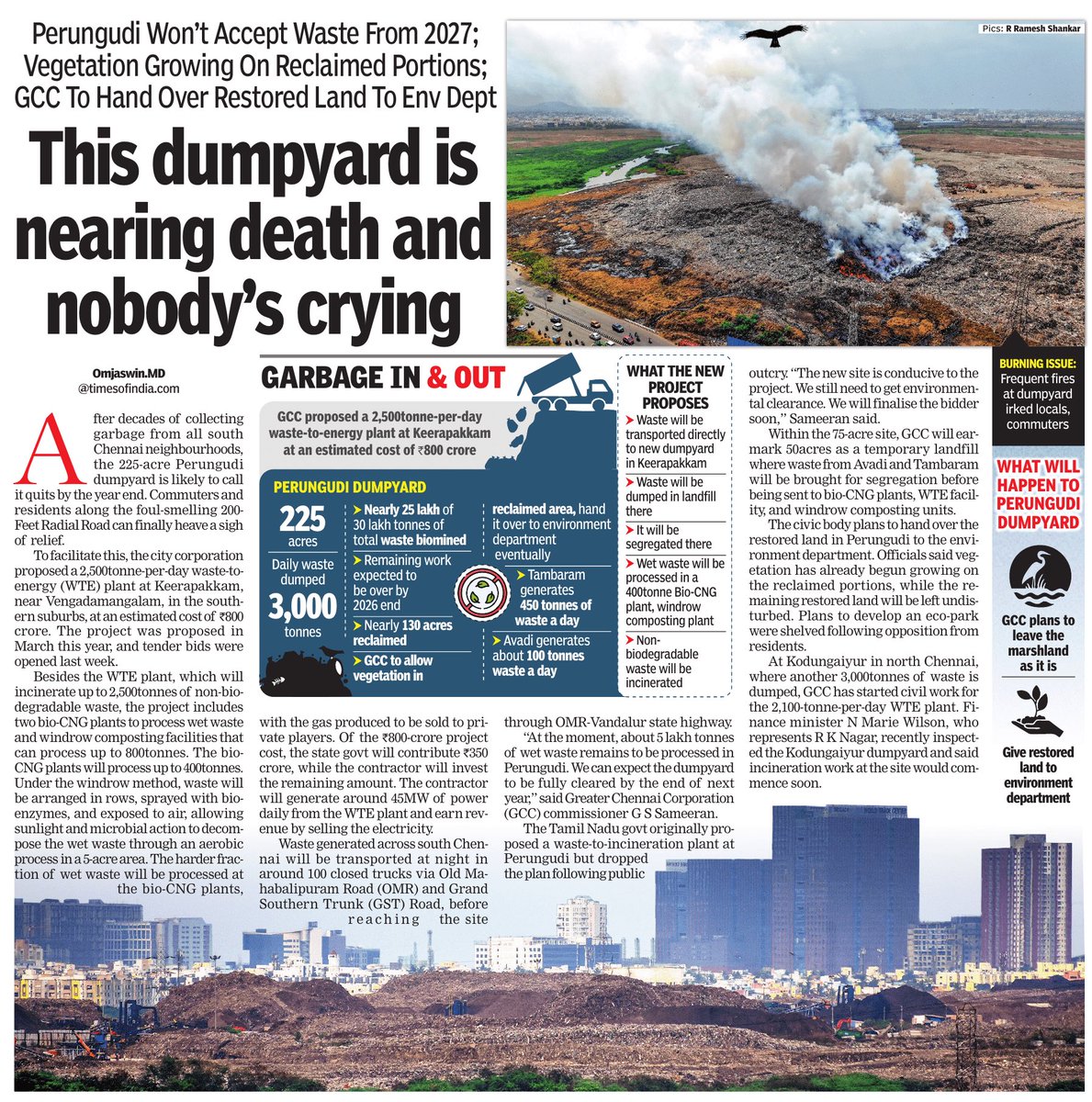
Solid waste will be stopped from being dumped in #Perungudi Dumpyard inside the Pallikaranai Ramsar site by this year end. The reclaimed 200+ acres land will be left as it is for vegetation to grow.
Pune Ketan Agarwal case is deeply disturbing. Ketan and his family deserve a fair, thorough, and impartial investigation, and above all, justice.
I introduced the National Commission for Men Bill in Parliament. Every victim deserves justice, support, and equal protection under the law.
The Ketan case is a reminder that men, too, can be victims. They deserve institutional support, legal protection, and a platform where their voices are heard. Justice must be equal for everyone, irrespective of gender.
#NationalCommissionForMen #MenRights #JusticeForMen
@MLJ_GoI@India_NHRC
To the Government of India:
@PMOIndia@PIB_India@pib_law@HMOIndia@mygovindia
VSJ Ventures LTD was built on a promise — fairness, transparency, and the discipline to see what others miss.
We studied India’s E20 ethanol programme deeply. Our considered conclusion is uncomfortable but clear: E20 no longer looks like a farmer-first fuel programme. It looks like an architecture through which US corn and corn-derived products can enter India by whichever route remains open — whole corn, industrial ethanol, DDGS, derivatives, or technology routing.
Maize has been diverted from animal feed into ethanol. FCI rice has been made available for ethanol conversion. Broken-rice streams linked to the PDS are being positioned as ethanol feedstock. Sugar has also been diverted. Whatever the explanation — surplus, damaged grain, stock management or quality improvement — the policy fact remains: food security is being converted into fuel feedstock.
Then comes the DDGS contradiction.
India was exporting nearly 300,000 tonnes of maize DDGS in 2024. Yet your government opened the door to DDGS imports from the United States. DDGS is not a rare American input; it is the automatic by-product of maize-based ethanol production. Indian distilleries already produce it. India did not need the US for ordinary DDGS.
So why import it?
US DDGS comes from US corn ethanol, and US corn is overwhelmingly GMO. India has resisted GM corn directly. Is DDGS now the indirect route?
Then comes Petron Scientech — a US company with DuPont-linked ethanol technology, brought into a 50:50 JV pathway with GAIL. India did not need Petron for ordinary ethanol or DDGS. Indian companies already do both.
So what exactly was being introduced — animal feed, or a pathway?
Add the industrial ethanol route. Industrial ethanol and fuel ethanol are both ethanol. The distinction is not molecular; it is a correctable specification-and-compliance gap — grade, denaturant, water content, impurity limits, paperwork, classification and declared end use.
The routes are now visible: food grains into ethanol, US ethanol directly, US DDGS indirectly, and US technology inside the architecture.
No institutional fund says this lightly to a sovereign government: we want to be proved wrong. We understand the asymmetry and the risk. We assume it knowingly, because the research demands it and the country deserves clarity.
So here is our challenge.
Now prove us wrong.
Declare in Parliament: no US corn-derived ethanol into India’s E20 programme under any label; US DDGS, if permitted, capped, feed-use-only, end-use audited, and barred from ethanol reprocessing; no US GM corn entry through grain, ethanol, DDGS, derivatives or technology routing; and no permanent use of public food stocks as fuel feedstock.
Not a clarification. Not a technical denial. A binding public safeguard.
For India’s farmers, food sovereignty and seed independence, we sincerely hope you prove us wrong.
We will be the first to celebrate it.
— Vishal Singh Jain
Director, VSJ Ventures LTD
— Team Bharat
@tehseenp@FactswithDinesh@nachiket1982@ShivrattanDhil1@ExportGov@USDA@usgrainscouncil@USDAForeignAg@howardlutnick@CommerceGov@ajeetbharti@MumbaichaDon@business@Reuters@bsindia@badjourno@PiyushGoyal@nitin_gadkari@OfficeOfNG@INCIndia@HardeepSPuri@PriyankKharge@REDBOXINDIA@malpani@sabeer
Research 1 - https://t.co/fAifr83k9p
Research 2 - https://t.co/Y7fgQ0ab9Z
Research 3 - https://t.co/g9D7yiRoYf
firewalls can't stop this.
A developer just open sourced a tunnel that smuggles your entire internet through port 53 the port every router on earth is forced to leave open.
It's called MasterDnsVPN. It hides your traffic inside DNS queries, the one type of packet no network can block without breaking itself.
Every firewall on earth has to allow DNS. Schools, airports, hotels, hotel WiFi, entire countries running ISP-level censorship all of them keep port 53 open or nothing on the network resolves. This repo turns that loophole into a full encrypted tunnel.
Here's what makes it different from every other DNS tunnel that came before:
→ Custom ARQ layer gives you TCP-level reliability over UDP DNS, so nothing drops even on garbage networks
→ Sends every packet through up to 12 different resolver paths at the same time, if 11 fail the packet still arrives
→ Auto probes the maximum DNS payload your path can handle, then locks in the fastest MTU possible
→ AES-256-GCM, ChaCha20, AES-128, AES-192 all built in, pick your encryption
→ SOCKS5 proxy on 127.0.0.1:1080 point any browser or app at it and you're through
Killed: $12/mo Mullvad, $10/mo NordVPN, $15/mo Astrill, every commercial DNS tunnel charging monthly fees for the exact same idea.
Pre-built binaries for Windows, Linux AMD64, Linux ARM64, macOS ARM64. No Python install needed. Configure two DNS records, drop in the encryption key, run the executable.
Works in environments where every other VPN protocol is dead on arrival.
MIT License. 100% Opensource.
India accounts for nearly one-third of all NGOs across G20 countries, making it home to by far the world's largest NGO ecosystem.
When millions of entities operate across every state, sector, and issue, scale itself becomes a challenge. Such a vast ecosystem of NGOs makes it easier for external interests to find partners, amplify narratives, and project coordinated campaigns as spontaneous grassroots movements.
Over the years, several strategic projects, from nuclear power and mining to industrial and infrastructure projects, have faced prolonged protests, litigation, and pressure campaigns. The 2014 Intelligence Bureau assessment warned that such disruptions could shrink India's annual GDP growth by 2-3%.
A country with millions of NGOs cannot afford to treat transparency as optional. The larger the ecosystem, the greater the need for safeguards. FCRA reforms are about ensuring that foreign contributions are used for their declared purposes and that activism does not become a vehicle for the organised obstruction of development.
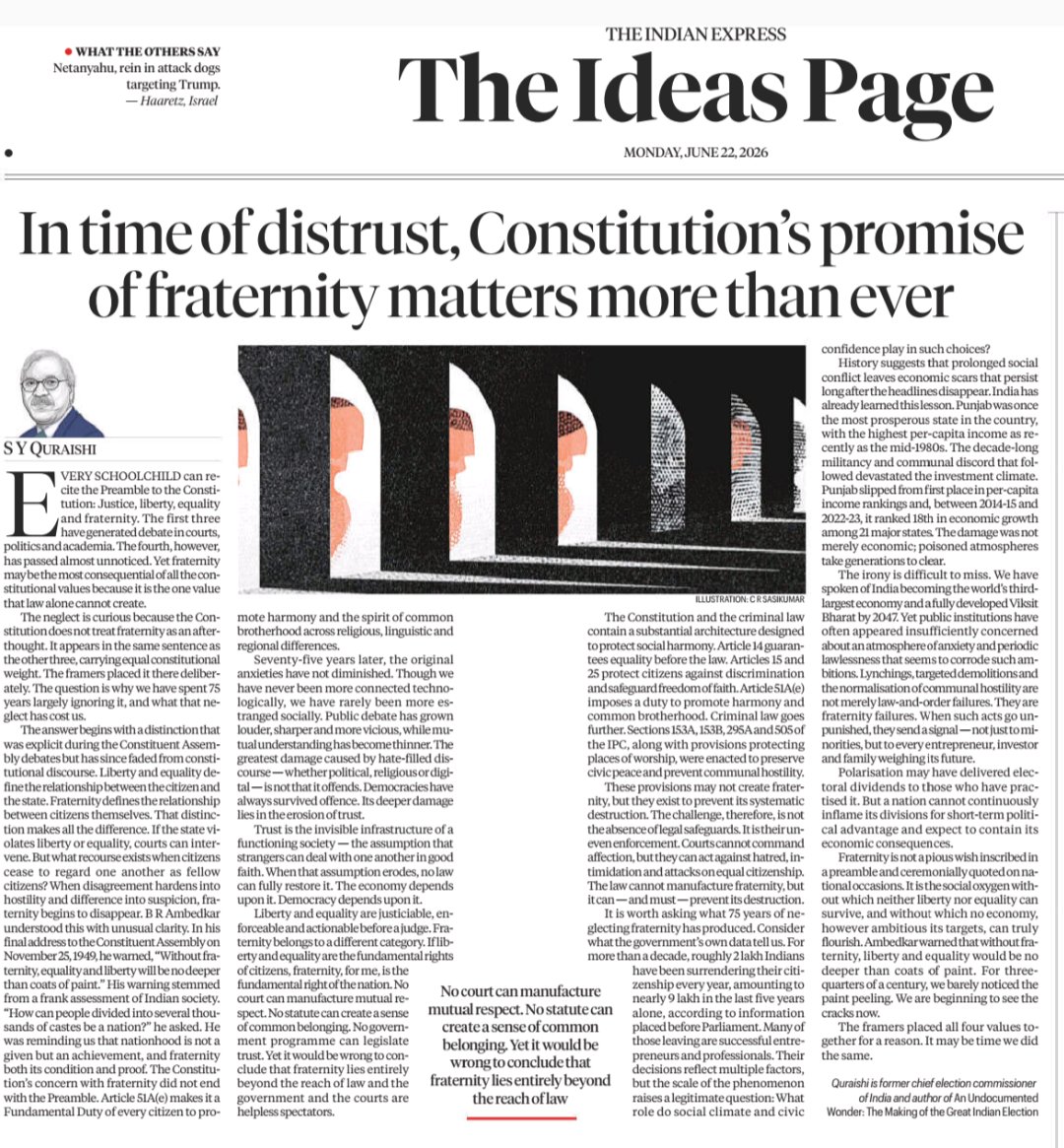
How many of us can write even 150 words on FRATERNITY?
Now, read this article. Nothing out of ordinary but thats how interpretation gives us such good content.
Encounters like the one in this video capture an essential learning curve in the wild. Cubs, Sub-adult leopards use these interactions to map their environment and test prey boundaries. Lacking the experience to breach keratin armor, their approach is driven by curiosity rather than predation. The pangolin’s defense, rolling into a sphere, safeguards its underbelly entirely. On the ground, we usually see this novelty wear off over time, leaving the young cat to walk away. It represents a quiet, ongoing balance between prey defense and predator development.
VC: Sudantha_Chandrasena
#Leopard #Predator #Pangolin #Wildlife #AnimalBehavior
In 1965 Malaysia kicked Singapore out of the Malaysian federation, and Tunku Abdul Rahman thought he had won. He had dumped a port city with no oil, no farmland, no fresh water, and two and a half million people crammed onto an island smaller than Lake Tahoe. Sixty years later Singapore's GDP per capita runs past $84,000 while Malaysia limps along under $12,000. The man who got expelled built the richest patch of dirt in Asia. The man who did the expelling built the New Economic Policy.
Let's study what happened.
Start with what Singapore lacked. No resources. No hinterland. No domestic market worth the name. By every theory that says a nation needs raw materials to prosper, Singapore should have starved. Instead Lee Kuan Yew made his country a place where capital felt safe. Low tariffs. Easy entry for foreign firms. Courts that enforced contracts instead of shaking down the parties. Corporate tax dropped to 17 percent, personal rates capped at 22, no tax on most capital gains. Money flowed in because money is not stupid.
Malaysia chose the opposite. The New Economic Policy was racial central planning dressed up as fairness. Bumiputera quotas demanded that ethnic Malays hold 30 percent of corporate equity, that government contracts favor Malay-owned firms, that universities admit by race rather than ability. The state picked winners by bloodline. Predictably, the productive Chinese and Indian minorities took their capital and brains elsewhere, much of it to (where else) Singapore. You distort prices and incentives long enough, the talented people leave. They always leave.
Lee Kuan Yew was not perfect. The man jailed opponents, sued journalists into poverty, and ran a soft authoritarian state with a fondness for caning. He banned chewing gum, which is the kind of thing a control freak does when he runs out of real problems. Singapore is no libertarian paradise. The government owns Temasek and GIC, sovereign wealth funds sitting on close to a trillion dollars combined, and public housing covers 80 percent of the population. Plenty there for a free market thinker to dislike.
But here is the lesson Malaysia missed. Lee understood the difference between an interventionist government and a parasitic one. Singapore's state stayed mostly out of the price system. It kept inflation low, the currency credible, the bureaucracy clean, and trade open. Transparency International ranks it the fifth least corrupt country on earth. Malaysia sits at 57th, with a former prime minister, Najib Razak, currently serving time for looting 1MDB to the tune of billions. One country treated public office as a trust. The other treated it as a buffet.
Capital responds to incentives, not slogans. When Singapore guaranteed property rights and kept the rules predictable, Exxon and Shell built refineries, banks set up regional headquarters, and the port became the busiest transshipment hub in the world. When Malaysia told investors that race would override merit and that the rules could change whenever a minister felt like it, the smart money discounted everything by a risk premium. Over fifty years that premium compounds into a $70,000 gap in living standards.
The greats study the greats (bookmark this list)
Alexander the Great
Philip of Macedon
Hannibal Barca
Scipio Africanus
Julius Caesar
Augustus
Ghengis Khan
Joan of Arc
Alexander Hamilton
George Washington
Abraham Lincoln
Napoleon Bonaparte
John D. Rockefeller (technically)
Winston Churchill
Adolf Hitler
Franklin D. Roosevelt
These great men of history are worth studying. The greats study the greats.
India throws away over 7 million tonnes of textile waste every year, not because people don't care but because they don’t know how to dispose of it.
Two engineers saw this gap and built NoKasa, an app where you can book a pickup. An agent comes to your home, grades your clothes on the spot, and sends cashback via UPI immediately.
They've already kept 1 lakh garments out of landfills. Such a good innovation to keep cities clean.