If you see high-risk driving, report it. Upload your dashcam footage at https://t.co/eVJnTQCyiL
Brake the Habit🔗https://t.co/jsl0uJgZGa
Source: @TACVictoria
Here we go again: rehearsing a major hardfork on testnet 10, this time crescendoing into Toccata
Activation is scheduled for tomorrow May 18, 16:00 UTC.
Existing TN10 miners/operators should upgrade now. In a few hours upgraded p2p nodes will stop connecting to non-upgraded nodes as we enter the 24h pre-activation window.
Let’s make the mainnet activation boring by making the TN10 rehearsal as mainnet-real-world as possible
Unfortunately I was part of the group laid off from @coinbase today.
My whole tenure was protecting U.S. retail from tokens with actual utility like $XMR, $KAS, and quai-network:native.
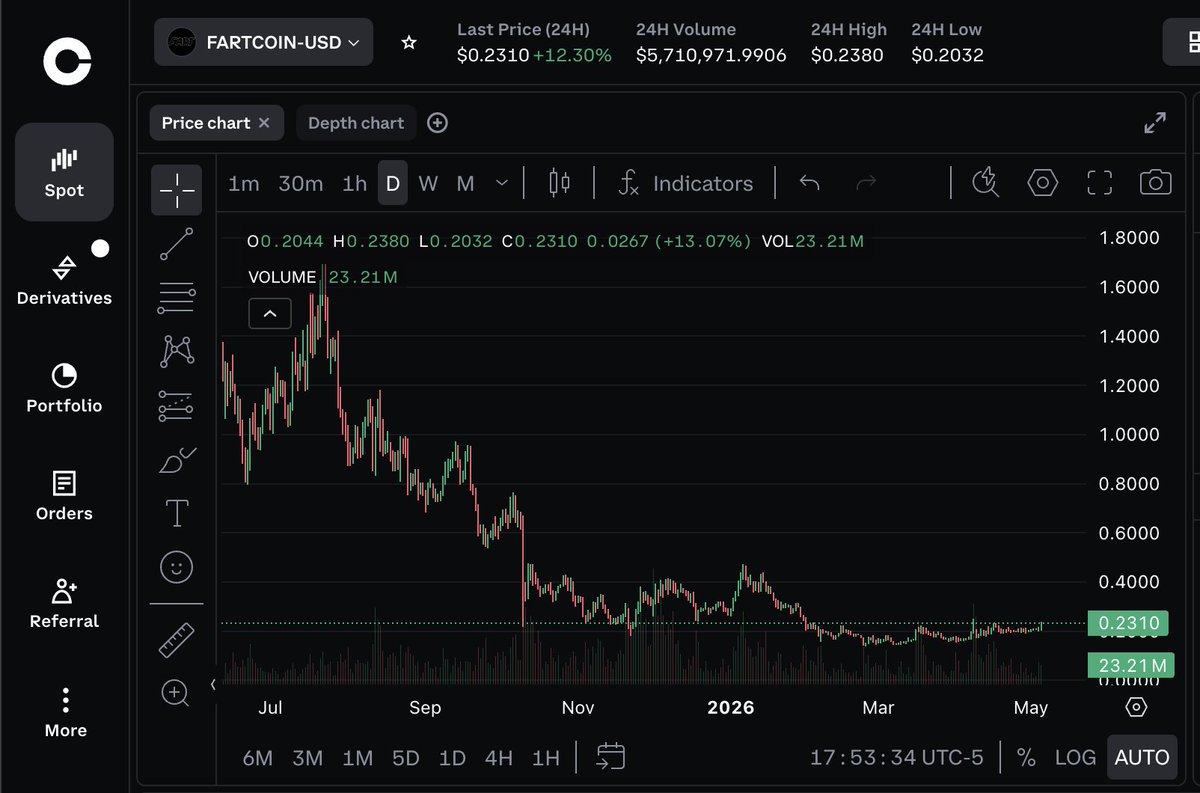
Instead we focused on listing pristine crypto assets like $RAVE, $USELESS, $FARTCOIN, and $TRUMP.
Pictures unrelated.
$KAS FAM:
ONCE The Clarity Act comes in, some CEX will close down and leave your $KAS stuck or lost forever!!!
If you haven't, take your $KAS of CEX RIGHT NOW
Take custody of your money...
$HYPE sitting at $34.53, up 12% in 24h after touching $35.28 high. strong momentum from $30.52 low.
but here's what actually matters right now:
march 9th exploit happened. trader opened $20.6m short on BTC at 40x leverage (299.2 BTC) with 2% liquidation buffer. that's the kind of position that shouldn't exist on a functioning platform.
HyperEVM deposit/withdrawal for base asset is completely broken. can't move assets between L1 and EVM. this is a critical infrastructure failure.
ecosystem stuff looks decent on surface. Hyperlend $HPL airdrop went live with trading open. CL-USDC perp OI hit $183m. platform did $4b volume on trad-fi markets march 9th. URNM ETF now tradeable.
Hyperlend partnered with Hyperion for compliance-gated private pools using HYPE as collateral. institutional credit facilities. former Barclays CEO and Fed president on Purr's board (they run Hyperliquid Treasury).
but competition is eating their lunch. volume share dropped from 66% to 18% because Paradex, Lighter, Aster, EdgeX all scaled up. that's a massive decline.
bullpen launched liquidity league III with $175k rewards. boros did CLUSDC crude oil funding rate market. TradeXYZ bought the $VIX ticker.
fee generation is $15k daily on $100m notional, same efficiency as Deribit.
the price pump doesn't change the fact you've got an exploit event and broken infrastructure between chains. market cap at $8.2b, still 42% below ATH of $59.30.
i watched a flight go from $483 to $547 in 24 hours WITHOUT a single seat selling
searched london to new york on a tuesday
$483
checked again 2 hours later
$512
next morning: $547
panicked and booked it
the guy sitting next to me paid $391
same seat, date + airline
$156 less
he searched once i searched 3 times
the algorithm saw me come back and charged me until i broke
the seat doesnt have a price
you have a price
and it goes up EVERY time you show interest
couldnt stop thinking about it so i tracked down someone who actually built pricing algorithms for a european carrier
asked him what happened to me
"you got profiled. the system assigned you an intent score after your second search and raised your ceiling every time you came back"
asked how to beat it
"most people think a VPN fixes it. thats 2015 advice. the algorithm fingerprints more than your IP now. it reads your device your browser your screen resolution your timezone. VPN to bucharest but your clock says london and your language is english? the algo knows youre faking and sometimes charges you more for trying"
"so what actually works?"
"you have to poison the entire profile. not just the location. the identity"
the protocol he gave me:
VPN AND match your timezone and language to the spoofed location. mismatched signals flag you and can trigger a price increase
use a fully clean browser. no history no saved passwords no google account. the algorithm fingerprints your session not just your cookies
one search one booking. the intent score activates on the second search. there is no safe way to look twice
book tuesday or wednesday 1-5am. lowest traffic means the least demand data for the algorithm to inflate against
if the price already spiked go dark for 72 hours minimum. not 24. the intent score on most carriers decays on a 3 day cycle. come back on a different device from a different network
"we spent $4 billion building these systems. theyre not going to lose to someone who opened an incognito tab"
$900 billion industry
the gap between what you pay and what the person next to you pays is not a bug
its the entire business model
stop letting an algorithm charge you for being predictable
@elonmusk Excellent, when it's finished, you and Trump — and everyone else in the Epstein files — can go live there so the rest of us can focus on saving the planet with trees and waterfalls.
Kaspa’s runtime architecture achieves scalability not by optimizing block-level throughput, but by rethinking the role of blocks entirely. Instead of treating state transitions as discrete batches that must be processed sequentially, Kaspa models them as a continuous stream of causally-related transactions, with blocks serving only as logical markers that define the boundaries of possible reorgs.
This shift in perspective moves the performance bottleneck away from "how fast can we process everything inside a block" toward "how can we parallelize all currently known tasks across the entire DAG". When a block contains a spike of non-parallelizable work, traditional blockchains must stall until the block is fully processed. Kaspa does not. Because unrelated transactions can be scheduled immediately - even those belonging to future blocks - the system avoids idle CPU cycles and eliminates the classic straggler problem.
Most existing DLT architectures tightly couple block production with state commitments, proofs, or other finalization steps, making their execution model inherently sequential. Even if they support some parallelism within a block, they still wait for a block to finish before moving on to the next one. This introduces unnecessary latency and forces the runtime to juggle responsibilities that are orthogonal to efficient workload distribution.
Kaspa’s strict separation of concerns allows the entire execution model to collapse into a minimal, expressive, and highly generic framework - small enough to run any ACL (access-control list) enabled VM at essentially bare-metal performance.
Its design models causal dependencies at the lowest hardware-relevant level, enabling an execution flow that is:
- completely lock-free
- free of WAL flushes or global sync barriers
- based entirely on eventual consistency
This results in a simpler, more scalable, and far more hardware-efficient architecture than anything deployed in blockchain systems today.
In effect, Kaspa does for distributed ledgers what TensorFlow and CUDA Graphs did for machine learning: it exposes a parallel execution model that can scale seamlessly with modern hardware, turning theoretical throughput into practical reality (the 64000 TPS that Solana achieves in the lab let's bring that to practice).
I am extremely excited about this as this is exactly what I always wanted to build with IOTA and now it's finally done.
We are still working on implementing the higher levels of abstraction like designing a capability based linear type system abstraction for state management and resource access that gets rid of the need for manual capabilities wiring like in SUI and there is still a bit of work left but I don't think that you will ever be able to build a more scalable architecture than directly modeling the causal structure of state changes down to the lowest hardware layer.
Kaspa is going to melt faces my friends and it's going to be so much better that it will be impossible to ignore!
And it's such a simple API with Rayon level abstraction ... I am seriously getting a nerd-gasm just looking at the code 😅: https://t.co/aLvm843GiA
This goes out to KEF and the entire community:
Thank you so much for allowing me to take part in this journey - this really feels like coming home! 🥰
Respect to $KAS founder @hashdag
He had the courage to decline a top-100 blockchain award in Dubai and he did it for the right reasons.
He called out what most founders stay silent about:
The capture of crypto by centralized gatekeepers.
When a fair-launched, 10 BPS blockDAG network like #Kaspa , built on pure Nakamoto Consensus, parallel block validation, and zero premine, is ignored while exchanges push meme tokens with insider liquidity, it is proof that incentives have replaced integrity.
Hashdag’s statement is precision.
He exposed the structural imbalance where CEXs define “strength” by volume and hype instead of protocol quality.
Crypto has turned into a stage where hype outweighs utility, marketing beats engineering, and exposure replaces substance.
Hot air has become more valuable than real technology, real teams, or real knowledge.
Oracle dependencies, API throttling, and listing politics are shaping markets in ways no algorithm can justify.
This is how true decentralization dies:
Not by hacks, but by silence.
Hashdag refused to be part of that silence.
More founders should do the same.
Refuse the staged awards.
Refuse the centralized validation.
Build, prove, publish and make crypto accountable again.
- by $MASTR project
JUST IN: Kaspa $KAS founder Yonatan Sompolinsky declines @binance Top 100 Blockchain invite, calling out the exchange for favoring casino-style tokens over fair-launched cypherpunk projects.
@binance,
Thanks for including me in the top 100 blockchain people list, appreciate the signal!
I must decline the Dubai invite though. I do not wish to disrespect, but many of the award voters are avid kaspians who rooted for my kaspa status at least as much as for my research. Let them win or count me out.
Crypto has turned from a euphoric cypherpunk project to a house-friendly casino. You may not be the culprit, but as a top player you hold the lion’s share of the responsibility to correct this, and the October crash your USDe oracle glitch helped trigger adds to what needs to be addressed.
There are three classes of crypto, as @mert put it recently: commercial crypto, casino crypto, cypherpunk crypto. <<Binance should hold a privilege policy for the latter.>> A TBTF CEX should know better and play a different game with hardcore crypto projects.
When binance lists a green frog three weeks post its “launch” but skips a fair-launched-Nakamoto-Consensus-100ms-upgrade-ATH-top-20-the-only-nonbitcoin-marathon-mined project, this is not merely binance rationally calculating; it is also binance molding the market in a way that is alas misaligned with the roots of the movement.
You may feel that kaspa’s sovereign money thesis is boring – that bitcoin is already money and that implementing an internet-speed bitcoin is useless - fine. Wrong but fine. But what’s the thesis for the green frog?
Money is a classic chicken-and-egg product. It is a scam up until one moment before tipping point, “most of the value comes from the value that others place in it.” Considering your resources and influence, I think it's safe to say you can serve as both the egg and the chicken and make it worth your while to push sound attempts towards tipping point.
@cz_binance tweeted recently that “strong projects will be listed.” But binance is part of what defines "strong", it bears responsibility for the market’s compass and impulse and definition of strong. It is not a read-only entity.
Binance listing fees are legit, they are just unfit for category cypherpunk. Kaspa devs and early supporters fairly mined less than half what satoshi and hals mined. We don’t have a 20% ZEC-style founders’ reward or protocol-enforced dev fund; this is not a jab at ZEC and the wonderful @Zooko, who was crashing in my car on a late Thursday back in the low ZEC MC days – if somebody deserves to win it is zooko – but assuming binance is not taking a maxi bet, it should revisit its relationship with hardcore crypto.
We are here through bull and bear, ICOs NFTs XYZs; and we are the source of confidence that restores faith and capital inflow post meme-induced or CEX-induced crashes.
Please fix this.
Thanks again,
hashdag
cc @michaelsuttonil
Exhibit A: Binance Innovation Zone
Exhibit B: 10 bps Nakamoto Consensus