@OncoThor We run a UK patient Helpline covering Lung NETs - the confusion around hearing TC and AC is huge. And not only for the patient. Remains such an unhelpful classification. @ncukcharity
Twice today already at ASCO I have heard presenters say “patients failed treatment”.
Can we please, please stop that?
Treatments fail patients, not the other way around…
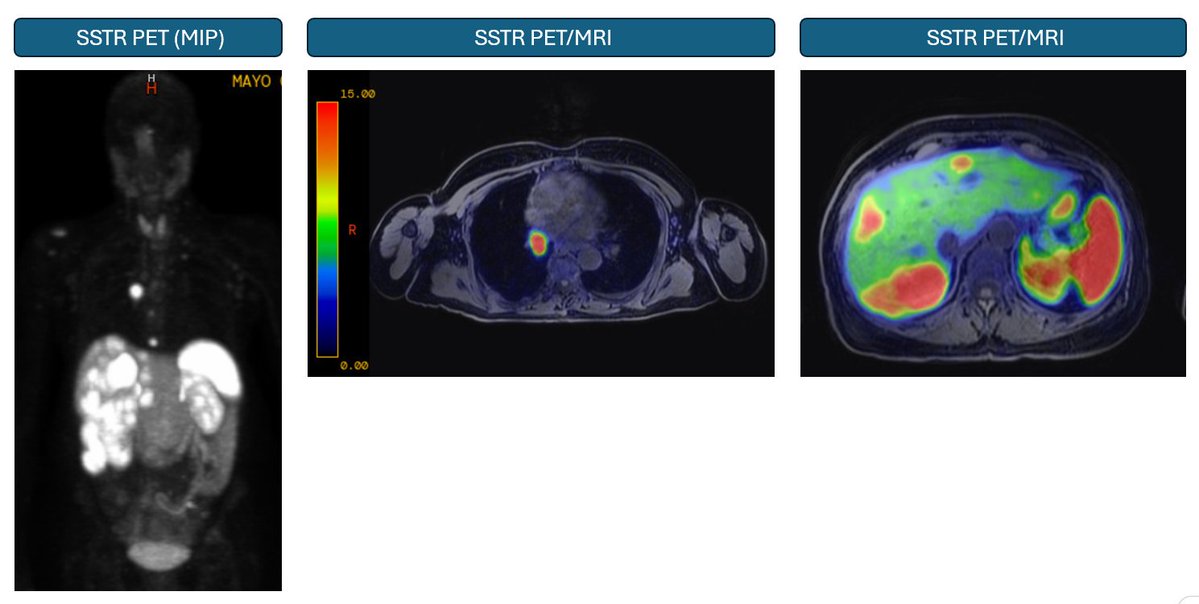
Images from the NET clinic...
Working in the NET clinic is often humbling... Tumors do not read textbooks and sometimes, things just do not make sense but yet are happening right in front of you. As I often say, every patient with NET is unique (of course, every patient with cancer regardless of cancer type is unique...) with their own clinical presentation.
This patient below has metastatic lung NET, indolent, producing very large amounts of serotonin but with no diarrhea or flushing (serotonin does not cause flushing by the way but does cause diarrhea) so essentially asymptomatic in terms of typical carcinoid syndrome. This patient however has carcinoid heart disease with severe tricuspid and pulmonary valve regurgitation. Interestingly, there is no lower extremity edema but there is pulsatile hepatomegaly (a classic finding), both systolic and diastolic murmur, elevated JVP but not a trace of lower extremity edema.
Below you can see evidence of hepatic venous congestion in the venous phase of the CT with what sometimes is called nutmeg liver. That lobular pattern is not seen on the arterial phase or on the recent gadoxetate enhanced delayed MRI imaging.
I just thought I should share that carcinoid syndrome can present in very atypical ways without the cardinal symptoms of diarrhea and flushing. In this case, carcinoid heart disease is the only manifestation of the syndrome.
Want to know more about the intersection of endocrinology and oncology when it comes to diabetes...?
Things like:
1) Glucose control problems with systemic therapy like mTOR inhibitors, ICIs, somatostatin analog and others?
2) Secondary cause of diabetes as an early manifestation of malignant
Look no further. @TheLancetEndo has this and much more covered in this excellent review
https://t.co/uwLu2WtNLo
Much of the eye-opening @BenSasse interview is instructive as to how NOT to communicate as an oncologist
1) get to the point quickly (before the “tinnitus of terror” sets in) and 2) make it clear that the primary & metastatic sites are the SAME cancer
https://t.co/Ig8SV7TKms
@OncoThor@Ja_Capdevila@ENETS_ORG And this is why I don’t leave X.
Thanks for sharing, from a patient perspective it can feel like a dearth of information on lung NETs, so new papers are precious!
Much welcomed @ENETS_ORG guidance paper on management of patients with lung and thymic NETs (soon we will stop calling them carcinoids...).
As always from ENETS, this is quality stuff! If you see patients with this malignancy, you SHOULD read this paper!
Thanks ENETS and team including @Ja_Capdevila@deroose_c@GCarboneroLab!
https://t.co/DSojMVwYUa
@OncoThor@ENETS_ORG Thanks, Thor. We still need so much more for Lung NETs patients. This (deep breath) ‘carcinoid’ @BTOGORG podcast is a step in the right direction too: https://t.co/4vEmXpVvNE
More on treatment related myeloid neoplasms (t-MN) following radioligand therapy (PRRT) in patients with NETs. 4.2% of patients develop t-MN after a median time of 48.3 months. Nine of 13 patients with t-MN received radiosensitizing chemotherapy, almost exclusively capecitabine (not standard practice in the U.S. ). As expected, survival after t-MN and diagnosis was short. 10.4 months.
This is a very valuable addition to the literature from @DrDavidLChan and team!
https://t.co/8AylMesHAE
Podcast - BTOG Does Lung Neuroendocrine Tumours: Changing the Conversation.
What is PRRT?
Hosted by @emmalodowd, @MatthewEvison1 and Prof Was Mansoor explain why we should move beyond “carcinoid,” how diagnosis and staging pathways differ from standard lung cancer, and what is needed to improve access, follow-up, and treatment options.
Watch, listen or download the full podcast at Apple Podcasts, Spotify, Amazon or our website https://t.co/dRwTV5uW4z
https://t.co/sEmS3KBcaD
https://t.co/uUTvnlls12
https://t.co/DrcTUE0bZV
Podcast - BTOG Does Lung Neuroendocrine Tumours: Changing the Conversation.
Follow-up: 15 years (and why)
Hosted by @emmalodowd, @MatthewEvison1 and Prof Was Mansoor explain why we should move beyond “carcinoid,” how diagnosis and staging pathways differ from standard lung cancer, and what is needed to improve access, follow-up, and treatment options.
Watch, listen or download the full podcast at Apple Podcasts, Spotify or our website https://t.co/dRwTV5uW4z