Medical Oncologist focused on GI & Endocrine Malignances. Vall Hebron University Hospital. Vall Hebron Institute of Oncology (VHIO). Teknon Cancer Institute.
🔥Presidential session at ESMO 2026 🔥
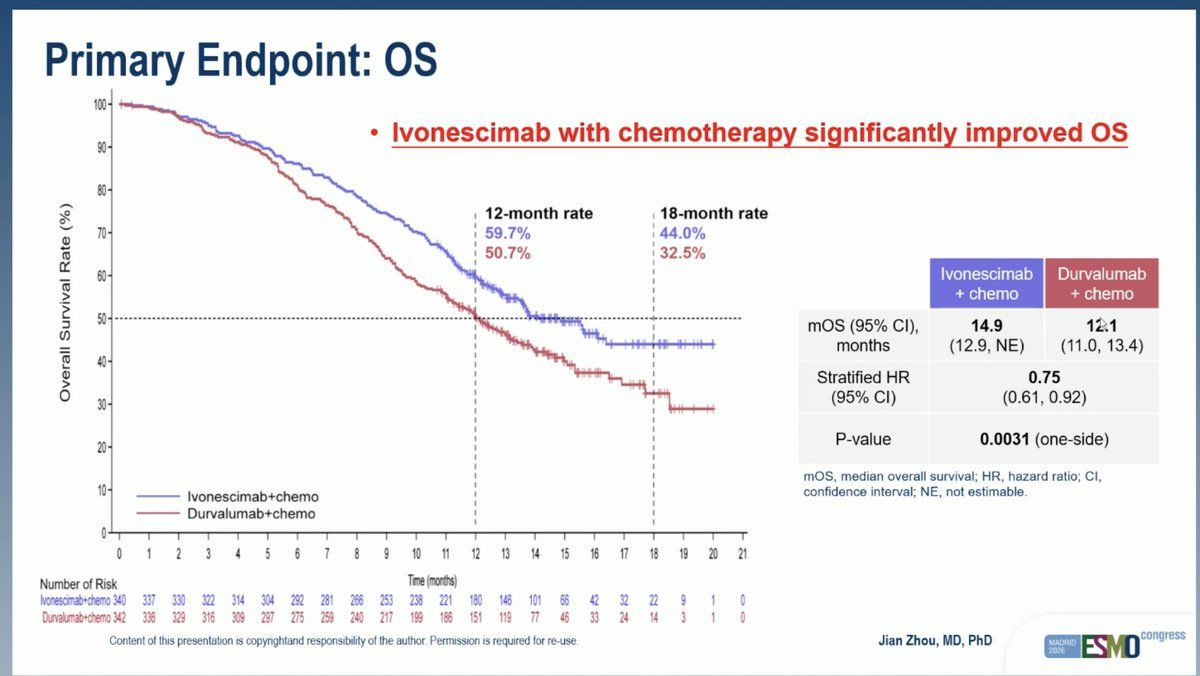
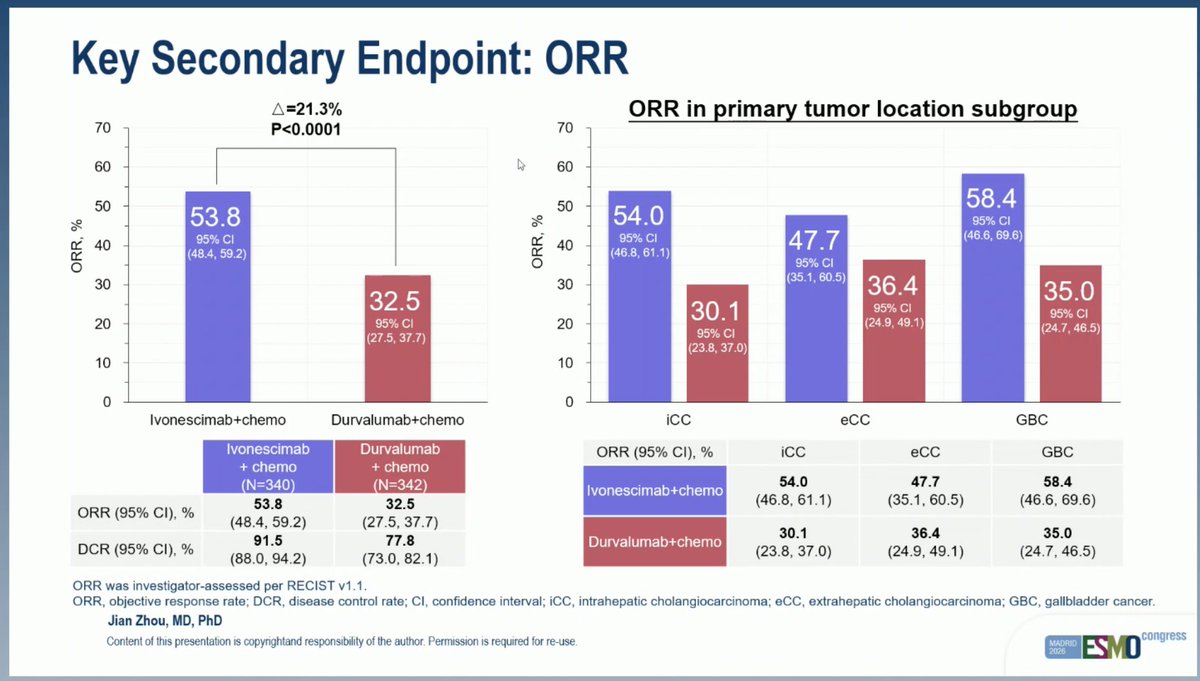
HARMONi-GI1 ph-3: Ivonescimab + CTx vs durvalumab + CTx as 1L for BTC
#ESMO26#ESMOAmbassadors
👉ORR: 53.8 vs. 32.5 %
👉mPFS: 8.4 vs 5.8 mo
👉mOS: 14.9 vs. 12.1 mo
🧐 Very promising Chinese data, would be great to see data in a global population
@myESMO@ASCO
Clinical Complete Response with Dostarlimab Monotherapy in dMMR/MSI-H Locally Advanced Rectal Cancer: First Results from the Global AZUR-1 Trial - Annals of Oncology https://t.co/iai9wqm9YF @VHIO@vallhebron@GrupoTTD
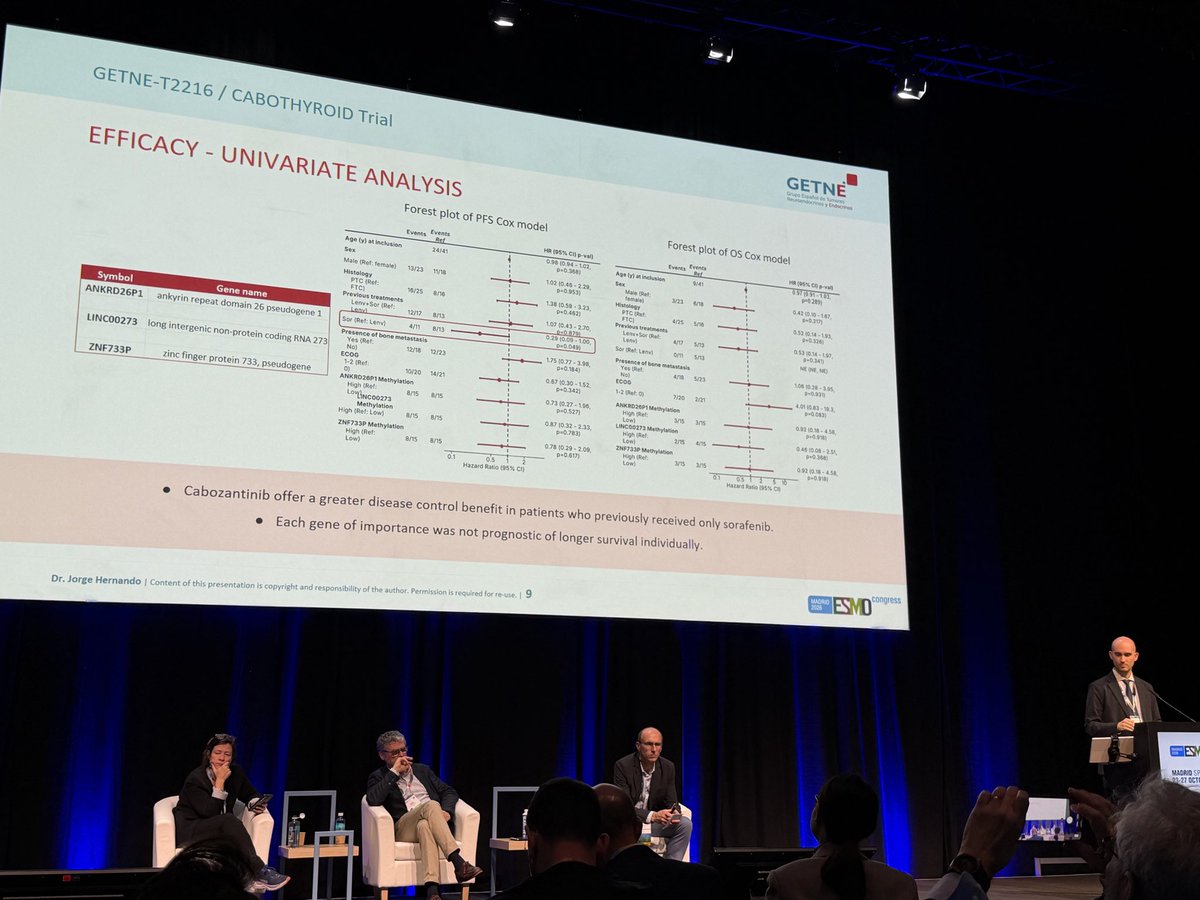
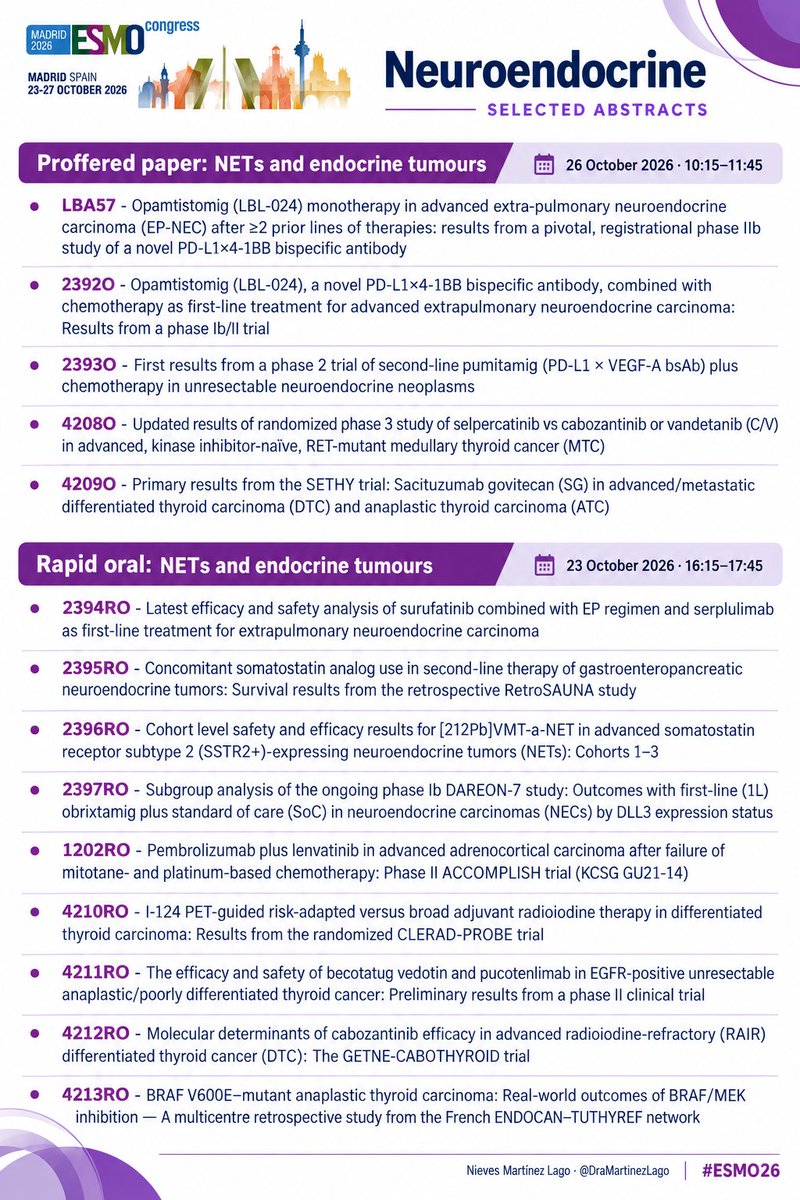
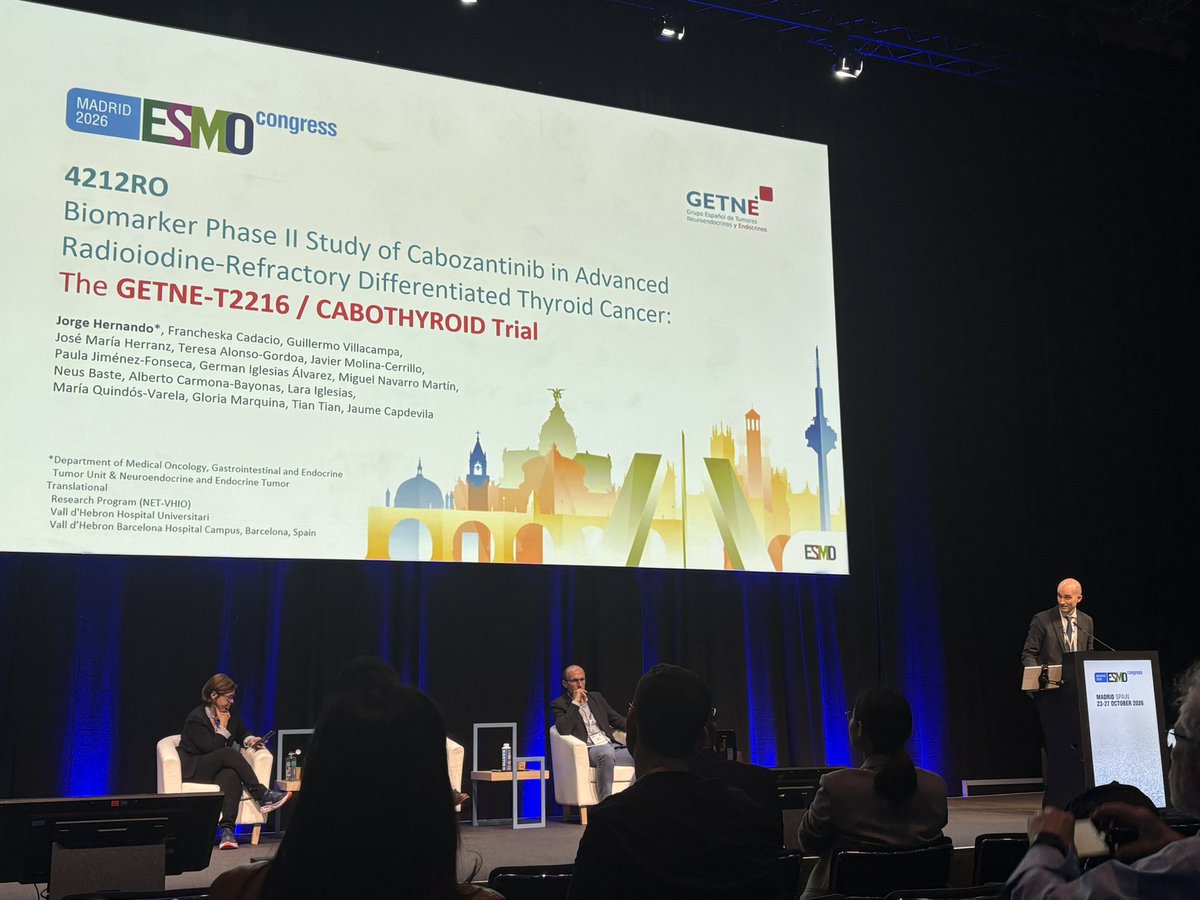
#ESMO26 🇪🇸 🧬 GETNE-CABOTHYROID | Fase II
presentado por @JHernando3
👥 41 pacientes | Cáncer de tiroides refractario a radioyodo
💊 Cabozantinib
🎯 ORR 25,6%
📈 SLP 16,1 meses
⏳ DoR 18,4 meses
🧬 Metilación de cfDNA: potenciales biomarcadores predictivos.
🔬 ¡Seguimos impulsando la investigación desde @GrupoGetne
🔬 The #VHIO team is at #ESMO2026!
Our researchers are in Madrid to present their work, exchange ideas and connect with colleagues from across the oncology community.
Looking forward to a great congress!
👏 Huge congratulations to my friend @JHernando3 on presenting the GETNE-T2216/CABOTHYROID trial at #ESMO26!
Promising results with cabozantinib in advanced thyroid cancer: ORR 24%, DCR 89.7% and median PFS 16.1 months.
Great work by @GrupoGetne 🇪🇸! @Ja_Capdevila@OncoAlert
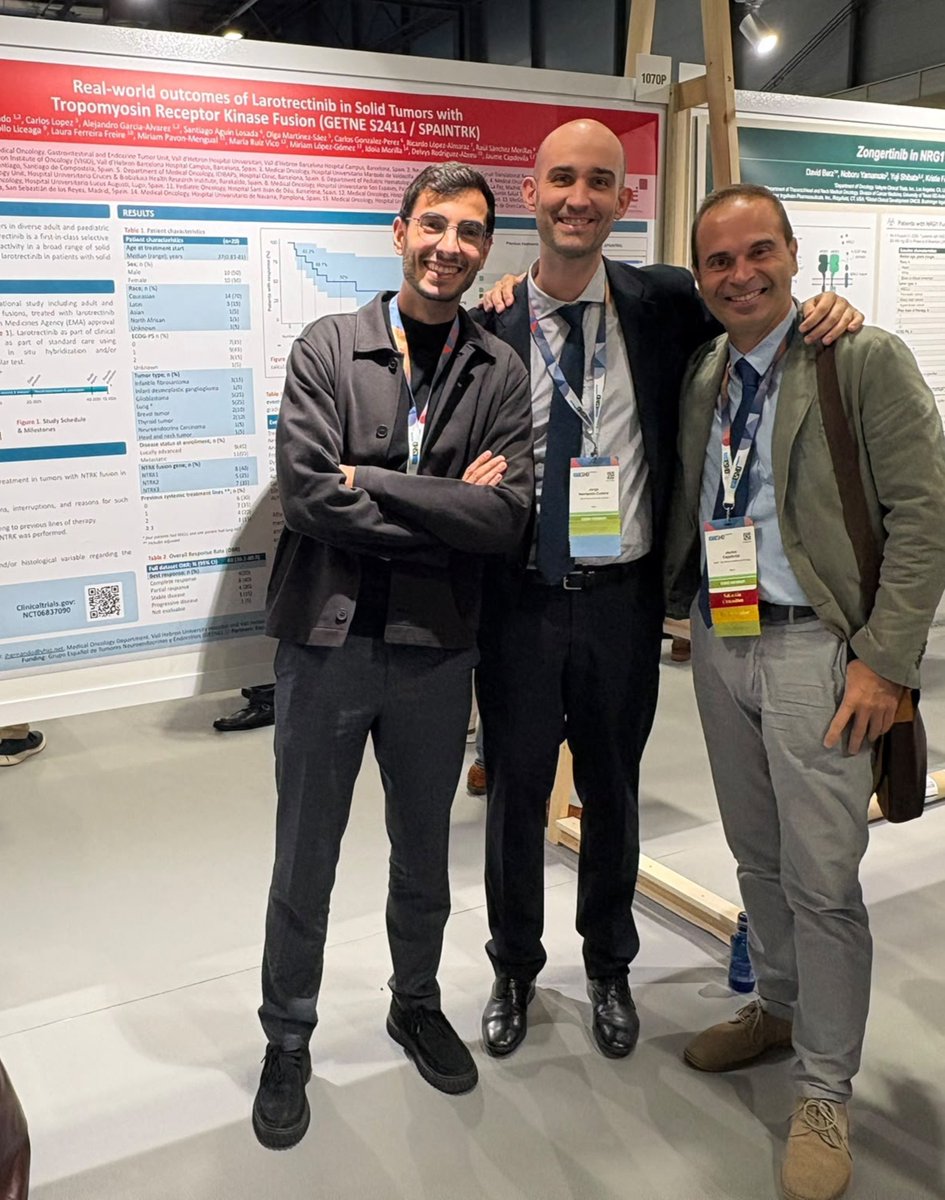
Great to present the results of the @GrupoGetne SPAINTRK study at #ESMO2026!
Our real-world data in spanish population support the efficacy and durability of larotrectinib across NTRK fusion-positive solid tumors.
Proud of this collaborative effort!
📣 Desde GETNE damos visibilidad a #NETPRACTICE 🌍
🔬 ¿Tratas pacientes con TNE? ¡Participa en esta encuesta internacional sobre práctica clínica y necesidades no cubiertas!
🌎 70 respuestas | 12 países
⏱️ 12–15 min | 🔒 Anónima
📊 Primeros resultados en #ENETS
✍️ https://t.co/UmrBN3asYh
@Alej_GarciaMD@Ja_Capdevila@JHernando3
🚨 FDA approval for dostarlimab in locally advanced dMMR/MSI-H rectal cancer!
This was based on AZUR-1, with full data coming at @myESMO. #ESMO26
No recurrences among responders after more than 2 years of median follow-up!
We know immunotherapy works, and when patients respond, those responses can be incredible.
I’ve been using immunotherapy with curative intent in these patients, and I haven’t been disappointed.
The fact that we’re potentially curing solid tumors with systemic therapy alone, without chemotherapy, radiation, or surgery, is magical.
Looking forward to the full data and seeing this approach become more broadly available to patients.
@OncoAlert@Onco_Nexus@TheGutOncLab
https://t.co/WH5EwpBi02
Pancreatic Adenocarcinoma, Version 4.2026: NCCN Clinical Practice Guidelines in Oncology
🎯Tumour NGS is recommended for every patient who is a candidate for anticancer therapy, with RNA sequencing added because it detects fusions better.
- Neoadjuvant PAXG is listed as a useful-in-certain-circumstances option on the Italian Phase 3 result against mFOLFIRINOX (median EFS 16.0 vs 10.2 months, HR 0.63).
⚠️After neoadjuvant therapy, resection decisions are now framed by biological response (RECIST, CA 19-9, clinical status) rather than vascular contact alone.
🩸 The panel declines to make a consensus recommendation on postoperative ctDNA.
#NCCN #GIOnc #PDAC
https://t.co/IideDaZ652
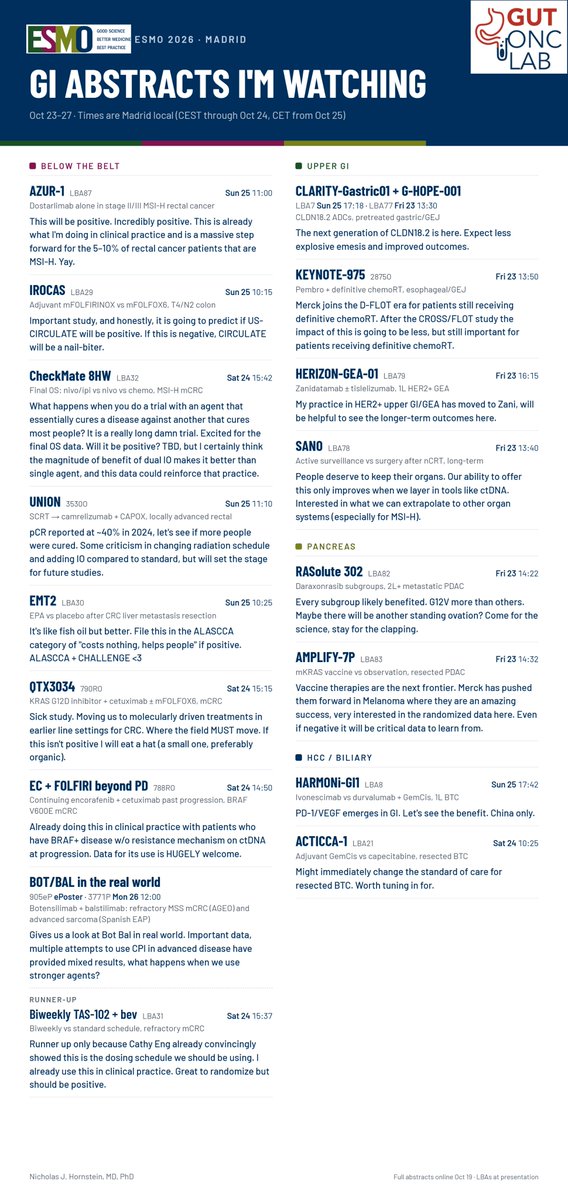
ESMO 2026: GI abstracts I’m watching
ESMO is a week away so time to post thoughts on studies that will either change practice, move the field forward or are thought provoking!
Gut Onc Lab video next week once text is released.
BELOW THE BELT
AZUR-1: Dostarlimab for dMMR/MSI-H locally advanced rectal cancer (LBA87)
When: Sun Oct 25, 11:00 CET. Lower GI Proffered Paper session.
What: Stage II/III MSI-H rectal cancer (n=154) treated with dostarlimab alone.
My take: This will be positive. Incredibly positive. This is already what I’m doing in clinical practice and is a massive step forward for the 5–10% of rectal cancer patients that are MSI-H. Yay.
IROCAS: Adjuvant mFOLFIRINOX vs mFOLFOX6 in high-risk stage III colon cancer (LBA29)
When: Sun Oct 25, 10:15 CET. Lower GI Proffered Paper session.
What: Phase 3 of adjuvant mFOLFIRINOX vs mFOLFOX6 in T4 and/or N2 stage III colon cancer.
My take: Important study, and honestly, it is going to predict if US-CIRCULATE will be positive. If this is negative, CIRCULATE will be a nail-biter.
Encorafenib + cetuximab + FOLFIRI beyond progression in BRAF V600E mCRC (788RO)
When: Sat Oct 24, 14:50 CEST. Lower GI Rapid Oral session.
What: Continuing EC past progression, adding FOLFIRI, in BRAF V600E mCRC.
My take: Already doing this in clinical practice with patients who have BRAF+ disease w/o resistance mechanism on ctDNA at progression. Data for its use is HUGELY welcome.
CheckMate 8HW: Final overall survival (LBA32)
When: Sat Oct 24, 15:42 CEST. Lower GI Rapid Oral session.
What: Final OS for nivo/ipi vs nivo vs chemo in MSI-H metastatic CRC.
My take: What happens when you do a trial with an agent that essentially cures a disease against another that cures most people? It is a really long damn trial. Excited for the final OS data. Will it be positive? TBD, but I certainly think the magnitude of benefit of dual IO makes it better than single agent, and this data could reinforce that practice.
UNION: Short-course RT → camrelizumab + CAPOX in locally advanced rectal cancer (3530O)
When: Sun Oct 25, 11:10 CET. Lower GI Proffered Paper session.
What: Phase 3 of SCRT → camrelizumab + CAPOX vs long-course CRT → CAPOX in locally advanced rectal cancer.
My take: pCR reported at ~40% in 2024, let’s see if more people were cured. Some criticism in changing radiation schedule and adding IO compared to standard, but will set the stage for future studies.
EMT2: Omega-3 EPA after resection of colorectal liver metastases (LBA30)
When: Sun Oct 25, 10:25 CET. Lower GI Proffered Paper session.
What: Phase 3, double-blind, EPA vs placebo after CRLM resection.
My take: It’s like fish oil but better. File this in the ALASCCA category of “costs nothing, helps people” if positive. ALASCCA + CHALLENGE ❤️
QTX3034 + cetuximab ± mFOLFOX6 in KRAS G12D CRC (790RO)
When: Sat Oct 24, 15:15 CEST. Lower GI Rapid Oral session.
What: Early data on an oral G12D-preferring KRAS inhibitor + cetuximab ± mFOLFOX6 in KRAS G12D mCRC.
My take: Sick study. Moving us to molecularly driven treatments in earlier line settings for CRC. Where the field MUST move. If this isn’t positive I will eat a hat (a small one, preferably organic).
BOT/BAL in the real world: refractory MSS mCRC and advanced sarcoma (905eP, 3771P)
When: 905eP is an ePoster available throughout the meeting. 3771P is Mon Oct 26, 12:00 CET, sarcoma poster session.
What: Real-world botensilimab + balstilimab in refractory MSS mCRC (AGEO, France) and advanced sarcoma (Spanish expanded access).
My take: Gives us a look at Bot Bal in real world. Important data, multiple attempts to use CPI in advanced disease have provided mixed results, what happens when we use stronger agents?
Runner-up: Biweekly vs conventional TAS-102 + bevacizumab in refractory mCRC (LBA31)
When: Sat Oct 24, 15:37 CEST. Lower GI Rapid Oral session.
What: Randomized comparison of biweekly vs standard-schedule TAS-102 + bev in refractory mCRC.
My take: Runner up only because @cathyengmd already convincingly showed this is the dosing schedule we should be using. I already use this in clinical practice. Great to randomize but should be positive.
UPPER GI
CLARITY-Gastric01 + G-HOPE-001: CLDN18.2 ADCs in pretreated gastric/GEJ cancer (LBA7, LBA77)
When: CLARITY-Gastric01 is Sun Oct 25, 17:18 CET, Presidential Symposium II. G-HOPE-001 is Fri Oct 23, 13:30 CEST, Upper GI Proffered Paper session.
What: Two phase 3s of CLDN18.2 ADCs vs physician’s choice. Sone-Ve (CLARITY) was positive for OS, and arcotatug tavatecan (G-HOPE) was positive for PFS.
My take: The next generation of CLDN18.2 is here. Expect less explosive emesis and improved outcomes.
KEYNOTE-975: Pembrolizumab + definitive chemoradiotherapy in esophageal/GEJ cancer (2875O)
When: Fri Oct 23, 13:50 CEST. Upper GI Proffered Paper session.
What: Phase 3 of pembro vs placebo with definitive chemoradiation in esophageal/GEJ cancer.
My take: Merck joins the D-FLOT era for patients still receiving definitive chemoRT. After the CROSS/FLOT study the impact of this is going to be less, but still important for patients receiving definitive chemoRT.
HERIZON-GEA-01: Zanidatamab + chemo ± tislelizumab in 1L HER2+ GEA, second interim (LBA79)
When: Fri Oct 23, 16:15 CEST. Upper GI Rapid Oral session.
What: Second interim of zanidatamab + chemo ± tislelizumab vs trastuzumab + chemo in 1L HER2+ GEA.
My take: My practice in HER2+ upper GI/GEA has moved to Zani, will be helpful to see the longer-term outcomes here.
SANO: Active surveillance vs surgery after neoadjuvant chemoradiotherapy for esophageal cancer, long-term results (LBA78)
When: Fri Oct 23, 13:40 CEST. Upper GI Proffered Paper session.
What: Long-term outcomes of active surveillance vs esophagectomy after nCRT in esophageal cancer.
My take: People deserve to keep their organs. Our ability to offer this only improves when we layer in tools like ctDNA. Interested in what we can extrapolate to other organ systems (especially for MSI-H).
PANCREAS
RASolute 302: Daraxonrasib vs chemotherapy in previously treated mPDAC, subgroup analyses (LBA82)
When: Fri Oct 23, 14:22 CEST. Upper GI Proffered Paper session.
What: Additional subgroup analyses from the phase 3 of daraxonrasib vs chemo in 2L+ metastatic PDAC.
My take: Everyone benefited. G12V more than others. Maybe there will be another standing ovation? Come for the science, stay for the clapping.
AMPLIFY-7P: mKRAS vaccine ELI-002 7P vs observation in resected PDAC (LBA83)
When: Fri Oct 23, 14:32 CEST. Upper GI Proffered Paper session.
What: Randomized phase 2 of an off-the-shelf mKRAS vaccine vs observation after PDAC resection. It missed its DFS endpoint.
My take: Vaccine therapies are the next frontier. Merck has pushed them forward in Melanoma where they are an amazing success, very interested in the randomized data here. Even if negative it will be critical data to learn from.
HCC / BILIARY
HARMONi-GI1: Ivonescimab vs durvalumab + GemCis in 1L biliary tract cancer (LBA8)
When: Sun Oct 25, 17:42 CET. Presidential Symposium II.
What: China-only phase 3 of a PD-1/VEGF bispecific vs durvalumab, both with GemCis. It was positive for OS.
My take: PD-1/VEGF emerges in GI. Let’s see the benefit. China only.
ACTICCA-1: Adjuvant gemcitabine + cisplatin after resected biliary tract cancer (LBA21)
When: Sat Oct 24, 10:25 CEST. Upper GI Proffered Paper session.
What: Phase 3 of adjuvant GemCis vs standard of care (capecitabine) after resection of cholangiocarcinoma or gallbladder cancer.
My take: Might immediately change the standard of care for resected BTC. Worth tuning in for.
@TheGutOncLab@Onco_Nexus@OncoAlert@oncodaily
Early data on VS-7375, @VerastemOncolog KRASG12D inhibitor in 2nd line and beyond #PancreaticCancer
50% ORR in 2nd line, 35% in 3rd/4th line
6mo OS of 80%
Proceeding with Phase 3 randomized trial in 1st line pancreatic (VS-7375 +EGFRi v VS-7375 + chemo)
https://t.co/DQbMMWKkOx
Today I learned preliminary data suggests that Daraxonrasib, although a pan-KRAS inhibitor, has varying efficacy depending on mutation. Patients with G12V mutations had the highest response rates with overall response rates of 50%. Numbers are small so we’ll see how this pans out
NANETS is pleased to share NET-PRACTICE, an international survey from our NET friends & colleagues in Barcelona on real-world NET treatment strategies. Anonymous, 12–15 min.
👉 https://t.co/5qxvuwOD4N
#NETCancer#NETResearch
🚨⭐️🔥 HOT OFF THE PRESS 🔥 @NatRevClinOncol
⭐️👉Pleased to share our new commentary 👉 @Dr_R_Kurzrock & I love the Daraxonrasib FDA label, and we explain why @FDA
👉 “An imprecise label in the era of precision medicine: labelling and access for daraxonrasib, the first pan-RAS inhibitor approval”
👉The FDA recently approved daraxonrasib for patients with metastatic pancreatic adenocarcinoma who received at least one prior systemic therapy, OR who are not candidates for multiagent systemic therapy.
👉Critics have called that second clause non-evidence-based. We see it differently.
👉Clinical trials generally enroll only patients with good performance status. That does not reflect reality for most people with metastatic pancreatic cancer. Many never reach second-line therapy because their clinical condition deteriorates first. A label written strictly around trial eligibility would leave these patients with nothing.
👉Here, the imprecision enables access. It lets physicians offer an effective RAS-targeted drug to the patients who need it most, at the point in their illness when it can still help.
👉Real-world evidence should resolve any remaining uncertainty.
👉Precision medicine should mean the right drug reaching the right patient, not a label that excludes the sickest among them @OncoAlert@oncodaily@Aiims1742@KRASKickers@PanCAN@DianaNrco@EileenMOReilly@DrShubhamPant@GIcancerDoc
#PancreaticCancer #RAS #PrecisionOncology #FDA #OncTwitter
Link: https://t.co/kQFRMQE7Uk