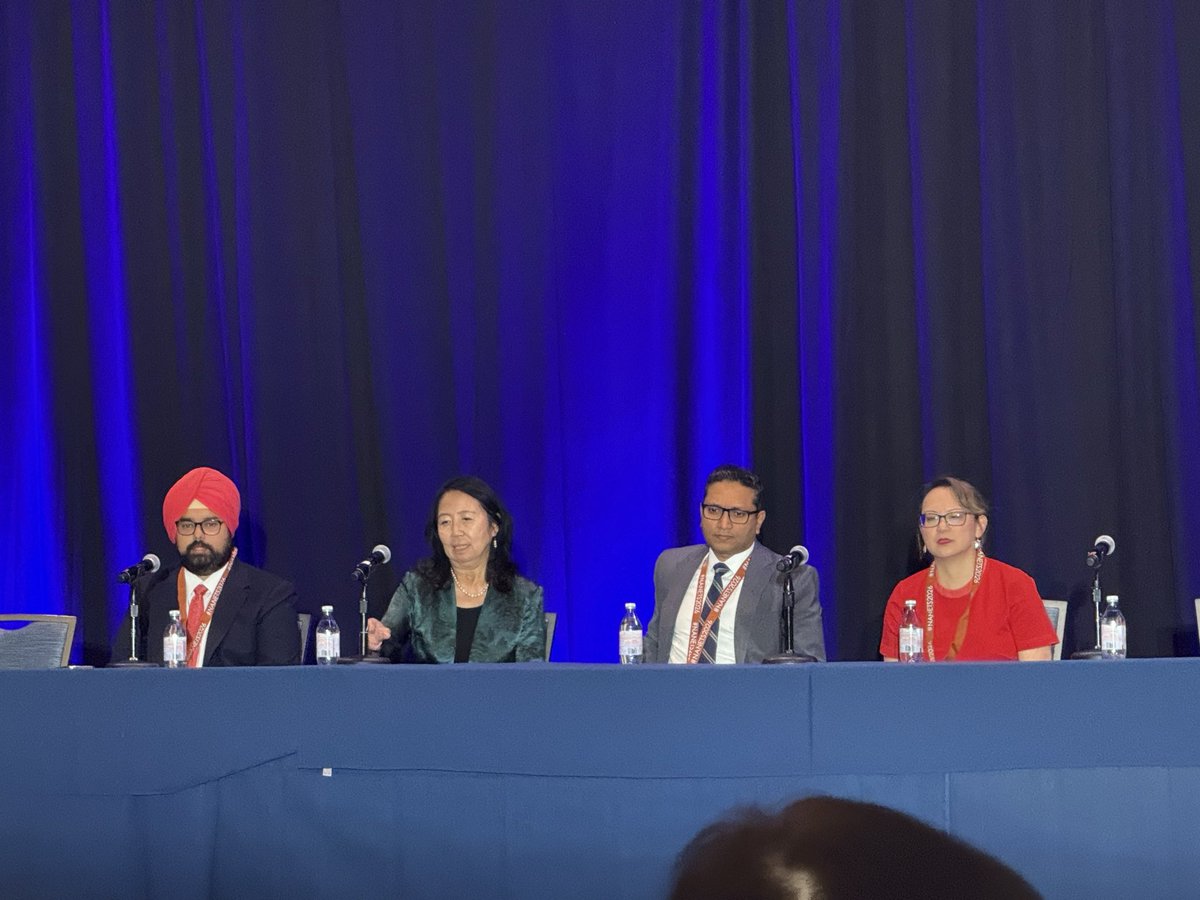
The Gut Onc Lab podcast now available on Apple Podcasts and Spotify! @GIMedOnc@TimothyJBrownMD@UGrewalMD
Spotify- https://t.co/wZUyrw8F6T
Apple- https://t.co/VUhbE7dY16
Subscribe and tune in! We’re planning to bring many thoughtful discussions to you in forthcoming episodes.
🚨 FDA approves bezuclastinib (a KIT kinase inhibitor) in combination with sunitinib for advanced gastrointestinal stromal tumors.
Based on the PEAK study- mPFS 16.5 months (95% CI: 13.8, 19.2) in the bezuclastinib plus sunitinib arm and 9.2 months (95% CI: 7.2, 11.0) in the sunitinib arm (hazard ratio 0.50 [95% CI: 0.39, 0.65]; two-sided p-value <0.0001).
- ORR 46% (95% CI: 39, 53) in the bezuclastinib plus sunitinib arm and 26% (95% CI: 20, 32) in the sunitinib arm (two-sided p-value <0.0001).
- OS not mature at the time of the PFS analysis. Cross-over was allowed. @TheGutOncLab
https://t.co/9Nuqck6SEI
New paper out (and only 1 year in review)!
Anyone that has been around me for more than about 15 minutes knows a constant refrain, Appendiceal Cancer is NOT colon cancer. Totally different diseases. Evidence is sorely needed, so we put together a database comprised of 20 years of non-metastatic patients and have shown many of the assumptions we make aren't actually true. Traditional "poor" risk factors in colon? Not at all predictive in appendiceal adenocarcinoma. Molecular and histopath tell the tale. And adjuvant chemotherapy probably isn't useful outside of select cases...
Now in JAMA Surgery. 439 patients with stage I–III disease at MD Anderson (2000–2024), plus a stage II validation cohort from MSK.
Relapse after resection is uncommon: 9.4% overall. 6% in stage II, 19.5% in stage III.
Histology does most of the work. Relapse rates:
Goblet cell 3%
Mucinous 14%
Enteric-type 17.5%
Signet ring 29%
On multivariable analysis, the independent predictors were mucinous histology (HR 5.6), enteric-type histology (HR 6.6) and pT4 (HR 3.3).
Poor differentiation, perforation, LVI and PNI didn't predict relapse. Those are the features we use to call stage II colon "high risk".
Molecular: Most important factors for recurrence. TP53 (HR 6.93) and GNAS (HR 17.0) were worst actors. The numbers are small and the CIs wide. GNAS-mutant tumors are also the ones least sensitive to 5-FU.
Critically, adjuvant chemo, showed no RFS or OS benefit after adjustment. The stage II cohort at MSK showed the same thing. The "high-risk" subsets showed no benefit either.
So next time someone says to just treat appendiceal like colon cancer, send them the paper.
@jpshen_md@acpmpresearch@OncoAlert@TheGutOncLab@Onco_Nexus
https://t.co/MOkoWmAgbH
Global Top 15 GI cancer KOLs on X, ranked by:
👉 verified physician engagement
👉with posts about GI cancer clinical trials.
👉ASCO, ESMO and ASCO GI content ranks highest
1 @arndtvogel
2 @GIMedOnc
3 @dramartinezlago
4 @CathyEngMD
5 @OncBrothers
https://t.co/CjjgF8fLkA
Thanks @KolPulseAI ; surprised people are interested in my thoughts but always excited to share the latest in GI oncology. Grateful @TheGutOncLab keeps me on track.
@Onco_Nexus
Grateful for the opportunity to record a two-part series on DLL3 and emerging landscape of DLL3-targeting therapies in extra-pulmonary neuroendocrine carcinomas for @ASCOPost
Link: https://t.co/hG1MQjbJek @WinshipAtEmory
Moving PRRT upfront: Dr. Simron Singh joins Drs. Udhayvir Grewal and Nicholas Hornstein on The Gut-Onc Lab to discuss NETTER-2, patient selection, marrow safety and what’s next for radioligand therapy.
🎧 https://t.co/VNe63rnA0i
#ESMO26 came and introduced a huge number of practicing changing data in GI Oncology.
@TheGutOncLab made some predictions before the presentations so @TimothyJBrownMD and I sat down to go over what landed, and what didn’t.
On OncoNexus now and Apple/Spotify by end of week.
https://t.co/qEuNtRT5A9
@Onco_Nexus@OncoAlert
🔥 Just out in @JAMANetworkOpen
Kudos to Manas Pustake (PGY3 IM @TexasTech) for leading this important work from our group on subsequent primary cancer diagnoses in patients with Neuroendocrine Tumors.
The overall incidence is low- but important differences in incidence and type of SPC based on age.
There is a real need to focus on survivorship in this space; especially now with a rise in the incidence of early-onset NETs. @WinshipAtEmory@TheGutOncLab@NCFCancer@CureNETs@NANETS1@GIMedOnc@TimothyJBrownMD@CShi321@SethConcorsMD
Link:https://t.co/uAlenKKNU0
Tune in to this very insightful podcast episode with renowned Neuroendocrine cancer expert Dr Simron Singh on radioligand therapy and where the field is headed. @NANETS1@GIMedOnc@UGrewalMD@TimothyJBrownMD@Onco_Nexus
https://t.co/dSRvMbaMt4
Indeed a very stimulating discussion this morning during the @ENETS_ORG /INCA @netcancerday educational webinar with Dr Nicola Fazio (ENETS Chair), Meredith Cummins (INCA President), Heather Davis @NCFCancer Dr Clement @MaastrichtUMC and others.
Thoughtful conversations regarding treatment selection, diet, palliative care and beyond. Grateful for the invitation to join. @WinshipAtEmory@TheGutOncLab
🎯 Alpha vs. beta PRRT: who gets what, and could sequencing both be the next step? Dr. Simron Singh explores the promise, patient selection questions, and toxicity trade-offs—watch the full @TheGutOncLab podcast on OncoNexus. https://t.co/zBxvrKPSeR @GIMedOnc@TimothyJBrownMD@UGrewalMD@Sunnybrook@NANETS1
Grateful to the Nichole Borchard Foundation and @NANETS1 for this incredible opportunity to develop a biomarker for DLL3-targeting therapies in high grade neuroendocrine neoplasms. I’m eternally thankful to @jberchuck for being a tireless mentor and collaborator (this is my second grant with him as a mentor). Just the beginning! Can’t wait to do good science with this project. @WinshipAtEmory
🎙️ Watch the full @TheGutOncLab episode on OncoNexus to hear why NETTER-2’s 72% lower risk of progression or death got the team talking about using radioligand therapy up front in advanced neuroendocrine tumors. @GIMedOnc@UGrewalMD@TimothyJBrownMD@NANETS1 https://t.co/zBxvrKQq4p
Anyone impacted or working with GI cancer patients should take a moment and offer some words of support to patients battling the disease. KRAS Kickers has been an awesome resource over the years and RevMed is providing significant funding to them (if people click a link and submit a few anonymous words).
@TheGutOncLab@Onco_Nexus@OncoAlert
Would you like a glimpse of the future? Where solid tumor oncology may be heading?
Look no further.
Agenus may have had some ups and downs in the past (BATMAN -> ROBBIN), but Bot Bal looks like it has the capacity to absolutely change how we manage MSS solid tumors.
UNICORN, now in Nature Medicine. Phase 2, non-randomized, window-of-opportunity. Resectable rT3-4 colon cancer. One dose of botensilimab, two doses of balstilimab, surgery around day 30-40.
Highlights:
MPR 36% (5/14) in MSS disease, pCR 29%. Omg. (compare to FOLFOX in FOxTROT: 8%)
Bot alone in MSS: 0%. The PD-1 matters.
dMMR Bot Bal: MPR 100%, pCR 93%
😍12-month EFS 100% in both Bot Bal cohorts
Yes there is tox. irAEs in 54%, mostly flu-like symptoms, and only one grade 3 (hyperthyroidism). No grade 3 diarrhea.
Every MSS responder cleared ctDNA before surgery, that’s a helpful tool for predicting response in a disease that may fibrose and stay visible on imaging.
The holy grail is almost here: melting the majority of rectal cancers away. In MSI-H we have AZUR-1. In MSS, perhaps we have this in the future.
https://t.co/5x2tbpDNDm
@OncoAlert@TheGutOncLab@Onco_Nexus
Been chewing on non-GI data. This readout is in lung but highly relevant to high grade extrapulmonary NET.
DeLLphi-305 at #ESMO26. Tarlatamab, a DLL3 x CD3 T-cell engager, added to durvalumab as 1L maintenance in extensive-stage SCLC.
Design • Phase 3, randomized, open-label, n=563 • durva + platinum/etoposide induction -> Durva + tarlatamab vs durva alone • OS primary, interim analysis
OS 21.1 vs 12.7 mo, HR 0.42 12-mo OS 79% vs 53%
ES-SCLC survival creeping from around a year, now nearly at 2 years.
DLL3 isn't a lung target, it's a neuroendocrine one. (Right @UGrewalMD ? This is your thing for sure).
Extrapulmonary NEC has the same story SCLC had: a short response to chemo, then minimal on-label options.
The catch is CRS and ICANS, so you need the infrastructure. Maintenance Tarla seem well worth the survival advantage.
@OncoAlert@TheGutOncLab@Onco_Nexus