McGonagall, Harry Potter&the Cursed Child North American Tour. VO artist. dog and puffin lover. politics junkie. expat southerner. my heart's in the highlands.
As the bulldozers roll into Big Bend to build miles of needless border walls, roads and vehicle barriers, I want to remind you just how horrific it was to spend years watching walls go up across protected public lands in Arizona.
We watched DHS bulldoze ancient saguaro cacti that were older than the border itself. They dynamited Indigenous gravesites in Organ Pipe Cactus National Monument—I was there watching the shockwaves rattle cactus arms as O'odham tribal members wept. We watched them pump up millions of gallons of precious desert groundwater, permanently altering fragile desert springs.
We can't allow this to happen to Big Bend, where DHS's own statistics say virtually nobody crosses the border. We can't let this happen to Texas' crown-jewel national park, its Congressionally protected wild and scenic river. We'll never stop fighting to save the last best place left in the borderlands.
On the 250th anniversary of the start of the American experiment, it’s worth listening to the words of a president who understood the true responsibility of public service.
To every single American who is not prepared to sit by and accept the delusions of a malignant narcissist, I ask one simple question. Can ‘We the people’ live up to the true ambitions of the Founding Fathers to reject feudalism and create a more prosperous and equitable society?
Y E S WE C A N
🎥 TikTok - https://t.co/p7P3W73Mwu
Nobody wants data centers everywhere. Nobody wants flying cars. Nobody wants a city on Mars. Nobody wants AI in every app. Nobody wants a robot butler. All we want is clean water, we want bees to survive, and we want a habitable planet.
A reflecting pool can be cleaned.
A ballroom can be repurposed.
Buildings can be rebuilt.
Signs can be taken down.
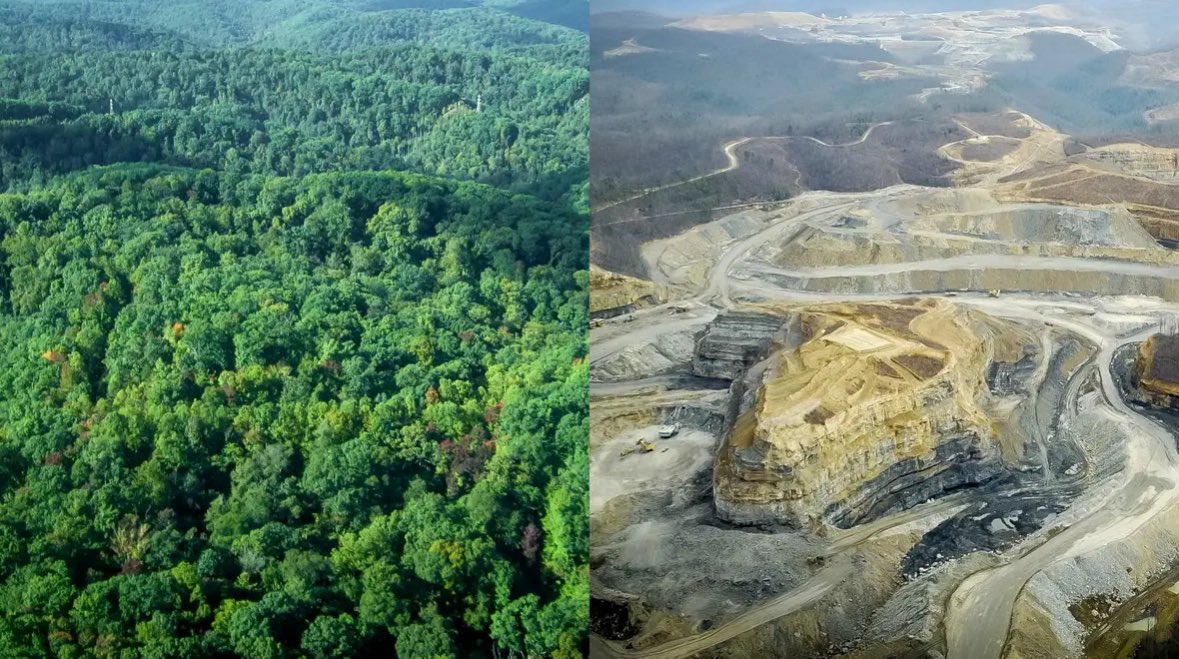
This is what MINING does to our forests. When these lands are destroyed, they're gone forever.
In yet ANOTHER unsigned court order, Trump’s Supreme Court majority just made it harder for disabled Americans to vote.
They're literally weakening protections for some of the most vulnerable people in our country.
This is voter suppression!
Across Britain right now, farmers are shearing their sheep, bagging up the wool, and burning it. Some bury it. Some leave it to rot in a corner of the field. The wool-burning has made the odd headline as a protest, but the truth is duller and sadder. The fleece is worth less than the diesel it would take to haul it to the depot.
The numbers are grim. In recent years a kilo of British wool has fetched somewhere between twenty and sixty pence, and hill breeds like Swaledale and Welsh Mountain sank as low as ten. A whole fleece off a mountain ewe might bring thirty pence. Shearing that same ewe costs the farmer around two pounds. One Lincolnshire farmer added it up out loud: over three pounds to shear and cart a single fleece to the depot, and twenty-six pence back. So she burns them. A great many do.
Here is the part that stings. The shearing still has to happen, every year, whatever the wool will fetch. A sheep left in full fleece overheats, struggles to move, and gets eaten alive by maggots. So the job carries on purely as welfare, a cost the farmer simply eats to spare the animal, with the wool itself going on the fire straight after.
And think about what this fibre once was. For centuries wool was the engine of the English economy, the country's greatest export and the crown's main source of tax. It raised the soaring wool churches of the Cotswolds. It turned merchants into princes. To this day, whoever presides over the House of Lords sits on the Woolsack, a literal cushion of wool, put there in the fourteenth century so nobody would forget where the nation's wealth began.
Prices have lifted off the floor this past year, the first real relief in a long while. It still does not cover the shears for a hill farmer. The fibre that built England now smoulders in a heap behind the barn, and almost nobody notices the smoke.
If you had told me 10 years ago that a billionaire would accuse humans of drinking too much water in 2026 because data centres need it to power the AI tech that is now threatening our entire way of life, I would have told you to write a better Bond villain, because wtf?
If we lose our bee population, the Earth basically collapses. They are responsible for pollinating about 1/3 of the food we eat. They are far more important to humans than any AI tool or data center. Save the bees NOW.
On October 1969, in a quiet advertising office in Los Angeles after midnight, Daniel Ellsberg stood alone at a Xerox machine feeding page after page of classified documents through the feeder.
Each sheet was stamped TOP SECRET. Each copy he made was a federal felony.
He was not a radical or a traitor. He was a 38-year-old former Marine Corps officer with a Harvard PhD in economics, a senior Pentagon analyst who had helped shape U.S. Vietnam policy, and one of the few civilians granted the highest security clearances in the country. He had believed in the war. He had briefed cabinet members, advised ambassadors, flown combat missions as an observer. He had seen the inside of the machine.
Then he read 7,000 pages that proved the machine had been lying for a quarter century.
The documents—later known as the Pentagon Papers—were a classified, 47-volume study commissioned by Defense Secretary Robert McNamara in 1967. They traced American involvement in Vietnam from World War II through 1968. Their central revelation was stark: four consecutive presidents—Truman, Eisenhower, Kennedy, and Johnson—had privately concluded the war was unwinnable yet continued to escalate it, sending tens of thousands of young Americans to their deaths to avoid the political cost of withdrawal.
By late 1969 more than 40,000 U.S. troops had been killed in a war the government knew it could not win. The public had been told victory was near, progress steady, the dominoes safe. The documents showed the opposite: deliberate deception, manipulated intelligence, repeated decisions to prolong a lost cause for reasons of credibility and domestic politics.
Ellsberg faced a choice: protect his career, his freedom, his family—or expose the truth that was killing thousands.
He chose truth.
Copying 7,000 pages alone at night was excruciatingly slow. Every passing headlight outside could be the FBI. Every jammed sheet risked exposure. The risk was not abstract: under the Espionage Act he could face life in federal prison.
Then Ellsberg made a decision that still stuns people who hear it.
He brought his children into the room.
His son Robert was 13. His daughter Mary was 10.
On the nights they helped, Robert ran the Xerox machine—feeding pages, collating stacks. Mary sat cross-legged on the floor with scissors, carefully cutting the words TOP SECRET off each photocopy so the duplicates would not be immediately identifiable as stolen classified material.
Years later Ellsberg explained why he involved them:
“I expected to be in prison very shortly. I wanted them to know that their father was doing something in a businesslike way—a calm, sober way—that I thought had to be done.”
He told Robert directly: this would probably put him in prison. He wanted his children to understand that conscience sometimes demands sacrifice, that doing the right thing is not always safe, and that a parent’s most important legacy is not wealth or status but the example of moral courage.
For nearly two years Ellsberg tried to act through official channels. He approached six senators and several congressmen, urging them to enter the documents into the Congressional Record so they could be published legally and protected by the Speech or Debate Clause. Every one of them declined—some out of political caution, some because they feared the legal consequences.
So in March 1971 he gave copies to The New York Times.
On June 13, 1971, the Times published the first installment. The Nixon administration reacted with fury. For the first time in American history, the federal government sought prior restraint—asking a court to block a newspaper from publishing. A federal judge issued a temporary injunction against the Times.
Ellsberg responded by giving the documents to The Washington Post. When they were blocked, to the Boston Globe. Then to more outlets. The truth spread faster than the government could contain it.
President Nixon did not merely want the leak stopped. He wanted Ellsberg destroyed.
He formed a secret White House unit nicknamed “the Plumbers,” tasked with discrediting the leaker by any means necessary. They broke into the office of Ellsberg’s psychiatrist, Dr. Lewis Fielding, searching for compromising personal material. They found nothing usable, but the break-in was a felony.
The Justice Department charged Ellsberg with espionage, theft, and conspiracy. He faced 115 years in federal prison.
The trial began in Los Angeles in 1973. Prosecutors portrayed Ellsberg as a traitor who had endangered national security. They demanded he be made an example.
Then the government’s own misconduct began to surface.
The Fielding break-in became public. Evidence of illegal wiretaps and prosecutorial overreach mounted. Most explosively, it emerged that Nixon had offered trial judge William Matthew Byrne Jr. the directorship of the FBI—while the trial was under way.
The offer was blatant judicial tampering.
On May 11, 1973, Judge Byrne dismissed all charges against Ellsberg with prejudice, citing “improper government conduct that precluded a fair trial.”
Daniel Ellsberg walked free.
The Pentagon Papers did not end the Vietnam War overnight, but they changed everything. They confirmed what millions already suspected: the government had systematically lied to the public for decades about a war that cost more than 58,000 American lives. Public opposition surged. Congress began restricting funding. The war that could not be ended politically was finally being ended by exposure.
There was one more consequence Nixon had not foreseen.
The same Plumbers unit that burgled Ellsberg’s psychiatrist later broke into the Democratic National Committee headquarters at the Watergate complex. Nixon’s obsession with destroying Daniel Ellsberg helped set in motion the scandal that destroyed his presidency.
Ellsberg did not just expose lies about Vietnam. He inadvertently helped expose corruption at the highest level of American government.
He lived to 92, dying on June 16, 2023. For the rest of his life he remained an antiwar activist, whistleblower advocate, and lecturer on government secrecy and conscience. He never regretted his decision.
His children, Robert and Mary, grew up understanding something profound: that citizenship sometimes requires courage. That doing the right thing is not always safe. That their father chose conscience over comfort, even when it meant risking prison and involving them in an act that could have cost him everything.
The Pentagon Papers did not stop the war immediately. But they changed how Americans view their government. They proved that citizens have both the right and the responsibility to demand truth from their leaders.
Today Daniel Ellsberg is remembered as one of history’s most consequential whistleblowers. The phrase “pulling an Ellsberg” entered the language as shorthand for exposing government wrongdoing at great personal risk.
But in late 1969 he was simply a man in a friend’s office at night, feeding classified pages into a Xerox machine while his 13-year-old son collated and his 10-year-old daughter cut TOP SECRET stamps off the copies.
He could have stayed silent. Kept his clearances. Protected his career and family.
Instead he handed scissors to his daughter and told her to start cutting.
Because sometimes the most patriotic act is to tell the truth—even when your government calls it treason.
If you like the dogs I share and they cheer you up daily, I’d love you to watch this one video.
I only do this once a year and never ask any other time.
You can support here and if you can’t sharing this video helps 🙏 https://t.co/Roftrb3ZWW
Land bordering Yosemite, Sequoia, and Pinnacles National Parks — now cleared for oil rigs and fracking. YES fracking!
Two hundred thousand people said NO. The federal government did it anyway.
Over 1 million acres of California public land just got opened up - land that touches ancient sequoia groves older than the country itself and sits right in Yosemite’s backyard.
Patagonia's CEO came out swinging, accusing the administration of putting oil profits over the planet's health and saying public land was never meant to be sold off to drilling companies.
And the man who'll make the final call? He was recently confirmed to run BLM after his own state party called him "an outright enemy of public lands."
Who's going to tell a tree older than the country that its time is up?
#DemsUnited
It's hard to fathom how deeply evil this is, and that we have people running our country who get sick pleasure from sending women fleeing violence in Iran to an African country in the middle of a brutal civil war.
https://t.co/JaN8z2LFI2
On a hillside this summer, a man will pay good money to take the coat off a sheep, then watch that coat earn him almost nothing at all.
This is the wool trade now. A thing his great grandfather built a life on, worn down to a chore he runs at a loss.
So look at the maths square in the face. It costs him around two pounds to shear one ewe. The fleece that comes off her, even now, in the best year for a decade, brings back about a pound and a half if she is a fine crossbred. If she is a hill sheep, a Welsh Mountain or a Swaledale, he might get thirty pence for the whole fleece. British Wool says the price would have to nearly double again just to cover the shearing.
So every sheep he clips, he loses on. And he has to clip every one.
A sheep left in her fleece overheats, cannot walk right, and gets eaten alive by maggots. The wool has to come off, for her sake, whatever it is worth. He pays, quite literally, for the privilege of being kind to his own animals.
Now feel the weight of what we have let go.
Wool once made this country rich. Whole towns were built on the back of it, and the great wool churches still standing across the Cotswolds were paid for with it. To this day the Lord Speaker of the House of Lords sits on a woolsack, set there centuries ago so nobody in the room would forget where England's wealth came from.
A fleece was worth fourteen pounds a kilo in the 1950s. The wool cheque, in his father's day, paid the rent for the year.
Today it will not cover the diesel to deliver it.
And so, in farmyards across the country, men who would rather not are quietly burning the fleeces off their own sheep, because a fire is cheaper than the trip to the depot. A material so fine that a kingdom was built on it, going up in smoke in the yard because nobody will pay a pound for it.
And what did we reach for instead. Plastic. Most of our clothes are now spun from oil, polyester and acrylic and nylon, shedding tiny threads into the sea with every wash, into the fish, into our own blood. It will not rot for generations.
So here we stand. A fibre that grows back every spring on nothing but grass and rain, that warms a child and then feeds the soil when its work is done, burning unwanted in a field.
While we dress ourselves, head to foot, in the very oil it was meant to spare us.
The sheep on that hill is still growing the finest coat in the world. We simply stopped being worthy of it.
@alexanderchard It’s what I call my “Theory of the Non-Refundable Ticket” @alexanderchard —
You have to plan the vacation and mean it!
Then the magic happens. 😂
Some thoughts on the new Epstein Files revelations:
I’ve now read everything that’s come out from the new Haberman and Swan book, and the thing I keep coming back to is the Situation Room. They held multiple meetings in the Situation Room about the Epstein files. That room is for war. It’s for national security emergencies. It is not for figuring out how to spin a scandal you’re telling the country is a hoax.
While the President was deflecting or calling this old news, his own Vice President and Chief of Staff were huddled in the most leak-proof room in America because they knew how bad it really was.
You don’t take a nothingburger to the Situation Room.
And I have to be honest, reading all this brings back a lot of frustration about what happened in the House of Representatives. I sat there and watched Mike Johnson send the House home early to dodge a vote on releasing these files. I watched him refuse to swear in a duly elected colleague for months just to stall the discharge petition. Month after month of excuses, arm twisting, and procedural games, all to keep this information from the public. We only got the files because survivors, families, and a handful of members in both parties simply refused to let it go.
So when people ask me why I talk so much about transparency and accountability, this is why. The truth eventually comes out. It always does.
The only question is whether your leaders helped reveal it or helped bury it.
Everyone who voted to keep these files hidden should have to answer for that.
Finally, notice what’s missing from all of this is any sign that Trump’s DOJ will actually investigate the powerful men named in these files.
Draw your own conclusions about why a Justice Department run by the President’s former defense lawyers might not be eager to pull that thread.
Ray Bradbury understood something most people forget: attention is not just something you spend, it is something you train. His advice was simple but disciplined — read one short story, one poem, and one essay every night for a thousand nights — because the mind gets stronger by repeated contact with concentrated language and ideas.
The deeper point is that rebuilding attention span is not about avoiding distraction for a week and calling it fixed. It is about giving your mind regular doses of depth until depth feels natural again. Bradbury’s method works because it mixes three things the brain needs: narrative, compression, and argument.
What I like about this advice is that it treats attention as a craft, not a mood. You do not rebuild it by waiting to feel focused. You rebuild it by feeding the mind better material every day, long enough for your defaults to change.
The image captures that well: attention span is not only about reading more, it is about reclaiming the ability to stay with something long enough for it to shape you. In Bradbury’s view, the real payoff is not just more focus — it is a fuller head, a richer inner world, and better raw material for thinking and writing.