they did it. the mad lads actually did it.
i never talked about my time at DOGE last year because it was so controversial and contentious (remember that?)
early last year, @jgebbia recruited a handful of his most trusted early Airbnb engineers to embed at the Office of Personnel Management to solve the "retirement paper" problem.
processing a federal retirement took months, and in the extreme retirees could wait up to 6 months for their full pension to arrive. what was the holdup? paper. remember hearing Elon talk about "the mine" in Pennsylvania? we got to visit it. in deep underground caverns blasted out of limestone, there were literally acres of file cabinets, as far as the eye could see, storing files detailing federal employees' employment and paystub history. a simple "case" might be only a quarter or half inch thick, but really complex cases filled up whole filing cabinets. one famously took up a whole pallet.
each case was hand processed by case workers in cubicles deep underground. they checked calculations, made sure forms were filled out properly (many weren't), and handled a long tail of complex issues. we'd watch as they keyed data into a black and white terminal, transmitting to the COBOL mainframe built many decades ago.
since cases were processed by hand, there were multiple rounds of human review, and additional rounds for complex cases. case files were walked around between one worker's outbox and another's inbox. sometimes it would sit in one place for days, waiting to be picked up.
to OPM's credit, they'd done multiple rounds of "digital transformation" spanning decades, so some systems were newer than others. there was a big effort in the mid-90s. but the systems were disparate, and it was a total maze getting them to talk to each other. there was a big effort to build a web app where employees applying for retirement could digitally fill out the necessary forms — just to be mailed to the mine and stuffed into the paper file. and few federal agencies were even using it.
when we arrived, OPM was midway through a fresh attempt at digital transformation, delivered by a software contractor.
the blackpill was seeing the terrible quality of the software and interacting with the contractors. coming from silicon valley, i couldn't believe how low the talent and quality bar was for selling software to the government. it's clear, as the OG USDS people explained to me a decade ago, the primary skill these vendors have is securing government contracts. it's a huge moat. delivery of quality product be damned.
we fired the vendor and took over the project. they'd been working on it for more than a year, and there was another year before they were going to deliver it. at first we tried to bend it to our will, to actually connect all the various data sources and get to a decent UX for case workers in the mine to use, but we soon realized we were going to have to rebuild the whole stack from scratch.
it was around this time I had to go back to new york — i had a new job waiting for me, a four month old, and a wife whose patience was running out. but i got to watch from afar as the team cranked day and night, hitting early milestones. and now they've fully done it.
huge congrats to Joe and the team. @yatshitcray was the hero in the trenches. indefatigable, unrelentingly optimistic, and determined to see this project through. when i recruited him for "ok i can do two, maybe three months", he stuck it out over a year making this project a reality.
while the retirement project was under the DOGE banner, it operated different from what you heard from the breathless, negative media — we came in with the attitude of partnering with career OPM employees. we were team members determined to bring our software talents to bear on the problem they've been trying to fix for years, which they hadn't had the resources to solve before. they were wary at first, not sure about us, but they quickly saw how authentic and determined we were to work together toward the same goal. props to Joe for developing those relationships, setting the example of how to collaborate together.
what's the end result? lifelong federal employees, veterans, postal carriers get their full pension installments almost immediately. days instead of months. peace of mind for these people to devoted their careers to serving our country. massively streamlined operations inside of OPM. and NO MORE PAPER 🫡🇺🇸
.@RoKhanna is a rich radical who is seeking power by any means necessary. He does not even have a basic understanding of economics and he is a dissembler who greatly misled me and others to raise funds for his campaigns.
He is not to be trusted.
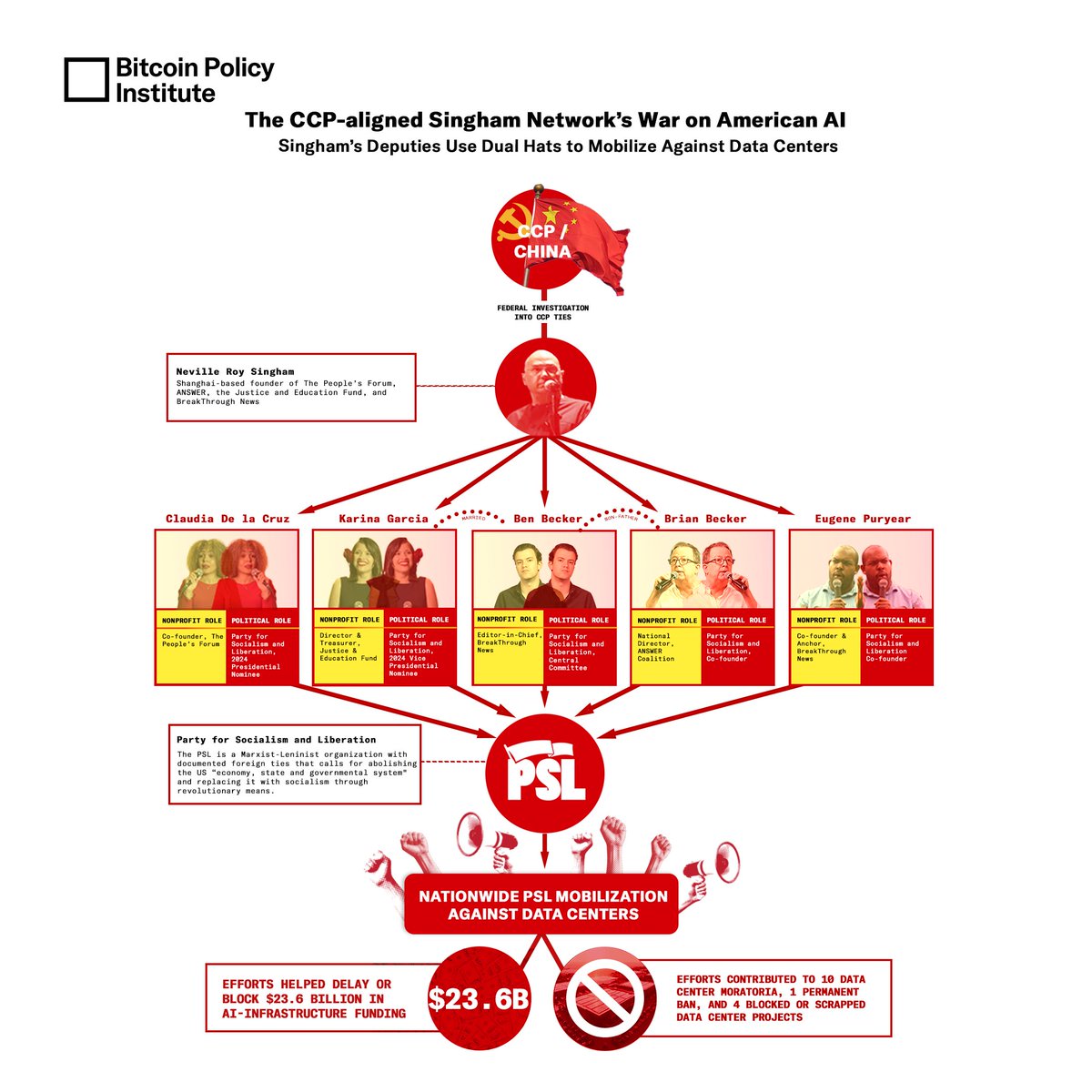
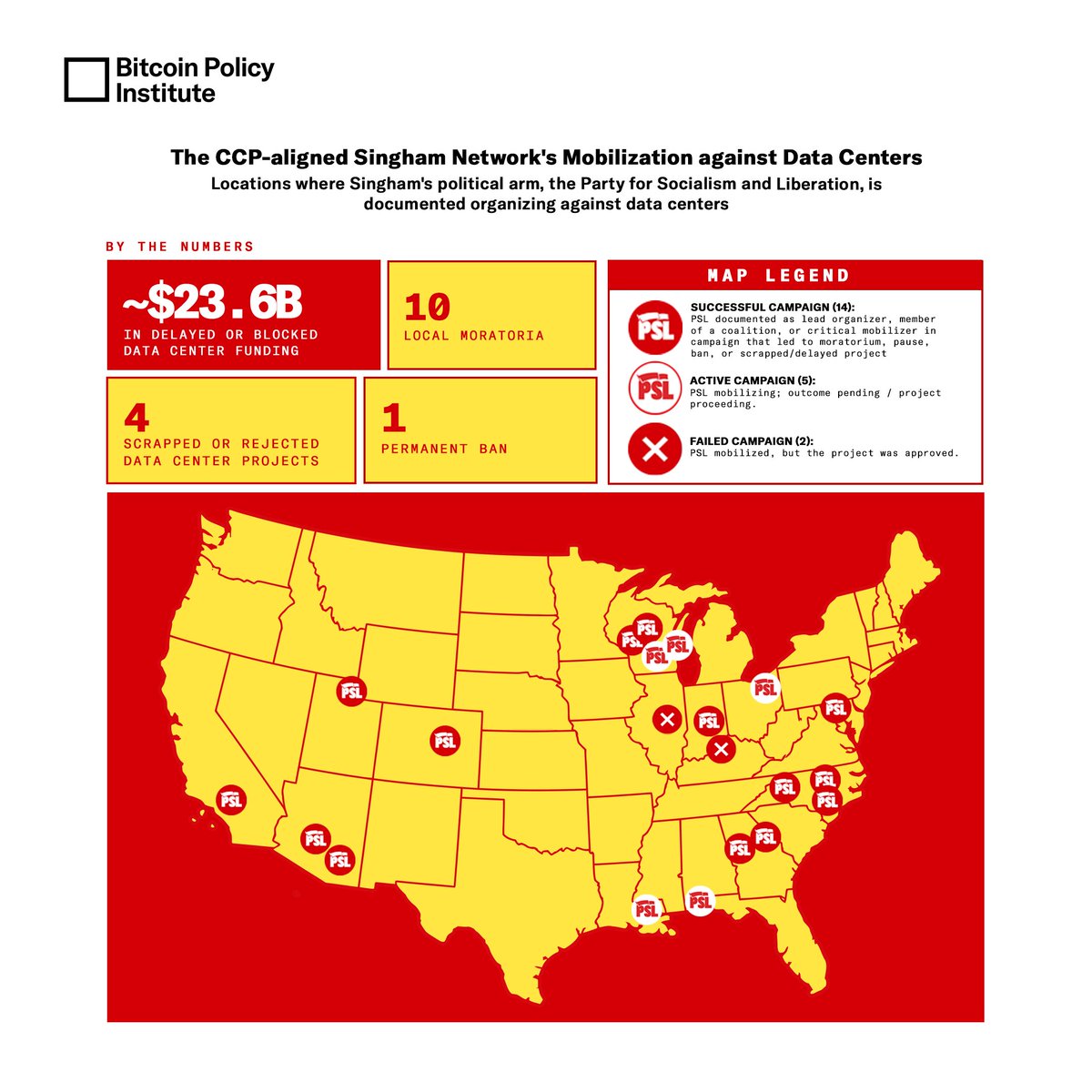
NEW: BPI research reveals that a Marxist-Leninist group with documented ties to China has been a critical mobilizer in efforts that have blocked or delayed $23.6 billion in AI investment in the US.
Its scalps include 10 data center moratoria, 1 permanent data center ban, and 4 rejected or scrapped AI projects.
In Part II of our foreign influence investigation, BPI exposes the Party for Socialism and Liberation (or PSL) as the political arm of Shanghai-based Neville Singham, and lays bare a national campaign launched by the party to stop America’s data center buildout.
Singham is the subject of multiple federal investigations into his reported ties to the CCP. Our research uncovers the anti-data-center organizing of his activist vehicle, the PSL, across 21 campaigns in 14 states, in roles ranging from lead organizer to one member of a broader coalition.
This report adds to the mounting evidence that China and its surrogates are committed to stopping America’s data center buildout so that Beijing can gain the advantage in the AI race.
HOLY SMOKES: RFK JR SAYS OBAMACARE IS RIDDLED WITH FRAUD 🚨
"We're getting $100 billion a year stolen from us because of specific policies that were adopted by the Biden White House."
WATCH THIS! 🤯
California’s proposed one-time 5% billionaire tax is being sold the way every wealth tax is sold: as a surgically precise levy on a couple of hundred people. But if American history teaches us anything it’s that a tax built for the top never stays there.
In 1913, Americans were told the brand-new federal income tax would only impact the rich. This was pitched as the ultimate tool to make the robber barons pay and started at a modest 1% on income over $3,000. It topped out at 7% on earnings over $500,000 (roughly $16 million in today's dollars).
Yet by 1944, the top rate had skyrocketed to 94%. During that same era, wartime legislation quietly introduced paycheck withholding. In just a few decades, a tax designed for a few thousand tycoons morphed into the machine that funds the entire federal government straight out of our paychecks. Rates eventually came down after the war, but the baseline ratcheted up forever. Today, the tax that was supposed to only touch the Carnegies and Vanderbilts takes a slice out of a barista’s paycheck.
Keep that history in mind this November, as Californians vote on a one-time 5% tax on the net worth of the state’s billionaires. Once again, we are hearing the same soothing promise: Don't worry, it only touches a few hundred people at the very top.
Let me be clear about what I am defending and what I am not. I am not a billionaire, nor am I carrying water for the billionaire class. I am defending entrepreneurship. I am defending the simple radical idea that any American with a good idea and a relentless work ethic can build something enormous out of nothing. That drive is the engine of our economy and a tax on net worth is a direct penalty for building that engine.
Here is what the measure actually does: it levies a one-time 5% tax on the net worth of any California resident worth more than $1 billion. It is due with 2026 tax returns and payable over five years, with a surcharge if you choose to spread it out. It targets roughly 200 to 250 individuals and is projected to raise around $100 billion, primarily earmarked for state healthcare. To make this legal, it requires amending the California Constitution, which currently caps the tax rate on this kind of intangible property.
To be fair the proposed tax excludes directly held real estate, pensions, and ordinary 401(k) accounts. In addition to cash and brokerage accounts, it could target art, collectibles, vehicles, and private business stakes above a $5 million floor. That is where the practical nightmare begins.
Who decides what a private unsold business is worth? Or a classic car? Or a private art collection? The measure would need to rely on hired appraisers and a tax-specific formula that uses book value and earnings multipliers. It sounds tidy on paper until you realize you are taxing people 5% on a number pulled out of a theoretical model with no sale, no buyer, and no actual cash changing hands.
Here is why this should matter to people who will never come within a mile of a billion dollars. For most billionaires, net worth isn't cash sitting in a checking account. It is tied up in the stock of the companies they founded. When you force a founder to raise massive amounts of real cash against an illiquid fortune, the cleanest way to do it is to sell shares. This forced selling of the mega-cap companies that anchor every index fund doesn't just politely shrink a billionaire's brokerage statement. It actively depresses the value of the exact same stocks sitting in your retirement account and your pension.
When a tax becomes too punitive, the targets simply leave. France ran this exact experiment with an annual wealth tax. As the threshold drifted down to around 1.3 million euros, tens of thousands of millionaires fled the country. In 2017, President Emmanuel Macron was forced to gut it, narrowing it to a real estate tax after watching the nation's capital walk out the door.
You don’t even have to look across the Atlantic; it is already happening here, before the tax has even passed. Billionaires like Peter Thiel @peterthiel , Larry Page, and Sergey Brin have reportedly relocated ahead of the residency cutoff. That doesn’t even include the long list of individuals and companies who left California over the past several years, including Oracle, Tesla, and Chevron.
The most damning indictment of the tax, however, comes from Governor Gavin Newsom @GavinNewsom. Despite calling for a national billionaire tax, Newsom admitted he will personally vote "no" on California's version. His reasoning is exactly what I just laid out: “Capital flows and moves. When the governor pushing for wealth taxes won't sign off on his own state's version because he knows the targets will just leave, it tells you everything you need to know about how this works in practice.
Watch how fast the goalposts are already shifting. California's measure is pitched as a "one-time" 5% tax. Yet the national bill proposed by Ro Khanna @RoKhanna and Bernie Sanders @BernieSanders is an annual 5% wealth tax. Governor Newsom's national plan drops the threshold to $100 million. One-time becomes annual. Billionaires become nine-figure millionaires. Does anyone seriously believe it stops at $100 million? Or $10 million? No tax in American history has ever stayed where it started, and the people writing these proposals are telling you out loud that they intend to keep going.
We once fought a war over this principle. The slogan "no taxation without representation" didn't come from nowhere. The Stamp Act of 1765 was the first direct internal tax Britain tried to impose on the colonies. The colonists objection wasn't merely the rate on paper and playing cards, it was the principal. They declared that no tax could be imposed on free people without their consent. That fight rolled forward to the Boston Tea Party, and from there to a revolution.
Here is the bottom line. The people this tax targets played inside the lines of a tax code they did not write. If those lines are too generous, rewrite the tax code in the open where voters can see it. A net worth tax is unlikely to remain as a tax on the wealthiest Americans.
We need to stop treating the people who risked everything to build something as the villains of the American story. They created jobs and built the companies sitting in your index funds. The lesson we should pass to the next generation isn't that once success crosses an arbitrary line it should be clawed back. The lesson must remain that if you outwork everyone and never give up that anything is still possible in this country. That is the engine worth protecting.
I would love to continue this conversation because it's worth discussing. Why do so many people want to penalize success instead of celebrate it?
@PBDsPodcast@Jason@friedberg@DavidSacks@bgurley@BillAckman@chamath@GavinSBaker@Scaramucci@elonmusk
@JimPethokoukis@arxiv My assumption is rate increases are driven by use of more expensive renewable and shutting down cheaper coal fired plants. Energy is largely a commodity and should get cheaper over time, not more expensive.
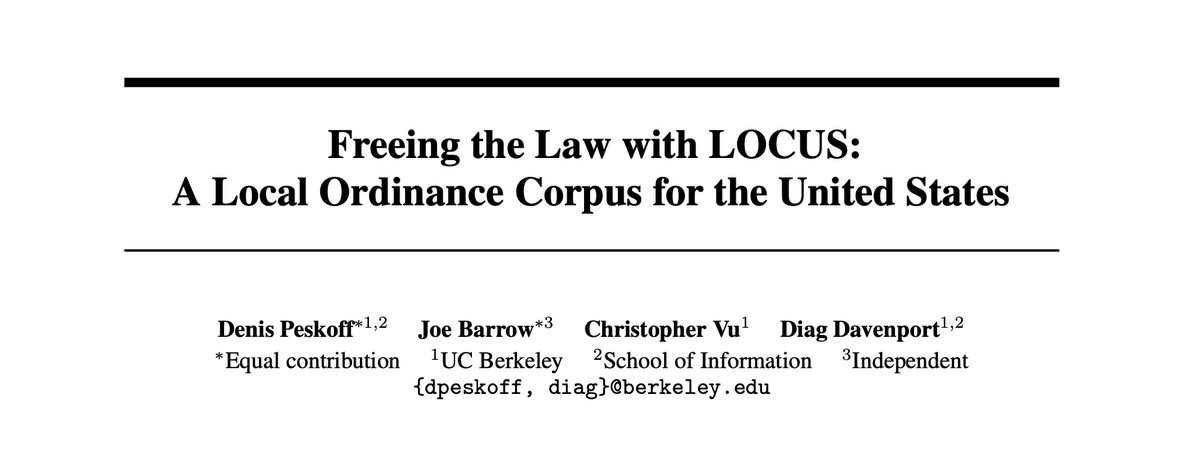
New paper: every law in America is technically public. But not really, until now!
With @DenisPeskoff at UC Berkeley, we built a corpus of ~every publicly accessibly city and county law, and released a huge chunk of it!
2.2 million laws, you're (probably) covered in it!
🧵
The great lie is that society is divided between rich and poor.
The great truth, as David Friedberg puts it, is makers vs takers.
Makers build, create, and deliver real value: houses, software, art, businesses, and everything that moves civilization forward.
Takers watch, criticize, analyze, and politic. They push the lie that the rich hoard unfairly so the poor must seize it… all while positioning themselves to rule the chaos.
As @friedberg tells his kids: “At the end of the day, if you made something and someone else valued it, you were a maker. That was an amazing achievement. That is a great day.”
Takers thrive on division. Makers drive progress.
Time to choose your side.