BREAKING NEWS
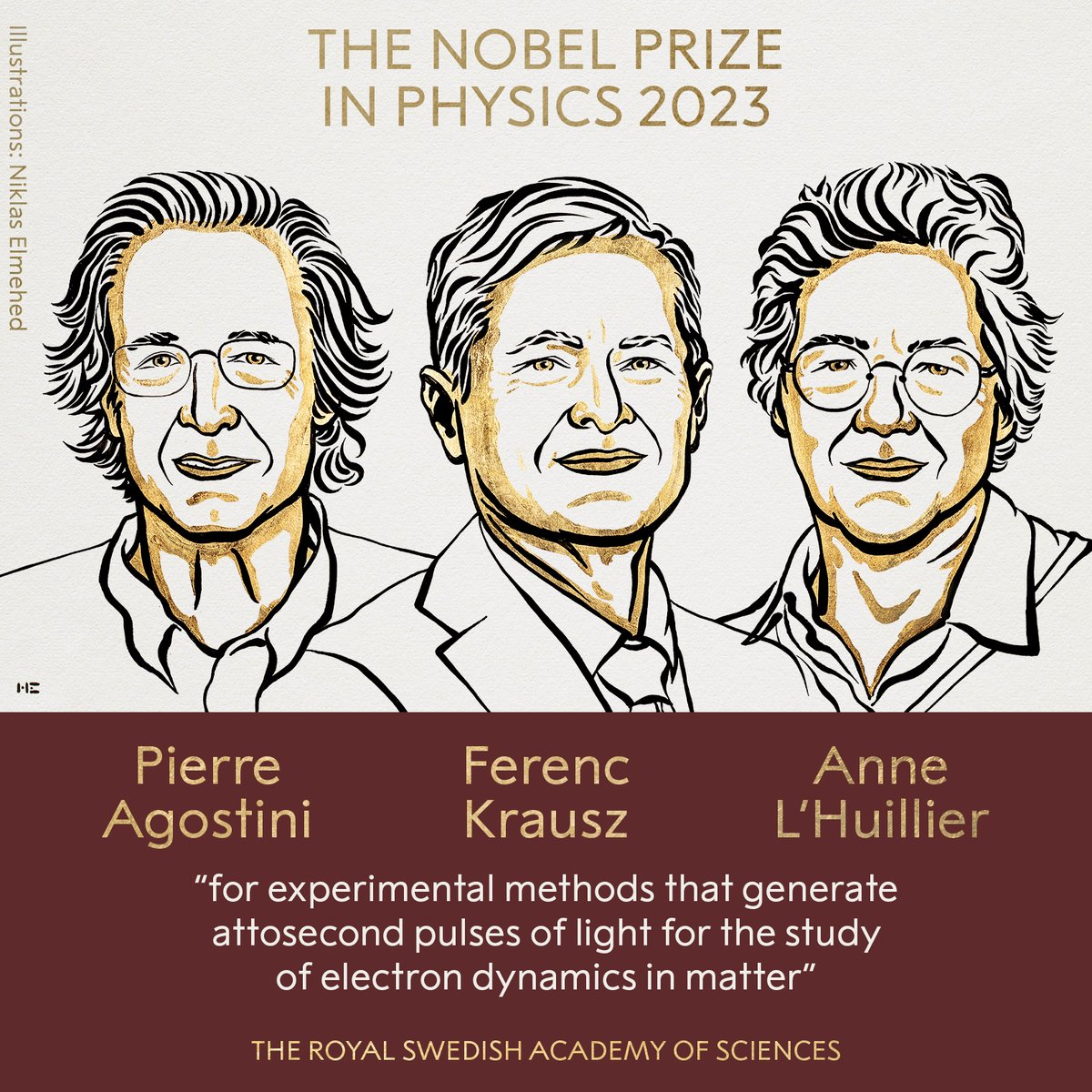
The Royal Swedish Academy of Sciences has decided to award the 2023 #NobelPrize in Physics to Pierre Agostini, Ferenc Krausz and Anne L’Huillier “for experimental methods that generate attosecond pulses of light for the study of electron dynamics in matter.”
Caroline Piaulet, an amazing PhD student at @iExoplanets started a non-profit to offer kids from underrepresented communities the opportunity to pursue research with a mentor. She is currently crowdfunding to provide more opportunities for the next cohort https://t.co/6OeCS1ietP
Final published version describing the current flavor of our PICASO radiative-convective equilibrium model by @smastrophysics @NatashaBatalha@jjfplanet and me. Descendant of model I started working on in 1990. https://t.co/RqukNwhgdO
Words cannot express the excitement of the first detection of sulfur in an exoplanet atmosphere. What makes it even more interesting is it exists in an oxidized form SO2 (sulfur dioxide) in a reducing, H2-atmosphere of the hot Jupiter #WASP39b seen by #JWST.
3) The first detection of sulfur dioxide (SO2), a molecule produced from chemical reactions triggered by high-energy light from the planet’s parent star. On Earth, the protective ozone layer in the upper atmosphere is created in a similar way.
📷NASA/JPL-Caltech/Robert Hurt
The #JWST Transiting Exoplanet Early Release Science Team is excited to share the latest science results from observations of the exoplanet #WASP39b, described in 5 papers released this morning. 🧵
https://t.co/d1aYCgNMzn
📷Melissa Weiss/CfA
Plenty of others are covering this result in detail, so I'll give you my key takeaways.
1) JWST's transit spectra are every bit as exquisite as we had hoped, if not more so. We are going to learn so much from this incredible feat of engineering, a testament to everyone involved.
Proud and privileged to be a very small cog in a very big wheel for this result. I and the other modellers get to play in earnest in subsequent papers! Being part of this team has been so much fun over the last few months and I can't wait for the next instalments.
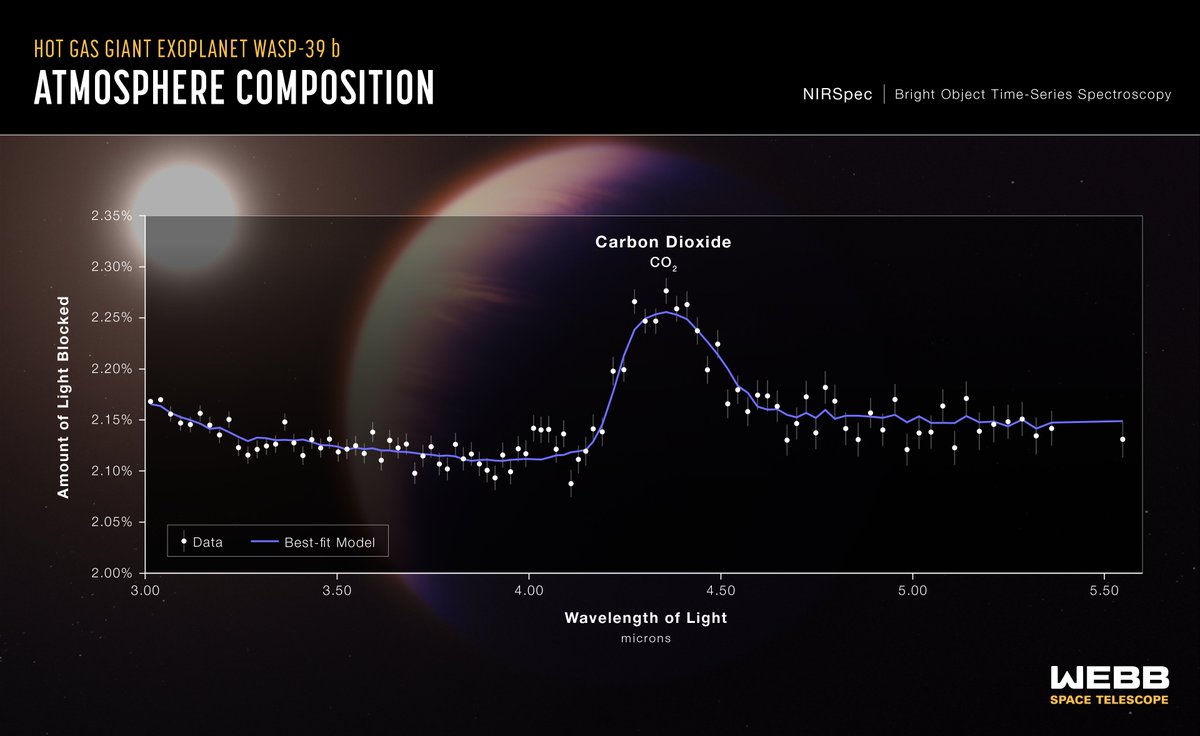
Our JWST Transiting Exoplanet Early Release Science Team is proud to report on the detection of Carbon Dioxide in the atmosphere of the exoplanet WASP-39b. Press release and a thread 🧵 ...
https://t.co/XpAxZMg4PG
Summary: We suggest NH3 and CH3OH as the most useful surface-signatures in the context of utilizing JWST to distinguish temperate super-Earths and mini-Neptunes (~1.6-3.5R⊕) with H2-atmospheres (1/5).
Our ApJL paper: https://t.co/C3IfXuQATs is inspired by the neat work by Yu et al. 2021 (https://t.co/I1ID4kchnE). Given the challenges to directly observing the planet's surface and the degeneracies in M-R, we revisit the idea of identifying the "surface-signature" molecules. 🧵: