User privacy is an ultra-meta that will never go away in modern society
We need ways ensure users have security when they need it PLUS privacy when they want it.
That's core to what we build at @MASQ_ai
And ALL privacy & dVPN tech deserves support!
We're partnering with @partylayerkit to improve wallet connectivity across the @CantonNetwork ecosystem.
PartyLayer's wallet aggregation layer allows applications to support multiple wallets through a single integration, with Send Connect included as a supported wallet.
For users, that means easier access to Canton applications.
For developers, it means less wallet infrastructure to build and maintain.
Together, we're reducing friction across the network.
I’ll give a high-level explanation, and happy to point to more formal resources if you want.
Since you’re coming from the Zcash perspective, it’s worth noting that Canton’s privacy and integrity guarantees differ because they address a different problem. Zcash aims to fulfill Satoshi’s vision of an encrypted Bitcoin, and ZKPs are really the only practical way to achieve that combination of censorship resistance, public verifiability, and issuer-less assets.
The key insight behind Canton is that in almost all real-world use cases, you don’t need public verification. If you assume that every asset has an issuer (an assumption Zcash can’t make by design), you can achieve strong privacy in much simpler and more efficient ways, without the usability, performance, and integrity-bug blast-radius tradeoffs that come with ZKPs. Credit to the Zcash community for being open about these tradeoffs and constantly improving them.
In Canton, the issuer (more precisely, the registrar) can be centralized or decentralized, but you don’t get privacy from that issuer. That’s intentional: my bank should know my balance, my custodian should know my holdings, but the public should not. If someone wanted privacy even from the issuer, that’s where ZKPs would come in. It’s technically straightforward to integrate into Canton, but so far there has been no demand for it.
Here’s how Canton achieves privacy. Canton's privacy works on a strict 'need-to-know' basis. Every smart contract explicitly lists the finite set of parties who are entitled to see it. Like Zcash, Canton uses a UTXO-style model rather than accounts, so the ledger state is a collection of contract instances (UTXOs), and each participant only sees the subset they are part of. Once you have selective disclosure at the data model level, consensus becomes much simpler. Canton essentially performs a two-phase commit among all stakeholders of a transaction, where each participant only sees the parts they are authorized to view.
To go a bit deeper, Canton has formal definitions of the contract language and abstract ledger model, which make privacy a composable property of the system. Each transaction can contain multiple sub-transactions, and each sub-transaction can have its own visibility set. Parties involved in one part of a transaction can see only what they’re entitled to, while still participating in a larger atomic operation that spans others. So, for example, we can swap cash for an asset, and our banks will only see the cash leg while our custodians only see the asset leg. When we first created the language and ledger model, I still assumed we would use ZKPs for consensus. Because of that, Canton’s smart contract language actually provides an excellent high-level abstraction for a ZKP-based system, if anyone ever wants to build that layer. All of these formal definitions are in the open-source repository. Because of these abstractions, we were able to make Canton’s consensus Byzantine fault-tolerant while relatively simple, at least for a single synchronizer (which orders transactions without seeing their contents). Canton can also scale horizontally across multiple synchronizers, but that’s a separate topic.
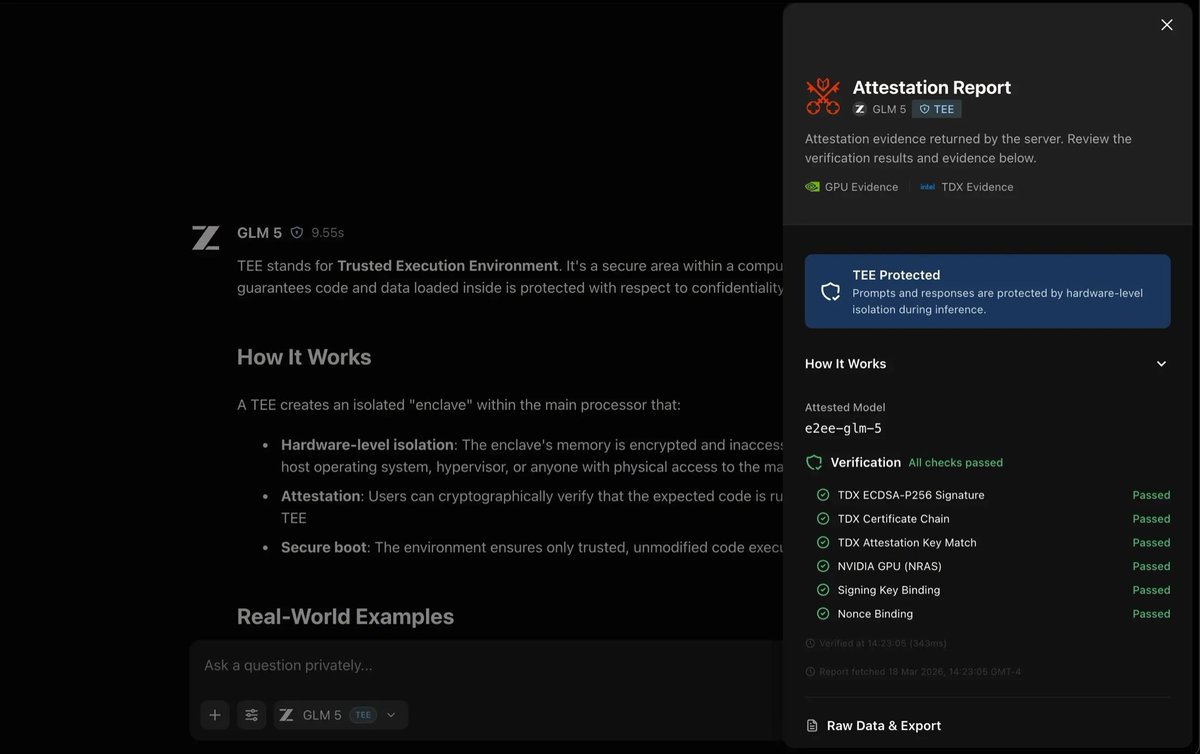
This is what NEAR AI private inference looks like in production.
An @AskVenice ($VVV) user selects a TEE model, sends a prompt, and receives a hardware-signed attestation report. Six cryptographic checks passed and verified in 343ms.
Sure, just share repo access to the gbrain source.
Gbrain is made to keep the brain source git tracked and can be accessed by other machines, agents or harnesses as you like.
Cron jobs can make sure it commits any changed to the brain source (and you can use gitignore for Privacy in certain folders/files)
Each machine can also have its own pglite db for embedding graph links for rich semantic search
Search nobody owns. A browser that doesn't track you. One free trial.
@Timpi_TheNewWay is your default search.
Your MASQ account runs silently in the background.
Nothing extra to set up.
7 days free 👇
Try it here:
https://t.co/ZGgBOewZpB
Something we've been building toward is now live.
The Timpi Ad Portal is open. The $NTMPI buyback mechanism is activated.
This isn't just a product update. It's the moment Timpi becomes starts its journey of being a self-sustaining engine, where real revenue flows back into the ecosystem and directly rewards the community that built it.
You stuck around. You searched. You believed in this before it was easy to.
This one's for you.
Full breakdown - https://t.co/6J41A0Ph1w
Big Tech gives you search. Big Tech gives you a browser. Big Tech gives you connectivity.
Then uses all three to track everything you do.
MASQ × Timpi flips that.
Search. Browser. VPN. One privacy stack. No surveillance. No compromise.
This is what it was always supposed to look like.
Download MASQ > https://t.co/KqAUZrdZNo
@gdb@ycombinator Don't worry - the smart, user centric ones will ask @ErikVoorhees for some credits at @AskVenice, to shield their users' data and build in a way that respects their consumer base beyond services rendered.
Very nice and certainly helps confirm some things Ive been self-teaching on the same stuff!
One question for ya - i started out using Ollama rather than llama.cpp
Mainly since i can directly dowbload desired models from CLI, use it from tray and chat directly with the local models (on my RTX 5070Ti 12GB) in the app for testing.
Would you recommend llama.cpp for less cpu/ram overhead compared to Ollama?
A first just happened in DeFi history.
The first PRIVATE decentralized stablecoin minting on @ethereum just executed.
Complete capital freedom: borrow against your assets with zero on-chain trace linking back to you.
I talked about this vision weeks ago on a space with @jchaskin22 from @ethereumfndn.
Now it's real: https://t.co/hKmPo0mSNv