Prof. Mitali Mukerji Ji (Professor in the Department of Bioscience and Bioengineering at IIT Jodhpur) sent me a paper a few days ago and I have not stopped thinking about it.
Her team found that a meditation retreat and a sleeping pill leave a similar mark in the blood.
Let me explain, because it took me a while to absorb...
Her IIT Jodhpur team had blood gene-activity data from 106 people who went through an Inner Engineering meditation program. Samples were taken before the preparation began, after 8 weeks of preparation, after the 8 day retreat, and 3 months later.
Most of us would ask the usual question: did meditation reduce stress?
They asked something else entirely.....
They took this data to the Connectivity Map, a giant library that records how about 5,000 drugs change gene activity in human cells. And they asked: which drug footprints does the meditation footprint resemble?
The answer is 438.
Read that again. Four hundred and thirty eight.
And where did the matches keep pointing? The brain. One pathway showed up at every single stage: the neuroactive ligand-receptor pathway, the wiring through which chemical signals speak to our nerve cells.
But here is the part that stuck me the most.
The most striking single match was zolpidem, a common sleeping pill. The gene pattern of the retreat phase resembled a drug that works through GABA, the brain's main braking system. Deep meditation, a practice with no pill involved, left an echo of a sedative's signature in the blood.
And the story kept changing with the stage. Preparation resembled dopamine and reward-related drugs. The retreat itself, GABA and calcium-channel modulators. Three months later, GABA together with dopamine and serotonin, the molecules of motivation and mood.
One more detail I cannot stop thinking about. The 106 people did not all respond the same way. Their molecular responses split into 2 clear groups, with completely different drug matches.
Meditation is not one medicine. It behaves like a personal one.
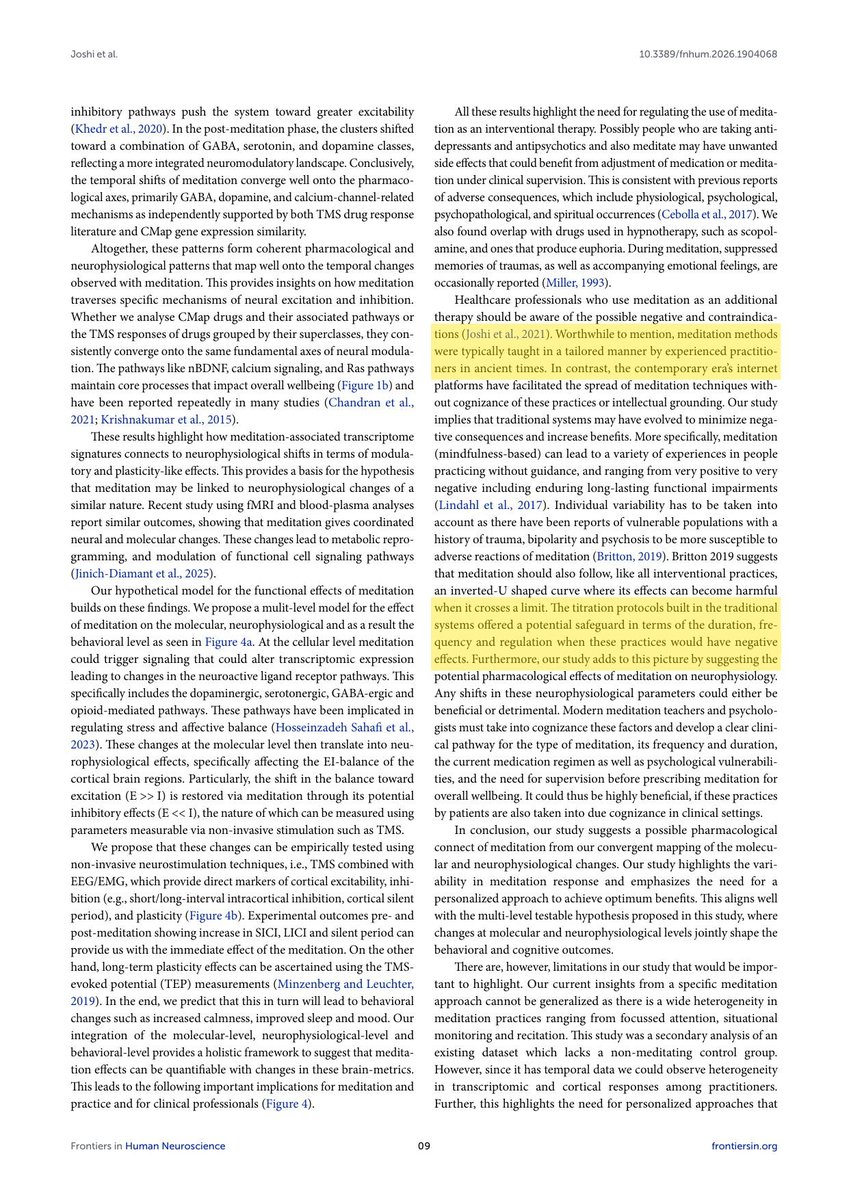
Which is exactly how our traditions always taught it. The paper notes that ancient teachers never taught meditation the same way to everyone; they tailored it to the student.
The authors suggest these systems evolved as safeguards, because a practice that touches the same pathways as psychiatric medicines needs care, especially for people already on antidepressants or antipsychotics.
Thank you, Mitali ma'am, for sharing this with me. 🙏🙏
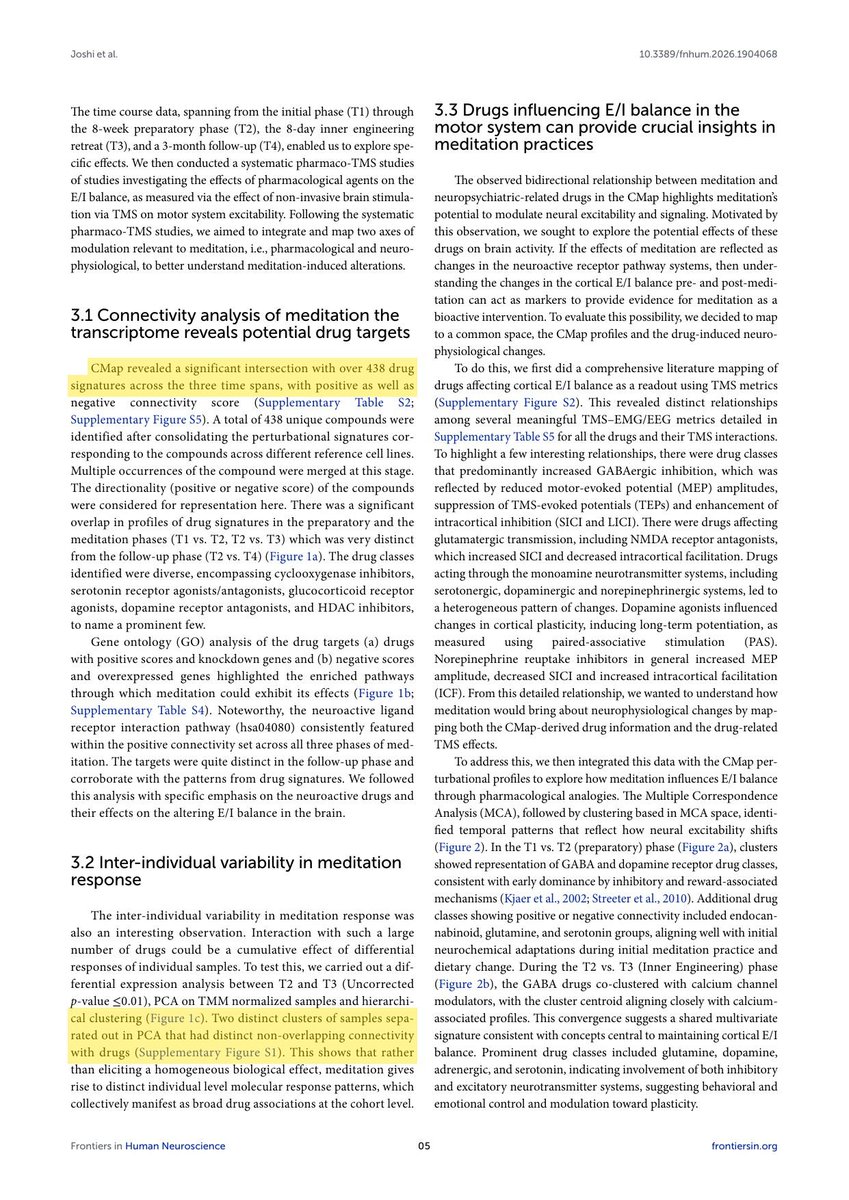
The images below are figures from the paper itself. I am waiting to see what this team does next.
Source: Joshi, Muralidharan, Patel and Mukerji, Frontiers in Human Neuroscience, 2026
Photo 1: All 438 matches, pathway heatmap, two response groups
Photo 2: Stage by stage drug-class map
Photo 3: Page 7, zolpidem line highlighted
Photo 4: Page 5, 438 drugs and the two response clusters highlighted
Photo 5: Page 9, tailored teaching and titration safeguard highlighted
He came home after 12 years with all the Vedas memorised, head high. His father asked him one question, and he had no answer.
So Uddalaka taught him with a banyan seed broken down to nothing, and a pinch of salt that vanished in water but was in every sip. Then he turned both lessons on his son. Three words people still quote today 🌳
📜 Source: Chandogya Upanishad 6.1 to 6.13 (Nikhilananda's translation).
Dev Patel, Lara Raj, Meera Nair...all these NRI folks just view India & Indians from the same lenses of westeners. ...they use their Indian Heritage as Schtick to show there is something "unique" about them...when in reality they are JUST white people in brown skin.
I have no problem with modernity, but Diwali party is something I genuinely hate.
People have completely changed the meaning of festivals. Diwali is an auspicious festival to do Lakshmi Pujan, spend time with family and friends.
But instead you choose to drink alcohol, dance and party. Seriously ? Is this what Diwali has become?
There is a difference between being modern and forgetting your own culture and traditions. Every festival doesn’t need alcohol, loud music and a party. Sometimes, it’s better to understand the meaning of a festival before celebrating it.
James Gunn addresses his departure as co-CEO of DC Studios:
“I will miss the people around me, and I will miss being the co-caretaker of these great characters, but I’m also incredibly relieved and excited to get back to pure filmmaking.”
Listen to Tavleen Singh exposing Sonia Gandhi and the Lavasa smart city project, promoted by industrialist Ajit Gulabchand.
How many opportunities for India’s progress were lost during Congress regime And who was accountable?
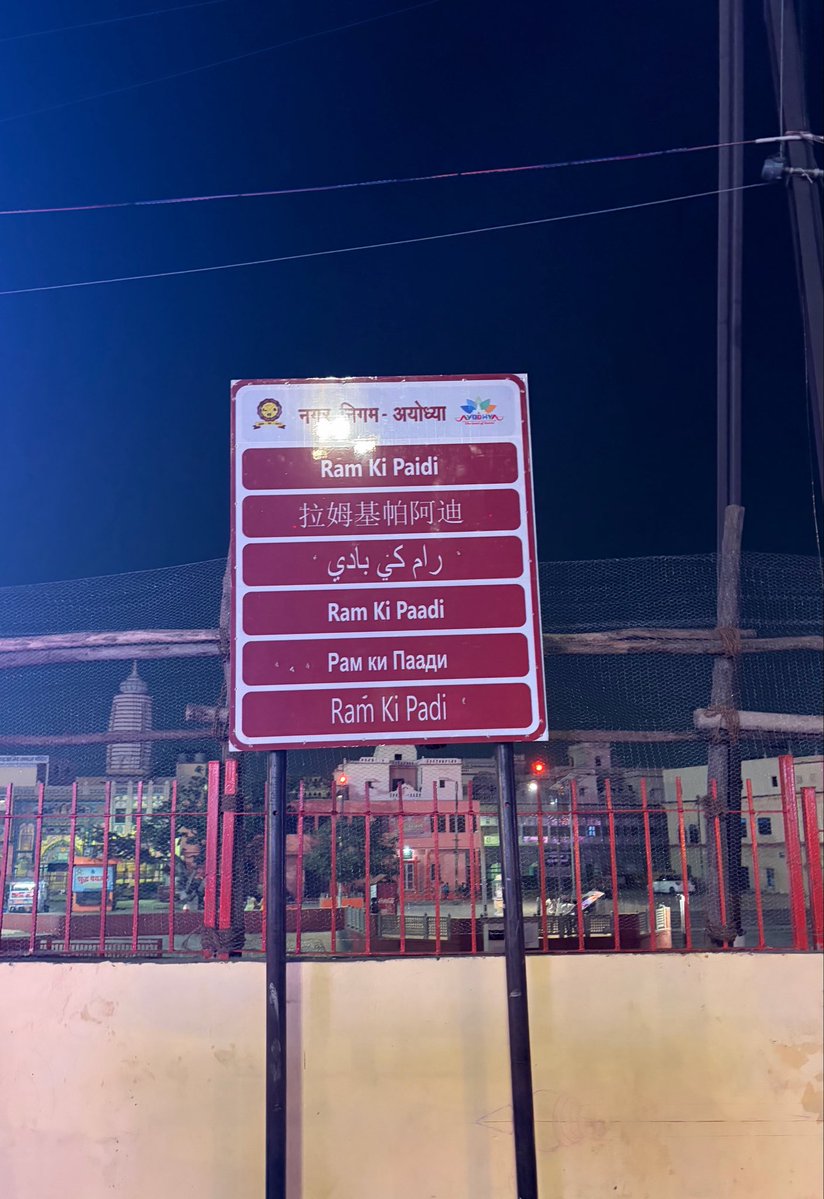
🚨 Road signs in Ayodhya feature six foreign languages and 22 Indian languages.
South Indian CMs, take notes from Yogi. Your job is to make roads easier to navigate not turn every signboard into a political battlefield. 🙏
"Speed is the asset of the horse; the majestic walk is the glory of the elephant; wit is the ornament of a woman; being industrious the pride of man"
- Sanskrit Subhashita (Subhashita Ratna Bhandagara)
NOAKHALI MASSACRE, 1946: THE KOJAGORI LOKHKHI PUJA THAT TURNED INTO A NIGHTMARE FOR BENGALI HINDUS
Today is Kojagori Lokhkhi Puja, one of the most sacred and emotionally significant days for us Bengali Hindus.
Eighty years ago, on this very festival, our ancestors in Noakhali, East Bengal (now Bangladesh), were massacred.
The Noakhali Massacre began on 10 October 1946, the day of Kojagori Lakshmi Puja.
I do not commemorate Noakhali on 10 October every year. For me, its anniversary is Kojagori Lokhkhi Puja itself.
It was on this sacred day that Muslim mobs unleashed violence against Hindu villages.
Hindus were murdered, women raped and abducted, houses looted and burned, temples desecrated, and people forcibly converted to Islam.
The violence spread across Noakhali and neighbouring Tippera (now Comilla).
Golam Sarwar, a former Muslim League legislator, emerged as one of the principal instigators.
Entire villages were devastated. Thousands fled their ancestral homes. Contemporary reports described mass conversions, sexual violence, killings and widespread destruction.
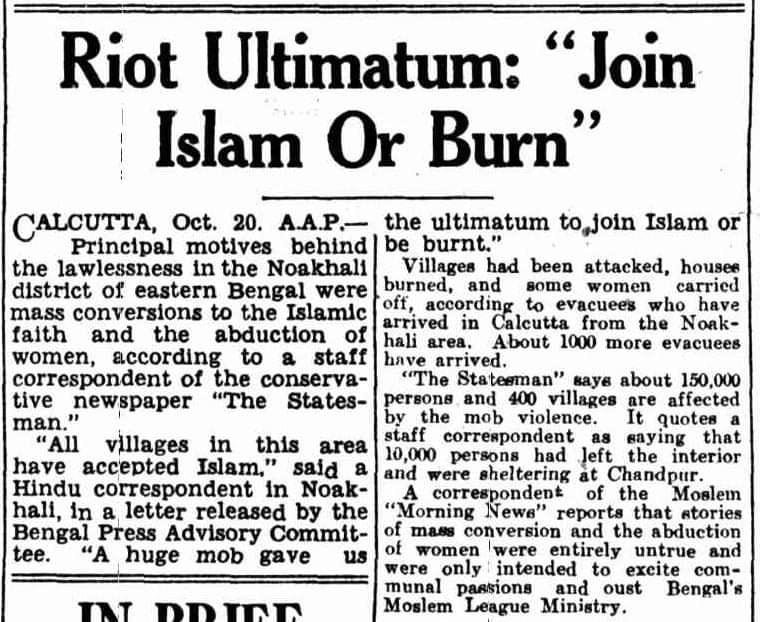
1. “RIOT ULTIMATUM: JOIN ISLAM OR BURN”
OUR ANCESTORS, TOO, HAD THEIR RALIV, GALIV YA CHALIV MOMENT IN HISTORY.
An Associated Press report dated 20 Oct 1946, citing The Statesman, described mass conversions to Islam and the abduction of Hindu women.
The report stated that approximately 150,000 people across 400 villages had been affected by the violence.
It quoted a Hindu correspondent from Noakhali describing an ultimatum from a mob to convert to Islam or be burned.
2. THE TELEGRAM FROM NOAKHALI
A telegram dated 17 Oct 1946, sent from Chaumuhani to the Bengal Provincial Congress Committee, reported that murder, looting, arson and forced conversions were continuing.
It warned:
“Unconverted people are being slaughtered on mass scale.”
The telegram also reported starvation and the failure of local authorities to provide protection, demanding immediate military intervention.
3. GANDHI AND THE WOMEN OF NOAKHALI
On 18 Oct 1946, after being informed of the atrocities, Gandhi spoke about the plight of women in Noakhali.
Gandhi suggesting that self immolation by taking poison was preferable to surrendering to dishonour.
4. WOMEN CHOSE DEATH OVER SEXUAL VIOLENCE & DISHONOUR
In 1946: The Great Calcutta Killings and Noakhali Genocide, Dr. Dinesh Chandra Sinha and Ashok Dasgupta reproduce these statements on page 266.
The book also quotes the Hindusthan Standard, which reported that women in Noakhali, desperate to escape sexual violence, had jumped into fires, taken poison or hanged themselves.
Gandhi visited Noakhali in Nov 1946 and undertook his peace mission. But the killings, forced conversions, displacement and trauma had already devastated Hindu communities.
5. “QUIT NOAKHALI OR DIE, GANDHI WARNS HINDUS”
Even six months later, on 8 April 1947, The New York Times published a report under this headline.
It described continuing threats against Hindus, including attempts to burn them alive.
The terror had not simply disappeared.
6. THE HUMAN REMAINS OF NOAKHALI
One of the photographs attached to this post shows human skeletal remains in Noakhali following the communal violence.
It is preserved in the Bridgeman Images archive, sourced from Dinodia, with the description:
“A human skeleton at Noakhali East Bengal after the riots between Hindus and Muslims, November 1946.”
Archive reference: DND2561152.
This is not an illustration. It is an archival photograph documenting the aftermath of the violence.
For Bengali Hindus, Noakhali was not simply another communal riot. It was an assault on their lives, their faith, their women, their homes and their right to exist in their ancestral land.
And the timing makes it particularly painful.
Kojagori Lokhkhi Puja is the night when Bengali Hindu families worship Maa Lakshmi, light their homes and pray for peace, prosperity and the well being of their loved ones.
NOAKHALI, 1946. NEVER FORGET.
I saw a post on Reddit that said, “When you walk through a museum, you’re not just looking at art. You’re moving through centuries of people trying to explain love, grief, power, beauty, and belonging.” I don’t think I’ve ever seen a museum described so beautifully.
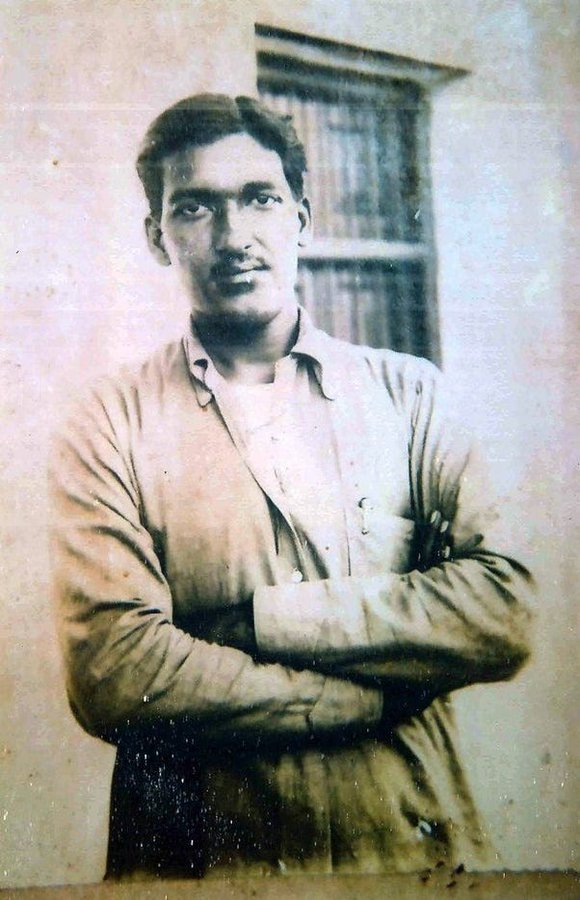
Today is Jayanti of Ashfaqullah Khan, one of the 4 convicted and hanged to death for his role in Kakori conspiracy along with Ram Prasad Bismil, Thakur Roshan Singh and Rajendra Lahiri.
Born on Oct 22, 1900 in Shahjahanpur into a well to do family, he was introduced to Bismil’s poetry, through his elder brother Riyasatullah, who happened to be his classmate.
The poetry of Bismil, so impressed Ashfaq, that he wanted to meet him as soon as he could. However Ram Prasad was absconding then for his involvement in the Mainpuri conspiracy.
When Ram Prasad came back to Shahjahanpur in 1920, that was the time Ashfaq got a chance to meet him.
Though he tried meeting Bismil many a time earlier, he could not. However one evening when Bismil was at the river,in a meeting with other friends, Ashfaq did manage to meet him.
Ram Prasad asked Ashfaq to meet him at Arya Samaj. The principles of the Arya Samaj had a deep impact on Ram Prasad, which was not to the liking of his father. He even ran away from home after an argument with his father, and was later bought back by his father’s friends.
Ashfaq advised Bismil that along with their revolutionary activities, they should also be part of Congress party. Many youngsters of Shahjahanpur too joined the Congress. Bismil along with Ashfaqullah and another freedom fighter Prem Kishen Khanna joined the Congress in 1921.
In 1921, Mahatma Gandhi called off the Non Cooperation movement and it gave an impetus to the revolutionary movement. This decision split the Congress into two groups, one headed by Gandhi, another by Chittaranjan Das.
Around this time some of the youth of Bengal, requested Bismil to start a new party. His fame had already spread wide, due to his involvement in the Mainpuri conspiracy. However Bismil, was busy with his silk weaving factory, and felt he would not be able to devote time to it.
It was Ashfaqullah again who convinced him to do so, and assured him of all cooperation. Bismil went to Allahabad in 1923, and drafted the constitution of the new party along with Sachindranath Sanyal and Dr.Jadugopal Mukherjee.
On 3 Oct 1924, the Hindustan Republican Association was founded in Kanpur, with Sanyal as the Chairman and Bismil as the District in charge for Shahjahanpur, he was also in charge of the Arms.
With his business established well, Ram Prasad plunged headlong into the revolutionary movement again, organizing the workers and volunteers. However the lack of funds was proving to be a main hindrance.
While he led some dacoities initially to gather money, Ram Prasad realized it was not sufficient, and there was no point in harassing his own fellow Indians. And that would lead to the famous Kakori conspiracy.
Kakori was a small town near Lucknow, and the 8 Down between Shahjahanpur and Lucknow used to pass through it daily. Ram Prasad decided to stop the train at Kakori and take away the money bags.
Though Ashfaqullah initially opposed the plan, saying it was too risky, and the Government would crack down real hard. However with others like Rajendra Lahiri, Thakur Roshan Singh going along with Bismil, he too lent his support.
August 9, 1925, evening time, along with 9 other revolutionaries, Rajendra Lahiri pulled the chain at Kakori station, while Ashfaqullah held the driver hostage with his Mauser pistol . While Ram Prasad Bismil pushed the guard down and looted the Government money from his cabin.
However when none could break the safe, it was #AshfaqullaKhan once again who managed to break it with all his strength.There was no bloodshed, except for one passenger killed accidentally.
Soon the Government cracked down, on the Kakori conspirators and, and arrest warrants were issued.While Chandrasekhar Azad managed to evade the crackdown, Ram Prasad was arrested soon enough, while Ashfaqullah went into hiding for some time.
He spent some time in Kanpur, working in Ganesh Vidyarthi’s printing press. And for quite some time he wandered all over the North from Kanpur to Bihar to Rajasthan, changing names.
He finally went to Delhi, and wanted to somehow escape India and meet Lala Hardayal. However he was betrayed by his own friend in Delhi, to the police and was arrested by Ikramul Haque.
Tasadukk Hussain, the SP, tried to provoke Ashfaq, against Bismil, using the Hindu-Muslim angle, but he refused to be provoked and fall into the trap.
“Ashfaq, I am also Muslim. I am very sorry for your arrest. I can have you released if you accept my advice. You become Government approver. Ram Prasad Bismil is a Hindu and wants to establish the rule of Hindus. You should not be with him.”
And Ashfaq shot back in reply
“Mind your tongue, Panditji( Ram Prasad Bismil), aim is to for the freedom of India. He is my brother. I would rather die under the rule of Hindus than to live under the British rule."
Finally Ashfaq was detained in Faizabad prison, his brother took the help of Kripa Shankar Haleja, a senior advocate. Others like Acharya Narendra Dev, Chandra Bhanpu Gupta, G.B. Pant too did their best to defend the Kakori case accused.
In spite of the best efforts of Hajela, Ashfaqullah was convicted of conspiracy and sentenced to death. Ram Prasad Bismil, Rajendra Lahiri and Roshan Singh were also convicted to death along with him.
The whole country protested against the death sentences.Petitions were made to the Viceroy to reduce their death sentence into life sentences. Even the Privy Council was approached. It was all in vain.
At Faizabad, Ashfaqullah was put in solitary detention, where he spent time reading the Quran and doing the Namaz. During his confinement in Faizabad, he penned his own diary, apart from Urdu, was equally good in Hindi and English.
This however is the most moving part of Ashfaqullah's diary, written when he was about to hanged the next day.
I shall go empty handed but with the pain, that when will Hindustan be a free nation once again.
Bismil is a Hindu he says “I shall come, I shall come again and again, till I free Bharat from the foreigner”.
I also wish to say the same as Bismil, but am bound by my religion. I am a Muslim, do not believe in rebirth.
But if I meet Allah, I shall spread my arms in front of him, and ask him not for Jannat, but just one opportunity to be reborn again to free India.
Dec 19, 1927
District prison, Faizabad.
“My hands are not soiled with the murder of man. The charges framed against me are a bare false”.
Ashfaqulla’s last words before hanged. He kissed the rope, and began to recite the Shahadat, as the noose tightened around his neck.
The voice of #AshfaqullahKhan along with Ram Prasad Bismil fell silent on Dec 19, 1927, but their sacrifice for the cause of freedom would forever remain.
#Naman to a great patriot on his Jayanti.
Be Rash Behari Bose
Worked undercover at Dehradun Forest Institute, strategies the assasination of Lord Hardinge.
Goes to Delhi to see the attempt on him, and when it fails, comes back to his work, and goes about his duties normally.
Strategizes a 1857 style revolt among disgruntled soldiers of British Indian army, almost pulls it off.
Escapes to Japan, and evades the British attempts to capture him 17 times there.
Marries a Japanese lady, sets up the first Indian restaurant in Japan, receives it's highest civilian award Order of the Rising Sun.
Builds up the Azad Hind Fauj, coordinating with Indian diaspora in South East Asia, ex soldiers of the British Indian Army.
Invites Netaji to come to Singapore, hands over leadership of Azad Hind Fauj, now the Indian National Army.
Quite often overshadowed by his more famous namesake, Rash Behari Bose is as much a legend in his own right whose remarkable life needs to be known more.
#OTD in 1943, Netaji Subhas Chandra Bose declared freedom of India to the world & founded India's first truly functional national government. Each & every country of the Axis bloc recognised India's freedom. Thus today is the 83rd anniversary of India's declaration of freedom day