Introducing Claude Fable 5: a Mythos-class model that we’ve made safe for general use.
Its capabilities exceed those of any model we’ve ever made generally available.
This is Claude Sonnet 4.6: our most capable Sonnet model yet.
It’s a full upgrade across coding, computer use, long-context reasoning, agent planning, knowledge work, and design.
It also features a 1M token context window in beta.
The ongoing @UCC_Official@UgCERT Cyber drill has seen over 195 cyber security enthusiasts both beginners and professionals have hands on hacking competition as they solve numerous simulated cyber security challenges. As it stands now the top ten are shown below.
💪RAG Me Up
RAG Me Up is a generic framework (server + UIs) that enables you do to RAG on your own dataset easily. Its essence is a small and lightweight server and a couple of ways to run UIs to communicate with the server (or write your own).
https://t.co/zWo4RGHdNp
marco,a project I'm developing in my nights and weekends. its all about event discovery on WhatsApp . With Marco, you can effortlessly discover, manage, and engage with events. Stay tuned for more updates
@_nightsweekends
New multidisciplinary short courses open for April, May, and June intake
Apply now using the link below.
https://t.co/GRqezTdaVX
April Intake deadline: 29th March 2024
For details, WhatsApp us on 0708114300 or Call us on 0312350856
1/ 🌲Language Agent Tree Search (LATS)
LATS is a unified algorithm that uses self-reflection (and additional external feedback) to self-optimize and efficiently adapt to new tasks and environments. It performs better than similar algorithms like Tree of Thoughts, ReAct, and Reflexion.
LATS unifies a few important trends in AI:
1. Search (algorithmic)
2. Planning & "Reasoning"
3. Executing / Acting
It does this without any updates to the model (unlike complicated RL).
We created a simple implementation of LATS in LangGraph to demystify things, so you can appropriately apply it in your applications.
Check out the technical walkthrough and other results in the thread:
Paper by @andyz245, @aiatillinois,@HaohanWang, et. al.
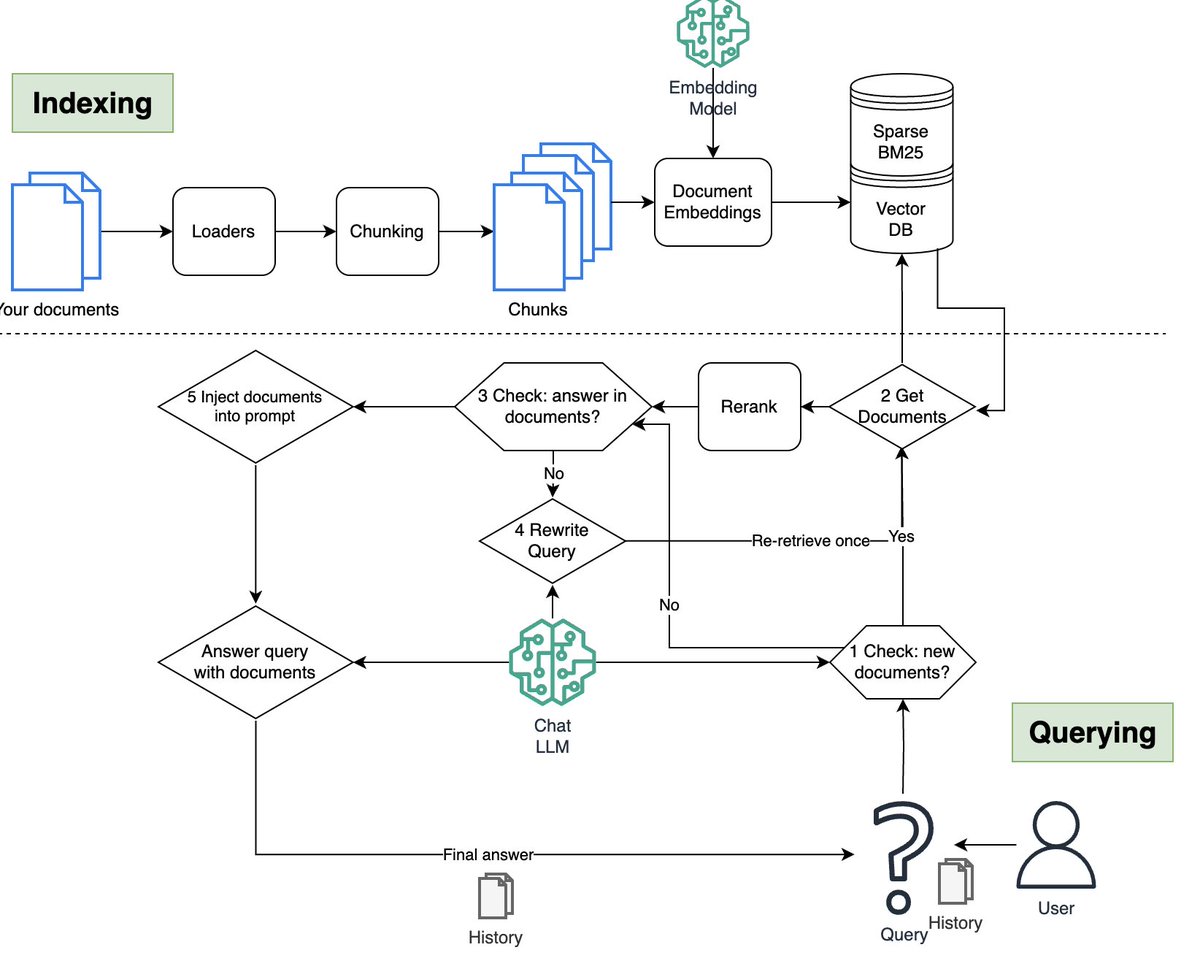
Self RAG
Self-reflection is one of the most interesting ideas in RAG, giving an LLM the ability to self-correct problems in retrieval and / or generation.
But, implementing this reliably can be tricky. We've found that graphs are a great way to reliably express logical flows, such as self-reflective RAG.
Here's a cookbook that shows how to implement ideas from the self-RAG paper by (@AkariAsai et al) using LangGraph.
It first uses a retrieval grader to (1) assess the quality of retrieved documents relative to the query. It then grades generations both for (2) hallucinations and for (3) usefulness in answering the question.
Cookbook:
https://t.co/3ThXzscI7g
Paper:
https://t.co/2oxTQOtViK
RAG From Scratch: Query Translation (Multi-Query)
Our RAG From Scratch video series walks through impt RAG concepts in short / focused videos w/ code.
Over the next few days we'll release videos focused on Query Translation, starting with Multi-Query.
🔧 Problem: User queries are a challenge in RAG. If a user provides an ambiguous query, they can retrieve ambiguous documents w/ distance-based similarity search.
💡 Idea: Re-write the user question from multiple perspectives, retrieve documents for each re-written question, return the unique documents for all queries.
📽️ Video:
https://t.co/7aqRET7NKw
💻 Code:
https://t.co/DGogC0sEZc
🧠 Related works / ideas:
1/ Ma et al w/ RRR
https://t.co/LWzW7e5DVt
2/ @Raudaschl w/ RAG-Fusion
https://t.co/sQvYmcnHXb
3/ @RickLamers
https://t.co/VcNt24Q8xy