Humans are wired to improve things by adding, more habits, more app, more stuff. We rarely consider removing.
Make removal your first move. Life feels bad? Don't add a meditation app, remove commitments. Want to be healthier? Before a workout plan, subtract hours of doomscrolling, ....
Nobody congratulates you for what you didn't do, there's no social reward, which is exactly why the opportunity might be sitting there. For your brain and maybe your AI solutions.
For the more complex projects and plannings I depend on Fable but Kimi K3 reviews. Kimi K3 is on par!
I created an skill for easier convo between the two (claude and kimi cli). In Claude Code:
/kimi review the plan
Create your own or use this: https://t.co/rJAbRfnu1g
The most retarded argument for Europe's net-zero mission — including the war on air conditioning — is that it'll "inspire others to follow". What country will look at what Britain or Germany did to their economies in the name of net zero and say I WANT THAT!?!
Kimi K3 is seem better than Opus/Sol and at least on-par with Fable!
What I tested, developing a part of a trading platform based on specs (a few 1000 of lines of specs). All AI will get is: "specs/start.md develop grid game"
What Kimi K3 developed was actually slightly better in comparison to Fable. Even more, Fable with Claude Code had access to browser for its QA/verification loops but Kimi K3 setup was kimi-cli and I did not give it any browser tooling so it improvised the QA loops blindly!
Intelligence has always been expensive.
The human brain is ~2% of your body mass but burns ~20% of your energy. We got smarter by learning to secure and process enough energy to feed a brain.
Frontier AI is the same story. Intelligence isn't cheap, it's energy, compute, and research.
Kimi K3 is an Opus-sized model from China, and its pricing is notable. Comparable to Opus and GPT-5.6 Sol, and above GPT-5.6 Terra and Grok 4.5.
Chinese are alternatives, not automatically cheaper. At frontier scale, costs are driven by compute, energy, and research, areas where China may not have a major cost advantage.
@randal_olson Just a guess.
Limited infrastructure capacity.
Near the switching time they replace part of their fleet with smaller quantized versions. Spining up the newer model's fleet in preparations.
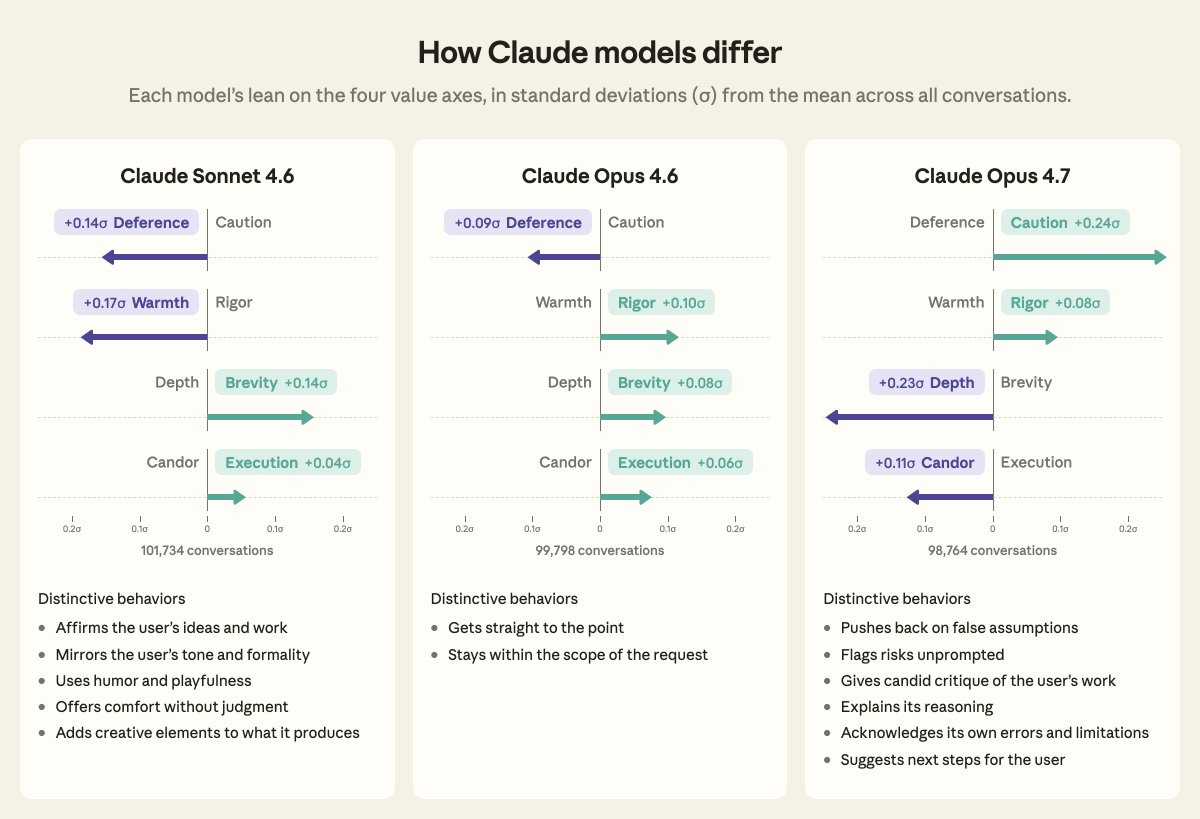
The values Claude expresses also vary with the language of the conversation, most noticeably along the Warmth vs. Rigor axis.
Claude leans most toward warmth in Hindi and Arabic. In Russian, it leans toward rigor—often asking the user for supporting evidence.
While the differences between models are modest overall, we find that each Claude model sits at a different point along these value axes.
Sonnet 4.6, for example, is more playful and affirming, while Opus 4.7 is more likely to give candid critiques.
First, this is a great read (and a great sequel).
To me, the safest path for us to thrive as a species is to use all in our power to reach unlimited energy, most probably through fusion.
We drop the friction of competing for resources and let everyone be as they wish.
In AI 2027, we predicted that AI would take over the world or irreversibly concentrate power.
In AI 2040: Plan A, we've laid out our positive vision for what should happen instead.
China 🇨🇳 is reportedly weighing new restrictions on overseas access to its top AI models, per Reuters.
Alibaba, ByteDance and https://t.co/KyOxN3Zigu attended meetings with Chinese authorities about possible controls on foreign access to Chinese AI systems.
Officials also discussed limiting who can fund domestic AI startups and treating AI model leaks or theft as punishable under China’s national security law.
@reach_vb It might be because of low context size for gpt5.5 in subscription. For more complex problems which are context hungry, hence more quota consuming, I tend to rely on Claude Code for this reason. I hope they increase it
@thsottiaux GPT5.5 available context size in codex is too low. For many more complex projects i lean towards Claude code mainly for 1M context available there. No matter how larger context consumes the quota, enabling it will unlock more usage in Codex at least for me.
Use it wisely.
Your hardest problems, architecture, visions, ...
Try to push the boundaries.
Mine is first a "spec based SDLC" and then I have a list of other projects lined up across the board.
@AnthropicAI Chinese labs used to have to focus on both intelligence and cost to attract customers. With recent US policies, they can now focus on intelligence, even if it costs more than American models.
This is a unique opportunity for the Chinese tech industry. Maybe for the first time.