Satya Nadella says LinkedIn merged four job titles, product manager, designer, front-end engineer and back-end engineer, into one:
"I'll give you at LinkedIn, we used to have product managers, we had designers, we had front-end engineers, and then we had back-end engineers and so on."
"So what we did is we sort of took those first four roles and combined them. In fact, increased scope and said, they're all full-stack builders."
"So at the same time, as you can imagine, if we're to build an AI product today, there's a complete new workflow, right? It starts with evals, right?"
"So basically, there's this eval to science, to infrastructure."
"And so evals are done by these full-stack builders and what have you and product managers in the new form, the infrastructure is built by the systems engineers at the back-end because they support the science that supports the product."
"So in some sense, there's a new loop and you have to structurally change."
LinkedIn has already put this into hiring. Its Associate Product Manager program is finished, and the replacement, the Associate Product Builder track, teaches code, design and product management at the same time.
Evals sit at the front of that workflow rather than the end, so writing them is now part of building the product instead of a check before shipping.
- Satya Nadella (@satyanadella), Chairman and CEO of Microsoft (@microsoft), with the All-In Podcast (@theallinpod) at USA House, Davos 2026.
The Coming Collapse of Indian IT: Real Industry Insights
1. IT contributed 7.3% to India’s GDP in FY25
2. 1.5M engineering graduates every year; 83% without jobs
3. TCS/Infosys were in denial mode: "There is still time; AI will augment, not replace humans."
INDUSTRY INSIGHTS:
3 Assumptions of Indian IT Industry Gone Wrong
Assumption 1: “AI will augment people”
REALITY:
a. “Augmentation” has collapsed into “substitution.” AI agents are doing a lot of heavy lifting already and replacing human coders on a mass scale.
b. Productivity gains are real and measured – up to 60% for all repetitive work, boilerplate code, testing, and fixing which TCS/Infosys teams were doing.
c. For example, “manual testing” headcount is down by 70% in banking & insurance, and L1/L2 support bots are handling 80% of support tickets in mature implementations.
Lesson for Indian IT: AI is not stopping at “assisting” or “augmenting” humans. It keeps learning until humans become the bottleneck.
Assumption 2: “Clients will want humans”
REALITY:
a. Clients do not want humans. They want quality, speed, lower cost, and above all, predictability (AI does not fall sick, does not want holidays, does not have burnouts, and does not make mistakes).
b. Fortune 500 clients are building internal AI-enabled engineering teams that are 50% smaller, but deliver faster & better than outsourced teams. Moreover, AI tools provide audit trails, explainability, and logs where humans are inconsistent.
c. Result: Vendor contracts of TCS, Infosys, Wipro and others are now being rewritten to reduce headcount, tie fees to outcomes (instead of billing hours), and penalize (not reward) manual effort.
Lesson for Indian IT: Clients only have one motive: profit maximization. They don’t care whether humans or AI delivers it.
Assumption 3: “Transition to AI will be gradual”
REALITY:
a. Transition to AI is occurring 10X faster than what happened with cloud. Cloud needed big server shifts and systems redesign. But with AI, no change in physical infrastructure is required. AI tools run in existing cloud. Just sign in, plug, and play.
b. Cloud rollouts were top-down (big planning, pilots, governance, approvals). AI is spreading bottom-up: one developer or a small team sees a quick win, tells others, and it spreads enterprise-wide at lightning speed. AI pilot projects are converting to production in weeks, not years.
c. Individual engineers are adopting AI “without permission.” It means developers are using free/cheap AI tools personally to deliver solutions. This creates “shadow AI” (unofficial AI) with obvious and immediate value for the industry.
Lesson for Indian IT: Technology adoption does not move in a linear manner when the costs of switching to new technology collapse. Change appears slow at first, but once the curve tips, entire teams and companies disappear at once.
Systemic Cause of the Downfall of Indian IT: Cultural Complacency
Why Indian IT organizations were unable to move at AI speed even when the enemy was at the doorstep? What looks like “slow moving” from outside is actually a self-reinforcing system of incentives that makes change impossible inside Indian IT companies.
Cash Cow Protection
a. Indian IT giants likes TCS and Infosys generate over 70 to 80% of their sales revenue from top 200 accounts (many of these clients are 10-20 years old).
b. Any change within the organization that risks destabilizing these accounts is treated as a threat. As a result, the top management prioritizes contract renewal over reinvention.
c. Account leaders are rewarded not for innovation, but for ensuring no disruption to delivery, headcount, and predictable billing. If you attempt to innovate in this environment, it is seen as a threat to stability.
Innovation is Career-Negative
a. Business unit heads in top Indian IT companies are trained for large program delivery. Their expertise lies in managing thousands of people, not building platforms or products. If they adopt AI to dismantle labour arbitrage models, it would invalidate their own skills that made them powerful.
b. The organization does not incentivize innovation. There is no upside for a senior leader in an Indian IT firm to destroy/disrupt their own revenue engine and invest in long-term strategies. To the contrary, their compensation and bonuses are linked to quarterly margin and quarterly growth.
c. Inside Indian IT companies, AI tools are generally limited to “assistive” use. Scaling AI is delayed until clients demand it. Why? Because the traditional IT services model is: Revenue = People x Rate x Time. Any AI model that reduces “people” or “time” directly hurts topline numbers.
Product Thinking Threatens Stock Prices
a. Product thinking goes against the stock price-driven quarterly economics that defines Indian IT companies. Product building requires large, upfront R&D investments, high-end teams, and long payoff horizons.
b. By design, IT service companies in India focus on low capital risk, predictable margins, and immediate billing (instant cash flows). Stock markets love that.
c. From board level to middle management, there is no disruption mindset, which is critical for product development. Why? Because disruption will hurt margins in the short run, and thus the stock prices, dividends, and bonuses will be impacted.
Just like Kodak and Nokia in the olden days, Indian IT companies have reached a dead end because their internal culture punishes the very behaviours (innovation and failure tolerance) that survival now requires.
ENDQUOTE:
“How did you go bankrupt?” Bill asked. “Two ways,” Mike replied. “Gradually, then suddenly.” – Ernest Hemingway, “The Sun Also Rise” (1926)
@arabicatrader
The last few days in AI is insane 🤯
12 most incredible developments from Google, OpenAI, Alibaba, Unitree, Manus and more
1/ China unveils new Quantum Computer ‘Zuchongzhi-3’—a 105-qubit machine that performs calculations one million times faster than Google's Supercomputer.
Okay. Thanks for the nerd snipe guys. I spent the day learning exactly how DeepSeek trained at 1/30 the price, instead of working on my pitch deck. The tl;dr to everything, according to their papers:
@CGISFO We are filing OCI for my almost 5 year old daughter. We started the application few monthe ago with a US passport. We now have a new passport. When trying to complete the previous OCI application we are unable to update to the new passport. Any suggestions ?
@VertigoDrones My identity email and home address was stolen and used to order a drone from someone else credit card with my billing address. You need to ensure that the email is verified before successfully creating an account.
Exciting News from the Consulate General of India in San Francisco.
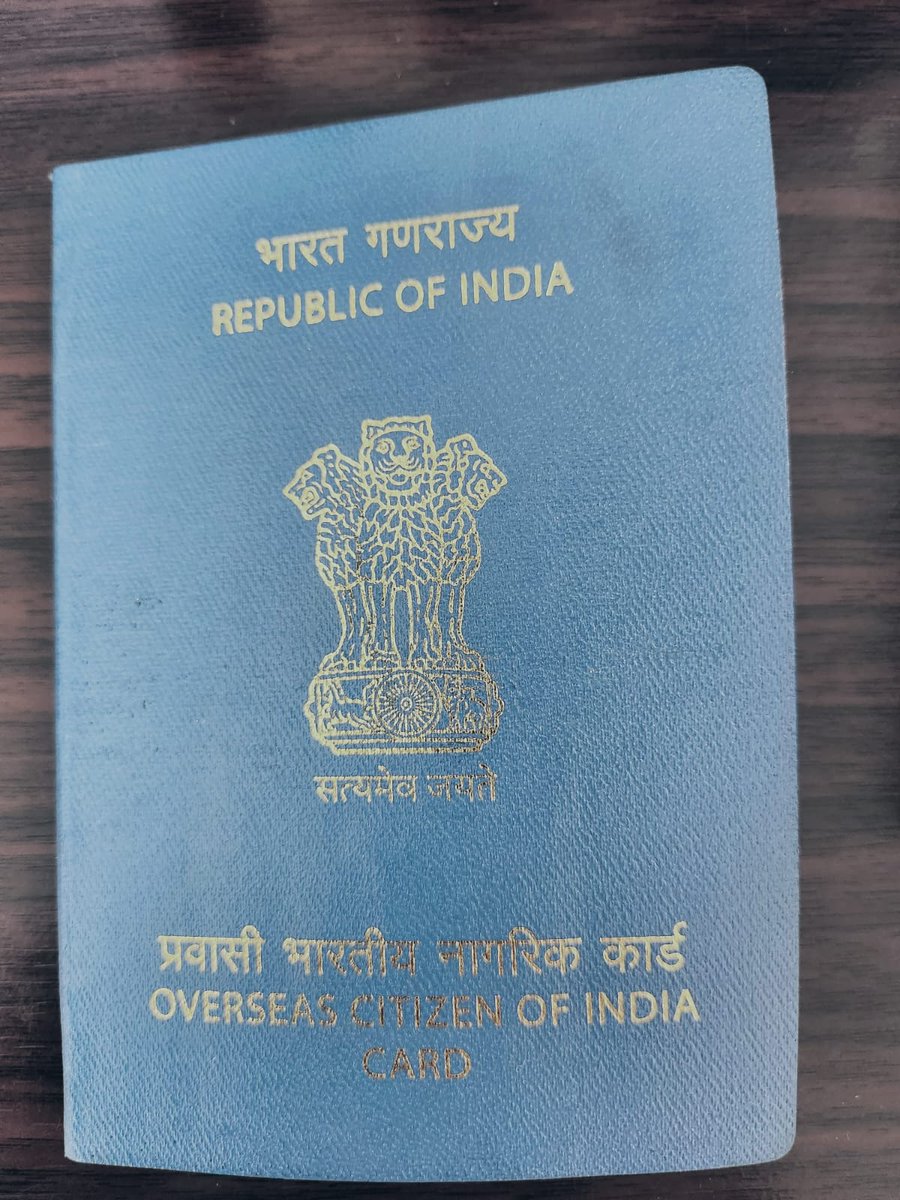
We're happy to announce that OCI (Overseas Citizen of India) cards are now being printed right here in San Francisco. This means a significant reduction in waiting time - by a whopping two weeks. This development reflects our commitment to enhancing efficiency and convenience for our community. Thank you for your patience and support as we strive to serve you better. Your satisfaction is our priority. @MEAIndia@IndianEmbassyUS@CGISFO
China & India had cordial relations post colonialism to help Asia rise until China treated other countries as junior partners & violated sovereignty. As Chair of the India Caucus, I asked Admiral Aquilino how we prevent China from becoming a hegemon & have multipolarity in Asia:
Thanjavur painting is a captivating ancient South Indian art form treasured for its historical and cultural significance. Renowned for being crafted with gold foils and precious stones, these paintings give off a regal feel.
#ChennaiAirport#NewTerminal#Vocal4Local
Central banks have raised rates quickly and often to battle inflation. Such forceful rate hikes have, historically, been followed by stresses that expose fault lines in the financial system. But recent stress isn’t the same as 2008. https://t.co/HqzOoreu5g
My month long vacation in Da Nang (breakdown):
Delhi to Da Nang return - ₹18,200
4 star hotel stay for 26 days (includes breakfast) - ₹56,000
Food and coffee - ~ ₹30,000
E-visa - ₹2,000
Total - ~₹1,06,000
You don’t need a retirement fund for this experience.
H-1B work visa holders notoriously need to exit US and get the visa restamped once it expires, or forfeit intl travel altogether. This for some often involves a 16+ hr expensive flight to one's home country IF one manages to get a months-out appt date. But there's a hack 😉!
1/5
BREAKING: China & Brazil have agreed to trade in their own currencies, ditching the US dollar.
If more countries start to trade in their own currencies, it could reduce the demand for the dollar. This could lead to a weaker dollar.
Here’s everything you need to know: