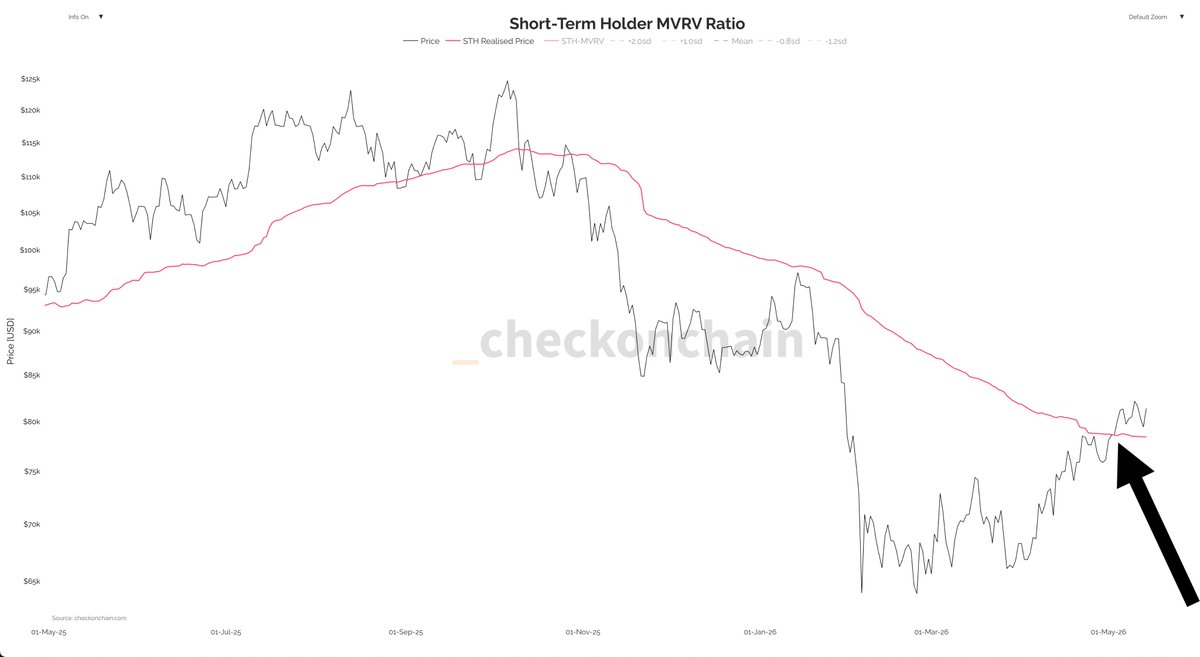
Fact: Bitcoin has never broken back above the Short-Term Holder Cost Basis and held it as sustained support during any prior extended bear market.
STH Cost Basis = $78,417
Today marks day 12 above the Short-Term Holder Cost Basis, but I'd like to see at least a month above it before calling it sustained.
At 112K, I projected that $BTC would trend down to 37K.
After updating my analysis, and with several months potentially still left in this broader bear phase, I now see the 50–60K range as a great area to scale in.
Whether we get another sweep below 60K remains to be seen. If it happens, I’ll take advantage of it; if not, I’ll simply wait for a clear structural shift and flip long accordingly rather than anchoring to a single target.
The broader cycle structure still leans toward a potential move below 60K, but ultimately we’ll see whether history repeats or this cycle deviates.
Until then... we observe.
🚨 Important Point: Bitcoin
Let me remind you again, like I said two months ago.
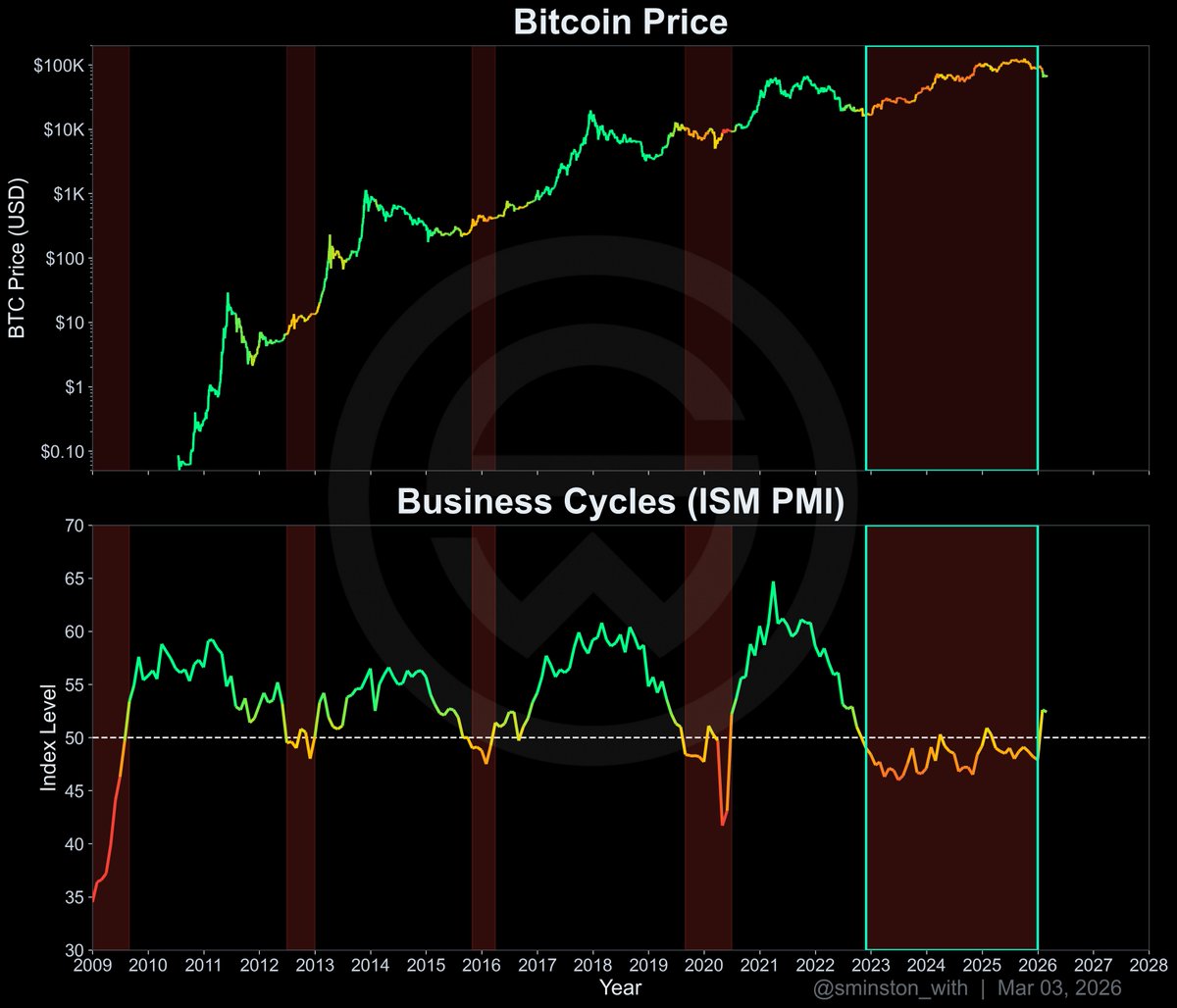
Bitcoin has NEVER had its FULL, complete bull market EVER while the PMI was below 50 the whole time.
It's wild that people honestly think Bitcoin will correct 50% from here...
It's not 2015, people. We're talking about a completely different asset.
Bitcoin also doesn't follow the 4-year cycle. It never has. It has always followed the business cycle, and once again it is.
Like clockwork.
Update: The Saylor Curve Model
A few improvements.
Instead of fixing the ceiling at 2.1M, I let the data decide.
All 3 logistic parameters (L, k, tₘ) are now free and optimized by the solver.
The data-derived ceiling comes in at 1,987,657, right around where my original 10% of supply anchor sat.
Switching from fixed L = 2.1M to free L = 1.99M pulled the inflection point back by about 7 weeks.
Both the ceiling and the inflection are now data-driven, so they will evolve with every new buy.
I also plotted all 107 Saylor buys on the chart as individual dots, plus some layout and design tweaks.
𝕏 has always been the best source of financial news for traders and investors. Billions of dollars are allocated every day based on what people read on Timeline.
Today we're launching our new Cashtags feature in the US and Canada on iPhone, bringing real-time financial data to X.
Here's how it works:
1. When you search for or post a cashtag (or contract address), X will automatically suggest matching stocks or crypto tokens, so you can select the exact asset you had in mind.
2. Anyone who taps a Cashtag will see posts mentioning it along with its price chart—without ever leaving X.
This ensures that you're always matched to the chatter for the right stock or token.
Cashtags are just the first step in our commitment to be the best destination for the finance and crypto community.
Introducing Claude Design by Anthropic Labs: make prototypes, slides, and one-pagers by talking to Claude.
Powered by Claude Opus 4.7, our most capable vision model. Available in research preview on the Pro, Max, Team, and Enterprise plans, rolling out throughout the day.
Saw some people panicking or asking about quantum computing's impact on crypto.
At a high level, all crypto has to do is to upgrade to Quantum-Resistant (Post-Quantum) Algorithms. So, no need to panic. 😂
In practice, there are some execution considerations. It's hard to organize upgrades in a decentralized world. There will likely be many debates on which algorithm(s) to use, resulting in some forks.
And some dead project may not upgrade at all. Might be a good to cleanse out those projects anyway.
New code may introduce other bugs or security issues in the short term.
People who self custody will have to migrate their coins to new wallets.
This brings to the question of Satoshi's bitcoins. If those coins move, then it means he/she is still around, which is interesting to know. If they don't move (in a certain period of time), it might be better to lock (or effectively burn) those addresses so that they don't go to the first hacker who cracks it. There is also the difficulty of identifying all his addresses, and not confuse with some old hodlers. Anyway, it's a different topic for later.
Fundamentally:
It's always easier to encrypt than decrypt.
More computing power is always good.
Crypto will stay, post quantum.
There have recently been some discussions on the ongoing role of L2s in the Ethereum ecosystem, especially in the face of two facts:
* L2s' progress to stage 2 (and, secondarily, on interop) has been far slower and more difficult than originally expected
* L1 itself is scaling, fees are very low, and gaslimits are projected to increase greatly in 2026
Both of these facts, for their own separate reasons, mean that the original vision of L2s and their role in Ethereum no longer makes sense, and we need a new path.
First, let us recap the original vision. Ethereum needs to scale. The definition of "Ethereum scaling" is the existence of large quantities of block space that is backed by the full faith and credit of Ethereum - that is, block space where, if you do things (including with ETH) inside that block space, your activities are guaranteed to be valid, uncensored, unreverted, untouched, as long as Ethereum itself functions. If you create a 10000 TPS EVM where its connection to L1 is mediated by a multisig bridge, then you are not scaling Ethereum.
This vision no longer makes sense. L1 does not need L2s to be "branded shards", because L1 is itself scaling. And L2s are not able or willing to satisfy the properties that a true "branded shard" would require. I've even seen at least one explicitly saying that they may never want to go beyond stage 1, not just for technical reasons around ZK-EVM safety, but also because their customers' regulatory needs require them to have ultimate control. This may be doing the right thing for your customers. But it should be obvious that if you are doing this, then you are not "scaling Ethereum" in the sense meant by the rollup-centric roadmap. But that's fine! it's fine because Ethereum itself is now scaling directly on L1, with large planned increases to its gas limit this year and the years ahead.
We should stop thinking about L2s as literally being "branded shards" of Ethereum, with the social status and responsibilities that this entails. Instead, we can think of L2s as being a full spectrum, which includes both chains backed by the full faith and credit of Ethereum with various unique properties (eg. not just EVM), as well as a whole array of options at different levels of connection to Ethereum, that each person (or bot) is free to care about or not care about depending on their needs.
What would I do today if I were an L2?
* Identify a value add other than "scaling". Examples: (i) non-EVM specialized features/VMs around privacy, (ii) efficiency specialized around a particular application, (iii) truly extreme levels of scaling that even a greatly expanded L1 will not do, (iv) a totally different design for non-financial applications, eg. social, identity, AI, (v) ultra-low-latency and other sequencing properties, (vi) maybe built-in oracles or decentralized dispute resolution or other "non-computationally-verifiable" features
* Be stage 1 at the minimum (otherwise you really are just a separate L1 with a bridge, and you should just call yourself that) if you're doing things with ETH or other ethereum-issued assets
* Support maximum interoperability with Ethereum, though this will differ for each one (eg. what if you're not EVM, or even not financial?)
From Ethereum's side, over the past few months I've become more convinced of the value of the native rollup precompile, particuarly once we have enshrined ZK-EVM proofs that we need anyway to scale L1. This is a precompile that verifies a ZK-EVM proof, and it's "part of Ethereum", so (i) it auto-upgrades along with Ethereum, and (ii) if the precompile has a bug, Ethereum will hard-fork to fix the bug.
The native rollup precompile would make full, security-council-free, EVM verification accessible. We should spend much more time working out how to design it in such a way that if your L2 is "EVM plus other stuff", then the native rollup precompile would verify the EVM, and you only have to bring your own prover for the "other stuff" (eg. Stylus). This might involve a canonical way of exposing a lookup table between contract call inputs and outputs, and letting you provide your own values to the lookup table (that you would prove separately).
This would make it easy to have safe, strong, trustless interoperability with Ethereum. It also enables synchronous composability (see: https://t.co/9jy6v1X6Fw and https://t.co/gZmu3YjebM ). And from there, it's each L2's choice exactly what they want to build. Don't just "extend L1", figure out something new to add.
This of course means that some will add things that are trust-dependent, or backdoored, or otherwise insecure; this is unavoidable in a permissionless ecosystem where developers have freedom. Our job should make to make it clear to users what guarantees they have, and to build up the strongest Ethereum that we can.
The last time Network Growth & Liquidity hit these extreme levels was in 2021, right before BTC’s final push to a new ATH. We are starting to see a recovery in these metrics, signaling a potential final bullish episode.
While the divergence—rising metrics vs. falling price—suggests investors are currently returning to sell, the key question remains:
Will they stay long enough for the market to stabilize?
Sustained growth in these indicators could be the catalyst for one last push.
BREAKING: Details of the historic trade deal between India and the EU have emerged:
1. Eliminates tariffs on ~90% of goods trade between EU and India
2. Set to double EU goods exports to India by 2032
3. Tariffs on cars from EU to India cut from 110% to 10%
4. Tariffs on wines from EU to India cut from 150% to 20%-30%
5. Tariffs on jewelry and textiles from India to EU cut to 0%
6. Tariffs on furniture, chemicals, leather, and metals from India to EU cut to 0%
This deal took nearly 20 years to reach and is being called the "mother of all deals."
India and the EU are looking to diversify away from the US.
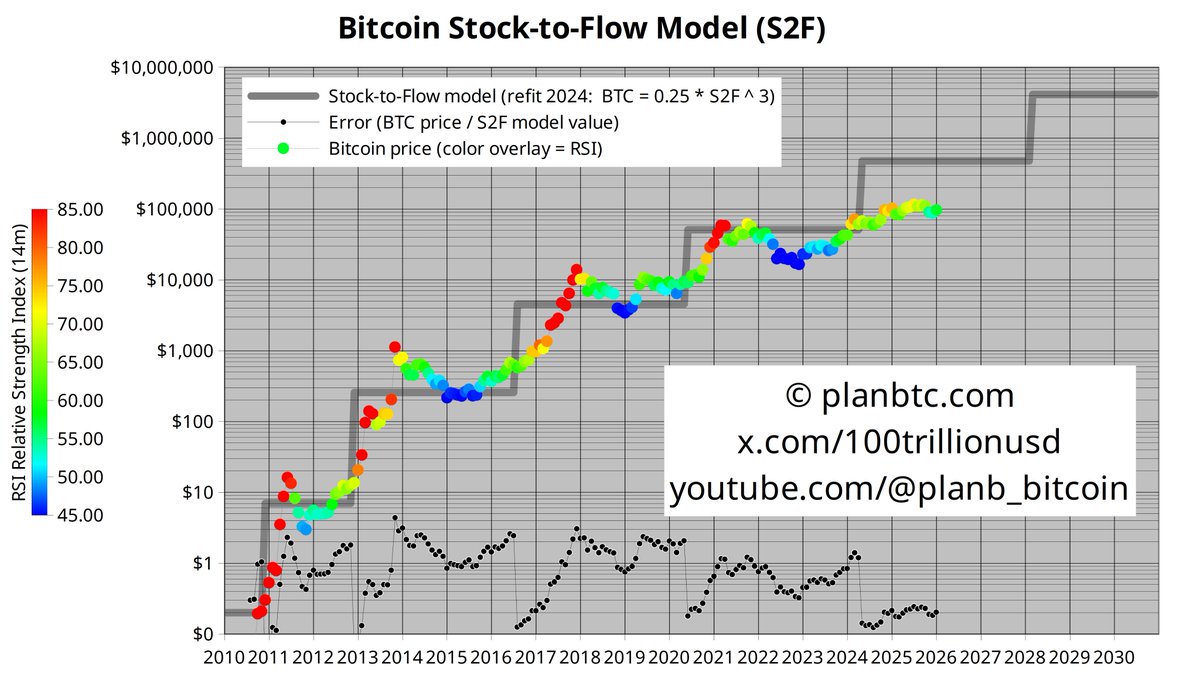
4 year cycle is NOT the same as stock-to-flow model.
The 4 year cycle says that the year after a halving is a bull year, like 2013, 2017, 2021 🟩🟥🟩🟩 and 2025 did obviously not fit that pattern.
But S2F says nothing about bull or bear, top or bottom. S2F is the thesis that scarcity drives value, that bitcoin should (ultimately) be more valuable than gold because BTC is scarcer than gold. S2F models the rough path of nonlinear phase transitions towards $30T+. S2F roughly models the average price during a 4 year cycle (regardless of which years are bull or bear). Current cycle average is $90k, clearly above past cycle's average of $34k, and is still going towards S2F $250k-$1m range (2 years to go) IMO. I still fundamentally believe that.