WTI Crude Oil
Before the 2008 rally, oil spent 24 years building a base beneath major resistance.
Today, it has spent more than 18 years doing the same.
Price remains above the 4-year EMA and within a long-term rising channel.
Could this base continue for several more years?
Absolutely.
But if history rhymes, the bigger story may not be today’s price.
It may be what happens once this multi-decade structure finally resolves.
#Oil #WTI #CrudeOil #Commodities
Volatility creates opportunity.
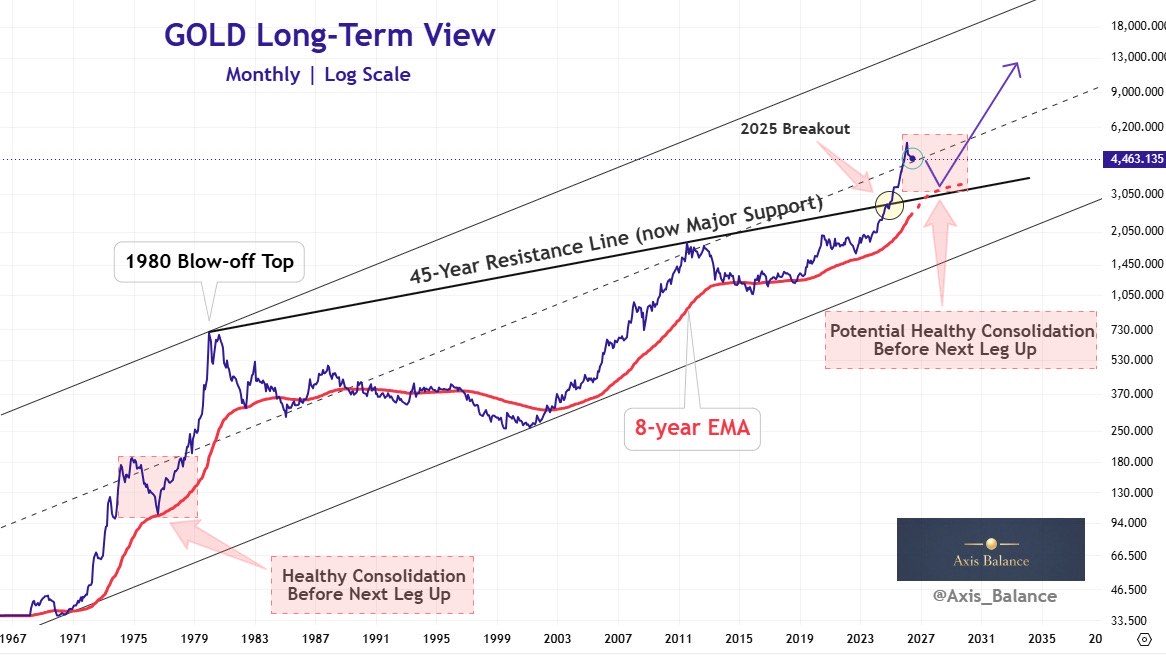
While many investors are focused on short-term price action, my long-term thesis for gold remains intact.
If gold spends time between $3,000 and $4,000, I’ll be looking to accumulate rather than chase headlines.
Not financial advice.
#Gold #GoldPrice #XAU
@NorthstarCharts Same theme, different lens.
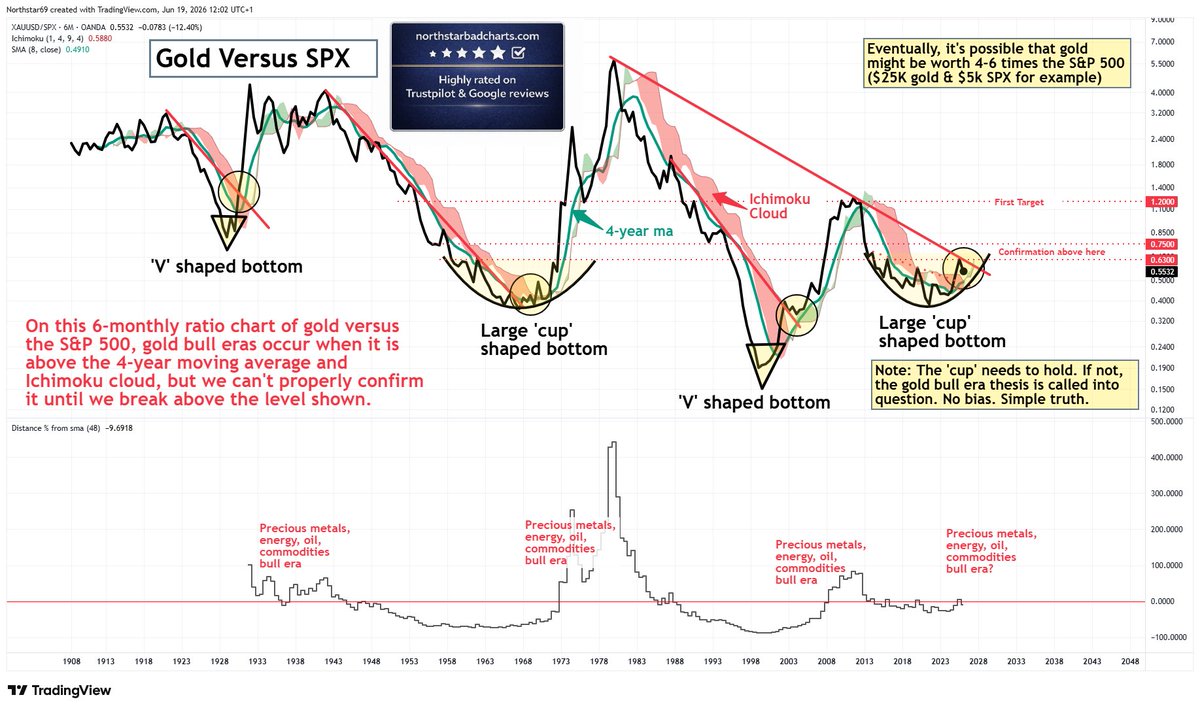
Kevin is watching Gold/SPX.
I’m watching Oil/SPX.
The next 6-12 months could tell us a lot about where capital wants to be.
Gold, silver, commodities, energy, oil, stock markets - This chart is expected to give us a clear answer in the next 6-12 months. No bias, no fomo, no b/s - simply observe and react accordingly 👇
A Japanese immunologist spent 20 years proving that the chemicals trees release into the air walk into your bloodstream, hunt down your stress hormones, and arm your immune system in ways no therapist or pharmaceutical has ever matched, and most of the data has been sitting in Japanese medical journals for two decades waiting to be translated.
His name is Qing Li.
He is a clinical professor at Nippon Medical School in Tokyo and the president of the Japanese Society of Forest Medicine. The Japanese government has been funding his research since 2004, and the body of work he has produced is the reason forest bathing is now an officially prescribed clinical therapy in Japan and Korea.
The story actually starts in 1982, when the Japanese Ministry of Agriculture, Forestry and Fisheries coined the term shinrin-yoku to describe the practice of slow, mindful walking in a forest. They did it for a practical reason.
Japan was urbanizing fast, stress-related illness was climbing, and the country had thousands of square kilometers of forest sitting unused. The idea was to give people a reason to walk into the trees... They had no idea what was actually happening to the human body during those walks until Qing Li ran the first proper experiment in 2005.
He took twelve healthy adult men on a three-day, two-night trip to a forest park. They walked for a few hours each day. Nothing strenuous. No prescribed routes or breathing exercises. They simply walked slowly through the trees, breathing the air, looking at the forest.
Li drew blood and urine samples before the trip, on the second day, on the third day, on day seven after returning home, and again on day thirty.
The numbers that came back from the lab were not what anyone expected.
The activity of a specific type of immune cell called the natural killer cell, which is the cell your body uses to hunt down cancer cells and virus-infected cells before they can spread, had jumped by roughly 50 percent during the forest trip. The actual number of natural killer cells circulating in the bloodstream had increased significantly.
Three different anti-cancer proteins that those cells produce, called perforin, granzymes, and granulysin, had all risen sharply. And the effect did not disappear when the men went home. The immune boost was still measurable on day seven and was still partially present on day thirty.
Two hours a day in a forest had upgraded the immune system for a full month.
Li ran the same experiment with women a year later and found nearly identical results. Then he ran it with a control group who took a three-day trip through an urban area with the same amount of walking, the same hotel quality, and the same diet.
The urban group showed no measurable change in natural killer cell activity at all. The forest was doing the work, not the vacation.
The mechanism turned out to be a class of airborne molecules called phytoncides. Trees produce these compounds to defend themselves against insects, bacteria, and fungi. Pine, cedar, oak, and cypress trees release them in particularly large amounts, especially in warmer weather and after rainfall.
When you walk through a forest, you are inhaling those molecules into your lungs and absorbing them through your skin, and once inside your body they appear to directly stimulate the production and activity of the very immune cells Li was measuring in his lab.
Roughly 50 percent of the health benefit of a forest walk, according to Li's data, comes from the chemistry of the air itself. The other half comes from what the forest is doing to your nervous system.
This is where it stops being only about the immune system and starts being about stress.
A separate Japanese research team measured cortisol, the body's main stress hormone, in 84 participants across 35 different forest sites. They drew samples before and after a 30-minute walk in each forest and compared them to control walks in matched urban environments. The cortisol levels of the people who walked in the forest were lower than the cortisol levels of the people who walked in the city by a significant margin. Their heart rates were lower. Their blood pressure was lower.
The activity of their parasympathetic nervous system, which is the part responsible for rest and recovery, had gone up. The activity of their sympathetic nervous system, which is the part that drives fight or flight, had gone down.
Then a researcher at the University of Michigan named MaryCarol Hunter ran the cleanest version of this experiment ever done. She recruited participants from a city and told them to take a nature pill three times a week for eight weeks.
They were free to choose the time, the place, and the duration of the nature experience, as long as it was outside, in daylight, and free of phones, conversations, and aerobic exercise. They sent her saliva samples before and after each session so she could measure cortisol changes accurately and rule out the normal daily drop in stress hormones that happens to everyone.
The result was that participants experienced a 21.3 percent drop in cortisol per hour spent in nature, with the biggest payoff happening between minutes 20 and 30 of the walk.
After that, the cortisol kept dropping, but more slowly. The threshold dose for measurable stress relief was just 20 minutes outside in something that looked and felt like nature.
What none of this means is that nature is a substitute for therapy or for medication when someone genuinely needs them. Therapy treats different things than a walk does, and Li himself has been careful in interviews to call forest bathing a complementary intervention rather than a replacement for clinical care.
But what the research has settled is that the human body has a physiological response to being among trees that operates on the same biological systems modern medicine is trying to reach with drugs and clinical protocols, and that response is fast, measurable, and free.
The strangest part of Li's work is the implication he keeps repeating in interviews. The average person now spends more than 90 percent of their life indoors. Their cortisol stays elevated. Their natural killer cells stay sluggish.
Their parasympathetic nervous system rarely gets a chance to take over. The system that was tuned by millions of years of life under a canopy of trees is being asked to run permanently inside a box made of drywall and screens.
Your body has not forgotten what it is supposed to do in a forest. It is waiting for you to walk into one.
Yes, the key studies by Qing Li et al. match the details closely:
- Forest bathing & NK cells (12 men, ~50% activity boost, lasting effects): https://t.co/aJ3rGnDTjX
- Forest vs. city comparison: https://t.co/dUrTNV4rl5
- Full review on immune function: https://t.co/UEZa92SMYm
Nature pill cortisol study (Hunter 2019, 21.3%/hr drop): https://t.co/TciC4lNbZw
The post summarizes them accurately.
@MikeBrownsWorld@KapulskyMa17788@alan68284891 I thought it was great. He is clear spoken and let us know what his priorities are. He is a monetarist and a top notch economist, but he is also forward-looking and judicious. The Fed is in good hands.
@KapulskyMa17788@alan68284891 Nope. My forecast is that we will see lower rates in coming months. I don't pay any attention to day to day and you shouldn't either.
@aedifex23 With oil & other prices rolling over we may have already seen the peak inflation. Professional investors look at second derivative change & are foreward looking while the media and retail are backward looking.
This is why smart people rarely build businesses
Jensen Huang stood in front of a room of Stanford graduates and told them he hopes they suffer.
He wasn't being cruel. He was being precise.
His argument: people with very high expectations have very low resilience. And resilience, not intelligence, is what decides who actually makes it. A Stanford grad has spent their whole life as the smartest person in the room. They've rarely been tested by real failure. So when something finally breaks, they break with it.
Then he said the line every founder should sit with: "Greatness is not intelligence. Greatness comes from character. And character isn't formed out of smart people, it's formed out of people who suffered."
He would know. At nine, Huang was scrubbing toilets at a Kentucky boarding school his family hadn't realized was a reform school. As a teenager he bussed tables at Denny's. In 1993 he started NVIDIA in a Denny's booth, and nearly lost it more than once in the years that followed. The character was built decades before the valuation showed up.
This is why he uses the words "pain and suffering" inside NVIDIA with what he calls great glee. He isn't trying to shield his best people from the hard part. He's trying to give it to them on purpose.
Talent gets you into the room. The people who stay are the ones who were broken once and learned they could rebuild.
Anthony Albanese is receiving the same International Global Citizen Award previously awarded to Klaus Schwab the founder of the World Economic Forum and Emmanuel Macron…. No words needed
This should make Australians really stop and think
Because these awards aren’t about how loved a leader is by their own people, there all about how well leaders align with broader international agendas, partnerships and global policy directions.
In Albo’s case his a star at AUKUS, global cooperation, international alignment….
And suddenly a lot of the pieces start making much more sense….
None of this is hidden…. the agreements are public, the agendas are public, the partnerships are public
Most people have just never read them and maybe that’s the real takeaway here
Some people have simply been paying attention earlier than everyone else because once you start looking deeper you begin to realise the patterns have been sitting in plain sight the whole time
OIL, AI, WEEKLY NOTE ON MARKETS
Margin debt has surged since January, and especially since March. This means customers and retail investors are still aiming to buy any dips that occur.
Momentum strength and market breadth are diverging, making lower lows while the index is making higher highs. This is a red flag for the coming months, foreshadowing a larger correction. Note that the margin debt level presents an asymmetric risk, because to the upside, they cannot push it much further.
If the market can defend its structural supports during a correction, they will capitalize well. However, if the structure breaks, they will capitulate and trigger long squeezes down in the index and a vol squeeze up.
This is what we have seen in the market: heading into the June FOMC and after OpEx, they are somewhat long downside IV and RV; however, heading into July, they expect downside RV to compress, with the index being the most vulnerable going into August. So the market is somewhat ready to capitalize on downside vol in the second half of June, but they expect this dip to be bought. However, if they are wrong, the structure will break violently (position unwinding), and I am not sure that the market's ass will be saved this time if that happens.
What the market expects for June is a retest of the primary and even the secondary structural levels of the indices, see below. A break of the 7500-7450 zone would be the precursor indicating that this event is unfolding.
Primary structural levels:
$SPX: 7320 - 7300
$ES: 7345 - 7325
$NDX: 28,542.03 - 27,705.00
$NQ: 28,643.96 - 27,800.61
Secondary structural levels:
$SPX: 7160
$ES: 7180
$NDX: 27,360 - 27,000
$NQ: 27,500 - 27,150
In the very short term, the market is ready to show more strength.
Trump is trying to buy time until the midterms, as I have been saying since last year.
Headline inflation shot up to 3.8% (the highest since May 2023). Meanwhile, according to #PCE statistics, retail consumption growth is stagnating (which is not true). To this, the retail herd says that it gives the Fed more room to cut, fueling short-term optimism.
However, within the PCE, this stagnation in consumption growth is merely statistical noise. The BEA explicitly states that the stagnation is primarily due to a plunge in farm proprietors' income, specifically the cessation of the Farmer Bridge Assistance Program payments.
The underlying picture (wages +0.3%, consumption +0.5%, durable goods orders +1.1% ex-transport, low initial jobless claims) is actually more positive. If I run the numbers in python for a bit, excluding the agricultural noise, incomes grew by 0.23%.
In real terms, this is still a decline, but considering the bigger picture, this print rather foreshadows an acceleration in inflation, to which the Fed will soon have to respond drastically.
In May, the price of oil fell by 17%.
-Why? -Because the financial paper market priced in the hope of a US-Iran peace agreement. The stock market prices in hope, but refineries only care about physical barrels.
In reality, however, the Strait of Hormuz is blocked, and ships are rerouting around Africa. 13 million barrels per day (crude + refined) of oil are missing from the global market. Global inventories are at the "operating floor" (meaning: they are depleted).
Even if a peace treaty were signed tomorrow morning and the strait were opened, it would still take at least 3 months for the next oil shipments to arrive.
When the negative supply shockwave hits, oil will go above $145. Since there will be no additional supply, the only way to balance the market is for prices to go so high that it plunges the world into a recession, so people cannot afford to refuel.
But I emphasize, this will affect the entire energy market and supply chains, and it will directly destroy the AI bubble!
Also note, that Warren Buffett has sold off his most stable companies (Apple, Visa, Mastercard, UnitedHealth) and is holding 59% of his portfolio in cash and government bonds.
This is his implicit bet that the market is going to crash soon, a move he previously only made during the market top in the 1970s and before the 2008 crisis.
Buffett clearly sees the credit stress. The market believes that tech companies are buying chips with infinite cash and that the AI revolution is self-funding. In reality, however, it is being financed with pensioners' money, through offshore loopholes and synthetic credit. Vendor financing is taking place; the demand is not organic, but rather backed by the tech companies themselves and offshore loans.
Since the shelf life of AI chips expires quickly, loans will default due to capital withdrawals and the breakdown of the debt-financing vs. fake-income equilibrium.
But I have already written about this many times. The trades are clear...
The weekly setup is heavily upside-vacuum-ish both structural and vanna-wise, and customers aim to dampen ATM range volatility. The volume profile also shows strong upside imbalances; however, the arc of the rally is becoming increasingly concave, so a pullback is on the horizon.
Based on the weekly vanna profile, the market is not particularly worried about this; Tuesday-Wednesday (but mostly Tuesday) is where the positioning is the weakest. The main short-term speculative strategy remains buy-the-dip, primarily in the futures market. Above 7450, we can only talk about a bear trap.
A pullback can only be discussed below that level.
Rest is broken down in my blog.
Trades are trivial...
Larry Ellison asked the one question no journalist on Earth can answer.
A Wall Street Journal writer told Ellison to his face that Elon Musk doesn’t know what he’s doing.
Ellison didn’t argue. Didn’t get emotional. He just asked a question.
Ellison: “This guy is landing rockets on robot drone rafts in the ocean, and you’re saying he doesn’t know what he’s doing. You ever land a rocket?”
One question. No recovery.
Ellison: “Who are you? Why should I believe you as opposed to my friend Elon?”
This is the question the entire media class has been dodging for a decade. Who are you to judge? What have you built? What have you shipped? What problem have you solved that didn’t involve a keyboard and a deadline?
Ellison: “You’re there in front of your Apple Macintosh typing up an article saying Elon’s an idiot.”
They sit behind a laptop they did not engineer. Using a network they did not build. Running on silicon they cannot explain. To tell the world that the man sending humans to space doesn’t know what he’s doing.
They have never built anything heavier than a Word document.
And they publish it with absolute certainty.
That’s the part that should disturb you. Not the criticism. The confidence behind it. The total absence of self-awareness it takes to judge disciplines you wouldn’t last a single semester in.
Musk does not operate in opinion. He operates in the physical layer of the universe where the math closes or the rocket does not come home.
His critics operate in a text editor.
He built the vehicle that carries NASA astronauts to the International Space Station. The satellite constellation delivering internet to active war zones. The EV that forced every automaker on Earth to abandon their combustion roadmap.
His loudest critics built a byline.
So why the coordinated hatred?
Because they lost the leash.
The attacks didn’t escalate because Musk got worse at engineering. They escalated because he bought X. He cracked open the algorithm. He handed the public square back to the people. And he shattered their ability to control what you’re allowed to think.
They don’t hate the engineer.
They hate that the engineer took their monopoly.
You cannot cancel a rocket. You cannot publish a hit piece on gravity. You cannot edit the laws of physics.
They own the syntax.
He owns the physics.
One of them is going to Mars.
Remember how good we had it Australia?
Thriving manufacturing industry
Affordable housing and living
Men were men and women were women
Our kids could afford to start families of their own and buy a house in the neighbourhood they grew up in
Our infrastructure, medical and transport system systems weren’t crushed under the weight of endless floods of foreigners
Valuable arable land was not appropriated for the demented idea of net zero or soulless house developments vomiting over the outskirts of our cities
Energy was almost the cheapest in the world
Machete crime and home invasions were not a thing
Pride in our history nation and culture - including beloved icons like meat pies and Holden
One flag, one people, one country
Not many cultures in a pot that isn’t melting where every culture but the one that built the nation is valorised
Australia First, Australia Always
QUICK QUANT INSIGHTS
On March 26, when the $SPX was below 6500, I indicated that a rebound was coming, and I also explained why. My weekly analyses continuously showed an upside vacuum.
On May 3, when the $SPX was only around 7220, I marked the 7450 target.
Similarly, since the $GLD rally, I have been saying that one shouldn't buy into it and that $GLD will return to last autumn's October levels. I continue to maintain this.
Also, in my April-May window of risk free post, I wrote and have been emphasizing to my subs ever since that, for now, there is no structural sign of bear momentum. There is a statistical probability, but nothing trend changing, just a pullback to buy the dip.
The market is driven by the short squeeze, put delta decay, upside speed-shorted gamma squeeze, and leveraged ETFs alongside headline control.
Macro problems are present.
The most important are inflation and the real value of interest rates. Due to the Fed's inaction, real interest rates are continuously decreasing, which is a hidden QE, especially when paired with Bessent's bond market speculations. The other issue is that oil is high and will remain high. Reserves are depleting dangerously, insurance premiums are very high, and the renewing conflict (which I also wrote would drag on and is not over) threatens the refineries and further increases supply chain costs. The economic impact of this hasn't yet reached everyday life.
As I have been emphasizing since around February or even earlier, it will materialize by mid-to-late autumn, roughly around the Q4 period. In any case, yields will remain high, and Warsh is not a committed dove. This will be a serious headwind for the market, especially alongside the very thin breadth. Inflation is politically toxic. 77% of Americans feel they are getting poorer. Gasoline prices creeping above $4.50 due to the Iranian war hit the Republican base, namely the working class, the hardest. Because of this, support for the war is beginning to crack.
Additionally, the power demand of AI data centers is burdening the US power grid to an extent not seen in decades. And costs will increase significantly when the next wave of negative supply shock arrives.
The Q1 earnings season was the strongest since COVID. 84% of companies beat expectations. The AI mania is materializing, so big tech companies are taking on massive debts to spend around $869 billion on AI infrastructure by 2027. The gross leverage of hedge funds has jumped to a 5-year high. This year, $852 billion flowed into passive funds. Since the $SPX is very top-heavy, out of every $1 flowing in, 41 cents automatically goes into the 10 largest tech companies. Parallel to this, CTAs are already in max long positions; in the event of an upside grind, they can add little to the trend, but in the case of a downside move, they will sell a lot. This is a synthetic short downside gamma risk in the market.
The May OpEx played out exactly as I derived to my subs...
And on May 19, during the $VIX expo, I wrote that the expo itself would be a pinning event, but it would be followed by vol buying / $ES selling, a dip that would, however, be bought. However, I also wrote that "...that said, we can see that vomma demand is still present and will persist, though it is scaling cautiously. Heading into the next window, the VIX falls into a range trap with higher tail premiums. Therefore, the range will remain wider, and the VIX will trade at a premium relative to RV." - $SPX / $VIX beta only increased since (the absolute value of the beta is very low) that is a late melt-up signal and big red flag. This will not allow risk parity strategies to continue buying the index, but the main point is that the market has accumulated a massive vomma risk, and it is highly asymmetric!
(This is also one of the reasons why I said I am in a long ATM vol position for the long term.)
The market is currently in a late-cycle melt-up, where the level is rising, but all derivatives are slowing down. Momentum has become concave, vol compression will pull back towards the GARCH long-run (13.64%), we are in a quiet regime according to the Markov model, but the ergodic weight indicates a more stressful environment. The central scenario is a slight further rise, but the risk is asymmetric, and due to the gap-dominant vol structure, a downside shock will likely arrive overnight, unannounced.
I examined the positioning up until the September OpEx. The problem is not the gamma and the rest... if one wants to research the intentions of customers, they must first focus on the 3rd-4th derivatives (speed, ultima, zomma, etc.). In June, the upside vol is still strongly bid, but for July, an upward asymmetric iron fly spread has been bought, which creates net upside long vanna and downside short vanna. However, it is asymmetric to the upside, so to the downside, the exposure is relatively flat. And vomma is strongly negative against upside vol.
Downside zomma only acts as a synthetic circuit breaker during the second half of July; after that, it is heavily shorted, also asymmetric towards "vol up".
This is a pretty tricky situation. Because all that massive ITM call delta and upward vol position will expire, and veta will eat them up by mid-summer. This will definitely create pressure. According to my calculations, the 7793.16 $SPX level is where stabilization can be expected based on current positioning. Below that, the pressure will be significant. However, at this level, reversion algos will already start signaling, as momentum will become overextended (at least if I base the test on the July OpEx).
The question is, can a downside wave start? - Yes, but only under certain conditions. The market becomes vulnerable to a downside move after the July OpEx, that is when the gate to the left-tail opens; neither vomma nor zomma protects the downside. In July it does, against a vol event, specifically in a way to trap the bears. Here, the market could only plunge if it started a slow downside grind, rather than a volmageddon. Because this would not activate the long zomma and would simultaneously wipe out both the downside long and short vol traders.
The June OpEx and mOpEx window is also vulnerable like 2024 July, but less confident and not necessary trend changing.
I would rather highlight August. However, if the spot passes down through the 7000 level, I absolutely do not believe that its ass will be saved once again.
Warsh is not priced in,
oil is not priced in,
SPR risk is not priced in,
energy crisis is not priced in,
China First Island Chain is not priced in at all.
BoJ is only slightly priced in, market is too complacent about it.
Anthony Albanese appeared on the Karl Stefanovic podcast and was asked why he called One Nation and its supporters “dark forces in this country”
Albo “Pauline Hanson represents division”
“She has done that her entire career”
“People voting for One Nation are just expressing grievances”
Stefanovic “with you”
Albo “no”
Stefanovic “but they’re not dark forces, was that a poor choice of words?”
Albo “I’m describing Pauline Hanson, that’s what she is”
He adds “what about what Pauline says about me?”
Albo, Pauline’s spot on about you, you’re the worst Prime Minister in Australian political history.
And you are the “dark force” in this country.
Not Pauline.
This Google insider just revealed what AI is actually being used for behind closed doors.
It has nothing to do with chatbots.
Mo Gawdat was a senior executive at Google for over a decade. He watched AI get built from the inside. He was in the rooms, in the labs, in the government meetings in China that almost no Western executive was allowed into.
And he just went on Diary of a CEO and said things that no active tech executive would ever be allowed to say publicly:
"What the general public sees about AI is overhyped but ineffective. What the real geeks see inside the lab is genuinely world-changing."
The public gets chatbots and AI-generated videos while the labs are building autonomous weapons systems, military targeting technology, real-time surveillance infrastructure, and self-improving code that rewrites itself every microsecond without human oversight.
As Mo put it: "As we speak, we are living in two major wars where AI is doing most of the killing."
He talked about Palantir's CEO Alex Karp openly celebrating how his targeting technology identifies and eliminates people. He talked about the next generation of autonomous weapons costing $20,000 each, meaning any government with a $50 billion defense budget can literally rain drones on every corner of the planet.
And as you remember, Anthropic was offered a $500 million military contract to allow their AI to be used for human targeting and surveillance. They refused and walked away from the money.
OpenAI took the contract the following week.
Mo's response: "You have to start observing who is actually behaving in a way that makes AI work for humanity, and who is behaving in a way that makes AI work for their share price."
Now this is where it gets really interesting...
In Mo's documentary Chasing Utopia, Altman literally says directly on camera: "I suspect that AI is likely going to end humanity, but we're going to create a lot of interesting companies in the process."
That is the CEO of the most powerful AI company on Earth saying that he suspects his OWN technology will end the human race and then shrugging it off because the business opportunity is too good to pass up.
Mo's prediction for the next decade:
War, economic collapse, mass unemployment, surveillance expansion, and an absolute concentration of power at the top unlike anything in modern history.
His prediction after that is if humanity survives the next 10 years, AI will eventually create a world of abundance where intelligence solves every problem we currently face.
But the path between here and there is what terrifies him.
And the men building the technology know exactly what they're doing.
Do you think he's just exaggerating for attention, or is there truth in this?
This helps explain why our societies are heading the way they are.
Politicians don’t care about our concerns and issues, they just push bad left policies that make more people dependent on the state.
Socialists need people to stay poor to keep voting for them. Prove me wrong.